You spent weeks fine-tuning your Large Language Model is an advanced AI system trained on vast datasets to generate human-like text and perform complex reasoning tasks.. The benchmarks look good. The internal tests passed. You deploy it to production, only to find that the model still hallucinates facts or misses subtle context in critical edge cases. This is the classic "last mile" problem of AI deployment. Automation gets you to about 85% accuracy, but getting that final percentage often requires a different approach entirely.
That approach is the Human-in-the-Loop (HITL) is a workflow strategy where human experts intervene at specific points in an AI process to validate, correct, or approve outputs before they reach the end user. review workflow. It’s not about replacing automation with manual labor; it’s about using human judgment as a safety net and a learning engine. By integrating people into the loop, you catch errors that cost money or reputation, while simultaneously generating high-quality training data to make your model smarter over time.
Why Pure Automation Hits a Wall
Fine-tuning improves a model’s performance on specific tasks, but it doesn’t eliminate uncertainty. Models are probabilistic engines-they predict the next likely token, not absolute truth. In low-stakes environments, like drafting a casual email, this is fine. But in healthcare, finance, or legal tech, a wrong answer isn’t just annoying; it’s dangerous.
The core issue is that models lack accountability. If an LLM gives bad financial advice, who is responsible? Without a human checkpoint, the liability falls squarely on the organization deploying the tool. HITL solves this by inserting a validation layer. According to industry observations from studios like NineTwoThree, achieving precision beyond roughly 80-85% frequently necessitates direct human intervention. That final slice of accuracy is where nuance, empathy, and contextual awareness live-traits that current models struggle to replicate consistently without oversight.
Core HITL Workflow Patterns
Not all human involvement looks the same. Depending on your risk tolerance and resource constraints, you can structure your HITL workflow in several distinct ways. Understanding these patterns helps you design a system that balances speed with safety.
- Approval Gate: The model generates a candidate output, and a subject matter expert must explicitly sign off on it before it is sent to the user. This creates a hard validation checkpoint. It’s slow but offers maximum control.
- Correction Gate: Experts review outputs and edit them if necessary. Crucially, these edits aren’t just discarded; they become labeled training data. This turns every correction into a feedback signal that directly improves future model performance.
- Adjudication Workflow: When multiple reviewers disagree on a complex case, a senior reviewer steps in to resolve the conflict. This establishes consistency in judgment across large-scale operations, preventing drift in quality standards.
These patterns often work best when combined with Human-on-the-Loop (HOTL) is a hybrid monitoring approach where humans oversee the system and intervene only when automated triggers indicate high uncertainty or risk. systems. HOTL allows the AI to handle routine, high-confidence tasks autonomously, routing only ambiguous or high-risk cases to humans. This preserves scalability while maintaining a safety net.
Designing a Tiered Validation Hierarchy
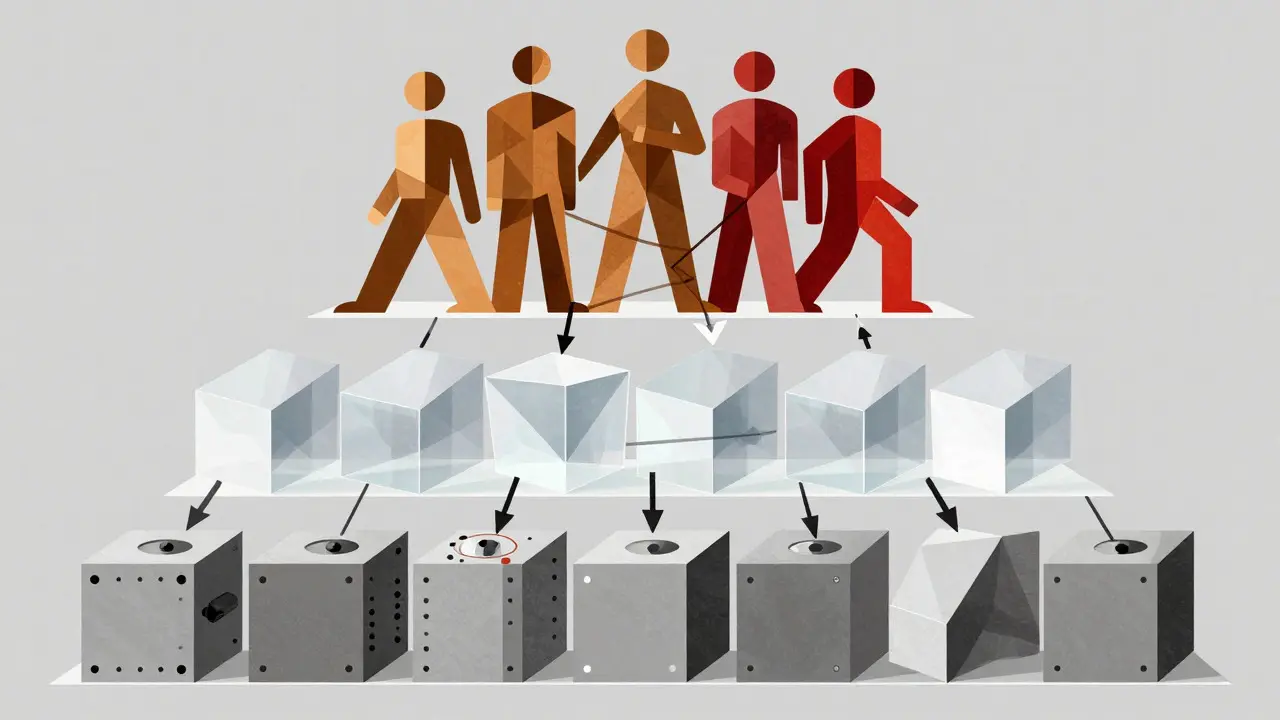
Reviewing every single output manually is expensive and unsustainable. To solve this, organizations like Kili Technology recommend a tiered validation hierarchy. This approach sequences interventions from fastest and cheapest to most expert-intensive, ensuring you only spend human effort where it matters most.
- Automated Checks (Tier 1): Start with cheap, fast filters. Use scripts to validate formatting rules, screen for policy keywords, run unit tests on code outputs, or verify citation presence. These catch obvious errors instantly.
- LLM-as-a-Judge (Tier 2): For scalable scoring, use another LLM to evaluate the output against a rubric. This can include pairwise comparisons for A/B testing, risk tagging, or critique generation. It’s faster than humans but less reliable.
- HITL Review (Tier 3): Reserve actual human review for high-risk cases identified by the previous tiers. Subject matter experts approve, correct, and assign severity classifications here. This is where the heavy lifting happens.
- HOTL Monitoring (Tier 4): For the remaining outputs, apply passive monitoring. Track metrics for drift, set up incident response protocols, and maintain rollback capabilities. This ensures long-term stability.
This hierarchy addresses the core scalability challenge. By filtering out the easy wins with automation, you reserve your expensive human resources for the complex, nuanced problems that actually require judgment.
| Tier | Method | Speed | Cost | Best Use Case |
|---|---|---|---|---|
| 1 | Automated Scripts | Instant | Low | Formatting, syntax checks |
| 2 | LLM-as-a-Judge | Fast | Medium | Rubric scoring, initial risk tagging |
| 3 | Human-in-the-Loop | Slow | High | High-stakes decisions, nuanced corrections |
| 4 | Human-on-the-Loop | Passive | Medium | Drift monitoring, audit sampling |
When to Choose HITL Over Active Learning
You might wonder how HITL differs from Active Learning is a machine learning technique where the algorithm selects the most informative data points for human labeling to improve model efficiency.. Both involve humans, but their goals are different.
Active Learning focuses on training efficiency. The model identifies data points it is uncertain about and asks humans to label them specifically to reduce the amount of data needed for training. It prioritizes label efficiency during the development phase.
HITL, on the other hand, focuses on operational reliability. Humans intervene in the workflow to review, validate, or override outputs in real-time. It enhances transparency, mitigates risks, and supports compliance during deployment. If your goal is to scale AI with fewer resources during training, choose Active Learning. If your goal is to ensure defensible, accurate outputs in a regulated environment, choose HITL.

Technical Implementation and MLOps Integration
Implementing HITL isn’t just about hiring reviewers; it requires robust technical infrastructure. Your HITL system must integrate seamlessly with your MLOps Framework is a set of practices and tools that automate and streamline the deployment, monitoring, and maintenance of machine learning models in production..
Key implementation requirements include:
- Data Annotation Pipelines: Automate the flow of flagged outputs to human annotators. Tools like OneShot demonstrate this by routing failed LLM outputs to trained humans via API, receiving corrected outputs, and storing edits as structured data.
- Audit Logging: Maintain comprehensive traceability. Record reviewer identity, timestamp, guideline version, specific changes made, and the reasoning behind each decision. This is critical for compliance audits.
- Feedback Loops: Transform corrected outputs and reviewer notes into evaluation datasets. Use this data to retrain your model, creating a continuous improvement cycle where the system learns from its mistakes.
Transparency is also vital. HITL systems require outputs to be understandable to humans at each interaction point. Reducing the "black box" effect builds trust with both the reviewers and the end users. If a reviewer can’t understand why a model made a suggestion, they can’t effectively validate it.
Measuring Success and Scaling Down
The ultimate goal of HITL is not to stay in the loop forever, but to train the model well enough that you can gradually reduce human intervention. How do you know when it’s safe to scale back?
Look for stabilization metrics. If your AI accuracy remains above 95% in domain-specific tasks and human interventions fall below defined thresholds, you can incrementally reduce manual review. However, always maintain safety nets. Clear conflict-resolution protocols should flag inconsistencies, escalate to experts, log all decisions, and retrain models using curated examples where human judgment overrode AI predictions.
By treating human feedback as a valuable data asset rather than a bottleneck, you create a system that becomes more accurate, efficient, and trustworthy over time. This is the essence of modern AI engineering: combining the speed of machines with the wisdom of humans.
What is the difference between Human-in-the-Loop and Human-on-the-Loop?
Human-in-the-Loop (HITL) involves active human intervention at specific decision points, such as approving or correcting outputs. Human-on-the-Loop (HOTL) is a passive monitoring approach where humans oversee the system and intervene only when automated triggers indicate high uncertainty or risk. HITL provides comprehensive accuracy but is slower and more expensive, while HOTL enables scalability by reserving human effort for exceptional cases.
How does HITL improve fine-tuned Large Language Models?
HITL improves fine-tuned LLMs by providing high-quality, context-rich feedback. When humans correct model outputs, these corrections are stored as labeled training data. This data is then used to retrain the model, allowing it to learn from its mistakes and adapt to new nuances. Over time, this continuous feedback loop reduces hallucinations and increases precision in specialized domains.
When should an organization implement a HITL workflow?
Organizations should implement HITL when the downside of an error is high, involving legal exposure, financial loss, safety risks, or security vulnerabilities. It is also essential when tasks require accountable professional judgment or when outputs must be defensible in audits. Common applications include legal document review, financial recommendations, and healthcare clinical decision support.
What are the key components of a HITL technical implementation?
Key components include automated data annotation pipelines to route flagged outputs to humans, comprehensive audit logging to track reviewer decisions and reasoning, and feedback mechanisms that transform corrections into training datasets. Integration with MLOps frameworks is crucial for managing these workflows sustainably and ensuring transparency throughout the AI lifecycle.
Can HITL workflows be scaled for large enterprise applications?
Yes, by using a tiered validation hierarchy. Instead of reviewing every output, enterprises use automated checks and LLM-as-a-judge systems to filter low-risk cases. Human review is reserved for high-risk or uncertain outputs identified by these earlier tiers. This hybrid approach maintains safety and accuracy while keeping costs and latency manageable for large-scale deployments.