Imagine an AI system diagnosing a patient with a rare condition. The model is confident. The data looks solid. But what if it’s wrong? In high-stakes fields like healthcare, law, and finance, a single hallucination from a Large Language Model (LLM) isn’t just a glitch-it’s a liability. This is why relying on AI alone is no longer an option for mission-critical tasks. Instead, organizations are turning to Human Review Workflows, also known as Human-in-the-Loop (HITL), to ensure accuracy, reliability, and regulatory compliance.
The core problem is simple: standard AI implementations often achieve only 85-90% accuracy in complex scenarios. When the cost of error is measured in lives or millions of dollars, that 10-15% margin is unacceptable. By integrating human expertise with AI scalability, properly structured review workflows can reduce critical errors by 60-80% while maintaining operational efficiency. Let’s break down how these systems work, why they’re becoming mandatory, and how you can implement them effectively.
Why Pure AI Fails in High-Stakes Environments
You might wonder why we need humans at all if AI is so advanced. The answer lies in the nature of "hallucinations"-plausible-sounding but factually incorrect outputs. In low-risk contexts, like drafting a casual email, this is manageable. In high-stakes environments, it’s catastrophic. Dr. Emily Wong, a healthcare AI ethicist at Johns Hopkins University, warns that "over-reliance on AI-assisted review without proper human oversight protocols can create false confidence in system accuracy." Her analysis of 17 medical AI deployments found that three demonstrated correlated failures where both human and AI reviewers missed errors simultaneously because they relied on similar flawed logic patterns.
This isn’t just about bad luck; it’s about structural limitations. LLMs predict the next likely word based on training data, not truth. They don’t "know" facts; they mimic patterns. In legal discovery, for example, an AI might generate a citation that looks perfect but refers to a case that doesn’t exist. Without a human reviewer to verify the source, this error propagates into court filings. According to RelativityOne’s internal testing data from Q3 2025, even sophisticated systems struggle with maintaining contextual continuity across document boundaries, leading to plausible but incorrect citations that require careful verification.
How Human-in-the-Loop (HITL) Workflows Operate
A robust HITL workflow isn’t just a person reading AI output. It’s a structured process designed to catch errors before they cause harm. Modern implementations, such as those by John Snow Labs, rely on four key technical components:
- Task Management Systems: These assign specific review tasks to domain experts based on their specialization. For instance, a cardiologist reviews cardiac diagnoses, while a general practitioner handles routine check-ups.
- Full Audit Trails: Every modification is captured with timestamp precision to the millisecond. This creates a legal record of who changed what and when, which is crucial for regulatory audits.
- Custom Approval Rules: Boolean logic rules determine when a response needs human sign-off. For example, any diagnosis involving a rare disease or a medication interaction flag triggers an automatic hold for expert review.
- Versioning Systems: These maintain complete lineage of all annotations, allowing teams to track how interpretations evolve over time.
Amazon SageMaker takes a slightly different approach, focusing on fine-tuning through a three-step methodology. First, they conduct supervised fine-tuning using labeled data. Then, they collect user feedback to label question-answer pairs. Finally, they implement Reinforcement Learning from Human Feedback (RLHF), where human evaluations are incorporated into the reward function. This trains the model to align more closely with human goals. For situations requiring massive scale, Amazon uses RLAIF (Reinforcement Learning from AI Feedback), employing another LLM to generate evaluation scores. This reduces subjectivity by eliminating dependency on a small pool of Subject Matter Experts (SMEs).

Key Metrics: Accuracy vs. Efficiency
Does adding humans slow things down? Yes, but the trade-off is worth it. The goal isn’t to replace AI speed with human slowness, but to use automation to handle the bulk of work while humans focus on edge cases. Here’s how different approaches compare in real-world scenarios:
| Implementation | Primary Use Case | Accuracy Improvement | Efficiency Gain |
|---|---|---|---|
| John Snow Labs (Generative AI Lab) | Healthcare Documentation | 22.8% higher semantic similarity (0.8100 vs 0.6419) | Error rate dropped from 12% to 3.5% in two weeks |
| Amazon SageMaker (RLAIF) | Engineering & Design | 8% improvement in AI feedback scores | 80% reduction in validation workload for SMEs |
| RelativityOne (aiR for Review) | Legal Discovery | N/A (Context-dependent) | 15-20% initial time increase due to verification needs |
In the Amazon EU Design and Construction pilot, engineers reported 43% faster information retrieval from unstructured documents after implementing a RAG pipeline with a fine-tuned Mistral-7B model. However, this speed came with a caveat: the system required rigorous validation against 274 samples to ensure the 0.8100 semantic similarity score was genuine. Without that human-led validation step, the speed gains would have been meaningless if the results were inaccurate.
Regulatory Drivers: Why You Can’t Ignore Compliance
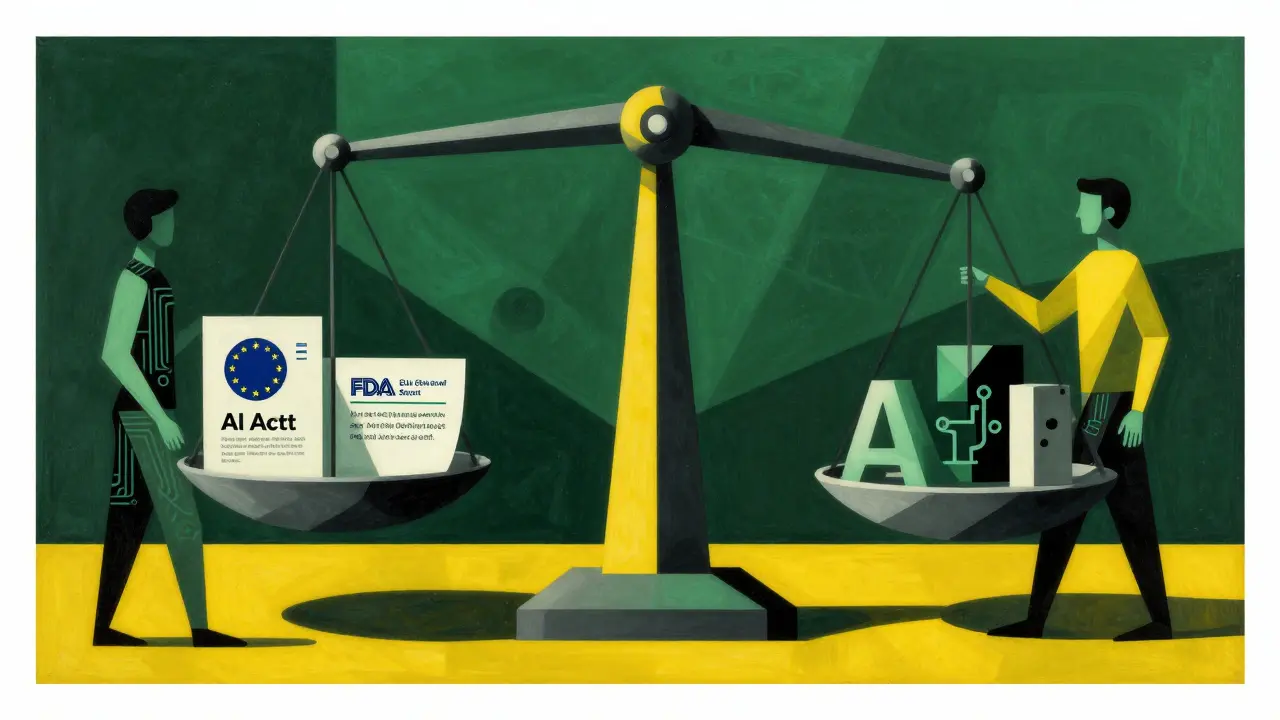
It’s not just best practice anymore; it’s the law. Regulatory frameworks are increasingly mandating human review capabilities for high-risk AI systems. The EU AI Act, effective February 2026, explicitly requires "human oversight mechanisms" for high-risk applications. Similarly, the FDA’s 2025 guidance for AI/ML-based software as a medical device specifies that "human reviewers must be able to understand, assess, and override AI-generated decisions."
This regulatory pressure has accelerated enterprise adoption. According to IDC’s AI Deployment Tracker, 78% of Fortune 500 companies implemented some form of human review workflow for LLM responses in critical applications as of Q4 2025, up from just 32% in Q4 2023. The global HITL market for AI validation was valued at $2.3 billion in 2025, with a projected 34.7% CAGR through 2030. Healthcare leads this growth at 38.2% market share, driven largely by these strict FDA requirements.
Implementing Your Own Review Workflow
If you’re planning to deploy LLMs in high-stakes areas, here’s how to start. First, define your risk thresholds. Not every output needs a human eye. Use boolean logic to flag only high-risk items-such as financial advice exceeding a certain dollar amount or medical diagnoses involving chronic conditions. Second, build a diverse team. Dr. John Snow, Chief Scientist at John Snow Labs, notes that HITL helps address biases by ensuring diverse data interpretation. A minimum team configuration should include one project manager, two annotators, and one reviewer. Provide 8-12 hours of training to ensure proficiency with the review interface.
Third, establish calibration sessions. Inconsistent review criteria are a major pitfall. A 2025 HIMSS survey found that 68% of healthcare implementations struggled with this issue. To fix it, have multiple experts review 5-10% of documents together. John Snow Labs reports that this practice reduced inter-reviewer disagreement from 22% to 7% in healthcare documentation projects. Finally, choose the right tools. Look for platforms that offer metadata-specific corrections, allowing reviewers to make precise changes and leave detailed comments. This targeted feedback is what 87% of professionals cited as the most valuable aspect of HITL workflows in a Gartner survey.
Future Trends: Automation and Multimodal Review
The future of human review isn’t about doing more manual work; it’s about smarter routing. John Snow Labs is developing "context-aware feedback routing," which directs specific error types to specialized reviewers based on historical performance data. Beta testing shows this can speed up review cycles by 18%. Meanwhile, Amazon plans to automate the continuous learning process, connecting AI feedback loops directly to engineering data infrastructure.
However, caution is needed. As NIH’s January 2026 report highlights, human review workflows must evolve to handle multimodal outputs-including images, audio, and video-while maintaining compliance. The paradox remains: over-automating the review process could undermine the very human oversight these systems were designed to provide. The human reviewer plays a critical role in calibrating the AI, ensuring it doesn’t drift into dangerous territory. As Wiley’s 2025 publication notes, the human element is essential for providing feedback to the LLM to keep it grounded in reality.
What is the difference between RLHF and RLAIF?
RLHF (Reinforcement Learning from Human Feedback) uses direct human evaluations to train models, ensuring alignment with human values. RLAIF (Reinforcement Learning from AI Feedback) uses another LLM to generate evaluation scores, which scales better and reduces dependency on a small pool of human experts, though it may introduce subtle biases from the evaluating AI.
Is human review legally required for all AI systems?
Not all AI systems, but high-risk ones are increasingly regulated. The EU AI Act (effective Feb 2026) mandates human oversight for high-risk applications. In healthcare, the FDA requires human reviewers to be able to override AI decisions. Legal and financial sectors are also seeing stricter guidelines due to potential liabilities.
How much does implementing a HITL workflow cost?
Costs vary by scale and industry. The global HITL market was valued at $2.3 billion in 2025. For enterprises, costs include platform licensing (e.g., John Snow Labs, Amazon SageMaker), training for staff (8-12 hours per expert), and ongoing labor for reviewers. While upfront costs are significant, they are often offset by reduced liability risks and improved accuracy rates.
Can AI completely replace human reviewers in the future?
Unlikely in high-stakes domains. While AI can handle routine checks, humans are needed for edge cases, ethical judgments, and regulatory compliance. Experts warn that over-automation can lead to "false confidence" and correlated failures. The trend is toward hybrid models where AI assists humans, not replaces them.
What are the biggest challenges in setting up a review workflow?
The main challenges are inconsistent review criteria among humans (reported in 68% of healthcare implementations) and integrating feedback loops without disrupting operations. Calibration sessions and clear boolean rules for triggering reviews help mitigate these issues. Additionally, handling multimodal data (images, audio) adds complexity to traditional text-based workflows.
Francis Laquerre
June 5, 2026 AT 19:38Oh, the sheer drama of it all! We are standing on the precipice of a digital abyss where our silicon overlords might just misdiagnose a heart condition because they hallucinated a symptom that doesn't exist in this dimension. It is absolutely thrilling and terrifying in equal measure to think that we need humans-flawed, tired, coffee-dependent humans-to stand between us and the cold, hard logic of an algorithm that thinks 'appendicitis' is a type of cloud storage. I mean, really, who would have thought that checking facts was still a thing? The world has gone mad.
michael rome
June 7, 2026 AT 07:46While the dramatic flair is appreciated, let us remain grounded in the reality that this workflow is not merely a safety net but a structural necessity for any organization that values its license to operate. The integration of human oversight into high-stakes LLM deployments is fundamentally about mitigating liability while preserving the efficiency gains that automation promises. We must acknowledge that the 85-90% accuracy ceiling mentioned in the post is simply unacceptable when lives or significant financial assets are at risk, and therefore, the Human-in-the-Loop model serves as the critical bridge between raw computational power and responsible application. It is imperative that we view these reviewers not as bottlenecks, but as essential quality assurance agents who provide the contextual nuance that current models lack.
Andrea Alonzo
June 8, 2026 AT 10:32I find myself deeply concerned about the mental load placed on these human reviewers, especially considering how long-winded the process can become when you factor in the necessary calibration sessions and the meticulous documentation required for audit trails. It is so important that we remember these are real people with real lives who are being asked to scrutinize every single output for subtle errors that could have catastrophic consequences, and if we do not support them properly with adequate training and clear boundaries, we risk burning them out before the system even reaches full maturity. The article mentions that inconsistent review criteria are a major pitfall, which makes perfect sense because without a shared understanding of what constitutes an error, each reviewer is essentially working in isolation, leading to frustration and inefficiency that undermines the entire purpose of having a structured workflow in place. We need to foster an environment where these experts feel valued and heard, rather than just treated as another component in the machine, because their judgment is the only thing standing between accurate results and costly mistakes.
Saranya M.L.
June 9, 2026 AT 09:05The epistemological framework underlying Large Language Models is fundamentally flawed for deterministic tasks, rendering the concept of 'accuracy' somewhat moot without rigorous ontological verification by domain specialists. In the Indian context, where we are rapidly deploying AI in healthcare and legal sectors, the reliance on Western-centric training data often leads to significant semantic drift and cultural bias, necessitating a more robust HITL architecture that incorporates local linguistic nuances and regulatory standards. The notion that RLHF alone can align models with human values is a simplistic oversimplification that ignores the complex socio-technical dynamics at play; instead, we must adopt a multi-layered validation protocol that includes both automated consistency checks and expert-led semantic analysis to ensure that the generated outputs adhere to the highest standards of factual integrity and ethical compliance. Furthermore, the cost-benefit analysis presented in the article fails to account for the opportunity cost of delayed deployment due to excessive manual review, suggesting that a hybrid approach leveraging RLAIF for initial filtering followed by targeted human intervention for edge cases is far more efficient.
om gman
June 9, 2026 AT 23:33oh look another article telling us how special humans are because we dont hallucinate like the machines oh wow ground breaking stuff i suppose we should all be on our knees thanking the gods for our superior cognitive abilities while the ai sits there waiting to be corrected by someone who probably forgot to take their morning medication anyway its hilarious how much money companies are willing to spend on 'oversight' when they cant even agree on what the truth is half the time
Jeanne Abrahams
June 11, 2026 AT 17:22Right, because nothing says 'trustworthy system' quite like having a burnt-out intern double-checking citations at 2 AM. But sure, let's keep pretending that adding a human step magically fixes the fundamental issue that these models are just stochastic parrots dressed up in a lab coat. It’s charmingly naive.