Imagine hiring a team of specialists to solve a problem. Instead of asking every single person to read the entire file and write a report, you hand the document to a manager who quickly decides which two experts are best suited for the task. Only those two people do the work. The rest stay on standby. This is exactly how Mixture-of-Experts (MoE) is a sparse neural network architecture that activates only a subset of parameters per input token. It allows large language models to scale their total parameter count into the trillions while keeping the computational cost per token low.
For years, making AI smarter meant making it denser. We added more weights to every layer, forcing the model to process everything at once. But this approach hits a wall: compute costs skyrocket, and energy consumption becomes unsustainable. MoE flips this script. By using intelligent routing strategies is mechanisms that determine which expert networks process specific input tokens., we can have our cake and eat it too-massive knowledge capacity with lean inference costs.
How Mixture-of-Experts Actually Works
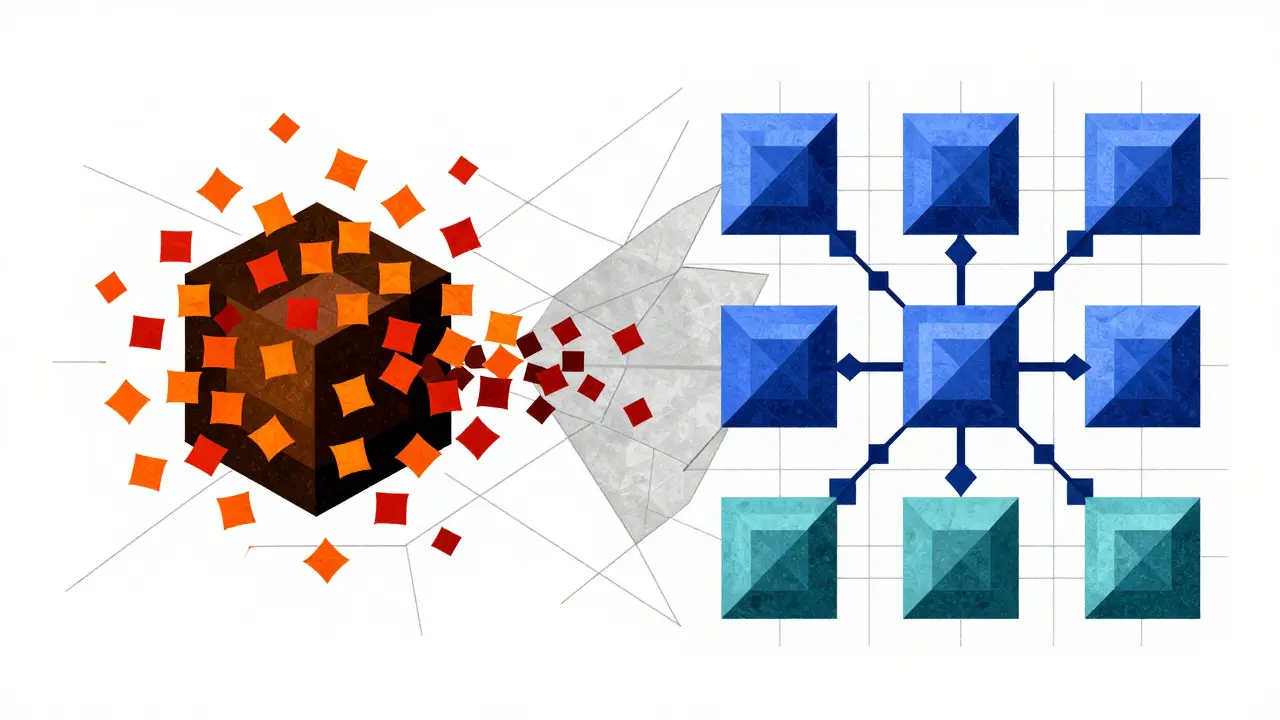
To understand the routing, you first need to see where the experts live. In a standard Transformer, each layer has a feed-forward network (FFN) that processes information. In an MoE Transformer, we replace that single FFN with a bank of multiple independent FFNs. These are the "experts."
Here is the catch: if we activate all experts for every token, we haven’t saved any compute. That’s why we need a router. The router is a small, lightweight linear layer that looks at the incoming token representation and assigns scores to each expert. Based on these scores, it selects a tiny subset-usually just one or two experts-to handle that specific token.
Consider Mixtral 8x7B is an open-source MoE model by Mistral AI with 46.7 billion total parameters but only 12-13 billion active per token. It has eight experts in each MoE layer. For any given word, the router picks the top two experts. The other six sit idle. This means the model behaves like a ~13B parameter model during inference, despite having the knowledge base of a 47B model. You get the quality of a larger model with the speed of a smaller one.
The Core Routing Strategies
Not all routers are created equal. The way you assign tokens to experts determines whether your model trains efficiently or collapses into chaos. There are three main approaches dominating the field right now.
Token-Choice Routing (Top-K Gating)
This is the classic method used by Google’s GShard is a large-scale MoE architecture developed by Google Research using up to 256 experts and top-2 gating. and later adopted by many others. Here, the token is the boss. For each token, the router calculates scores for all experts and picks the top-k (usually k=1 or k=2).
The problem? Popularity contests. If one expert is slightly better at handling common words, it might get overwhelmed while others starve. To fix this, engineers add a "load-balancing loss"-a mathematical penalty that forces the router to spread tokens more evenly. Without this, you get "expert collapse," where 90% of tokens go to one or two experts, rendering the rest useless.
Expert Choice Routing
Introduced by Zhou et al. in 2022, this strategy flips the script. Instead of tokens choosing experts, experts choose tokens. Each expert independently selects the top-k tokens from the batch that it thinks it can handle best.
Why does this matter? It guarantees perfect load balancing by design. Every expert processes exactly k tokens (assuming there are enough tokens in the batch). No complex auxiliary losses are needed to force balance. This simplifies the training loop significantly and reduces system overhead. However, it introduces variability: some tokens might be picked by five experts, while others are ignored. This requires careful handling during the backward pass to ensure gradients flow correctly.
Switch Routing (Top-1)
Switch Transformer is a simplified MoE architecture by Google using top-1 gating (k=1) to maximize training speedup. takes efficiency to the extreme. It uses k=1. One token, one expert. That’s it. Fedus et al. showed that this simplicity leads to massive speedups-up to 7x faster pretraining compared to dense models of similar active size. The trade-off? Slightly lower quality on smaller models because the gradient estimates are noisier. But at scale (trillions of parameters), the gap narrows, and the speed advantage makes it irresistible for huge training runs.
| Strategy | Selection Method | Load Balancing | Pros | Cons |
|---|---|---|---|---|
| Token-Choice (Top-K) | Token picks top-k experts | Auxiliary Loss required | Stable gradients, high quality | Complex tuning, risk of collapse |
| Expert Choice | Expert picks top-k tokens | Built-in (Perfect) | No balancing loss, simpler system | Variable compute per token |
| Switch (Top-1) | Token picks 1 expert | Auxiliary Loss required | Fastest training, lowest latency | Noisier gradients, slight quality drop |
Why Load Balancing Is Your Biggest Headache
You can have the smartest router in the world, but if your experts aren’t working equally hard, you’re wasting money. In distributed training, experts are usually split across different GPUs. If Expert A lives on GPU 1 and gets 90% of the traffic, GPU 1 will bottleneck the entire cluster. GPU 2 through 8 will sit idle, waiting for GPU 1 to finish.
This is why capacity factor is a multiplier determining the maximum number of tokens an expert can accept relative to the average load. matters. If the average load is 100 tokens per expert, a capacity factor of 1.25 means an expert can take up to 125 tokens. Tokens beyond that limit are either dropped or sent to a backup expert. Tuning this factor is a delicate dance. Too low, and you lose data. Too high, and you reintroduce imbalance.
Modern frameworks like DeepSpeed-MoE is a Microsoft library optimizing MoE training with efficient all-to-all communication kernels. and Tutel is an Alibaba framework providing high-performance MoE training via kernel fusion. handle much of this heavy lifting. They use optimized "all-to-all" communication primitives to shuffle tokens to the correct GPUs and gather results back. Without these tools, the communication overhead alone could negate the benefits of sparsity.
Real-World Performance: Mixtral vs. Dense Models
Let’s talk numbers. When Mistral released Mixtral 8x7B, the community was skeptical. Could a sparse model really compete with dense giants like LLaMA 2 70B?
The benchmarks said yes. On MT-Bench, Mixtral scored around 7.8-7.9, rivaling models twice its active size. More importantly, look at throughput. On a cluster of GPUs, Mixtral can process 1.5x to 2x more tokens per second than a dense 34B model. Why? Because memory bandwidth is often the bottleneck in LLMs. By activating fewer parameters, you move less data from VRAM to the compute units. Less movement means more computation.
However, don’t expect magic on a single consumer GPU. Running Mixtral 8x7B on an RTX 4090 might actually feel slower than running a 13B dense model. The overhead of routing logic and the fragmented memory access patterns hurt performance on limited hardware. MoE shines when you have the infrastructure to parallelize the experts effectively.

Future Directions: Beyond Simple Gating
The field isn’t standing still. Researchers are exploring Sinkhorn-based routing is a differentiable method for achieving globally balanced expert assignments without hard constraints., which uses iterative algorithms to find optimal assignment matrices. Others are looking at domain-specific experts, where certain experts specialize in code, others in math, and others in creative writing. Imagine a router that doesn’t just pick the "best" expert, but the most "relevant" specialist.
We’re also seeing hybrid approaches. Combining MoE with retrieval-augmented generation (RAG) allows the router to decide not just which internal expert to use, but whether to query an external database instead. This blurs the line between parametric memory and non-parametric knowledge.
Conclusion
Mixture-of-Experts isn’t just a trick; it’s a fundamental shift in how we build scalable AI. By decoupling total model size from active compute, we break the linear scaling laws that have constrained us for years. Whether you use Top-2 token choice for stability, Switch for speed, or Expert Choice for simplicity, the goal remains the same: do more with less. As hardware evolves and communication bottlenecks ease, expect MoE to become the standard for trillion-parameter models.
What is the difference between dense and MoE models?
In a dense model, every parameter is activated for every input token. In an MoE model, only a small subset of parameters (the selected experts) are activated per token. This allows MoE models to have far more total parameters while maintaining similar or lower inference costs.
Why is load balancing important in MoE?
Without load balancing, some experts may receive too many tokens while others receive none. This leads to inefficient GPU utilization, training instability, and "expert collapse," where the model fails to utilize its full capacity.
Is Mixtral 8x7B faster than LLaMA 2 70B?
Yes, typically. Mixtral 8x7B has only ~13B active parameters, whereas LLaMA 2 70B activates all 70B. This results in higher throughput and lower latency for Mixtral on well-optimized clusters, despite its larger total parameter count.
What is Expert Choice routing?
Expert Choice is a routing strategy where each expert selects the tokens it wants to process, rather than tokens selecting experts. This ensures perfect load balancing by design, as each expert processes a fixed number of tokens.
Can I run MoE models on my local PC?
You can, but performance gains may be minimal or negative compared to dense models. MoE benefits most from distributed systems where experts can be parallelized across multiple GPUs. On a single GPU, routing overhead can slow down inference.