Imagine you ask an AI assistant for a specific legal citation or a medical dosage. It answers with total confidence, citing a case that doesn't exist or a drug interaction that isn’t real. This is the core problem of LLM hallucinations, which are instances where models generate factually incorrect or fabricated information presented with high confidence despite lacking grounding in their training data. For businesses trying to deploy these tools in production, this isn't just a glitch; it's a major barrier. A January 2024 study found that 78% of AI practitioners identify hallucinations as a top concern for enterprise adoption. If you're building or managing AI systems, understanding how to control factuality is no longer optional-it's critical for trust and accuracy.
Key Takeaways
- Prompt Engineering: Using lower temperature settings (0.2-0.5) and explicit constraints can reduce hallucinations by up to 45% without changing model architecture.
- RAG is the Gold Standard: Retrieval-Augmented Generation offers the highest reduction rates (63-72%) by grounding answers in external, verified sources.
- Fine-Tuning Has High Costs: While effective for specialized domains, fine-tuning requires significant resources (200-300 hours of annotation) and is less flexible than RAG.
- Post-Generation Checks Matter: Decoding strategies and factuality alignment techniques can catch errors after generation, adding a safety net for critical applications.
- Human-in-the-Loop: Combining AI with human review workflows reduces escalation times and ensures final accuracy for high-stakes decisions.
Understanding the Mechanics of Hallucination
To fix the problem, you first need to understand why it happens. The phenomenon was systematically documented in a 2022 Microsoft Research paper by Ji et al., which established that hallucinations stem from three main dimensions: factual accuracy, logical consistency, and instruction following. Unlike simple errors, hallucinations often feel plausible because the language model predicts the next word based on probability, not truth. If a certain phrase is common in its training data, the model will likely repeat it, even if it’s factually wrong in your specific context.
This creates a unique challenge for developers. You aren't just fighting for better grammar; you're fighting for grounding. The model needs a tether to reality. Without external verification, the model relies solely on its internal weights, which are static snapshots of the internet at the time of training. As new facts emerge or old ones change, those weights become outdated, leading to confident misinformation.
First Line of Defense: Prompt Engineering
Before investing in complex infrastructure, start with your prompts. How you talk to the model significantly impacts its tendency to make things up. According to McGovern Institute's January 2024 guide, adjusting the temperature setting is one of the most effective quick wins. Lowering the temperature to the 0.2-0.5 range makes outputs more deterministic, reducing hallucinations by 32-45% compared to higher settings (0.8-1.0).
Beyond temperature, structure matters. Microsoft's Azure AI Foundry team recommends the 'ICE method' (Instructions, Constraints, Escalation). Here’s how to apply it effectively:
- Place Critical Constraints First: Put key rules at the beginning of the prompt. Models pay closer attention to early tokens.
- Repeat Key Instructions: Repeating crucial instructions 2-3 times within the prompt improves effectiveness by 15%.
- Define Fallback Behaviors: Explicitly tell the model what to do when it doesn't know. Adding "Say 'I don't know' if unsure" reduced hallucinations by 37% in Microsoft's testing.
Other advanced prompting techniques include chain-of-thought prompting, which encourages the model to show its work before answering, reducing errors by approximately 28%. Few-shot prompting, where you provide examples of correct responses, also yields a 22% reduction. These methods are low-cost and easy to implement, making them the starting point for any factuality control strategy.
The Power of Retrieval-Augmented Generation (RAG)
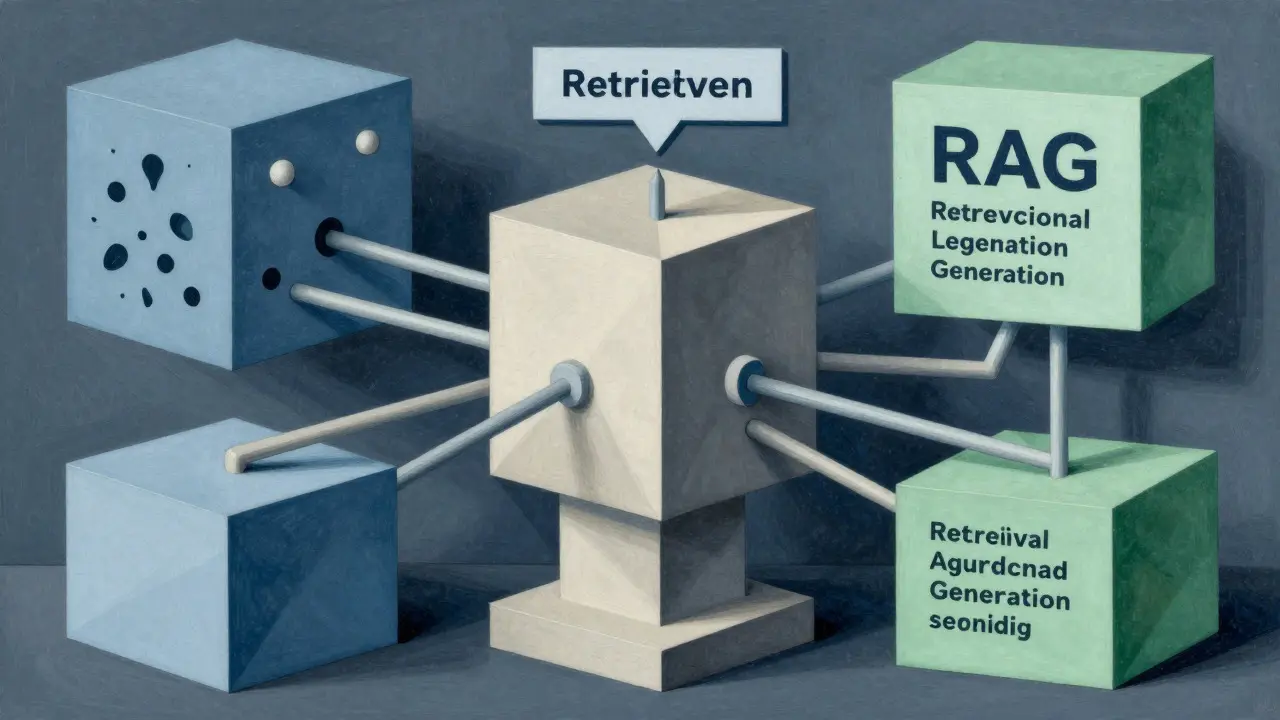
If prompt engineering is the band-aid, Retrieval-Augmented Generation (RAG) is the surgery. RAG works by retrieving relevant information from external knowledge sources before generating a response. Instead of relying on memory, the model reads fresh, verified documents. AWS research demonstrates that successful RAG implementation achieves a 63-72% reduction in hallucination rates across multiple benchmark datasets.
However, RAG is only as good as your data. A poorly implemented RAG system can actually increase hallucinations. IBM's October 2024 case study noted that uncurated data in RAG pipelines increased error rates by 22%. To avoid this pitfall, follow these best practices:
- Clean and Curate Sources: Remove outdated or biased content before ingestion.
- Organize into Topic-Specific Collections: Grouping data by topic improves search accuracy and reduces noise by 41%.
- Audit Regularly: Implement regular audits of grounding data to ensure freshness.
To measure success, use evaluation frameworks like RAGAS (Retrieval Augmented Generation Automatic Score). Developed in 2023, RAGAS measures metrics such as answer correctness and relevancy. When integrated with custom thresholds, it achieved 89% accuracy in hallucination detection, providing a reliable metric for continuous improvement.
Fine-Tuning vs. RAG: Which Approach Fits Your Needs?
Fine-tuning involves training a model on specific data to adapt its behavior. It is highly effective for standardized tasks but comes with significant resource requirements. Vellum AI notes that fine-tuning requires "a large number of high-quality prompt/completion pairs." In medical applications, domain-specific fine-tuning with 10,000+ examples reduced hallucinations by 58% compared to general-purpose models.
But there’s a catch. Creating a high-quality fine-tuning dataset typically requires 200-300 hours of expert annotation, according to a July 2024 Vectara study. This makes it less accessible for organizations with limited budgets or rapidly changing data. RAG, on the other hand, allows you to update your knowledge base instantly without retraining the model. For most enterprises, RAG offers a better balance of cost, flexibility, and accuracy. Fine-tuning should be reserved for scenarios where the task is highly repetitive and the data is stable.
| Strategy | Hallucination Reduction | Implementation Cost | Best For |
|---|---|---|---|
| Prompt Engineering | 18-45% | Low | Quick wins, general chatbots |
| RAG | 63-72% | Medium-High | Dynamic data, enterprise knowledge bases |
| Fine-Tuning | 43-58% | High | Standardized tasks, stable domains |
| Decoding Strategies | 29-33% | Medium | Technical optimization, latency-sensitive apps |
Advanced Techniques: Decoding and Post-Editing
For teams looking to squeeze out every bit of accuracy, post-generation techniques offer another layer of defense. Vectara's September 2024 research showed that decoding strategies like Contrastive Decoding (CAD) and Distributional Lookahead (DoLa) reduced hallucinations by 29% and 33% respectively. These methods adjust how the model selects words during generation, favoring paths that lead to consistent facts.
Factuality alignment is another powerful tool. By adjusting the model's internal representations to favor factual consistency, you can reduce hallucinations by 41% with minimal impact on response quality. Additionally, post-editing frameworks formulate hallucination detection as a chain of Natural Language Inference tasks. These systems achieve 82% detection accuracy while preserving text quality, acting as a final filter before content reaches the user.

Implementing Human-in-the-Loop Systems
No technical solution is perfect. That’s why advanced enterprise implementations include human-in-the-loop systems. AWS’s implementation using Amazon Bedrock Agents created a customizable hallucination detection system that triggers notifications to customer service queues when hallucination scores fall below predefined thresholds. This system achieved 92% accuracy in identifying hallucinations requiring human intervention, reducing customer escalation time by 68%.
While effective, this approach has trade-offs. Red Hat’s March 2024 analysis noted that such systems can increase overall latency by 400-600ms compared to static workflows. For real-time applications, you must weigh the value of human verification against the speed penalty. For high-stakes industries like healthcare and finance, where errors carry regulatory risks, the extra milliseconds are often worth it.
Future Trends and Emerging Solutions
The field is moving fast. Emerging research directions include iterative self-reflection methods, where models generate, score, and refine their own answers. This strategy demonstrated a 52% hallucination reduction in medical domain testing. Teacher-student approaches, where larger models guide smaller ones, also show promise, achieving 39% reduction in constrained environments.
Looking ahead, multimodal verification techniques that cross-reference text with images and structured data are projected to offer 65% hallucination reduction potential by Q3 2026. Anthropic’s constitutional AI approaches, which embed factuality constraints directly into model architecture, showed 73% reduction in preliminary testing. Industry analysts predict that by 2027, hallucination rates in enterprise LLMs will decrease from current averages of 25-35% to 8-12% through combined implementation of these techniques. However, Stanford HAI cautions that as LLM capabilities expand, new forms of hallucinations may emerge, suggesting that factuality control remains an ongoing journey rather than a final destination.
Frequently Asked Questions
What is the fastest way to reduce LLM hallucinations?
The fastest method is prompt engineering, specifically lowering the temperature setting to 0.2-0.5 and adding explicit fallback instructions like "Say 'I don't know' if unsure." This can be implemented immediately without code changes or data preparation.
Is RAG always better than fine-tuning?
Not always. RAG is generally better for dynamic data and broad knowledge bases because it allows instant updates. Fine-tuning is superior for highly standardized, repetitive tasks where the data is stable and the volume of queries justifies the high upfront cost of annotation and training.
How do I measure if my hallucination mitigation is working?
Use evaluation frameworks like RAGAS to measure answer correctness and relevancy. Establish baseline metrics before implementing changes, then track the reduction in error rates over time. For enterprise systems, integrate automated scoring with human spot-checks to validate accuracy.
Can hallucinations be eliminated completely?
Currently, no. While techniques can reduce rates from 25-35% to under 10%, complete elimination is difficult due to the probabilistic nature of language models. The goal is risk management: reducing errors to acceptable levels for your specific use case and implementing safeguards for critical failures.
What role does data quality play in RAG effectiveness?
Data quality is critical. Poorly curated data can actually increase hallucination rates by introducing noise and contradictions. Cleaning, organizing into topic-specific collections, and regularly auditing source documents are essential steps to ensure RAG improves accuracy rather than degrading it.