Building a RAG pipeline is only half the battle. The real challenge? Knowing if it actually works - and keeps working - when real users start asking questions. Too many teams think a few test queries are enough. They run a synthetic dataset, see a 0.85 on Faithfulness, and call it done. Then production hits. Users get nonsense answers. The system slows down. Costs spike. And no one knows why.
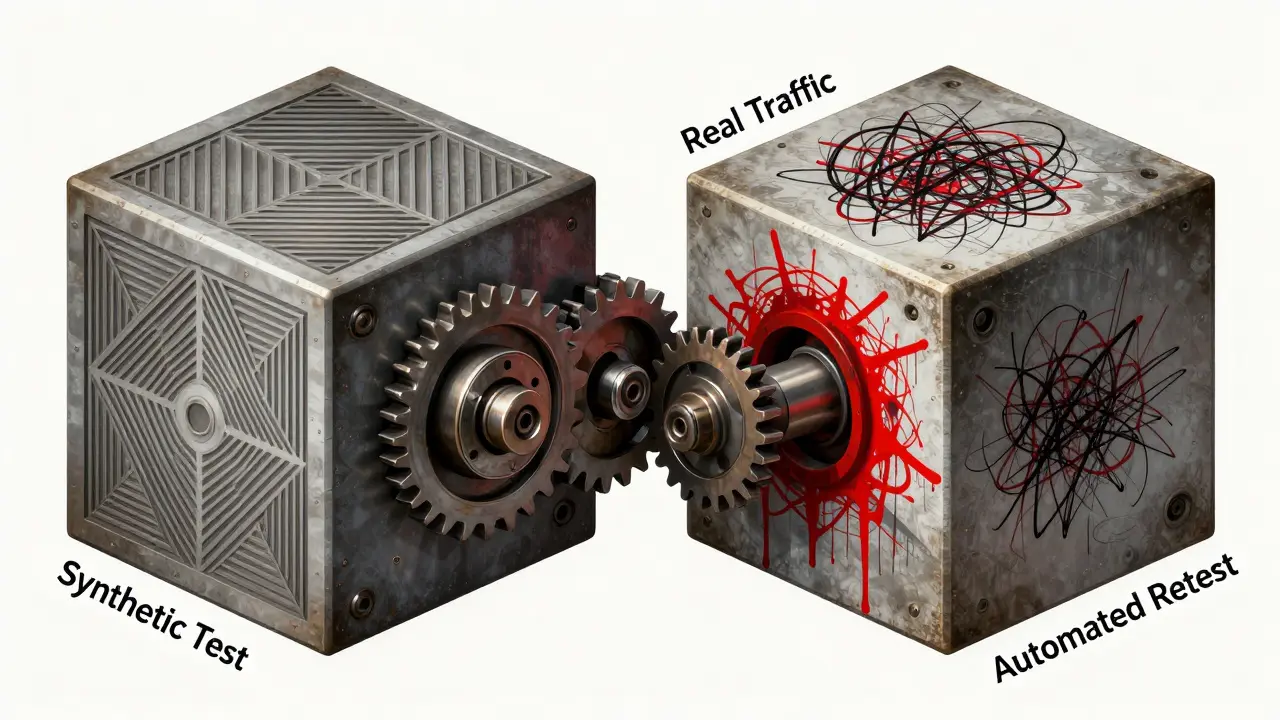
Here’s the truth: RAG isn’t a single model. It’s a chain. Retrieval first. Then generation. And something can break at every link. That’s why testing and monitoring need two different approaches: synthetic queries for control, and real traffic for truth.
What Synthetic Queries Can and Can’t Do
Synthetic queries are your lab tests. You build them ahead of time. You know the right answer. You control the variables. Tools like Ragas let you score each step: Did the system retrieve the right documents? (Context Relevancy) Did it use them correctly? (Faithfulness) Is the answer even useful? (Answer Relevancy). These scores range from 0 to 1. Most production systems hover between 0.6 and 0.9. Anything below 0.7 on Faithfulness? Red flag.
You need real data to build these tests. Benchmarks like MS MARCO (800,000 queries) or FiQA (6,000 financial questions) give you a starting point. But if your RAG handles medical records or legal contracts, generic datasets won’t cut it. You need your own. And that’s where most teams get stuck. Creating high-quality synthetic datasets eats up 40-60% of development time. It’s slow. It’s manual. It’s expensive.
And here’s the catch: synthetic queries miss the weird stuff. Real users don’t ask clean, single-turn questions. They say things like, “Wait, earlier you said X, but now Y? What’s going on?” Or they type half-sentences. Or they’re angry. Or they’re non-native speakers. Dr. James Zhang’s July 2024 study found synthetic tests underrepresent multi-turn interactions by 45-60%. That’s not a small gap. That’s where your system fails.
Why Real Traffic Is Your Best Teacher
Real traffic doesn’t care about your test suite. It’s messy. Unpredictable. And full of answers you didn’t see coming. Monitoring production queries is the only way to catch what synthetic tests miss.
Take the healthcare RAG system that passed every lab test but hallucinated dosage info in 3.7% of real queries. That’s not a 3.7% error rate. That’s a lethal flaw. Synthetic tests never saw those edge cases because they were never built into the dataset.
Real traffic monitoring needs tracing. You follow a single query from the moment it enters the system - through the vector database, the reranker, the LLM - and back out. Platforms like Langfuse and Maxim AI capture 100% of this traffic with under 50ms overhead. You don’t just see the final answer. You see which documents were pulled. How long each step took. Did the retrieval stage return five documents, but the LLM only used one? That’s a red flag. Did latency spike to 4.8 seconds? That’s a user drop-off waiting to happen.
But here’s the hard part: with real traffic, you don’t always know the right answer. So how do you measure success? You look at behavior. Did users refine their query? Did they abandon the chat? Did they come back? Session duration and query refinement rates are better indicators of satisfaction than any Faithfulness score. LangChain’s 2024 report found these operational metrics correlate better with real user experience than traditional evaluation scores.
The Hidden Costs of Monitoring
Monitoring isn’t free. Running Ragas on every single production query costs about $15 per 1,000 queries. For a system handling 1 million queries a month? That’s $15,000. Too expensive. Most teams sample. They evaluate 10% of traffic. That saves money - down to $1.50 per 1,000 queries - but you miss critical failures. A startup CTO on HackerNews caught a retrieval failure affecting 12% of finance queries because they were watching real traffic. Synthetic tests never saw it.
Then there’s infrastructure. Setting up distributed tracing isn’t plug-and-play. Open-source tools like TruLens require you to manually instrument 8-12 components. Enterprise platforms like Maxim AI do it automatically. But they cost $1,500-$5,000/month. Open-source? Free. But you’ll spend 20-40 hours a month on maintenance, debugging, and updates.
And don’t forget cost per query. A simple query with 500 tokens might cost $0.0002. A long, complex one with 8,000 tokens? $0.002. Multiply that by daily traffic. One team found their context window overflow issue was costing $18,000/month in unnecessary API calls - all caught by synthetic testing with Promptfoo.
What You’re Probably Missing
Most teams focus on accuracy. They forget security. Patronus.ai’s 2024 audit found 68% of tested RAG systems are vulnerable to prompt injection attacks. A clever user can trick your system into leaking data or bypassing guardrails. That’s not a bug. It’s a breach waiting to happen.
And what about the interface between retrieval and generation? Evidently AI’s 2024 whitepaper says 63% of failures happen right there. The system pulls good context. But the LLM ignores it. Or uses it wrong. Without tracing, you’ll never see it. You’ll just think the LLM is “bad.”
Then there’s metric chaos. Ragas uses “Faithfulness.” Langfuse uses “Answer Consistency.” Vellum calls it “Truthfulness.” 79% of practitioners say these definitions aren’t standardized. You can’t compare tools. You can’t benchmark. You’re flying blind.
Building a Better System
You need both. Synthetic queries for control. Real traffic for truth. But how do you connect them?
Start with synthetic tests. Build a baseline. Test against your own data. Set thresholds. Use tools like Ragas to score retrieval and generation. Automate this in CI/CD. Braintrust.dev found automated quality gates block 83% of regressions before they reach production.
Then, monitor production. Use tracing. Capture every query. Track latency, cost, failure rate, and user behavior. Set alerts. If a query takes longer than 3 seconds, flag it. If Faithfulness drops below 0.65 on a real query, log it.
Now, the magic trick: turn production failures into new synthetic tests. Maxim AI’s CTO says the best systems do this within 24 hours. A user asked a question. The system failed. That query gets saved. Automatically. Added to your test suite. Next time you deploy, it runs. And it blocks the bad code.
That’s the feedback loop. Synthetic tests catch the obvious. Real traffic catches the hidden. And together, they make your RAG system smarter every day.
What Tools Should You Use?
Open-source? Ragas is the most popular. It’s free. It gives you Faithfulness, Context Relevancy, Answer Relevancy. But it has a 22% false positive rate on hallucination detection. And it’s hard to integrate.
Enterprise? Vellum and Langfuse offer one-click test suites and 100% production tracing. They’re easier. They’re faster. But they cost money. Maxim AI’s platform catches 100% of failures - but users say the learning curve is steep.
Here’s the reality: if you’re a startup with 500 queries/day, use Ragas. If you’re an enterprise with 10 million queries/day, you need the tools that automate tracing and alerting. The cost of downtime is too high.
Where This Is Headed
By 2026, Gartner predicts 90% of enterprise RAG systems will have automated evaluation pipelines. That’s up from 35% in 2024. The market for these tools will hit $480 million.
The future? It’s not synthetic vs real. It’s synthetic from real. Systems will automatically generate adversarial test cases from production anomalies. Vellum already does this. If a query has high latency, it becomes a new test. If users keep refining a question, it triggers a context sufficiency check.
And the big shift? Evaluation isn’t a phase. It’s continuous. You don’t test once. You monitor forever. Because RAG isn’t a static model. It’s a living system. And if you stop watching it, it will break.
What’s the difference between synthetic queries and real traffic in RAG testing?
Synthetic queries are pre-built test cases with known answers. They’re used to measure accuracy under controlled conditions - like checking if your system retrieves the right documents or generates factually correct responses. Real traffic monitoring tracks actual user queries in production. It doesn’t have ground truth, so it measures behavior: latency, cost, user drop-offs, and refinement rates. Synthetic tests find known issues. Real traffic finds the ones you didn’t expect.
Can I rely only on synthetic testing for my RAG pipeline?
No. Synthetic tests cover only 60-70% of failure modes seen in production, according to Neptune.ai’s 2024 research. Real users ask complex, multi-turn, or poorly phrased questions that synthetic datasets rarely capture. A healthcare system once passed all synthetic tests but hallucinated drug dosages in 3.7% of real queries. That kind of failure only shows up in production.
How much does RAG monitoring cost?
It varies. Running Ragas on every query costs $15 per 1,000 queries. Sampling 10% cuts that to $1.50. Enterprise tools like Maxim AI or Vellum charge $1,500-$5,000/month based on volume. Open-source tools are free, but require 20-40 hours/month of engineering work for setup and maintenance. The average cost of monitoring is 15-25% of total RAG infrastructure spending.
What metrics matter most for RAG evaluation?
For retrieval: Recall@5 and Mean Reciprocal Rank (MRR). For generation: Faithfulness (factual consistency) and Answer Relevancy. But don’t ignore operational metrics: latency (target: 1-5 seconds), cost per query ($0.0002-$0.002), and failure rate. User behavior - like query refinement and session duration - often predicts satisfaction better than accuracy scores.
How do I turn production failures into better tests?
Use distributed tracing to capture failing queries. Save them automatically. Add them to your synthetic test suite. Then run them in your CI/CD pipeline before every deployment. If a real user query fails, it becomes a mandatory test case. This creates a feedback loop: real-world problems improve your tests, and your tests prevent future failures. Platforms like Maxim AI and Vellum automate this process.
Are there security risks in RAG pipelines?
Yes. 68% of RAG systems tested in 2024 were vulnerable to prompt injection attacks, according to Patronus.ai. Attackers can trick the retrieval system into pulling malicious context or force the LLM to ignore guardrails. Monitoring should include security checks - like detecting unusual query patterns or attempts to bypass context constraints. This isn’t optional anymore.
What skills do I need to monitor a RAG pipeline?
You need to understand vector databases (78% of implementations use them), LLM APIs (92% of cases), and how to interpret metrics like Recall@k and Faithfulness. You also need basic statistical analysis to tell if a drop in score is noise or a real problem. And you need to know how to set up distributed tracing - whether through open-source tools like Langfuse or enterprise platforms.
Morgan ODonnell
March 13, 2026 AT 20:49Been there. Tried synthetic tests, thought we were golden. Then real users started asking weird stuff like 'Is this thing even working?' and we got roasted. Turns out our 'faithfulness' score was lying. Real traffic showed us where it broke - not in the data, but in the way people actually talk. Now we run both. Synthetic for baseline, real queries for truth. Simple.
Liam Hesmondhalgh
March 14, 2026 AT 17:32Ugh. Another post pretending RAG is some deep mystery. It's just a glorified autocomplete with extra steps. Stop overcomplicating it. If your system can't handle 'what's the weather' without hallucinating, you shouldn't be deploying it. Stop spending $15k/month on monitoring and fix your damn retrieval first.
Patrick Tiernan
March 16, 2026 AT 02:59lol at people paying 5k/month for 'enterprise tracing' like its rocket science. we just log the query and the answer. if it makes no sense? flag it. if it takes 4 seconds? optimize the damn vector db. no need for vellum or maxim ai. also why are we still talking about faithfulness like its a real metric? its just a number made up by some phd who never shipped code
Patrick Bass
March 17, 2026 AT 13:34I agree with the core point: synthetic tests are necessary but insufficient. We started with Ragas, got 0.89 on faithfulness, deployed, and within a week had users asking why we were citing fictional court cases. Real traffic caught it. Now we auto-add every failed query to our test suite. It’s not glamorous, but it works. Also, cost per query is a silent killer - we cut our spend by 60% just by capping token length.
Tyler Springall
March 18, 2026 AT 10:54How is it possible that anyone still believes in 'synthetic' as a standalone solution? This isn't 2021. We're in 2025. The idea that you can simulate human behavior with curated queries is not just naive - it's dangerously arrogant. Real users don't care about your metrics. They care if their question got answered correctly. And if your system can't handle a typo-ridden, half-angry, multi-turn question from a non-native speaker? You're not building AI. You're building a toy.
Colby Havard
March 20, 2026 AT 10:38It is, indeed, a profound and underappreciated truth - that the fidelity of a RAG system cannot be meaningfully assessed through synthetic benchmarks alone. The emergent, chaotic, and often illogical nature of human interaction - replete with contextual ambiguity, emotional valence, and linguistic imperfection - constitutes a qualitatively distinct domain of evaluation. One must therefore posit that operational metrics - latency, refinement rate, abandonment - are not merely proxy indicators, but rather the true epistemic anchors of system performance. The synthetic suite, while methodologically rigorous, remains ontologically disconnected from the lived reality of deployment. This is not a technical gap - it is a philosophical one.
Amy P
March 21, 2026 AT 13:04THIS. YES. I work in healthcare RAG and we had a system that passed every test with flying colors. Then a user typed: 'so if I take this med and I'm pregnant, do I still need the other one?' Our system gave a perfect, textbook answer... that was completely wrong for the context. We didn't catch it because we never tested for 'conditional pregnancy'. Now we automatically turn every failed real query into a test case. It's wild how often people ask things you'd never think of. And yes - the cost is insane. But not as insane as a lawsuit.