Remember when writing code meant typing every single bracket and semicolon? That era is effectively over. In 2025, a new paradigm called vibe coding has taken the tech world by storm. It’s not just about autocomplete anymore; it’s about describing what you want in plain English and watching an AI build it. This shift isn’t just changing how we work-it’s fundamentally redefining who gets to be a software engineer.
If you’re a developer, product manager, or founder, you need to understand this change. The role of the engineer is no longer defined by how fast they can type, but by how well they can guide artificial intelligence. Let’s break down what vibe coding actually is, which tools are leading the charge, and what this means for your career in 2025.
What Exactly Is Vibe Coding?
Vibe coding is formally defined as AI-powered code generation via natural language prompts. Instead of manually implementing logic line-by-line, you use conversational interfaces to generate applications. Think of it as having a junior developer who never sleeps, knows every library ever created, and listens to your instructions instantly.
This method emerged sharply between 2023 and 2024 as large language models (LLMs) became sophisticated enough to handle complex tasks. When Claude 3.5 Sonnet was released in April 2024, it hit an 89.7% accuracy rate on HumanEval benchmarks. That was the tipping point. Suddenly, you could ask for a "login page with OAuth integration" and get working code back.
By the first quarter of 2025, half of all surveyed developers reported using these tools regularly. The job shifted from manual implementation to AI orchestration. You aren’t writing the code; you’re validating it. You aren’t building the bricks; you’re directing the construction crew.
Is vibe coding just fancy autocomplete?
No. Traditional autocomplete suggests the next few words based on syntax. Vibe coding uses LLMs to generate entire functions, components, or even full applications based on high-level natural language descriptions. It understands context across multiple files, not just the current line.
The Top Tools Driving the Shift
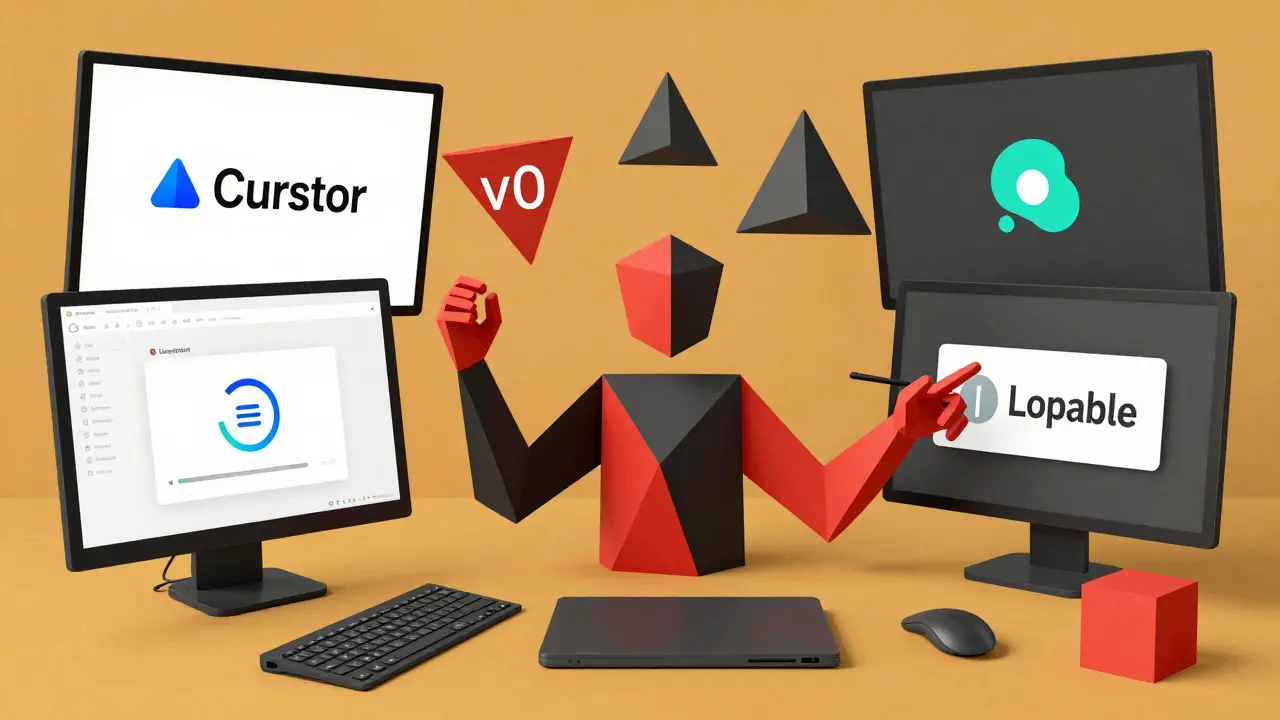
You can’t vibe code without the right tools. The landscape in 2025 is crowded, but a few players have established themselves as leaders. Each has a slightly different approach to how they interact with you.
Cursor is an AI-first code editor that leverages powerful LLMs like Claude 3.5 Sonnet through its Composer feature. Released in version 4.2 in January 2025, it allows you to describe an entire application in plain English. It costs $20 per month for individuals. If you are already used to VS Code, Cursor feels familiar but supercharged.
Then there is v0 by Vercel, which transforms text into production-quality React components using Tailwind CSS. Version 2.4, released in February 2025, focuses heavily on frontend design. If you need a beautiful UI quickly, v0 is often the go-to choice.
For non-technical founders, Lovable offers chat-based development accessible to users with little to no coding experience. Its v1.8 update in March 2025 made it easier than ever to build full-stack apps. It has a free tier, with a Pro plan at $15 per month.
Enterprise teams often stick with GitHub Copilot Chat, which provides project-aware suggestions based on your existing codebase patterns. Version 3.1, released in late January 2025, integrates deeply with GitHub repositories, making it safer for large, regulated organizations.
| Tool | Best For | Price (Monthly) | Key Feature |
|---|---|---|---|
| Cursor | Full-stack development | $20 - $40 | Composer multi-file editing |
| v0 by Vercel | Frontend/UI components | Free / Paid tiers | React + Tailwind generation |
| Lovable | Non-technical founders | Free / $15 | Chat-based full app creation |
| GitHub Copilot | Enterprise integration | $19 - $39 | Codebase-aware suggestions |
How the Role of Software Engineers Has Changed
The biggest impact of vibe coding is on the human element. The title "Software Engineer" still exists, but the day-to-day work looks completely different. Here are five major shifts documented in 2025:
- From Coder to Validator: Developers now spend about 63% of their time refining prompts and verifying AI output rather than writing raw code. Your value comes from knowing if the AI is right, not from being able to write the function from memory.
- Prompt Archaeology: Debugging has changed. You don’t just look at stack traces. You have to reverse-engineer why the AI generated specific problematic code. This requires understanding the model’s logic, not just the language syntax.
- Architectural Focus: System architecture is now the primary value-add. Engineers focus on structuring problems so the AI can consume them. Breaking a complex app into small, manageable prompts is a critical skill.
- Cross-Disciplinary Collaboration: Product managers are now contributing directly through natural language prompts. According to Bubble.io, 44.4% of teams see PMs using these tools. The barrier between "tech" and "non-tech" is blurring.
- The "AI Whisperer": Senior engineers are becoming specialists in model limitations. They know which models struggle with state management or database connections. This expertise commands a 22.7% salary premium according to Hired.com’s 2025 report.
If you are a junior developer, this is good news. The barrier to entry has dropped by 68% for non-CS graduates, says Dr. Sarah Chen from MIT. You can contribute more immediately because the AI handles the boilerplate. However, you must learn to think critically about the code you accept.
The Risks: Technical Debt and Trust
It’s not all sunshine and rapid prototyping. There is a dark side to vibe coding, and ignoring it will hurt your projects.
Dave Farley, co-author of *Continuous Delivery*, famously declared vibe coding "the worst idea of 2025." His concern? Technical debt. He analyzed 2,347 GitHub repositories and found a 41.3% increase in post-release defects in AI-generated codebases. Why? Because developers ship code they don’t fully understand.
This is the "black box" problem. When Lovable or Cursor generates a complex authentication flow, do you know exactly how it handles tokens? If it breaks in production, can you fix it? Many developers say no. This leads to fragile systems that collapse under scale.
There is also the "80% solution" trap. AI is great at getting you 80% of the way there. But the last 20%-customizing edge cases, optimizing performance, ensuring accessibility-often takes disproportionate effort. On Reddit, developers shared stories of spending three weeks debugging React components generated by v0 that violated accessibility standards.
Furthermore, maintenance costs have risen. GitHub’s Octoverse 2024 report noted that while prototyping time dropped by 78.3%, maintenance costs increased by 34.7% when AI prototypes moved to production without significant refactoring. Speed up front doesn’t mean cheap later.

How to Succeed with Vibe Coding in 2025
To avoid the pitfalls and reap the rewards, you need a strategy. Here is how top-performing teams are adapting:
- Implement AI Code Review Gates: Don’t let AI code merge automatically. Organizations that added strict review processes saw a 42.6% increase in production readiness. Treat AI output as untrusted input until verified.
- Learn Prompt Engineering: It’s a real skill. Pluralsight’s certification shows that learners improve their effectiveness by 3.2x after training. Learn to break down tasks, provide context, and iterate on prompts.
- Focus on Architecture: Spend more time designing the system structure before you start prompting. If your architecture is messy, the AI will amplify that mess.
- Stay Compliant: With the EU AI Act effective February 2025, companies need "human oversight logs" for AI-generated code. Ensure your workflow documents who approved what AI did.
- Master the Fundamentals: Knowing how JavaScript closures work or how SQL joins operate helps you spot when the AI is lying to you. You can’t validate what you don’t understand.
The Future: Hybrid Development
Where is this going? The trend is toward hybrid platforms. By 2027, experts predict the lines between vibe coding and visual development will blur. Tools like Bubble.io are capturing market share by combining AI generation with visual editors.
We are also seeing new modalities. Audio-driven development tools like Audiolab allow you to speak your code changes, reducing typing bottlenecks. Persistent codebase agents will maintain living models of your entire project, making AI smarter over time.
Vibe coding won’t eliminate software engineers. It will eliminate engineers who refuse to adapt. The future belongs to those who can orchestrate AI, ensure quality, and solve strategic problems. The keyboard is becoming a steering wheel, not a typewriter. Are you ready to drive?
Will AI replace software engineers entirely?
Unlikely in the near term. While AI can generate code, it lacks strategic judgment, business context, and accountability. Engineers are shifting from coders to architects and validators. The role evolves rather than disappears.
Is vibe coding safe for enterprise use?
It depends on governance. Enterprises must implement strict code review gates, compliance logging (per EU AI Act), and security audits. Tools like GitHub Copilot offer better enterprise controls than open-ended chatbots.
Do I need to know how to code to use vibe coding?
You can build simple apps without coding knowledge, but to maintain, scale, and debug complex systems, basic programming literacy is essential. Understanding logic, data structures, and APIs prevents costly errors.
Which vibe coding tool is best for beginners?
Lovable is often recommended for beginners due to its chat-based interface and low barrier to entry. Cursor is better for those with some coding experience who want a traditional IDE feel with AI power.
How does vibe coding affect job salaries?
Salaries are polarizing. Junior roles may face pressure due to lower barriers to entry. However, senior engineers who master AI orchestration and architecture command premiums of up to 22.7% according to 2025 reports.