We are living through a moment where it is increasingly difficult to tell what is real. A photo of the Pope in a puffer jacket, a voice message from your CEO asking for an urgent wire transfer, or a perfectly written essay submitted by a student-how do you know if a human made it? This uncertainty is the core problem driving the race for AI content watermarking, which is the practice of embedding imperceptible but algorithmically detectable signals into generative AI outputs like text, images, audio, and video so they can be identified as synthetic. It is not just about adding a logo; it is about building a digital fingerprint that survives compression, cropping, and editing.
The technology behind this has evolved rapidly. While digital watermarking dates back to the early 1990s for copyright protection, applying it to large-scale generative models accelerated after 2020 with the rise of transformer-based large language models (LLMs). Today, watermarking and provenance techniques have become central to policy discussions, including the EU AI Act’s Article 50 transparency obligation adopted in 2024. But does it actually work? And where does it fail?
How Text Watermarking Works Under the Hood
For text generated by LLMs, watermarking is less about visual marks and more about statistical bias. The most widely cited modern milestone comes from Scott Aaronson’s residency at OpenAI in 2022, where he designed cryptographic-style watermarks for LLM text. His approach used a Gumbel-max-style scheme: at each step, the model produces a probability distribution over tokens, and a pseudorandom vector generated from a secret key biases the selection toward specific words.
A related family of schemes, introduced by Kirchenbauer et al. in their 2023 paper "A watermark for large language models," partitions the vocabulary at each position into a "green list" and a "red list" based on a keyed hash. The sampler is biased to select green-list tokens with high probability (e.g., 0.95) while preserving overall fluency. Detection then counts the number of green-list tokens in a passage. For sequences of length around 800-1000 tokens, reported detection accuracy exceeded 99% at low false-positive rates.
This method is attractive because it can be implemented with minimal runtime overhead-typically less than 5% additional sampling time-and no changes are visible to users. However, it faces strong robustness challenges against paraphrasing. If you take watermarked text and run it through another LLM to rewrite it, or even just ask a human editor to rephrase it, the statistical signal weakens significantly.
Image Watermarking: From Pixels to Neural Networks
Image watermarking predates AI by decades. Traditional methods used discrete cosine transform (DCT) or discrete wavelet transform (DWT) to embed low-amplitude signals into mid-frequency coefficients, allowing them to survive JPEG compression and small rescaling. In the generative era, AI-specific image watermarking has evolved along two main tracks: post-hoc neural encoders and model-integrated watermarking.
SynthID-Image, developed by Google DeepMind and announced in August 2023, is a prominent example of a post-hoc encoder/decoder pair. A U-Net-style encoder network embeds a multi-bit watermark into the pixel space of images generated by models like Imagen. DeepMind reports that the watermark is "holographic," meaning the information is distributed across the image so that even cropped regions retain detectable signal. Internal evaluations claimed high detection reliability (>90% true positive rate) under common transformations like resizing and JPEG compression.
On the other hand, model-integrated schemes like Stable Signature fine-tune the VAE decoder of a latent diffusion model (such as Stable Diffusion) to ensure that each decoded image contains a fixed binary signature. Because the watermark is embedded in the latent-to-pixel mapping, it persists even if the model is used with different prompts. However, major edits-like applying another generative model on top-can degrade the signal.
Provenance Metadata vs. Watermarks: The C2PA Approach
It is crucial to distinguish between watermarking and provenance metadata. Watermarking modifies the content itself, whereas provenance metadata attaches cryptographically signed assertions to the file. The Coalition for Content Provenance and Authenticity (C2PA), founded in 2021 by Adobe, Microsoft, Intel, Sony, and others, publishes a technical specification for these signed assertions.
Adobe’s "Content Credentials" implementation uses signed JSON metadata stored in containers like XMP in JPEG/PNG files. This approach is complementary to watermarking. Metadata is more reliable when preserved because it is cryptographically verified and tamper-evident. However, it is brittle; a single save/export step or a screenshot can strip the metadata entirely. Watermarking is harder to remove without degrading quality but may be probabilistic and fallible.
| Method | Survives Screenshot/Crop? | Cryptographic Proof? | Primary Weakness |
|---|---|---|---|
| Text/Image Watermarking | Yes (partially) | No (statistical) | Paraphrasing/Re-generation attacks |
| C2PA Metadata | No | Yes | Easily stripped by export/screenshot |
| Heuristic Detectors | N/A | No | High false positives, bias against non-native writers |
Key Limitations and Attack Vectors
No current system is perfect. Across all modalities, limitations fall into several categories. First, there are robustness gaps. Even robust watermarks can be degraded by extreme transformations, such as re-generating an image by prompting another diffusion model with a screenshot, or transcoding audio through low-bitrate codecs.
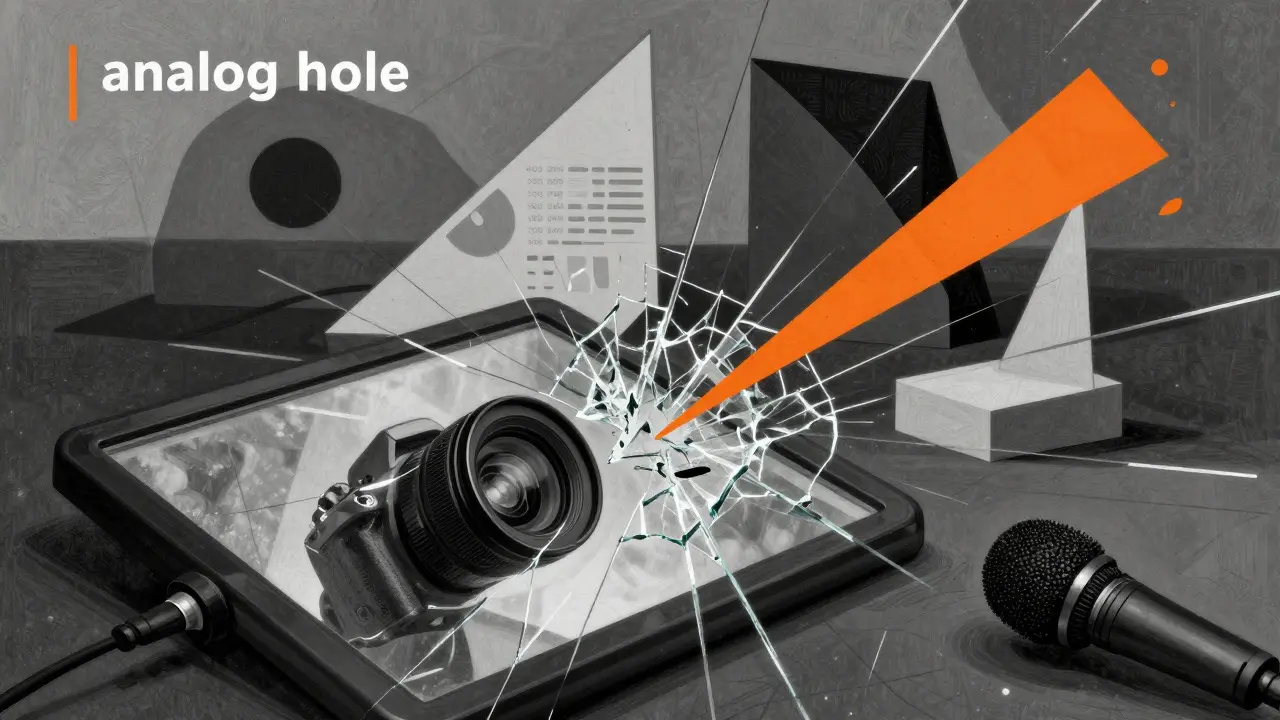
Second, there is the "analog hole." Once content is displayed on a screen or loudspeaker, an attacker can capture it via camera or microphone. This destroys many digital watermarks while preserving human-perceptible content. Third, model proliferation complicates things. Open-source generators like Stable Diffusion or LLaMA-family models can be used without watermarks. Therefore, the absence of a watermark cannot reliably indicate "human-made" content in the wild; at best, it attests that content was "generated by model M that implements key k."
For text specifically, paraphrasing attacks are a major concern. Academic papers from 2023 demonstrate that rewriting watermarked text via another LLM can reduce detection accuracy close to chance (approximately 50% true positive rate at fixed false positive rate) for some schemes. Additionally, short texts offer limited statistical power. Detection below roughly 50 tokens often becomes unreliable, leading to either high false positives or low true positives.
Regulatory Landscape and Industry Status
The regulatory environment is pushing for standardization. The EU AI Act, formally adopted in 2024, includes Article 50 on "Transparency obligations for certain AI systems." It requires providers of generative AI systems to ensure outputs are marked in a machine-readable format and detectable as artificially generated. The law does not mandate any specific algorithm but lists possible methods including watermarks, metadata identifications, and cryptographic methods.
In the United States, voluntary commitments signed by major AI companies in July 2023 explicitly mention developing robust mechanisms such as watermarking. The U.S. Executive Order on Safe, Secure, and Trustworthy AI (EO 14110) directs agencies like NIST to develop guidance for authenticating digital content. However, concrete technical requirements remain largely undefined as of 2024.
Industry implementation varies. Google’s SynthID is one of the most publicized implementations, initially available for images on Vertex AI. OpenAI experimented with a text watermarking system for ChatGPT in 2022-2023, achieving 99.9% detection accuracy in internal tests. However, by mid-2023, OpenAI indicated that watermarking for ChatGPT was not deployed due to robustness concerns. Instead, many services like Adobe Firefly and Microsoft’s Bing Image Creator have adopted C2PA-based metadata rather than pixel-level watermarks.
Practical Implementation Considerations
If you are looking to implement watermarking for a production LLM, you need access to the sampling code or logits, secure key management (e.g., storing AES-128/256-bit keys in hardware security modules), and calibration of thresholds using large validation sets. Engineering teams report that deploying text watermarks can be done in weeks for a single model but requires months of evaluation for multiple languages and domains. Multilingual models pose extra challenges because tokenization and statistics differ significantly across languages.
For images, audio, and video, integrating encoder/decoder networks adds dependencies on GPU/TPU inference infrastructure and may necessitate per-model retraining. Support and documentation quality vary; while Google’s SynthID and Adobe’s Content Credentials publish high-level overviews, full algorithmic details are often proprietary. Many academic schemes are open-sourced on GitHub but lack hardened production implementations.
Is AI watermarking foolproof?
No. Current watermarking methods are probabilistic, not definitive. They can be defeated by paraphrasing (for text), re-generation (for images), or analog capture (screen recording). Experts recommend using watermarking as one signal among many, rather than absolute proof.
What is the difference between C2PA and watermarking?
C2PA uses cryptographic metadata attached to the file, which provides strong proof of origin but can be easily stripped by saving or screenshotting. Watermarking embeds a signal directly into the pixels or tokens, making it harder to remove without altering the content, but it relies on statistical detection rather than cryptographic verification.
Why did OpenAI stop using text watermarks in ChatGPT?
OpenAI found that existing text watermarking schemes were not robust enough against paraphrasing and editing. Users could easily rewrite the text, destroying the statistical signal, leading to unreliable detection in real-world scenarios.
Does the EU AI Act require specific watermarking technology?
No. The EU AI Act (Article 50) requires that AI-generated content be marked in a machine-readable format and detectable as artificial. It allows for various methods, including watermarks, metadata, fingerprints, or logging, without mandating a specific algorithm.
Can I watermark my own AI-generated images?
Yes, if you use platforms that support it, such as Google Vertex AI with SynthID, or tools that integrate C2PA metadata like Adobe Firefly. For custom models, you would need to implement an encoder/decoder network or fine-tune the generation process, which requires significant technical expertise.
Jacob Baby Official
July 28, 2026 AT 11:33Another day, another tech bro trying to sell us a leash for the digital dogs.
Let's be real here, this whole 'watermarking' circus is just a massive waste of compute and brainpower designed to make you feel safe while they strip-mine your data. You think embedding a statistical bias in a token list is going to stop a determined actor? Please. It's like putting a name tag on a ghost.
The article admits it fails against paraphrasing, which is basically what every human does when they read something and retell it. So now we're criminalizing natural language processing by humans? Brilliant. And don't get me started on the EU AI Act. Bureaucrats writing code requirements for algorithms they don't understand. It's not security; it's theater.
We are building a panopticon where the only people who can prove they are 'real' are those with the right cryptographic keys issued by Big Tech. The rest of us are just noise. I'd rather deal with deepfakes than deal with a world where my own words are flagged as synthetic because I used a synonym that fell on the 'red list'. This isn't protection; it's control disguised as safety. Wake up.
john randall
July 28, 2026 AT 22:19I've been reading through some of the papers mentioned here, specifically the one by Kirchenbauer et al., and it seems like the green/red list approach is clever but fragile. It makes sense why OpenAI backed off if the robustness drops that low after a simple rewrite. It feels like we are chasing a moving target with a net made of cheese.
Jeff Falcon
July 30, 2026 AT 14:28Oh, absolutely, John! You hit the nail on the head there, really! It is quite fascinating, isn't it? How the technology evolves so quickly, yet the fundamental problem remains somewhat elusive, don't you think? I mean, look at all these different methods, watermarks, metadata, C2PA, and it's just a huge jumble of solutions looking for a problem that might not even be solvable in the way we want it to be solved, right? And then you have the regulatory side of things, which is always lagging behind, as usual, creating this weird gap between what is technically possible and what is legally required, which is often contradictory or vague, to say the least! So, yeah, I agree with you, it's tricky, very tricky indeed!
Alyson Karson
July 31, 2026 AT 10:45omg yes!! Jeff u r so right about the regulatory mess lol. i mean come on, how are we supposed to keep up when the laws change faster than the models update?? its crazy. i tried using adobe firefly recently and the metadata thing was super confusing bc half the time it got stripped anyway when i saved it to instagram. like wtf?? why do we need this complexity just to post a pic of a cat?? lets just trust each other more ok??
Chris Neal
August 1, 2026 AT 16:30You're both missing the forest for the trees. The issue isn't the regulation or the specific algorithm; it's the definition of 'authenticity.' We are trying to apply a binary label (human/AI) to a spectrum of creation. The Aaronson watermark relies on statistical deviation, which is mathematically sound but practically brittle. If you look at the SynthID implementation, it's actually more robust for images because it uses a U-Net encoder that distributes the signal holographically. That means cropping doesn't kill it. Text is harder because language is inherently lossy when transformed. Paraphrasing changes the token distribution entirely. So, saying it's 'fragile' is an understatement; it's fundamentally incompatible with semantic preservation unless you lock down the vocabulary, which kills creativity. We need a hybrid approach, not a silver bullet.
tiffany King
August 2, 2026 AT 16:52This is such an interesting discussion everyone! I love seeing how different perspectives come together here. While the technical challenges are huge, I think there's still hope that these tools will help us navigate this new landscape with more confidence and less fear. Let's keep learning and adapting together!