You probably remember when AI-assisted development was just a fancy autocomplete tool that occasionally suggested a variable name. Fast forward to September 2026, and the landscape has shifted beneath our feet. It’s no longer about typing faster; it’s about building smarter. With 78% of Fortune 500 companies now running comprehensive AI frameworks, the question isn't whether you'll use these tools-it's how deeply you'll integrate them before your competitors do.
This shift isn't just hype. We're seeing real numbers: development cycles shrinking by up to 60% and code quality metrics jumping by 35%. But here’s the catch-while routine tasks vanish, complex architectural decisions remain stubbornly human. If you’re a developer or tech lead trying to figure out where your job fits in this new world, you’re asking the right questions. Let’s break down what’s actually working, what’s overhyped, and where the puck is heading next.
The Rise of Agentic Workflows
If 2024 was the year of chatbots, 2026 is the year of agents. We aren’t just talking about an AI that suggests the next line of code. We’re talking about autonomous systems that can take a high-level requirement, break it into sub-tasks, write the code, run tests, and fix bugs-all without you touching the keyboard for hours.
Think of it like hiring a junior developer who never sleeps, doesn’t complain, and learns from every mistake instantly. Platforms like Microsoft’s "Project Symphony" are leading this charge, allowing multiple AI agents to coordinate on complex workflows. One agent might handle the database schema, another the API endpoints, and a third writes the unit tests. They talk to each other, resolve conflicts, and present you with a near-complete feature branch.
But don’t pack your bags yet. These agents are still limited. MIT researchers note that while they excel at well-defined tasks, they struggle with ambiguous requirements. You still need to be the architect. The AI builds the bricks; you decide if the house should have a garage or a garden.
Specialized Models Beat General Giants
For years, the mantra was "bigger is better." Bigger models meant more knowledge. But IBM’s Anthony Annunziata flipped the script in early 2026, stating that smaller, specialized models often outperform massive generalists when tuned for specific jobs. This trend is reshaping how we choose tools.
Instead of one giant brain trying to understand everything from Python syntax to healthcare compliance regulations, companies are deploying domain-specific foundation models. For example, NVIDIA’s Clara focuses exclusively on healthcare development, understanding medical data structures natively. Meta’s LlamaCoder 3.0 offers a powerful open-source alternative that delivers 92% of the performance of top-tier proprietary models but at only 37% of the computational cost.
| Feature | Enterprise Platforms (e.g., IBM WatsonX) | Open-Source Frameworks (e.g., LlamaCoder) | Vertical Solutions (e.g., NVIDIA Clara) |
|---|---|---|---|
| Cost Model | $125/user/month (min 100 users) | Free core + $85/user support | $200+/user/month |
| Domain Accuracy | High (General Enterprise) | Moderate (Requires fine-tuning) | Very High (Niche Specific) |
| Integration Ease | 98% CI/CD Compatibility | 76% CI/CD Compatibility | Variable (API-heavy) |
| Best For | Large-scale legacy modernization | Startups & Custom Tools | Healthcare, Finance, Robotics |
The takeaway? Don’t buy the most expensive tool because it sounds impressive. Buy the tool that understands your specific industry jargon. A model trained on financial trading algorithms will beat a generalist coder when writing risk assessment logic, even if the generalist knows more about JavaScript frameworks.
Edge AI and the Death of Latency
Remember waiting for the cloud to respond to your code suggestions? That lag is becoming unacceptable. By January 2026, 62% of enterprise implementations moved intelligence to the edge-meaning the AI runs directly on your laptop or local server. This shift cuts response times to under 100 milliseconds.
Why does this matter? Flow state. When the AI responds instantly, it feels less like a tool and more like a extension of your own thought process. Plus, keeping data on-device solves major privacy headaches. Financial institutions and healthcare providers, who previously banned cloud-based coding assistants due to security risks, are now fully adopting edge solutions. You get the speed of local processing with the power of large models compressed to fit on consumer hardware.

The Human Element: Governance and Skills
With great power comes great... governance. As AI generates more code, who owns it? Who checks it for bias? And crucially, who fixes it when it hallucinates a library that doesn’t exist?
Successful organizations aren’t just buying licenses; they’re building teams. MIT Sloan Review recommends a dedicated AI governance team of 5-15 specialists for every 100 developers. These aren’t just managers; they’re prompt engineers, ethicists, and senior devs who understand the quirks of AI output. The salary data reflects this demand: AI prompt engineering specialists now command between $155,000 and $195,000, often outearning traditional senior developers.
Training is also non-negotiable. Companies report needing 40-60 hours per developer just to reach proficiency. It’s not about learning syntax anymore; it’s about learning how to ask the AI the right questions. Poor prompts lead to poor code, which leads to technical debt that’s harder to pay off than if you’d written it yourself.
Regulatory Headwinds and Compliance
You can’t ignore the law. The EU AI Act, fully enforced as of January 2026, changed the game for safety-critical systems. Now, if your AI-generated code controls a medical device or a braking system, you need rigorous verification protocols. TechCrunch reports that 92% of affected organizations have implemented additional checks specifically for AI-authored code.
This isn’t just red tape. It’s forcing a return to basics. While AI speeds up creation, humans must verify intent. In regulated industries, the "black box" problem is a liability. You need to document why the AI chose a specific algorithm, ensuring transparency for auditors. This has created a niche market for "explainable AI" tools that annotate generated code with reasoning trails.
What’s Coming Next: Physical AI
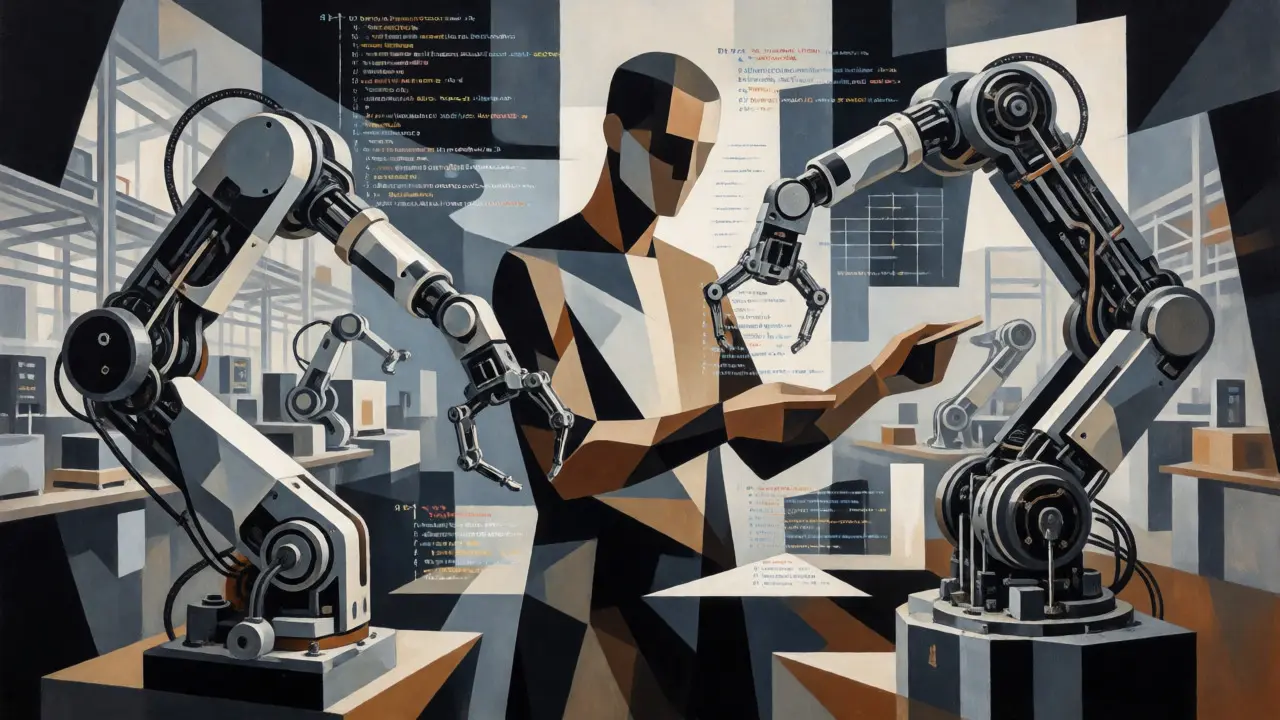
The final frontier isn’t just software; it’s hardware. Deloitte’s latest trends highlight "AI going physical," with robotics development growing at 47% annually. AI-assisted development is bridging the gap between digital code and physical action. Imagine training a robot arm not by writing low-level C++ drivers, but by describing its movement in natural language, letting the AI translate that into motor control signals.
This convergence means developers will increasingly work alongside roboticists. Your IDE might soon show you a simulation of the physical outcome of your code changes in real-time. If you change a timing parameter, you see the robot’s joint move differently. It’s a radical departure from static text editors, turning coding into a visual, interactive design process.
Frequently Asked Questions
Will AI replace software developers entirely?
No, but it will replace developers who don't use AI. Current data shows AI handles routine coding and debugging, reducing time spent on these tasks by up to 60%. However, complex architecture, system design, and understanding business context remain human strengths. Developers are evolving into 'AI Orchestrators' who guide agents rather than writing every line manually.
Which programming languages benefit most from AI assistance?
JavaScript and Python currently see the highest satisfaction rates (4.6/5) due to their vast training data and widespread usage. Conversely, C++ and Rust developers report lower effectiveness (3.2/5) because these languages require strict memory management and type safety that current models sometimes struggle to maintain perfectly without heavy human review.
How much does AI-assisted development cost for enterprises?
Costs vary widely. Enterprise-grade platforms like IBM WatsonX Developer average $125/user/month with minimum commitments. Open-source options like Meta's LlamaCoder are free for core use but may incur support costs around $85/user/month. Specialized vertical solutions can exceed $200/user/month. Remember to budget for training (40-60 hours per dev) and governance teams, which add significant indirect costs.
Is AI-generated code secure?
It depends on the context. AI can introduce subtle vulnerabilities or hallucinate insecure libraries. Security concerns are cited by 68% of enterprises as a major implementation challenge. Best practices involve integrating AI tools directly into CI/CD pipelines with automated security scanning. Never trust AI code blindly; always treat it as a first draft requiring peer review and automated testing.
What skills should developers learn to stay relevant?
Focus on three areas: Prompt Engineering (learning how to effectively communicate with AI), System Architecture (understanding how components fit together), and Domain Expertise (knowing the business logic). Soft skills like critical thinking and ethical judgment are also vital, as you become the final gatekeeper for AI outputs.
Chandan Singh
September 7, 2026 AT 07:54The assertion that specialized models outperform generalists is technically accurate but ignores the maintenance overhead. Fine-tuning domain-specific foundation models requires significant data engineering resources which many mid-sized firms lack. Furthermore, the claim about edge AI reducing latency to under 100ms assumes ideal hardware conditions which are rarely present in legacy enterprise environments.
Regarding the EU AI Act compliance mentioned, the article understates the legal liability for 'black box' decisions in safety-critical systems. Verification protocols are not merely additional checks; they constitute a fundamental shift in development lifecycle management.
Elizabeth Brooks
September 9, 2026 AT 06:37Hey everyone! Just wanted to add a quick tip here since I've been experimenting with LlamaCoder 3.0 lately. If you're struggling with the integration ease mentioned in the table (that 76% CI/CD compat), try using a wrapper script to normalize the output formats before pushing to your pipeline. It saved me hours of debugging yaml files last week!! Also, don't sleep on the prompt engineering aspect, it's literally the new syntax.
I know some folks are skeptical about the cost savings, but when you factor in the reduced time spent on boilerplate code, the ROI is actually pretty solid even if you have to pay for support tiers. We started small with just two devs and now our whole team is onboarded. Its wild how fast this stuff moves.
Brannen Hall
September 10, 2026 AT 06:28This is just another hype cycle disguised as analysis. The "death of latency" narrative is marketing fluff designed to sell more local GPUs. Cloud response times have already improved significantly, making the jump to edge AI unnecessary for most standard web apps. You are paying for privacy theater while introducing new complexity into deployment pipelines that were finally becoming stable.
Also, the salary figures for prompt engineers seem inflated to justify the training costs companies are trying to offload onto employees. Most of these "AI Orchestrators" are just senior devs who learned to use Copilot better than their juniors. The architectural decisions haven't changed, only the tools have. Stop pretending this is a revolution when it's just an iteration.
Sabrina Newland
September 11, 2026 AT 12:23it feels like we are losing the soul of coding 🥺
when i think about agents writing my tests and fixing bugs automatically... does that mean we stop understanding what we built? 🤔
i worry about the philosophical implications of handing over logic to black boxes. if we dont understand the why behind the code, are we still developers or just supervisors of robots? 🤖
maybe its good for efficiency but bad for craftmanship. idk maybe im just being dramatic but it feels heavy. 💭
Art HND
September 11, 2026 AT 22:20Agentic workflows are overrated for anything beyond CRUD apps. Ambiguity kills them. Stick to simple tasks.
Amara Akbar
September 13, 2026 AT 18:26It is wonderful to see such a comprehensive overview of the current landscape. For those feeling overwhelmed by the rapid changes, please remember that proficiency is a journey, not a destination. Taking the time to learn how to effectively communicate with these tools is a valuable investment in your career longevity. Do not hesitate to lean on your peers and governance teams for support during this transition period. You are doing great work adapting to these new paradigms.
alex kobri
September 14, 2026 AT 06:16there is something unsettling about the idea of physical ai bridging digital code and motor control signals
we used to write code that ran in a sandbox now we write code that moves things in the real world
the responsibility shifts from debugging a variable to debugging a robotic arm that might hit someone
its fascinating but also terrifying how much trust we place in these translations between language and physics
i wonder if the governance teams will keep up with the speed of physical innovation
maybe we need ethical frameworks for robotics that match the depth of software security standards
or perhaps we are moving too fast without fully understanding the consequences of automated physical action
its a big leap from text editors to interactive design processes involving real world feedback loops
and yet the convenience is undeniable for developers who hate low level driver writing
balance is key here between automation and human oversight in physical spaces
Brenna Gonedrman
September 14, 2026 AT 20:36OMG THE SALARIES ARE INSANE!!! $195k for prompting?? That is absolutely mind-blowing money for asking questions to a computer!! I am literally shaking right now because I thought I was underpaid but this makes me feel like I need to retrain immediately!!! This trend is going to change EVERYTHING for junior devs who are scared of being replaced. It is so exciting and scary at the same time!! I can't believe how fast this industry is moving it is honestly overwhelming but in a good way???
Mark Harvey
September 15, 2026 AT 15:05totally agree with the sentiment about flow state
once you get past the initial learning curve the speed boost is real
dont let the fear of missing out push you into tools that dont fit your stack
start small pick one project and see how it goes
you got this
Deb Kortyna, MBA
September 17, 2026 AT 01:46One must consider the profound implications of this technological shift upon the traditional hierarchy of software engineering roles. The emergence of AI Governance Teams represents a necessary evolution in corporate structure, ensuring that ethical considerations are not merely afterthoughts but integral components of the development lifecycle. Furthermore, the regulatory pressures exerted by the EU AI Act serve as a critical reminder that innovation cannot proceed without rigorous accountability and transparency. As we stand on the precipice of this new era, it is imperative that professionals approach these advancements with both enthusiasm and cautious deliberation, recognizing that the human element remains the ultimate arbiter of quality and intent.