Generative AI is moving fast. Faster than most of us can keep up with, let alone regulate. You’ve seen the headlines about deepfakes, copyright lawsuits, and algorithms that hallucinate facts. But behind the noise, a quieter, more critical conversation is happening in boardrooms and labs worldwide. It’s not just about what AI *can* do anymore; it’s about how we make sure it does so responsibly.
This is where AI ethics frameworks come in. They are the guardrails for the digital highway. Without them, you’re driving blindfolded at high speed. With them, you have a map, a set of rules, and a way to handle accidents when they happen. This article breaks down exactly what these frameworks are, which ones matter right now, and how you can actually put them into practice without getting bogged down in bureaucracy.
What is an AI ethics framework?
An AI ethics framework is a structured set of principles, policies, and technical standards designed to ensure artificial intelligence systems operate in ways that align with human values, rights, and societal norms. For generative AI, this means addressing specific risks like bias, misinformation, and intellectual property violations through measurable controls rather than vague promises.
The Core Principles: More Than Just Buzzwords
When people talk about "ethical AI," they often throw around words like fairness, transparency, and accountability. That’s fine for a press release. It’s useless for an engineer trying to code a model. Effective frameworks translate these abstract values into concrete requirements.
Take the OECD AI Principles, updated in June 2024. They don’t just say "be fair." They mandate human-centered values and inclusive growth. In practice, this means your generative AI system must be tested for disparate impact across demographic groups. If your hiring bot rejects women at a higher rate than men, it fails the principle. The Harvard Data Science Institute (DCE) takes this further, suggesting algorithmic fairness metrics should show less than 5% disparate impact. That’s a number you can test against.
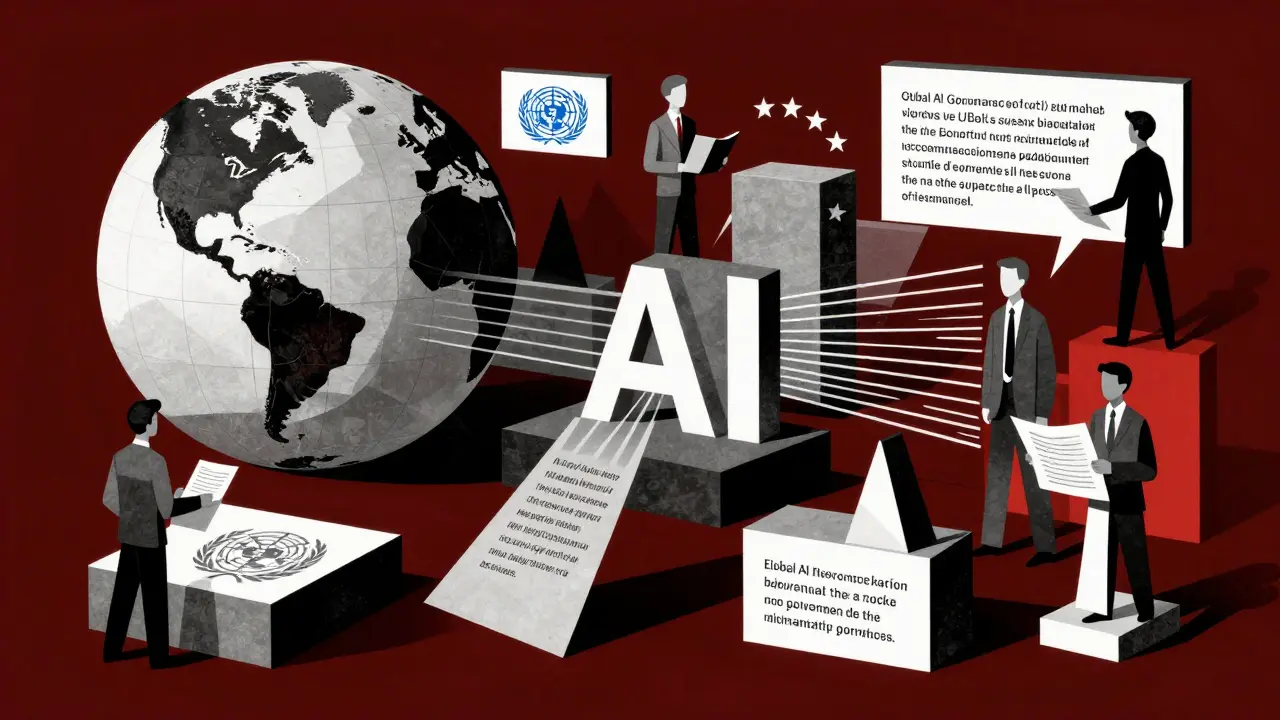
Another pillar is transparency. UNESCO’s Recommendation on the Ethics of Artificial Intelligence, adopted by 193 member states in 2021, emphasizes proportionality and doing no harm. For generative AI, this translates to provenance tracking. Can you trace where the training data came from? Can you tell if an image was generated by AI? The OECD’s 2024 update specifically calls for this. It’s not enough to say the output is "original." You need to document the lineage.
Then there’s accountability. Who is responsible when the AI messes up? The developer? The user? The company deploying it? Frameworks like Microsoft’s Responsible AI Standard v3.0 require human oversight for all high-stakes decisions. If an AI diagnoses a disease or approves a loan, a human must verify it. This isn’t just a nice-to-have; it’s a legal shield and a moral imperative.
Major Frameworks Compared: Which One Fits Your Needs?
Not all frameworks are created equal. Some are global treaties, others are corporate policies, and some are academic guidelines. Choosing the wrong one can lead to compliance gaps or wasted resources. Here’s how the big players stack up.
| Framework | Scope & Reach | Enforceability | Key Strength | Main Weakness |
|---|---|---|---|---|
| OECD AI Principles | 52 countries (as of June 2024) | Voluntary policy coordination | Strong international alignment | Lack of binding enforcement (only 22% of adherents have concrete regulations) |
| UNESCO Recommendation | 193 member states | Global standard-setting | Broadest global consensus | Implementation challenges (only 47 countries have dedicated regulatory bodies) |
| EU AI Act | European Union | Legally binding (effective Aug 2026) | Strict penalties (up to 7% of global revenue) | Complexity and cost for startups (25-40% increase in dev costs) |
| NIST GRMF | United States (technical guidance) | Voluntary but industry-standard | Detailed technical specs for foundation models | Newer framework, less mature ecosystem |
| Microsoft Responsible AI Standard v3.0 | Internal corporate use | Internal enforcement | Specific technical metrics (e.g., <3% false positive differential) | Not applicable outside Microsoft |
If you’re a multinational corporation, you likely need to comply with the EU AI Act while also aligning with OECD principles for global consistency. If you’re a startup, the NIST Generative AI Risk Management Framework (GRMF), released in February 2025, offers practical, technical steps without the immediate threat of massive fines. However, be aware that 78% of current generative AI ethics policies lack specific provisions for large language model training data provenance, according to Stanford HAI’s 2025 report. This is a gap you’ll need to fill yourself.
From Policy to Practice: Implementing Ethical AI
Having a framework on paper is easy. Living it is hard. McKinsey’s State of AI 2025 survey found that while 55% of Fortune 500 companies have AI ethics review boards, only 38% fully implement ethical AI practices. Why the gap? Usually, it’s because ethics becomes a checkbox exercise rather than a core part of the development lifecycle.
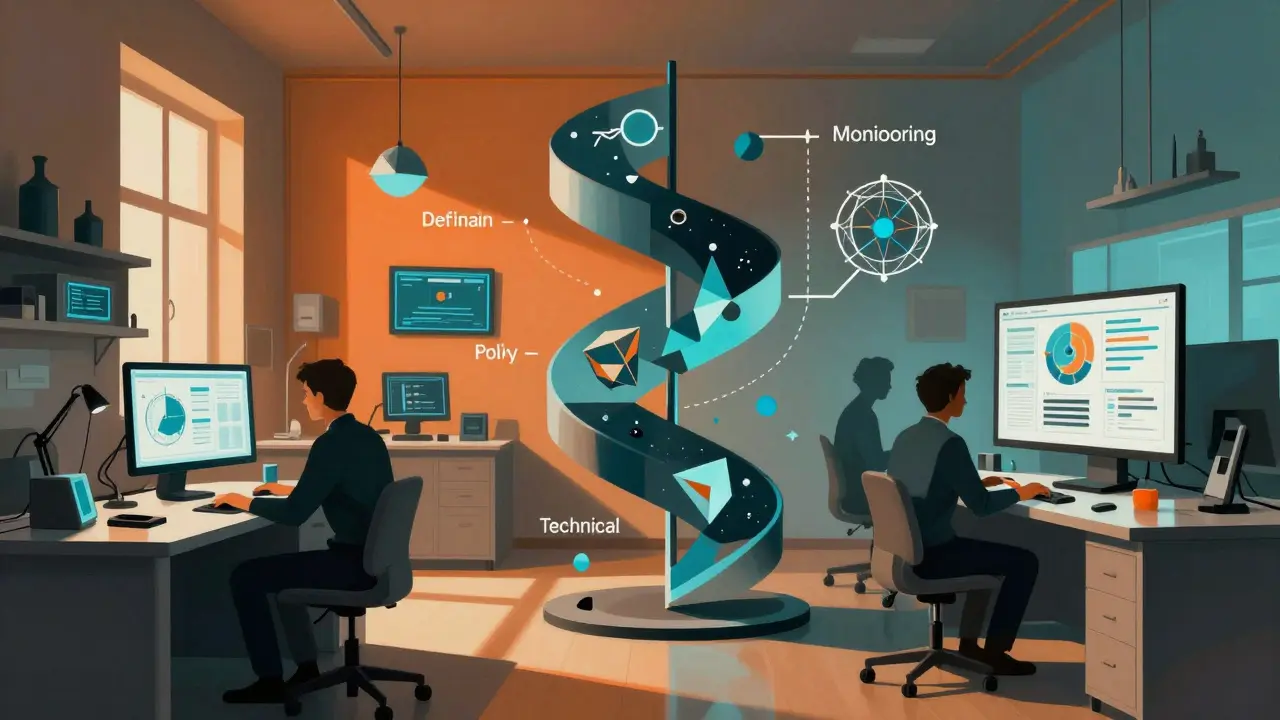
To bridge this gap, organizations need a four-stage process:
- Principle Definition (2-4 months): Form a cross-functional team including data scientists, ethicists, legal experts, and domain specialists. Don’t just copy-paste from another company. Define what "fairness" and "transparency" mean for your specific use case.
- Policy Development (3-6 months): Translate principles into actionable policies. For example, if privacy is a priority, mandate differential privacy with epsilon values ≤ 0.5, as suggested by Harvard DCE. If security is key, require adversarial testing against at least 10 known attack vectors.
- Technical Implementation (4-8 months): Integrate checks into your CI/CD pipeline. Use tools like the Canadian government’s Algorithmic Impact Assessment Toolkit. Automate bias testing across 15 demographic dimensions, aiming for false positive rate differentials below 3%, similar to Microsoft’s standards.
- Continuous Monitoring (Ongoing): Ethics isn’t a one-time fix. Set up quarterly review cycles. Dr. David Impink of Harvard DCE notes that governance mechanisms are more valuable than static frameworks. Establish technical boards that can adapt guidelines as technology evolves.
A critical success factor is leadership buy-in. Only 18% of AI ethics roles report directly to the CEO, limiting their influence. Organizations with dedicated Chief AI Ethics Officers are 4.2x more likely to succeed. Make sure your ethics team has a seat at the table, not just a footnote in the org chart.
Common Pitfalls and How to Avoid Them
Even well-intentioned efforts can fail. Here are the most common traps:
- Ethics Washing: Creating a flashy website page about ethics while ignoring internal practices. Professor Jessica Fjeld warns that without standardized measurement metrics, frameworks risk becoming mere PR stunts. Counter this by publishing annual transparency reports with real data on bias incidents and mitigation efforts.
- Inadequate Resources: ISO/IEC 24027:2023 cites insufficient staffing as the cause of 42% of framework failures. You can’t outsource ethics to one overworked employee. Allocate budget for training (15-20 hours annually per employee, per Microsoft) and hire specialized roles.
- Ignoring Environmental Impact: Dr. Timnit Gebru highlights that training a single LLM can consume 1,300 megawatt-hours of electricity and 700,000 liters of water. Most frameworks overlook this. Include carbon footprint assessments in your impact evaluations.
- Siloed Governance: 68% of organizations maintain separate AI ethics committees rather than integrating with existing risk management functions. This creates friction. Embed ethics into your overall risk and compliance strategy.
The Future of AI Ethics: Standardization and Certification
We’re moving from voluntary guidelines to mandatory standards. The EU AI Act, effective August 2026, sets a precedent with its strict liability regimes. Meanwhile, ISO is developing standard ISO/IEC 42001 for AI management systems, expected to finalize in Q3 2026. This will likely become the gold standard for certification, similar to ISO 27001 for cybersecurity.
Expect to see the rise of AI audit firms specializing in ethical compliance verification. Just as you hire auditors for financial statements, you’ll soon hire them to verify your AI’s fairness and transparency. The Partnership on AI’s 2025 Maturity Index shows 67% of organizations are already shifting from principle-based to practice-oriented frameworks, focusing on measurable outcomes.
For developers and businesses, the message is clear: ethics is no longer optional. It’s a competitive advantage. Companies that get it right build trust, avoid regulatory fines, and create better products. Those that ignore it risk reputational damage and legal liability. Start small, measure rigorously, and scale responsibly.
How long does it take to implement an AI ethics framework?
According to Harvard DCE's 2025 benchmarking study, organizations typically require 6-18 months to establish mature AI ethics frameworks. This includes 2-4 months for principle definition, 3-6 months for policy development, 4-8 months for technical implementation, and ongoing continuous monitoring.
What are the biggest challenges in implementing AI ethics?
The top challenges include inadequate staffing (cited in 42% of failures), lack of executive buy-in (37%), and poor integration with existing governance structures (68%). Additionally, many frameworks fail to address foundation model risks, with 78% lacking specific provisions for training data provenance.
Is the EU AI Act enforceable?
Yes, the EU AI Act is legally binding and becomes fully effective in August 2026. It imposes strict conformity assessments for high-risk AI systems and allows for fines up to 7% of global annual revenue for violations, making it one of the most powerful regulatory tools available.
What role do humans play in ethical AI systems?
Human oversight is critical. Frameworks like Microsoft's Responsible AI Standard require human-in-the-loop verification for all high-stakes decisions. This ensures that AI outputs are reviewed by qualified professionals before impacting individuals, reducing errors and maintaining accountability.
How can small businesses afford AI ethics compliance?
Small businesses can leverage voluntary frameworks like the NIST GRMF, which provides detailed technical specifications without immediate legal penalties. They can also adopt open-source tools for bias testing and impact assessment, and focus on high-risk areas first rather than attempting full-scale implementation overnight.