| Approach | Primary Method | Key Strength | Typical Use Case |
|---|---|---|---|
| Supervised Fine-Tuning (SFT) | Translated Instructions | Quick to implement | High-resource languages |
| X-CIT | Phased Learning (Principles $\rightarrow$ Parameters) | Mimics human acquisition | Complex instruction following |
| CrossAlpaca | Translation-following demos | Strong semantic alignment | Question Answering (QA) |
| Modular Merging | Layer-Swapping / Expert Models | Prevents catastrophic forgetting | Low-resource / Specialized tasks |
The Human Approach: Emulating Second Language Acquisition
Why do some models feel "robotic" in non-English languages? It's often because they've been forced to learn everything at once. Recent breakthroughs, specifically X-CIT (Cross-Lingual Continued Instruction Tuning), suggest we should treat AI more like humans learning a second language. Based on the Principles and Parameters Theory, X-CIT breaks the process into two distinct phases. First, the model undergoes training on English instruction data. This establishes the "principles"-the core logic, reasoning, and ability to follow instructions. Once the model is "smart" in English, it moves to the target language. In this second phase, it uses translated parallel data and customized chat-instructions. Interestingly, the model is guided to think in its native (English) language before transitioning the final response to the target language. This prevents the model from losing its reasoning capabilities while it struggles with new vocabulary. To make this even more effective, X-CIT uses Self-Paced Learning (SPL). This is a fancy way of saying the model starts with easy tasks and gradually moves to harder ones. When researchers tested this on Llama-2-7B across five languages, they saw a measurable jump in quality-specifically an 8.2% improvement in LLM-as-a-judge benchmarks over standard baselines.Solving the Semantic Gap with Alignment
One of the biggest headaches in this field is the "semantic gap." Just because you translated "What is the capital of France?" into Japanese doesn't mean the model understands the *intent* of the question in the same way. This is where CrossAlpaca changes the game. Instead of just giving the model a translated question and answer, CrossAlpaca uses translation-following demonstrations. These demonstrations explicitly show the model how to maintain semantic alignment between the source and target languages. By training on multilingual benchmarks like XQUAD and MLQA, it was proven that simply tuning on non-English data isn't enough. You need that explicit bridge-the demonstration of how a concept in English maps to a concept in another language-to avoid hallucinations and vague answers.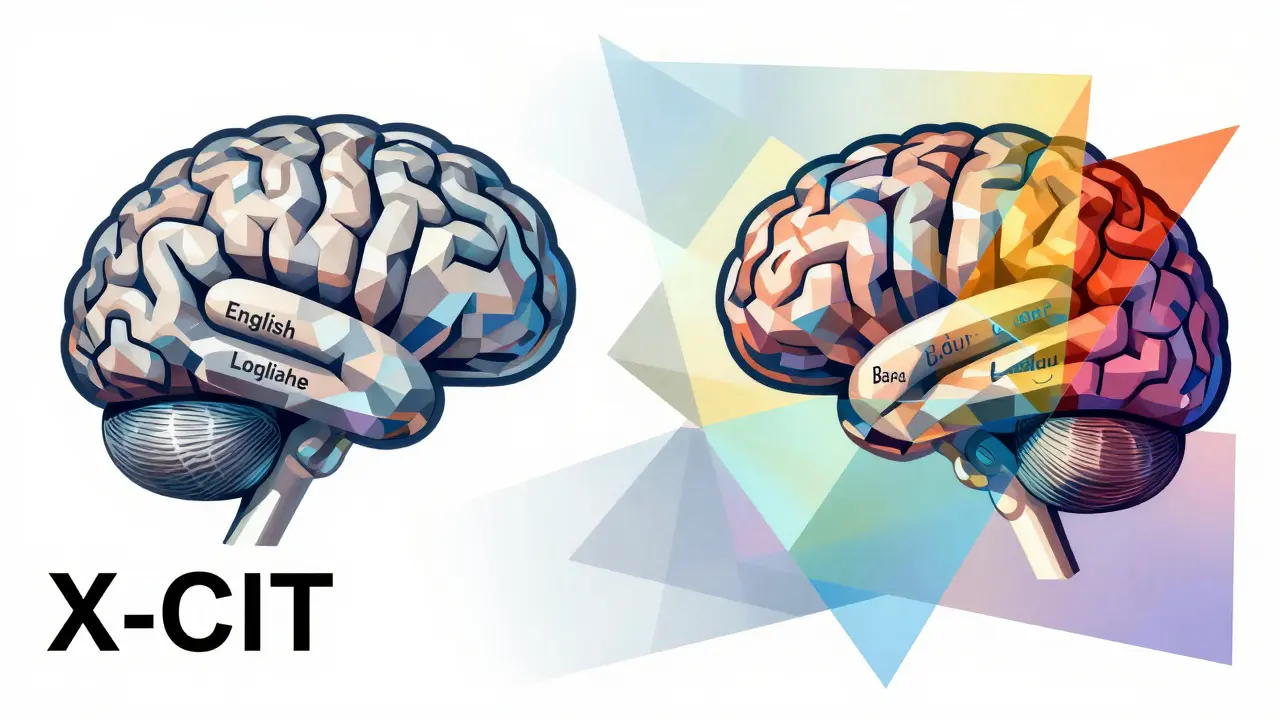
Modular Training for Low-Resource Languages
What happens when you don't have thousands of translated examples? If you're working with a language that has very little digital presence, full fine-tuning often fails because the model "forgets" its general knowledge (catastrophic forgetting) or simply overfits to the tiny dataset. Researchers have found a workaround by using modular frameworks. The secret is that the parts of a model used for mathematical reasoning and the parts used for linguistic fluency don't really overlap. By freezing certain parameters or using LoRA (Low-Rank Adaptation), developers can create separate "experts"-one for language and one for the specific task (like math). The most successful method here is a process called Layer-Swapping. Instead of just freezing layers, developers fine-tune separate experts and then merge them. In many cases, it's actually better to revert some of the fine-tuning updates after training rather than freezing them from the start. This gives the model the flexibility to keep its global knowledge while specializing in a niche language.Handling the Chaos of Code-Switching
In the real world, people rarely speak one language in a vacuum. In bilingual communities-like those in India-speakers frequently engage in code-switching, where they jump between English and a local language in a single sentence. For a standard LLM, this is a nightmare. Fine-tuning for code-switched contexts requires a different set of tools. At the RESOURCEFUL-2025 workshop, researchers introduced the S-index (Switching-Index) to quantify exactly how much code-switching is happening in a piece of text. By training models on specific combinations of Indian languages and English, they found that models could actually generalize to language pairs they hadn't seen during training, provided the underlying cross-lingual framework was strong enough. This is critical for building AI that feels natural to people who don't stick to a single dictionary.
From Natural Language to Multilingual Code
We are now seeing these techniques bleed into a new domain: code generation. Programming languages like Python or Java are essentially a global lingua franca, but the *comments* and *documentation* surrounding that code are often in natural languages. Cross-lingual fine-tuning is being used to help developers who think in their native language but need to generate high-quality code. By adapting LLMs to understand a prompt in, say, Vietnamese, and then translate that intent into an efficient C++ function, companies are seeing a huge jump in enterprise coding efficiency. It removes the "English tax" that developers in non-English speaking countries have had to pay for decades.Why can't we just translate the training data and call it a day?
Translation is only the first step. Simple translation often misses cultural nuance and the specific way instructions are phrased in different languages. Without techniques like X-CIT or semantic alignment, the model might know the words but fail to follow the intent, leading to responses that are grammatically correct but logically flawed.
What is the difference between Llama-2-7B and a fully multilingual model?
Llama-2-7B is a foundation model that is heavily weighted toward English. A fully multilingual model is either pre-trained on a balanced global dataset or, as in the case of cross-lingual fine-tuning, adapted after the fact to gain proficiency in new languages without losing the reasoning capabilities developed during English pre-training.
Does cross-lingual fine-tuning work for very rare languages?
It is much harder. For low-resource languages, modular approaches like Layer-Swapping and LoRA are preferred. These methods allow the model to lean on its existing knowledge of similar languages (cross-lingual transfer) rather than relying solely on a small amount of target-language data.
What is a "LLM-as-a-judge" benchmark?
Instead of checking if a model's answer exactly matches a gold-standard string (objective benchmark), a stronger model (like GPT-4) is used to grade the response based on nuance, helpfulness, and accuracy. This is often more reliable for evaluating the "feel" and fluency of a translated response.
How does the S-index help in training?
The S-index measures the frequency and complexity of language switches in a sentence. By using this metric, researchers can create balanced training sets that expose the model to varying levels of code-switching, ensuring it doesn't get confused when a user mixes two languages in a natural conversation.
Next Steps for Implementation
If you are looking to adapt a model for your own project, the path you take depends on your data:- High-resource data: Use X-CIT. Focus on a phased approach-English first, then target language with a mix of parallel and chat-instruction data.
- Medium-resource data: Implement CrossAlpaca-style demonstrations. Focus on semantic alignment by showing the model exactly how a concept moves from English to the target language.
- Low-resource data: Go modular. Use LoRA to train a language expert and then use model merging or Layer-Swapping to integrate it with a task expert (like a math or coding specialist).
Teja kumar Baliga
April 12, 2026 AT 13:04The part about code-switching in India is spot on! Most of us naturally mix English with Hindi or Tamil, and seeing AI actually handle the S-index is a huge win for accessibility.
k arnold
April 13, 2026 AT 14:53Oh wow, a table. How revolutionary. I'm sure the 'English tax' is the biggest tragedy of the century lol.
Zelda Breach
April 15, 2026 AT 04:23It's amusing that people think 'modular frameworks' are some secret sauce when it's basically just basic weight manipulation. Also, the phrase 'bleeding into a new domain' is a tired cliché that makes this read like a middle-schooler's essay. Absolute garbage.
Alan Crierie
April 16, 2026 AT 17:59I really appreciate the breakdown of the different resource levels! It makes the complex topic feel much more approachable for beginners. Keep sharing this kind of knowledge! 🌟🚀
Fredda Freyer
April 17, 2026 AT 02:50The concept of mimicking second language acquisition is where the real philosophical gold lies here.
If we treat the model's intelligence as a set of universal principles that are merely 'clothed' in different linguistic parameters, we're essentially arguing that reasoning is independent of language. This mirrors the Sapir-Whorf hypothesis but in reverse, suggesting a core cognitive structure that precedes the vocabulary. The X-CIT method isn't just a technical optimization; it's a statement on the nature of thought itself. By separating the 'logic phase' from the 'fluency phase,' we are acknowledging that knowing *how* to think is distinct from knowing *how* to speak. This has massive implications for how we define AGI. If a model can reason in English and then simply map that reason to Vietnamese, it proves that the 'intelligence' is an abstract layer. We should consider if this is how the human brain actually handles translation in real-time or if we are just creating a synthetic version of bilingualism. The use of a 'bridge' in CrossAlpaca further emphasizes this need for semantic alignment over literal translation. It's a fascinating intersection of linguistics and computer science. We're essentially building a digital Rosetta Stone that doesn't just translate words, but translates the very intent of human consciousness across cultural divides. I wonder if the 'semantic gap' mentioned is actually a cultural gap that no amount of fine-tuning can truly bridge.
Gareth Hobbs
April 18, 2026 AT 22:32Just another way for them to control how we speak...!! This 'S-index' is probly just a tool for the globallists to monitor our native tongues...!!! Totally fake news that Llama-2 is the standard when they're hideing the real data from us!!!! Wake up peopul!!!!
Nicholas Zeitler
April 19, 2026 AT 06:57This is such a great guide!!! Really helps clarify the modular approach!!! Keep up the amazing work!!!!