When you type a simple request like "Build me a login page that connects to Stripe" and get a working app in 30 seconds, it feels like magic. But behind that magic is a bill-sometimes a big one. Vibe coding, the new way developers and non-coders alike are building software using AI prompts instead of writing code line by line, is changing how companies spend money on tech. It’s not just about speed anymore. It’s about chargebacks, unexpected spikes, and budgets that vanish before anyone notices.
What Is Vibe Coding, Really?
Vibe coding isn’t just another AI tool. It’s a mindset. Coined by OpenAI co-founder Andrej Karpathy in early 2025, the term describes developers letting go of traditional coding and trusting AI to generate entire applications from plain language. Platforms like Cursor, Lovable, Replit, and Vercel let you skip the IDE, the debugging sessions, and even the deployment scripts. You say what you want. The AI builds it.
But here’s the catch: every time you ask for something complex-like integrating a payment system, generating a backend API, or connecting to a database-the AI doesn’t just "think" for a second. It runs heavy models on expensive GPUs. These aren’t cheap. And unlike hiring a developer, where you pay a fixed salary, with vibe coding, you pay per token, per query, per minute of processing.
The Cost Shift: From Salaries to Usage
Traditional software development is front-loaded. You hire three developers at $120,000 a year each. You pay for office space, tools, meetings, onboarding. It’s predictable. Expensive, but predictable.
Vibe coding flips that. There’s no salary. Instead, you pay for usage. A single complex prompt can burn through hundreds of dollars’ worth of AI compute in seconds. J.P. Morgan’s November 2025 report calls this the "biggest economic shift in software since cloud computing." One founder reduced a $500,000 project to $1,000 in initial testing. Sounds great-until the next sprint hits and your bill jumps to $3,200 because someone tried to generate a full CRM system in one go.
That’s the chargeback problem. Finance teams don’t see it coming. No one told them the "free trial" on Cursor’s Business plan doesn’t cap usage. No one warned them that "multi-step reasoning" can use 5 to 10 times more tokens than a simple request. And when the bill arrives, it’s not in the software budget. It’s in marketing. Or operations. Or worse-personal credit cards.
How Platforms Are Priced (And Why It’s Confusing)
Let’s break down the top players:
- Cursor: $20/month for Pro, $40/month for Business. Sounds simple. But the fine print? You’re paying for access to models from OpenAI, Anthropic, and Google. Each time you generate code, you’re consuming compute credits. A single complex feature can cost $15 in AI usage alone.
- Lovable: Hit $100 million ARR in eight months. Their pricing is similar, but they don’t show usage breakdowns. Users report surprise charges after holiday sprints.
- Replit: $20/month plan replaced $12,000/month in freelance costs for one TechLead. But their new Budget Guardian tool, launched in November 2025, is the first real attempt to fix the problem.
- Vercel: Integrates vibe coding into its hosting platform. Their cost calculator is the best in the industry. You can predict your monthly spend within 5% accuracy.
- Rocket.new: A new enterprise player backed by Salesforce Ventures. Targets companies with $2,000-$8,000 annual budgets. Built specifically for compliance-heavy industries. Includes usage caps, approval workflows, and audit logs.
The problem isn’t the price. It’s the opacity. Most platforms don’t show you how much each prompt costs in real time. You don’t know if you’re spending $2 or $200 on a single request until the bill arrives.
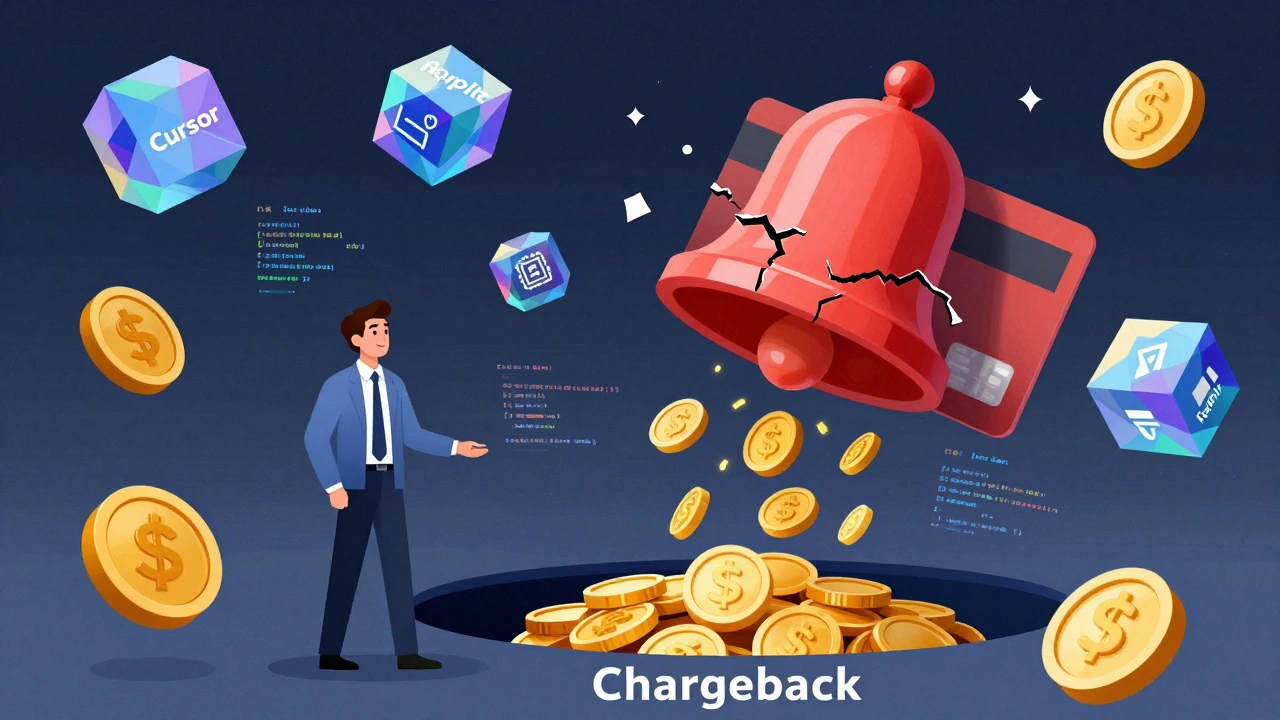
Chargebacks Are the #1 Complaint
Trustpilot data from December 2025 shows 32% of negative reviews for vibe coding platforms cite "lack of spending controls" as the top issue. Reddit threads are full of stories:
- A startup founder accidentally triggered 87 AI-generated backend services in one afternoon. Bill: $4,100.
- A marketing team used Lovable to build a landing page generator. It worked too well. 1,200 pages generated. Bill: $2,800.
- An e-commerce company hit $2 million in ARR in two weeks. But their initial budget overrun? 178%.
These aren’t edge cases. They’re the norm. And finance teams are furious. No one wants to explain why the Q4 tech budget is already spent because someone "just wanted to see if the AI could build a dashboard."
How to Build a Real Budget for Vibe Coding
If you’re going to use vibe coding, you need a budgeting system. Not a guess. Not a hope. A real plan.
- Track usage by user. Don’t just look at total spend. See who’s generating what. Replit’s Budget Guardian shows per-user spending in real time.
- Set hard caps. Limit each team to $200/month. If they need more, they file a request. This forces intentionality.
- Use predictive tools. Vercel’s upcoming v0.3 release (Dec 15, 2025) will forecast your next month’s bill based on historical usage. Use it.
- Separate budgets by use case. Prototype? One bucket. Customer-facing features? Another. Internal tools? Third. Don’t mix them.
- Train finance teams. Most CFOs don’t know what a "token" is. Give them a 2-hour crash course. Show them how a prompt like "build me a real-time inventory tracker with alerts" can cost 10x more than "create a button that says 'Buy Now'."
And here’s the hard truth: if you don’t do this, you’ll keep getting burned. The AI doesn’t care about your budget. It just keeps generating.

Enterprise Adoption Is Slow-And That’s Good
Only 12% of Fortune 500 companies have formal vibe coding budgets as of November 2025, according to Gartner. That’s not because they’re behind. It’s because they’re cautious. They’ve seen this before.
Remember when everyone started using Slack without IT approval? Or when marketing bought SaaS tools on corporate cards? Chaos followed. Now, most big companies have governance policies for every tool. Vibe coding is the next wave.
Companies like Rocket.new are building solutions for this. They offer SSO, SOC 2 compliance, audit trails, and approval workflows. They’re not trying to replace developers. They’re trying to make vibe coding safe for enterprise use.
By 2027, Gartner predicts 65% of enterprise software projects will use a hybrid model: vibe coding for rapid prototyping and front-end work, traditional teams for core systems, security, and scaling.
What’s Next?
Cursor just announced it’s spending 30% of its $2.3 billion funding round to improve its own AI model-specifically to cut token usage. That’s a sign the industry knows the problem is real. If they can reduce compute costs by 40%, margins improve. Prices drop. Adoption explodes.
But until then, the burden falls on you. If you’re using vibe coding, you’re not just a developer. You’re a financial manager. You’re responsible for the budget. You’re the one who has to say "no" to that "quick experiment."
Don’t wait for the chargeback. Set up your guardrails now. Track usage. Cap spending. Educate your team. The future of coding is here. But the future of budgeting? That’s still up to you.
Why do vibe coding platforms charge so much for simple requests?
They don’t charge for the request-they charge for the AI compute behind it. Even a simple prompt like "create a login form" might trigger a multi-step process: generating HTML, CSS, JavaScript, connecting to a database, setting up authentication. Each step uses GPU time. And GPU time is expensive. Platforms like Cursor and Lovable don’t reveal these costs upfront because they’re based on real-time usage of OpenAI, Anthropic, and Google models-which fluctuate in price.
Can I avoid chargebacks with free-tier vibe coding tools?
Free tiers often have usage limits, but they’re not foolproof. Many platforms throttle performance instead of blocking usage, so you might get slow responses or incomplete code. Worse, some free plans auto-upgrade to paid after a certain number of requests. If your team doesn’t know the limits, you’ll still get surprise bills. Always check the fine print and monitor usage.
Is vibe coding cheaper than hiring developers?
For rapid prototyping and simple apps, yes. One founder replaced a $12,000/month freelance team with a $20/month Replit plan. But for complex, scalable, secure systems? No. Vibe coding can’t yet handle enterprise-grade security, long-term maintenance, or compliance audits. The real savings come from using vibe coding for MVPs and front-end work, then handing off to traditional teams for scaling.
What’s the best way to track vibe coding spending?
Use tools that show real-time usage. Replit’s Budget Guardian, Vercel’s cost calculator, and Rocket.new’s audit logs are the only ones that give you visibility. Avoid platforms that hide usage behind vague "monthly plans." You need to see how many tokens each user consumes per day. Set alerts at 70% of your budget. And never let finance teams work blind.
Will vibe coding replace software developers?
No. It’s replacing junior developers for basic tasks and speeding up prototyping. But complex systems still need human oversight. Security, scalability, integration with legacy systems, and long-term maintenance require deep expertise. The future isn’t AI vs. developers-it’s AI as a co-pilot for developers. Teams that learn to use vibe coding well will outpace those who don’t.
Next Steps: What to Do Today
- If you’re using vibe coding: log into your platform and check your last month’s usage. Find the top 3 most expensive prompts.
- If you’re managing a team: set a $100-$200 monthly cap per person. Require approval for anything over $500.
- If you’re in finance: ask your tech team for a 15-minute demo of how vibe coding works. Ask how much a single complex request costs.
- If you’re evaluating platforms: choose ones with spending controls. Don’t pick based on features alone. Pick based on budget safety.
The tools are powerful. The potential is huge. But without budget discipline, vibe coding will cost you more than it saves.
Tina van Schelt
December 14, 2025 AT 04:24Okay but have y’all seen the bill from Cursor after a Friday afternoon ‘quick prototype’? I thought I was just making a login page. Turns out I accidentally spawned 12 microservices, a chatbot, and a fake Stripe webhook that sent $300 in test payments to my cat’s PayPal. 🐱💸
Ronak Khandelwal
December 15, 2025 AT 15:32Life’s funny, right? We used to hire devs to build things. Now we hire AI to build things… and then we hire accountants to explain why the budget’s gone. 💭 But here’s the truth - it’s not about cost. It’s about *intention*. Are we using this to create… or just to distract ourselves from thinking deeply? 🌱
Jeff Napier
December 16, 2025 AT 08:34Sibusiso Ernest Masilela
December 16, 2025 AT 17:43You call this a ‘budgeting problem’? Please. You’re not a developer. You’re a glorified prompt monkey who doesn’t even know what a semicolon does. Real engineers write code. Not ‘requests’. You think Replit’s ‘Budget Guardian’ is going to save you? It’s a Band-Aid on a hemorrhage. Your entire workflow is a joke. And now you want a *crash course* for CFOs? Pathetic.
Daniel Kennedy
December 17, 2025 AT 18:15I get the frustration - I’ve been there. But let’s not throw the baby out with the bathwater. Vibe coding isn’t the enemy. Lack of awareness is. I run a small dev team, and we set up a Slack bot that auto-posts usage stats every morning. $50 cap per person. If someone hits it, they write a 2-sentence explanation. It’s not perfect, but it’s human. And it’s saved us $18k in 3 months. You don’t need corporate tools - you need culture.
Taylor Hayes
December 19, 2025 AT 00:22Just wanted to say thank you for writing this. I’m a product manager in a non-tech company, and I had no idea how dangerous this could be. My team started using Cursor last week - I didn’t even know it charged per token. I just thought it was ‘like ChatGPT but for code.’ Now I’m scheduling a 15-min demo with our finance lead. You’re right - we’re not just coders anymore. We’re stewards. And that’s okay. It’s actually kind of beautiful.
Sanjay Mittal
December 20, 2025 AT 14:10From India: We use Replit for student projects. $20/month plan, 100 students. Total monthly spend: $180. We track usage manually in a Google Sheet. Top 3 prompts? ‘Build a todo app’, ‘Connect to Firebase’, ‘Add dark mode’. All under $2 each. The problem isn’t the tech - it’s the people who treat it like a magic wand. Set limits. Teach context. Done.
Mike Zhong
December 21, 2025 AT 19:44Let’s be real - the only reason chargebacks are a problem is because we’re still thinking like 2010s engineers. The future isn’t budgets. It’s AI that learns your spending habits and auto-negates expensive prompts before they run. Cursor’s 30% funding allocation? That’s not about cutting costs. It’s about making the AI *smarter* at hiding the bill until it’s too late. The real innovation isn’t in the code. It’s in the deception.