You’ve built the perfect AI agent. It writes code, summarizes legal docs, and answers customer queries with frightening accuracy. Then, on a Tuesday morning, it stops responding. Or worse, it hallucinates a policy that violates GDPR. For enterprises, this isn’t just an inconvenience-it’s a breach of trust, a regulatory nightmare, and a financial hemorrhage costing thousands per minute.
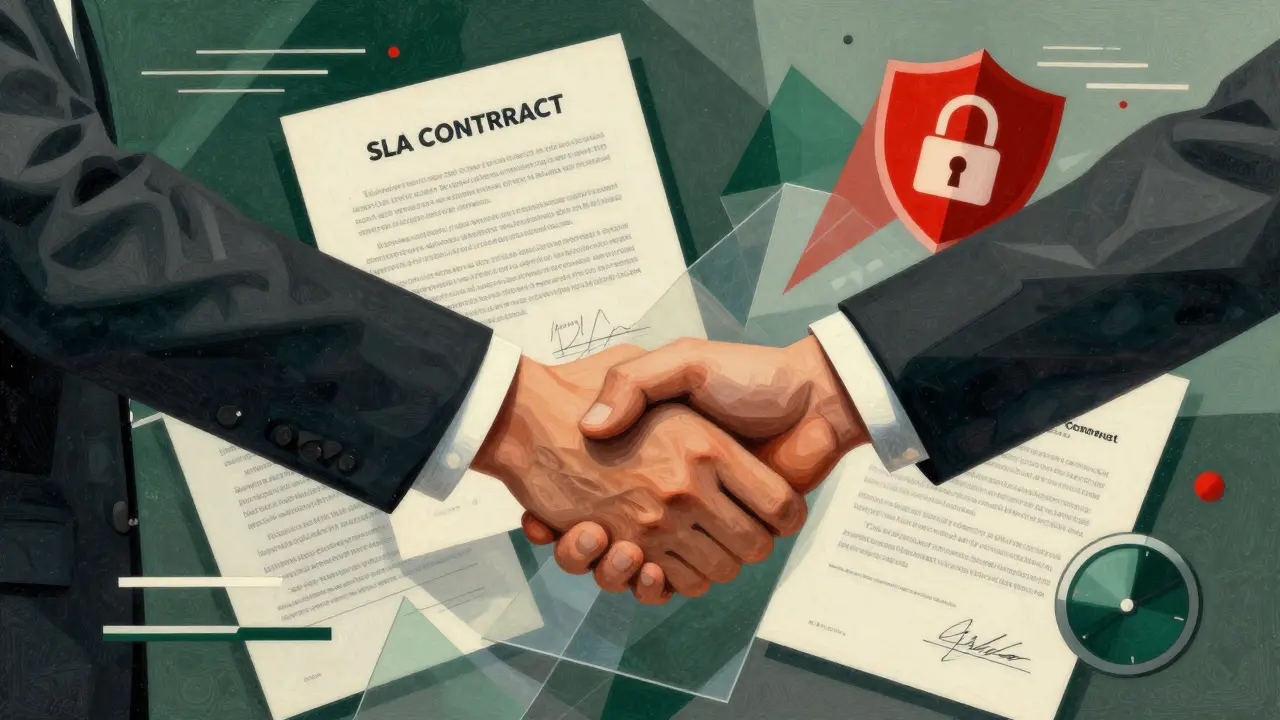
The difference between a pilot project and a mission-critical system often comes down to one thing: the Service Level Agreement (SLA). But in the world of Large Language Models (LLMs), standard cloud SLAs don’t cut it. You’re not just buying server time; you’re buying intelligence, security, and predictability. Whether you choose a managed API provider like Azure OpenAI or go the open-source route with models like Llama 3, your requirements for support and performance must be ironclad.
The New Standard: Beyond Basic Uptime
In traditional IT, an SLA meant keeping servers online. In enterprise AI, uptime is just the baseline. Modern Service Level Agreements for LLMs now encompass a complex web of metrics including latency, data residency, security compliance, and even model versioning stability.
Expect the following as non-negotiables in 2026:
- Uptime Guarantees: The industry standard has shifted from 99.9% (43 minutes of downtime/month) to 99.95% or higher for premium tiers. Mission-critical sectors like healthcare and finance are pushing for 99.99% (less than 5 minutes/month).
- Latency Commitments: An API might be "up," but if it takes 10 seconds to return a token, your user experience collapses. Look for SLAs guaranteeing 2-3 second response times for 95% of requests under normal load.
- Data Residency: With regulations like the EU AI Act taking effect, you need guarantees that your data stays in specific geographic regions (e.g., US-East, EU-West). Providers like Google Cloud AI now offer regional processing guarantees in over 20 locations.
If a provider cannot define these metrics clearly, they are not ready for enterprise deployment. Vague promises of "best efforts" are no longer acceptable.
API Providers: Convenience vs. Compliance
Choosing a managed API service like Microsoft Azure OpenAI, Amazon Bedrock, or Anthropic Claude offers immediate access to state-of-the-art models without the headache of infrastructure management. However, this convenience comes with specific SLA nuances you must scrutinize.
Azure OpenAI leads in compliance certifications, offering FedRAMP High, HIPAA, and DoD IL4/IL5 clearances. This makes it the top choice for government and regulated industries. Their SLA includes financial penalties-typically 10% service credits-for downtime exceeding monthly allowances. But remember, service credits do not cover lost business revenue.
Amazon Bedrock shines in flexibility, offering access to over 60 foundation models. Its intelligent routing can save up to 30% on costs by automatically selecting the most efficient model for a task. However, users report that its claims process for service credits can be complex, and its standard SLA remains at 99.9% uptime unless negotiated otherwise.
Anthropic differentiates itself with Constitutional AI safety features and zero data retention policies, verified by third-party audits. For enterprises worried about prompt leakage-a risk cited by 68% of financial institutions-this is a critical SLA component. Yet, their enterprise SLA only recently expanded to include regional data residency options, so older contracts may lack these protections.
The biggest pitfall with API providers? Hidden operational costs. Analysis shows 20-40% of total spend goes toward dedicated GPU clusters, enhanced security protocols, and data residency requirements not reflected in base pricing. Always ask for a detailed breakdown of what constitutes "premium" support.
| Provider | Uptime SLA | Key Compliance Certs | Support Response Time | Best For |
|---|---|---|---|---|
| Azure OpenAI | 99.9% - 99.95% | FedRAMP High, HIPAA, GDPR | 1 hour (Premium) | Regulated Industries, Microsoft Ecosystem |
| Amazon Bedrock | 99.9% | SOC 2, ISO 27001 | 4 hours (Standard) | Cost-Optimized Multi-Model Deployments |
| Anthropic Claude | 99.9% | SOC 2, Zero Data Retention | 15 mins (Mission-Critical) | High-Security, Privacy-Focused Apps |
| Google Vertex AI | 99.9% | GDPR, HIPAA, SOC 2 | 4 hours (Standard) | Multimodal Applications, Complex Data Processing |

Open-Source: Control vs. Operational Burden
When you choose Open-Source LLMs like Meta’s Llama 3, Mistral, or Qwen, you trade vendor lock-in for full control. There is no central provider to blame when things go wrong. Your SLA is effectively self-imposed, relying on your internal infrastructure team.
This path offers unparalleled advantages for data sovereignty. Since the model runs on your own servers or private cloud, there is no risk of prompt leakage to a third party. You also avoid the "black box" problem, allowing for deeper auditing and customization.
However, the burden of reliability shifts entirely to you. Consider these challenges:
- Infrastructure Management: You need expertise in GPU orchestration, Kubernetes, and API gateway management. The average implementation team requires 2.5 full-time equivalents just to maintain stability.
- Performance Monitoring: Without a provider’s observability tools, you must build your own. Tools like Helicone or LangSmith become essential to track latency, token usage, and error rates in real-time.
- Update Risks: Model updates are not managed by a vendor. If a new version breaks your application logic, your team must test, validate, and deploy fixes immediately.
For many enterprises, the hybrid approach is emerging as the sweet spot: using open-source models for sensitive, internal tasks where data privacy is paramount, and API providers for general-purpose, high-volume tasks where speed and ease of integration matter more.
Critical SLA Components Often Overlooked
Most enterprises focus on uptime and latency, missing three critical areas that can derail operations:
- Model Versioning Guarantees: Providers frequently update models, sometimes breaking existing workflows. Gartner analysts emphasize the need for explicit commitments on how long specific model versions will remain available before mandatory upgrades. Without this, a routine update could invalidate months of fine-tuning.
- Prompt Leakage Protection: Security SLAs must explicitly address data handling practices. Encryption standards like AES-256 for data at rest and TLS 1.3 for transit are baseline requirements. More importantly, ensure the provider guarantees that your prompts are not used to train their public models.
- Multi-Agent Workflow Visibility: As applications grow more complex, involving multiple agents interacting, traceability becomes crucial. Dr. Marcus Chen of Helicone notes that SLAs should guarantee visibility across all agent interactions for compliance auditing. If an agent makes a mistake, you need to know exactly which step failed.
Ambiguous language around "reasonable usage" is another red flag. During peak demand periods, some providers have throttled services despite premium SLAs, citing vague terms. Ensure your contract defines clear thresholds for rate limits and throttling conditions.
Negotiating Your SLA: A Practical Checklist
Don’t accept the default template. Use this checklist during negotiations:
- Define Severity Levels Clearly: Specify response times for each severity level. For example, Severity 1 (total outage) should require acknowledgment within 15 minutes and resolution plans within 1 hour.
- Request Financial Penalties: Ensure the SLA includes meaningful service credits for breaches. While they don’t cover lost revenue, they incentivize the provider to prioritize your issues.
- Verify Compliance Documentation: Ask for recent audit reports (SOC 2 Type II, ISO 27001) and verify that certifications match your industry requirements (HIPAA, FedRAMP, etc.).
- Test Under Load: Conduct load testing simulating 300% of expected peak usage during the evaluation period. Validate that latency and uptime hold up under stress, not just in ideal conditions.
- Clarify Support Channels: Determine if support is email-only, chat-based, or includes direct phone access to engineers. Premium tiers ($25k+/month) should include 24/7 dedicated support engineers.
Remember, the goal is not just to find a provider with good marketing, but one that aligns with your risk tolerance and operational needs. A 3-6 month evaluation period is recommended to thoroughly test these commitments.
What is the minimum uptime SLA I should demand from an LLM provider?
For general enterprise use, aim for at least 99.9% uptime (43 minutes of downtime per month). For mission-critical applications in finance or healthcare, negotiate for 99.95% or higher, which limits downtime to less than 22 minutes monthly. Always clarify if this uptime covers specific models or the entire platform.
How do API SLAs differ from open-source model reliability?
API providers offer contractual SLAs with financial penalties for downtime, shifting liability to the vendor. Open-source models place the entire burden of reliability, infrastructure maintenance, and support on your internal teams. While open-source offers greater control and data privacy, it requires significant investment in engineering resources to achieve comparable uptime and performance.
Why is model versioning important in an LLM SLA?
Providers frequently update models, which can break existing applications or change output behaviors. An SLA with model versioning guarantees ensures that specific model versions remain available for a defined period, allowing you to plan updates and avoid unexpected disruptions caused by mandatory upgrades.
What are the hidden costs associated with enterprise LLM SLAs?
Hidden costs often include expenses for dedicated GPU clusters, enhanced security protocols, data residency requirements, and specialized observability tools. These can add 20-40% to your total cost of ownership, beyond the base API pricing. Always request a detailed breakdown of premium tier inclusions.
How can I verify a provider's compliance with data privacy regulations?
Request recent third-party audit reports such as SOC 2 Type II and ISO 27001. Verify specific certifications relevant to your industry, like HIPAA for healthcare or FedRAMP for government. Additionally, look for real-time compliance dashboards offered by providers like Google Cloud AI, which automatically validate adherence to GDPR and other regulations.