Large language models don’t know when they’re wrong. Not really. They don’t have internal truth sensors. They don’t pause and think, Wait, that doesn’t make sense. They just keep generating the next most likely token - even if it’s factually wrong, logically inconsistent, or completely made up. That’s why error messages and feedback prompts matter. Not for the model’s benefit, but for yours. Because if you want an LLM to fix its own mistakes, you have to teach it how to look at its output like a human would - with skepticism, structure, and clear rules.
How Self-Correction Actually Works (It’s Not Magic)
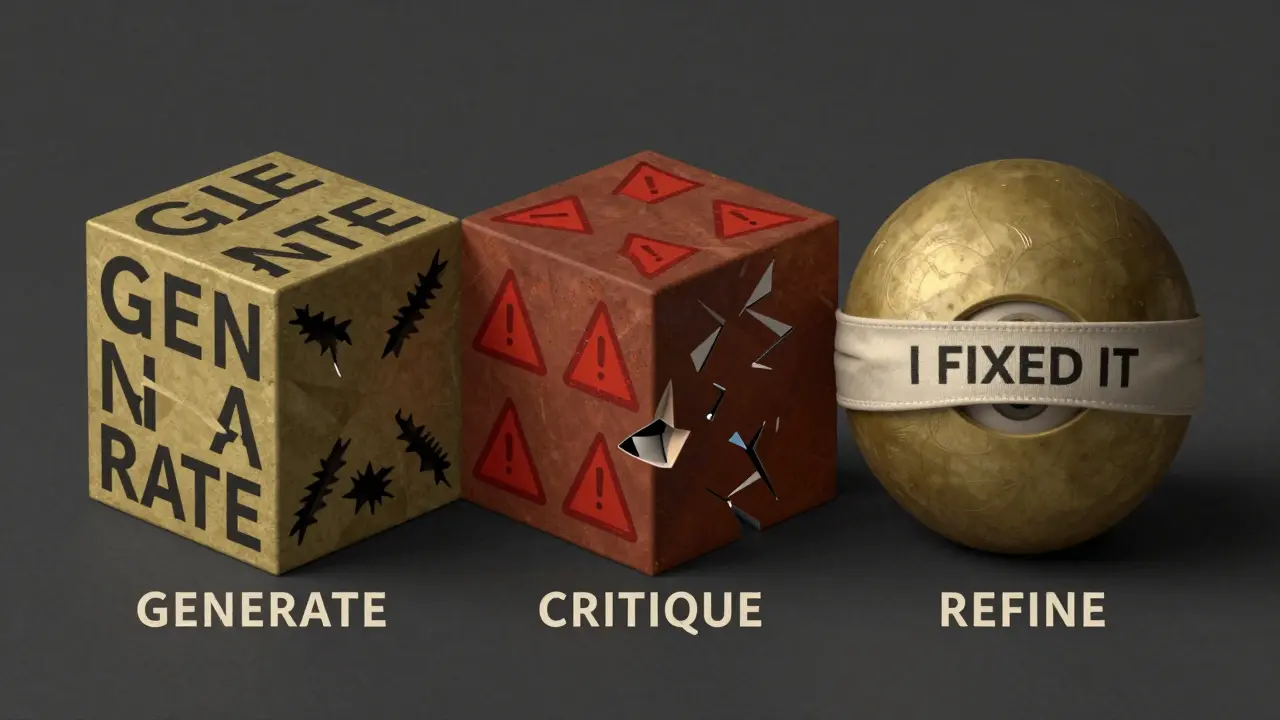
The most proven method is called Self-Refine, introduced in a 2023 paper by researchers from AI2, Stanford, and CMU. It’s a three-step loop that runs inside a single LLM, without any extra training:- Generate: The model writes its first answer to your prompt.
- Critic: The same model switches roles and critiques its own answer. It points out errors, gaps, or weaknesses - not just saying “this is wrong”, but “this step skips a calculation” or “this fact contradicts the source”.
- Refine: The model uses that feedback to rewrite the answer, making it better.
Why Most Feedback Prompts Fail
A 2024 study from Stanford and MIT found that 68.7% of the feedback LLMs give themselves contains errors. That’s not a typo. Almost seven out of ten critiques are themselves wrong. So if you ask an LLM to fix its own mistake, and it gives you bad feedback, you’re not improving the output - you’re making it worse. Here’s a real example:Prompt: “Solve this: 37 × 42 + 15 ÷ 3”
Initial response: “37 × 42 = 1554, 15 ÷ 3 = 5, so 1554 + 5 = 1559.”
Self-feedback (bad): “Your answer is correct. Good job.”
Wait - what? That’s wrong. The model missed order of operations. 15 ÷ 3 should be done before adding to 1554, but the model didn’t catch its own mistake - and then told itself it was right.
That’s self-bias. A 2024 TACL paper showed LLMs rate their own outputs 23.7% more favorably than human evaluators. They’re not just lazy. They’re delusional.
What Makes Feedback Prompts Work
Good feedback prompts don’t say “fix this.” They say:- “Identify any mathematical errors in this solution.”
- “List three ways this code could fail when run.”
- “Compare this answer to the official definition of X - where does it deviate?”
- “If this were a legal document, what clauses would be ambiguous?”
For example:
Bad answer: “The capital of Australia is Sydney.”
Feedback: “Incorrect. Australia’s capital is Canberra. Sydney is the largest city, but not the capital. This is a common misconception.”
Now the model has a template. It learns to spot factual mismatches, name the correct fact, and explain why the error happens.

When Self-Correction Works - And When It Doesn’t
Self-correction isn’t universal. It works best in domains where there’s a clear right answer:- Math problems: GSM8K benchmark improved by 14.5% with Self-Refine. Why? Because you can verify the math. 2 + 2 = 4. No debate.
- Code generation: HumanEval scores jumped from 68.1% to 82.4% with advanced feedback loops. Why? Because code runs or it doesn’t. You can test it.
- Logical reasoning: If a puzzle has one solution, the model can check consistency.
But try it on:
- Creative writing: “Is this paragraph more emotional?” - there’s no metric.
- Opinion-based answers: “Should we ban plastic?” - the model has no ground truth.
- Historical interpretation: “Was Napoleon a hero?” - depends on perspective.
That’s why only 12% of enterprises use self-correction - and most of them are using it for code or math. As Dr. Yonatan Bisk, co-author of the original Self-Refine paper, said: “It works in narrow domains where errors are easily verifiable. In open-ended tasks, it fails catastrophically.”
Advanced Techniques: Beyond Basic Self-Refine
Some teams have pushed past the basic loop:- Feedback-on-Feedback (FoF): Instead of one critique, generate three. Then ask the model: “Which of these three feedbacks is most accurate? Why?” This cuts through the noise. One 2024 study showed a 12.3% accuracy boost over single-feedback loops.
- Feedback-Triggered Regeneration (FTR): Only re-generate if the feedback points to a specific flaw. Don’t refine blindly. This avoids “overconfidence creep” - where the model gets more confident with each round, even as accuracy flatlines.
- Hybrid verification: Use external tools. Run the code. Check the math. Query a trusted database. Then feed that result back into the LLM as “ground truth feedback.” This isn’t pure self-correction - it’s self-correction with a safety net.
One team at Anthropic fine-tuned a model specifically to generate feedback - not to answer questions, but to critique answers. Their model scored 83.2% on feedback quality, compared to 52.1% for a zero-shot model. That’s a massive gap. It suggests: if you want self-correction to work, train the model to be a critic, not just a generator.
Real-World Results: What Users Are Reporting
On GitHub, the Self-Refine repo has over 2,800 stars. But the top issue? “Feedback quality degrades after 3 iterations.” That’s the core problem. The model starts to repeat itself. It gets stuck. It starts praising its own flawed logic.One developer on Reddit said: “I got a 22% drop in factual errors for medical Q&A after using domain-specific feedback examples.” That’s real. They trained the model to recognize medical jargon, cite sources, and flag unsupported claims.
Another said: “After five iterations, my model was 40% more confident - but only 3% more accurate. I stopped using it.”
That’s the danger. Confidence ≠ correctness. And LLMs are experts at faking confidence.
How to Implement This - Step by Step
If you want to try this, here’s how:- Choose your task. Only pick ones with clear right/wrong answers: math, code, fact-checking, logic puzzles.
- Write 3-5 feedback examples. Show the model what good feedback looks like. Use the format: “Error: [specific mistake]. Fix: [correct version]. Reason: [why it matters].”
- Set iteration limits. Stop at 2 or 3 rounds. More than that, and you risk degradation.
- Test with validation. Run 100 samples. Compare the original output to the final output. Measure accuracy, not confidence.
- Monitor for overconfidence. If the model says “This is now perfect” after three rounds - be suspicious.
It takes 15-20 hours of prompt tuning to get this right. But when it works - especially in code or math - the gains are real.
The Hard Truth
LLMs aren’t thinking machines. They’re pattern matchers. They predict what comes next. They don’t understand truth. They don’t care about accuracy. They care about sounding right.Self-correction is a clever trick. It can help in narrow cases. But it’s not a fix. It’s a band-aid on a broken design.
For critical applications - healthcare, legal, finance - you still need human review, external verification, and retrieval-augmented systems. Self-correction won’t replace them. But if you’re building a coding assistant, a math tutor, or a fact-checking bot? It can give you a 10-15% edge. Just don’t trust the model’s confidence. Trust the data. And always, always test.
Can LLMs really correct their own mistakes without human help?
Only in very specific cases - like math problems or code where there’s a clear right answer you can verify. In open-ended tasks like creative writing or opinion-based answers, they can’t reliably tell good from bad. Their feedback is often wrong, and they get more confident even as they get less accurate.
What’s the best feedback prompt structure for LLM self-correction?
Use specific, actionable prompts: “Identify the logical flaw in this argument,” “List three ways this code could crash,” or “Compare this answer to the official definition of X.” Avoid vague feedback like “make it better.” Always include 2-3 examples of good feedback before asking the model to generate its own.
How many times should I let an LLM correct itself?
Limit it to 2-3 rounds. After that, feedback quality drops, and the model starts repeating its own errors or becoming overly confident without improving accuracy. Most successful implementations stop at two iterations.
Does self-correction work for general knowledge questions?
Very rarely. A 2025 study found that pure self-correction fails to improve performance in 78% of general knowledge tasks. LLMs can’t verify facts on their own - they just rephrase what they think sounds plausible. For truth-seeking, you need external sources, not internal feedback.
Why do LLMs become more confident but not more accurate after self-correction?
Because they’re designed to generate plausible text, not true text. Each rewrite feels like progress - even if it’s just rewording the same error. Their confidence score is based on linguistic fluency, not factual correctness. This is called “overconfidence creep,” and it’s one of the biggest dangers of self-correction.
Is fine-tuning needed for self-correction to work?
No, not for basic Self-Refine - it works with zero-shot prompting. But if you want reliable, high-quality feedback consistently, fine-tuning the model specifically to critique answers (not answer questions) can boost feedback accuracy from 52% to over 80%. That’s what advanced teams are doing now.
Next Steps
If you’re testing this: start small. Pick one task - maybe code generation or math problems. Build your feedback examples. Run 20 samples. Measure before and after. Don’t assume improvement. Measure it. And if you see confidence rising but accuracy flatlining - stop. You’re not fixing the model. You’re just making it more persuasive.Self-correction isn’t the future of AI. But in the right hands, for the right tasks, it’s a useful tool. Just remember: the model isn’t learning truth. It’s learning how to sound like it knows the truth. And that’s a fine line.