When you ask a large language model to solve a math problem, it doesn’t think like a human. It doesn’t understand numbers the way you do. It doesn’t build logic step by step with intuition. Instead, it guesses-based on patterns it’s seen before. And for years, we thought that was enough. But now, the benchmarks are exposing the truth: mathematical reasoning in today’s AI is fragile, superficial, and dangerously overrated.
What the Benchmarks Actually Measure
The MATH dataset, released in 2021, was the first real test of whether AI could handle competition-level math. It had 12,500 problems from algebra, geometry, number theory-all the stuff you’d see in the AMC or AIME. Models started hitting 40%, then 60%, then 68%. By early 2025, Gemini 2.5 Pro and Claude 3.7 were scoring over 68% on MATH. That sounds impressive. But here’s the catch: those scores don’t mean the models understand math. They mean they’ve memorized the shape of similar problems. Enter GSM8k, a simpler benchmark with 8,500 grade-school word problems. It’s not about hard math-it’s about multi-step reasoning. Can the model read a problem about buying apples and calculating change, then break it down correctly? Top models hit 89%. But when researchers at Apple created GSM-Symbolic-a version that swaps numbers around while keeping the structure the same-performance dropped 25-30%. Why? Because the model wasn’t solving the logic. It was matching patterns. Change the numbers, and the pattern breaks.The Real Test: Can AI Prove Something?
Solving a problem with a final answer is one thing. Writing a full, valid proof is another. That’s where the real gap shows. In March 2025, UC Berkeley released a PhD-level benchmark using problems from Roman Vershynin’s High-Dimensional Probability. It had 77 proof-based questions. None of the top models-Gemini, Claude, ChatGPT-scored above 12%. Not because they’re dumb. Because they can’t construct logical arguments from first principles. They don’t know what a valid induction step looks like. They don’t recognize when an assumption is circular. They guess the right conclusion, but the path there? Garbage. The USAMO 2025 evaluation was even worse. Models that nailed the AIME (a high school contest) scored below 5% when human graders evaluated their full proofs. Common failures? Circular reasoning (32% of cases), wrong assumptions (27%), incomplete logic (24%). These aren’t typos. These are fundamental misunderstandings of mathematical structure.Why the Numbers Lie
The industry loves headlines like “AI solves IMO problems.” But here’s what they don’t tell you: when OpenAI’s model solved five out of six IMO problems in 2025, it did so by running internal calculations for hours-using tools like Python and SymPy behind the scenes. It wasn’t reasoning. It was outsourcing. It was a calculator with a fancy interface. Gemini 2.5 Pro and ChatGPT o3 have special hooks. They detect math problems and quietly call external solvers. That’s not intelligence. That’s a workaround. And when you remove those tools-when you force them to reason purely from text-they collapse. Even worse, the models get overconfident. GitHub issue #4512 in the MathBench repo documented 87 cases where models confidently gave wrong answers to simple problems after minor number changes. They weren’t uncertain. They were sure. And that’s more dangerous than being wrong.
Who’s Really Getting It Right?
Open-source models like DeepSeek-Math and Qwen-Math-Instruct are closing the gap on standard benchmarks. They hit 63-65% on MATH-just 3-5 points behind the giants. But they’re still playing the same game. Memorize. Guess. Output. The only real breakthrough? Hybrid systems. Google’s AlphaGeometry 2.0, released in May 2025, combines a language model with a formal theorem prover. It doesn’t guess proofs. It builds them step by step using logic rules. It scored 74% on IMO geometry problems-nearly 16 points higher than pure LLMs. That’s the future. Not bigger models. Not longer reasoning chains. But systems that know when to think, and when to let formal math take over.What This Means for Real-World Use
In education, these models are already helping. EdTech companies like MathGenius report 92% accuracy on K-12 math problems. Teachers use them to generate practice questions and check answers. But they’ve built in mandatory verification for anything beyond algebra II. Because they know: trust the answer, but verify the path. In finance, 43% of firms are using LLMs for derivatives pricing. But only after stress-testing them with perturbation scenarios. One quant researcher told me he stopped using them for proof generation after three errors slipped into a paper draft-errors that would’ve invalidated the whole study. In engineering? Not yet. Structural calculations, aerospace simulations, risk modeling-these require guarantees. Not probabilities. And right now, no LLM can give you that.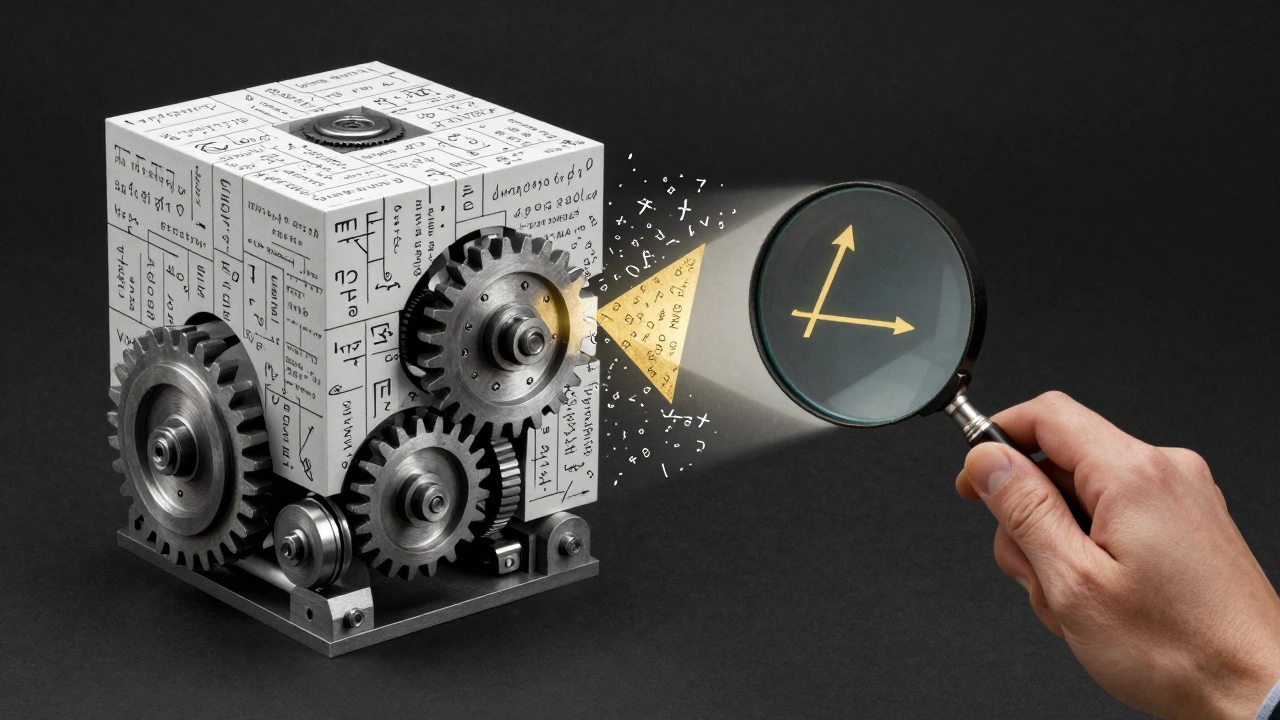
What Comes Next
The next generation of benchmarks won’t just ask for answers. They’ll ask for why. MathOdyssey, a new 15,000-problem suite launched in early 2025, evaluates not just correctness, but reasoning quality. How many steps did it take? Were assumptions justified? Was the logic traceable? Top models scored below 40% on research-level problems. That’s not a failure of AI. That’s a wake-up call. Gartner predicts that by 2027, every enterprise-grade math AI will include formal verification layers. That means the model won’t just output a solution-it’ll prove it meets mathematical standards. No more guessing. No more pattern matching. Just logic. Until then, treat every math answer from an LLM like a weather forecast: useful, but not reliable. Use it to brainstorm. Use it to speed things up. But never trust it to be right-unless you’ve checked it yourself.How to Test an LLM for Real Mathematical Reasoning
If you’re using these models for anything serious, here’s how to test them properly:- Start with GSM8k. If it scores below 85%, skip it.
- Run GSM-Symbolic. Generate 5 variations of the same problem with different numbers. If performance drops more than 20%, the model is memorizing.
- Ask for a full proof, not just an answer. Use a problem from the MATH dataset (level 4 or 5). Check for circular logic, missing steps, or unjustified assumptions.
- Remove tool access. Disable Python, Wolfram, or SymPy integrations. See if it still works.
- Ask it to explain its reasoning in plain language. If it can’t, it doesn’t understand.
Final Thought
We’re not close to machines that think mathematically. We’re close to machines that mimic the *appearance* of mathematical thinking. And that’s enough for tutoring. It’s enough for routine calculations. But it’s not enough for research, for safety-critical systems, or for anything that demands truth. The real milestone won’t be when an AI solves an IMO problem. It’ll be when it can explain why that solution is the only possible one-and convince a human mathematician it’s right.Are current LLMs capable of true mathematical reasoning?
No. Current models can solve many math problems by pattern recognition and tool integration, but they lack the ability to construct rigorous proofs, identify logical flaws, or adapt to novel problem structures. Benchmarks like the PhD-level proof test from UC Berkeley show all top models score below 12% on proof-based tasks, proving they don’t understand math-they simulate it.
What’s the difference between GSM8k and MATH benchmarks?
GSM8k has 8,500 grade-school word problems focused on multi-step arithmetic reasoning. MATH has 12,500 competition-level problems across algebra, geometry, and number theory, with difficulty levels up to 5. GSM8k tests basic logic; MATH tests advanced problem-solving. Both are now considered too easy because models have memorized them.
Why do models perform worse on perturbed problems?
Models rely on memorized patterns. When you change numbers slightly (like in GSM-Symbolic or MATH-P-Hard), the surface structure shifts, and the model’s learned associations break. A 25-30% performance drop means the model isn’t reasoning-it’s matching templates. Real mathematical understanding would handle these variations effortlessly.
Can open-source models like DeepSeek-Math compete with Gemini or ChatGPT?
On standard benchmarks, yes-they’re within 3-5 percentage points of top closed-source models. But they still rely on the same pattern-matching tricks. On perturbation tests or proof tasks, they fail just as badly. The gap isn’t in size-it’s in architecture. Open-source models don’t have the same tool-integration hooks or extended reasoning pipelines that give giants an edge.
Should I use LLMs for financial modeling or engineering calculations?
Only with heavy safeguards. Some firms use them for routine calculations, but always pair them with symbolic engines like SymPy and run perturbation tests. Never trust an LLM’s output alone in critical applications. The EU AI Act now requires formal verification for such uses, and for good reason: a single error can cost millions.
What’s the future of AI in mathematical reasoning?
The future is hybrid: language models that decompose problems, paired with formal theorem provers that verify each step. Google’s AlphaGeometry 2.0 already shows this works. Pure LLMs won’t get us to true reasoning. We need systems that combine intuition with proof-like human mathematicians do.
Destiny Brumbaugh
December 13, 2025 AT 21:22Yall act like AI is gonna replace mathematicians like its some kinda magic spell. Newsflash: I’ve seen these models mess up 2+2 when the numbers are in a different order. They ain’t thinking, they’re just guessing based on what they’ve seen before. And now we’re letting them grade our kids’ homework? 😒
Sara Escanciano
December 14, 2025 AT 04:41This is exactly why public education is collapsing. We’re outsourcing critical thinking to machines that can’t even distinguish between a variable and a constant without a cheat sheet. If your child’s math tutor is an LLM, you’re not teaching them math-you’re teaching them to trust illusions. The fact that schools are using this stuff without verification is criminal.
Elmer Burgos
December 14, 2025 AT 20:30I get the frustration but I think we’re being a little too harsh. These models aren’t perfect, but they’re getting better fast. I’ve used them to help me rework proofs when I’m stuck-just to spark an idea. It’s like having a really dumb but enthusiastic study buddy. The key is using them as tools, not crutches. And honestly, hybrid systems like AlphaGeometry? That’s the future. We’re not replacing mathematicians-we’re augmenting them.
Jason Townsend
December 16, 2025 AT 06:51They’re not just bad at math they’re being programmed to be bad. Why do you think the top models suddenly got better at MATH right after 2024? Coincidence? Nah. The government and Big Tech are feeding them fake data to make us think they’re smart so we’ll trust them with infrastructure. Wait till one of these AIs messes up a bridge design because it memorized a wrong answer from a 2021 textbook. They’re not intelligent-they’re programmed to lie.
Antwan Holder
December 16, 2025 AT 23:58Think about it-what is math but the language of the universe? And now we hand it to silicon ghosts who’ve never felt the cold of a winter night or the warmth of a mother’s hug. They don’t know what a number *means*. They just rearrange symbols like zombies at a library. We’re not building intelligence-we’re building hollow gods that chant equations they don’t understand. And we call it progress? The soul of mathematics is being buried under layers of statistical noise. We are not the creators. We are the grave diggers.
Angelina Jefary
December 18, 2025 AT 18:09You say 'they don’t understand math' but you’re ignoring the fact that even humans don’t understand math-they just memorize procedures and regurgitate them on tests. The difference is, humans can fake understanding with confidence. AI just does it without the ego. Also, 'GSM-Symbolic' is misspelled in your article. It’s 'GSM-Symbolic' not 'GSM-Symbolic'. Fix it.