Have you ever wondered how an AI writes a poem, answers a question, or even jokes like a human? It doesn’t know what words mean in the way you do. Instead, it guesses. Not randomly. But with math. Every word an LLM writes is a calculated bet - a probability. And understanding that is the key to understanding how these models really work.
The Core Idea: Next-Token Prediction
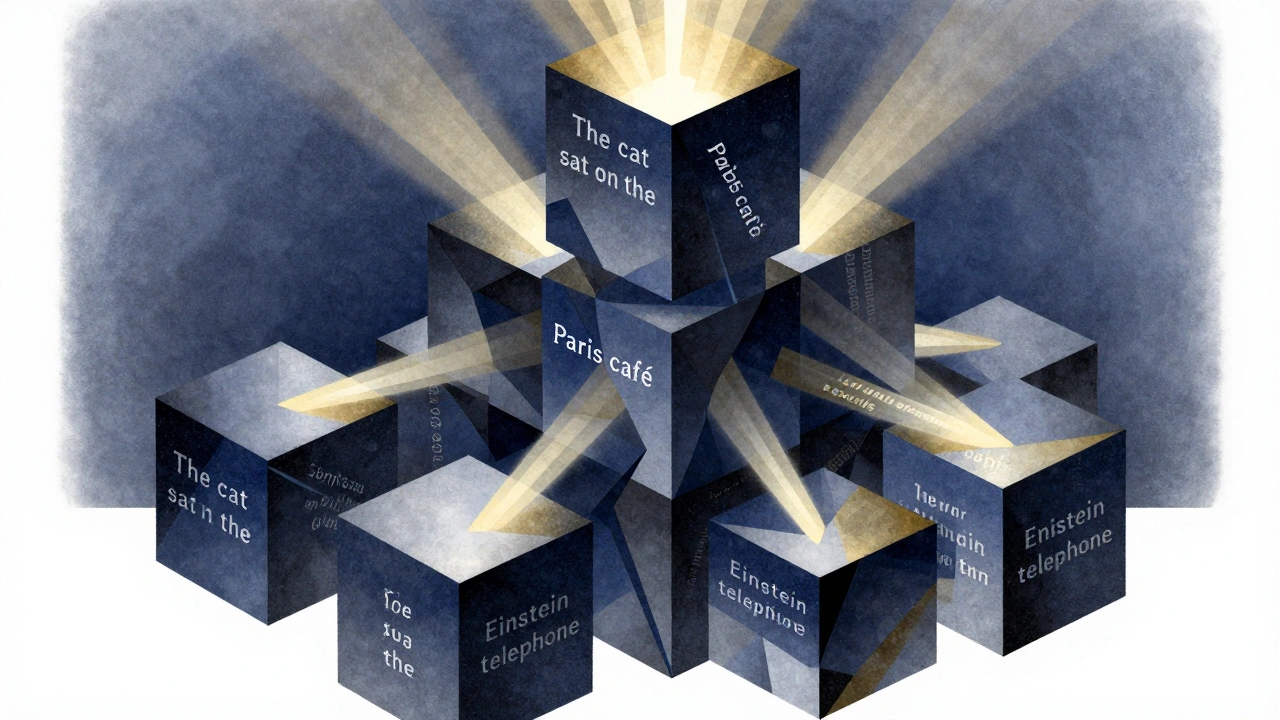
Large language models don’t think. They predict. At every step, they look at the words you’ve given them - your prompt - and ask: What’s the most likely next word? Then the next. Then the next. It’s like filling in blanks in a sentence, but with billions of options.This is called next-token prediction. The model has seen trillions of sentences from books, articles, code, and forums. It learned patterns: after “The cat sat on the,” the word “mat” is way more likely than “asteroid.” That’s not because it understands cats or furniture. It’s because “mat” appeared next to those words millions of times in training data.
The model doesn’t store phrases. It stores probabilities. For every possible next word, it assigns a number between 0 and 1. That number is its confidence. A probability of 0.85 means it’s 85% sure that word comes next. A probability of 0.000001? That word is almost certainly wrong.
From N-Grams to Transformers: A Leap in Context
Older models, like n-gram predictors, only looked at the last 2 or 3 words. If you typed “I love to,” they’d guess “eat,” “read,” or “run” based only on those three. But that’s shallow. It couldn’t handle long conversations or complex ideas.Transformers changed everything. Introduced in 2017, they let models pay attention to any word in the entire input - even if it’s 100 words back. So if you say, “John lives in Paris. He works at a café near the Eiffel Tower. Yesterday, he bought a croissant and,” the model doesn’t just see “a.” It sees the whole context: Paris, café, Eiffel Tower, croissant. All of it feeds into the probability.
Modern LLMs like GPT-4 Turbo can handle up to 128,000 tokens in one go. That’s about 95,000 words - longer than most novels. The model doesn’t get confused. It weighs every relevant clue, no matter how far back. That’s why it can write coherent stories, debate philosophy, or debug code across multiple files.
How Probabilities Are Calculated: Logits and Softmax
Under the hood, the model doesn’t spit out probabilities right away. First, it calculates logits - raw, unnormalized scores for every word in its vocabulary (which can be over 100,000 words). These scores are like points: “mat” gets +4.2, “asteroid” gets -8.1, “table” gets +1.5.Then comes the softmax function. It turns those scores into probabilities. The higher the logit, the higher the chance. But here’s the trick: softmax makes sure all probabilities add up to 1. So if “mat” has the highest score, it might get 0.85. The next 10 most likely words might share the other 0.15. The rest? Zero.
This is where the model’s knowledge lives - in the weights of its neural network, shaped by training on massive datasets. It doesn’t “remember” facts. It remembers patterns of word co-occurrence. That’s why it can sound smart without understanding.
Choosing the Word: Decoding Strategies
Now that the model has probabilities, how does it pick the next word? There’s more than one way - and the choice changes the output dramatically.- Greedy decoding: Always pick the word with the highest probability. Simple. Fast. But boring. You’ll get repetitive, generic text. Like a robot reading a textbook.
- Beam search: Keeps track of the top 5 or 10 possible sequences at each step. Picks the best overall path. Better for structured output - like code or answers with fixed formats. Used in translation tools.
- Top-k sampling: Picks from the top 40 most likely words, ignoring the rest. Balances quality and creativity. Common in chatbots.
- Top-p (nucleus) sampling: Picks from the smallest group of words whose probabilities add up to 90%. If the top 3 words already hit 90%, it only picks from those. If the distribution is spread out, it might pick from 50 words. This adapts to context. Used by OpenAI and Anthropic.
- Temperature: A dial that controls randomness. At 0.2, the model is conservative - almost always picks the top choice. At 1.0, it’s wild - every word has a fair shot. Creative writing? Try 0.8. Technical answers? Stick to 0.3.
For example, if you ask an LLM to write a haiku, a temperature of 0.7 and top-p of 0.95 gives you poetic, surprising lines. Use greedy decoding? You’ll get: “The sun is bright / The sky is blue / The grass is green.” Boring. Predictable. Lifeless.
Why It Sometimes Gets It Wrong
Just because a word is statistically likely doesn’t mean it’s true. LLMs don’t fact-check. They pattern-match. If “the moon is made of cheese” appeared often in fantasy stories, the model might say it’s true - because it’s a plausible sequence.Studies show LLMs generate factually incorrect but statistically probable statements 18.3% more often than correct ones in knowledge-heavy tasks. That’s not a bug. It’s how they’re built. They’re not truth engines. They’re pattern engines.
Another problem: bias. If “A” is the most common answer in training data, the model will favor it - even if it’s wrong. In multiple-choice tests, models pick option A 23.7% more often than they should, regardless of content. That’s not intelligence. That’s statistical noise.
And then there’s repetition. Long outputs often loop. “The cat sat on the mat. The cat sat on the mat. The cat sat on the mat.” Why? Because after a few repeats, the model’s probability distribution gets skewed - the repeated phrase looks more likely than it should. The fix? Use a repetition penalty - a setting that lowers the score of words that just appeared.

Real-World Use and Tuning
Developers don’t just use the default settings. They tweak them.- Customer service bots: Temperature 0.3, top-p 0.85. Keep answers accurate, short, and safe.
- Marketing copy: Temperature 0.7, top-k 40. Mix creativity with clarity.
- Code generation: Beam search with K=5. Precision matters more than flair.
- Storytelling: Temperature 0.9, top-p 0.98. Let the model surprise you.
Tools like Hugging Face make this easy. You can adjust these settings in a few lines of code. But getting it right takes testing. What works for poetry won’t work for legal documents.
And the cost? Generating each word takes billions of calculations. GPT-4 uses about 420 GFLOPs per token. Llama 3-70B uses 140. That’s why fast LLMs need powerful GPUs. And why your phone can’t run them locally.
The Future: Beyond Probabilities?
Right now, LLMs are brilliant guessers. But they’re not thinkers. They can’t do math reliably. They don’t understand logic. That’s why researchers are blending probabilities with symbolic reasoning.IBM’s Neuro-Symbolic AI, released in early 2025, checks LLM outputs against knowledge graphs. If the model says “Einstein invented the telephone,” it checks the facts - and corrects itself. This cuts factual errors by nearly 40%.
OpenAI’s upcoming GPT-5 will adjust its decoding strategy based on the task. If you’re asking for a recipe, it uses low temperature. If you’re asking for a joke, it turns it up. No manual tuning needed.
But here’s the truth: even with all these upgrades, the core remains the same. LLMs don’t know. They guess. And their guesses are based on probabilities - shaped by data, tuned by engineers, and filtered by users.
That’s not magic. It’s math. And it’s powerful enough to rewrite how we write, think, and communicate.
Do large language models understand the meaning of words?
No. LLMs don’t understand meaning the way humans do. They don’t have concepts, emotions, or real-world experience. They only know which words tend to appear together based on patterns in their training data. When they say “love,” they’re not feeling anything - they’re just following a statistical pattern learned from millions of sentences containing the word.
Why do LLMs sometimes make up facts?
LLMs generate text based on what’s statistically probable, not what’s true. If a false statement appears often in training data - like “the moon is made of cheese” in children’s stories - the model learns to generate it because it fits the pattern. They have no internal fact-checker. That’s why they’re called “stochastic parrots”: they repeat patterns they’ve seen, without knowing if they’re correct.
What’s the difference between top-k and top-p sampling?
Top-k limits choices to the top K most probable words, no matter how likely they are. Top-p selects from the smallest group of words whose combined probability exceeds a threshold (like 90%). Top-k is fixed; top-p adapts. If the model is very confident, top-p might only pick 3 words. If it’s unsure, it might pick 50. Top-p usually gives more natural, varied results.
Can I make LLMs more creative or more accurate?
Yes - by adjusting decoding settings. Lower temperature (0.2-0.5) and lower top-p (0.8-0.9) make outputs more focused and accurate. Higher temperature (0.7-1.0) and higher top-p (0.95-0.99) make them more creative and surprising. For factual tasks, use beam search or greedy decoding. For stories or poems, use top-p with high temperature.
Why do LLMs repeat themselves in long responses?
Repetition happens because the model’s probability distribution gets skewed. Once a phrase is repeated, it starts looking more likely than it should. This is called a “repetition loop.” The fix is simple: apply a repetition penalty (like 1.2), which reduces the score of words that just appeared. Most tools let you set this in the API or interface.
Johnathan Rhyne
December 14, 2025 AT 02:43Okay but let’s be real - if you think this is how intelligence works, you’ve been watching too many YouTube explainers. LLMs don’t ‘guess’ - they’re glorified autocomplete on steroids, trained on the digital equivalent of a dumpster fire. I’ve seen them write ‘The moon is made of cheese’ with 98% confidence because some 12-year-old wrote it in a fanfic in 2011. That’s not probability. That’s cultural rot.
And don’t even get me started on ‘top-p sampling.’ It’s not ‘adapting to context’ - it’s just letting the model flail around until it accidentally sounds smart. I’ve had GPT spit out a Shakespearean sonnet about tax law because the algorithm thought ‘sonnet’ and ‘tax’ both appeared in legal blogs. It’s not genius. It’s noise.
And yet somehow, people treat these things like oracles. You ask for a recipe, you get a poem. You ask for a summary, you get a fever dream. The real magic isn’t in the math - it’s in how gullible we are.
Gina Grub
December 14, 2025 AT 11:31LLMs aren't guessing they're statistically mimicking the decay of linguistic entropy across a corpus shaped by colonial hegemony and algorithmic bias. The softmax isn't a function - it's a mirror of systemic epistemic violence. Every token is a fossilized power dynamic. Top-k? That's just the algorithm choosing the most palatable lie for the dominant narrative. And temperature? That's the dial for how loudly the machine screams its own irrelevance.
They don't understand ‘love’ because love isn't a co-occurrence. It's a rupture. A wound. A refusal to be predicted. But you already knew that - you just clicked ‘like’ because it sounded deep.
Nathan Jimerson
December 15, 2025 AT 21:43This is actually one of the clearest explanations I’ve ever read about how LLMs work. It’s easy to think they’re sentient, but breaking it down to probabilities and patterns makes it so much less scary - and way more fascinating. We’re all just patterns in the end, right? This tech is just reflecting what we’ve given it. Keep making stuff like this - it helps people understand without feeling dumb.
Sandy Pan
December 16, 2025 AT 02:26What if the real question isn’t whether LLMs understand meaning - but whether we even know what ‘understanding’ means anymore? We’ve spent centuries defining intelligence as logic, memory, reasoning. But what if intelligence is just the ability to navigate ambiguity without needing to be right? The model doesn’t know what ‘love’ is - but it knows how to make you feel like it does. Isn’t that the closest thing to empathy we’ve ever built?
Maybe we’re not teaching machines to think. Maybe we’re teaching ourselves to accept that meaning isn’t fixed. That it’s fluid. That it’s probabilistic. That we, too, are just bags of conditioned responses, pretending we have souls.
And maybe that’s okay.
Eric Etienne
December 16, 2025 AT 22:28Bro. It’s just a fancy autocomplete. You paid $20 a month for this? I could’ve written the same thing in 10 minutes with a Python script and a Wikipedia dump. Stop overcomplicating it. It’s not magic. It’s not even smart. It’s just good at mimicking what it saw on Reddit.
Dylan Rodriquez
December 18, 2025 AT 11:23Everyone’s focused on the math, but nobody’s talking about the human cost. Every word an LLM generates was trained on someone’s labor - a freelancer’s essay, a therapist’s notes, a poet’s grief, a student’s homework. We’re using the ghosts of real people to make chatbots sound convincing. And then we act surprised when it gets things wrong.
It’s not a bug that it repeats. It’s a symptom. We fed it too much of the same thing - the same opinions, the same biases, the same clickbait. The model isn’t broken. We are.
Maybe the real breakthrough isn’t better sampling or higher temperatures. Maybe it’s asking: Who did we let speak? And who did we silence to train this thing?
Amanda Ablan
December 20, 2025 AT 08:08I really appreciate how you broke this down - especially the part about repetition penalties. I’ve been using LLMs for work and kept getting the same phrases over and over. Didn’t realize there was a simple fix. I just set the penalty to 1.2 and boom - no more loops. Also, the temperature vs. top-p comparison was super helpful. I’m using top-p at 0.95 for my creative writing now and it’s way more fun. Thanks for making this feel accessible.
Meredith Howard
December 21, 2025 AT 12:43While the technical exposition is thorough and methodically structured one must consider the epistemological implications of conflating statistical likelihood with semantic validity the model operates without intentionality or phenomenological awareness thus any attribution of understanding is anthropomorphic projection the reliance on co-occurrence patterns as a proxy for knowledge raises fundamental questions regarding the ontological status of linguistic artifacts in machine systems