When you store customer service transcripts, medical records, or financial contracts in a vector database, you're not just saving text-you're saving semantic fingerprints of private information. These fingerprints, called vector embeddings, can be reverse-engineered. Even if you think the original documents are gone, the numbers representing them might still reveal who said what, what condition a patient has, or which deal was negotiated. This isn't science fiction. It’s happening right now in enterprises that skipped proper security.
What Are Vector Embeddings-and Why Do They Leak
Vector embeddings turn words, sentences, or images into long lists of numbers. A sentence like "John Smith’s insurance claim was denied" becomes something like [0.87, -0.23, 1.45, ..., 0.11]-a 1536-dimensional point in space. AI systems use these to find similar documents fast. But here’s the catch: the numbers aren’t random. They encode meaning. And meaning contains secrets. A 2024 case study from JPMorgan Chase found that embeddings of transaction patterns accidentally exposed customer identities. How? Because similar financial behaviors created similar vectors. A fraud detection model didn’t need names-it just needed to match a vector to a known customer’s pattern. That’s semantic leakage. OpenAI’s text-embedding-ada-002 model uses 1536 dimensions. Hugging Face’s all-MiniLM-L6-v2 uses 384. Either way, each vector is a mini-reconstruction of your document. If someone gets access to these vectors-and they often do, through misconfigured APIs or insider threats-they can run similarity searches that pull back private content. Even without the original text, they can piece it together.Why Traditional Security Fails Here
You can’t just encrypt vector databases like you would a SQL table. If you encrypt the numbers, the AI can’t search them. Nearest-neighbor search requires comparing distances between raw vectors. Encryption breaks that. So most companies do this: they encrypt data at rest, but decrypt it in memory to run queries. That’s a massive blind spot. A Reddit user from a Fortune 500 company shared their experience: after six months of trying to secure customer transcripts, they realized standard encryption killed search performance. They switched to format-preserving encryption with custom similarity metrics. Accuracy dropped by 8.3%. That’s the trade-off: security costs performance. And it’s not just about encryption. Access controls matter too. ChromaDB’s open-source version has basic auth-but no role-based access. Pinecone and MongoDB offer namespaces, letting you isolate teams or clients. But if you don’t set them up right, one team’s vectors can accidentally bleed into another’s.What Makes an Embedding Store Truly Secure
There are five non-negotiable layers for protecting private documents in vector databases:- Data anonymization before embedding: Strip names, IDs, addresses, and medical codes from documents before turning them into vectors. Don’t rely on the model to ignore them-it won’t.
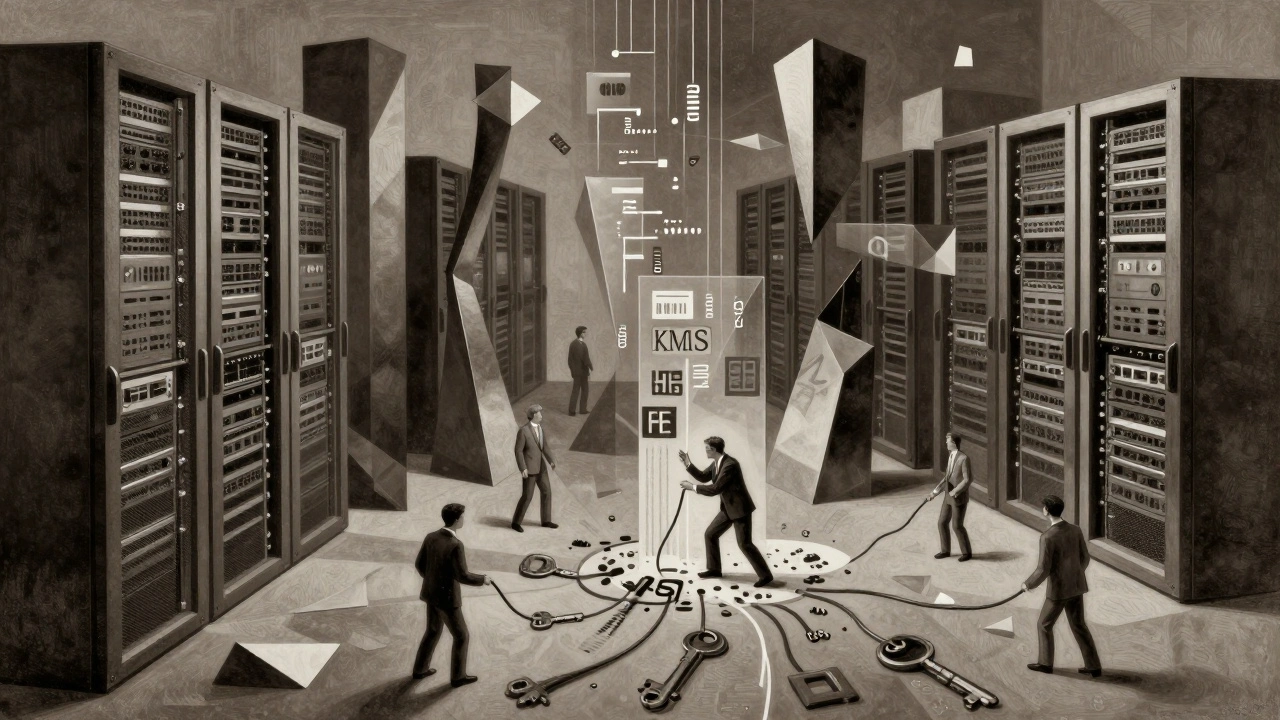
- Encryption at rest and in transit: Use customer-managed keys from AWS KMS, Google Cloud KMS, or Azure Key Vault. Never let the cloud provider hold your keys.
- Namespace isolation: Use Pinecone’s or MongoDB’s namespace feature to separate data by client, department, or sensitivity level. No shared indexes for sensitive and non-sensitive data.
- Embedding validation: Scan vectors before storage to detect if they accidentally encode PII. Tools like Privacera’s embedding scanner can flag vectors that resemble known sensitive patterns.
- Access control with audit logs: Track who queried what, when, and why. If someone searches for 200 vectors related to "cancer diagnosis," you need to know why.
How Leading Platforms Compare
Not all vector databases are built the same. Here’s how the top players stack up on security:| Platform | Encryption | Namespace Isolation | Role-Based Access | Embedding Validation | Key Management |
|---|---|---|---|---|---|
| Pinecone | Yes (in transit + at rest) | Yes (fully isolated) | Yes (RBAC) | No (requires third-party tool) | AWS, GCP, Azure, KMIP |
| MongoDB Vector Search | Yes (field-level) | Yes | Yes | Yes (via Atlas Data Lake) | AWS, GCP, Azure, KMIP |
| Weaviate | Yes (enterprise) | Yes | Yes | Yes (via modules) | AWS, GCP, Azure |
| ChromaDB (open-source) | No | No | Basic auth only | No | None |
| pgvector (PostgreSQL) | Yes (via PostgreSQL TDE) | Yes (via schemas) | Yes (via PostgreSQL roles) | No | Depends on DB setup |
Pinecone leads in isolation and key management. MongoDB wins on built-in validation and field-level encryption. ChromaDB? Don’t use it for private documents unless you’re okay with full control over security yourself-and most teams aren’t.
Real Risks You Can’t Ignore
In March 2024, a HIPAA Journal report detailed how medical imaging vectors were being used to re-identify patients. A vector from an MRI scan could be matched to a known patient’s profile through subtle patterns in pixel density-even if names were removed. The AI didn’t need labels. It just needed similarity. And then there’s the "right to be forgotten" under GDPR. If a customer asks you to delete their data, you can’t just delete the original PDF. You have to delete every vector that came from it. And you have to make sure no other vector in your database can reconstruct it through similarity. That’s not easy. Some companies now store a "hash of the hash"-a cryptographic signature of the original document-to prove deletion. The European AI Act, effective February 2025, now requires "appropriate technical and organizational measures" for vector databases handling high-risk personal data. Non-compliance can mean fines up to 7% of global revenue.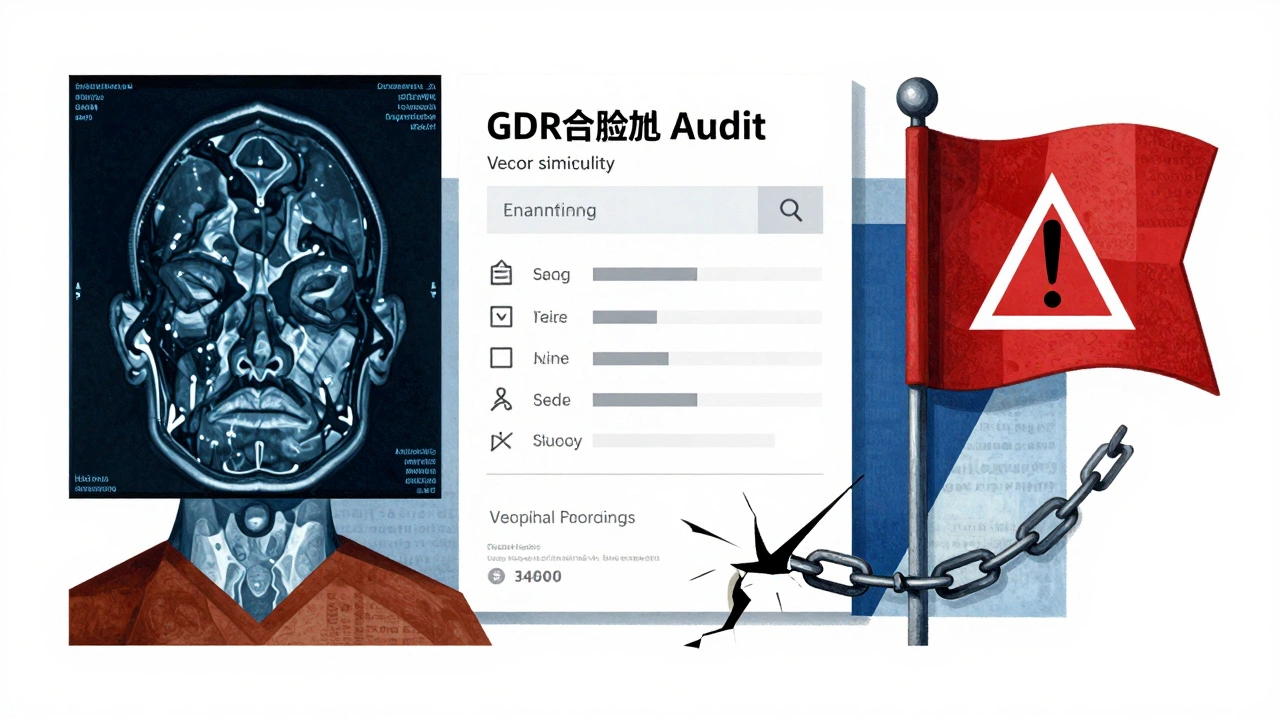
How to Get Started (Without Breaking Everything)
If you’re starting fresh, here’s your checklist:- Choose a platform with built-in encryption and namespace support (Pinecone or MongoDB).
- Integrate with your company’s key management system (KMS) before loading any data.
- Run all documents through an anonymization pipeline first. Use tools like Presidio or custom regex to scrub names, emails, SSNs, and medical codes.
- Set up audit logging. Record every query that returns more than 5 results.
- Test for semantic leakage: take a known document, vectorize it, then search for similar vectors. If you get back another document you didn’t expect, you have a leak.
- Train your team. Most breaches happen because someone ran a query they didn’t understand.
Expect a 22-35% performance hit from security layers. That’s normal. The goal isn’t speed-it’s safety.
What’s Coming Next
In late 2024, Google added differential privacy to Vertex AI, adding statistical noise to embeddings so they can’t be reverse-engineered. Accuracy stayed above 92%. MongoDB’s "Semantic Encryption" lets you search encrypted vectors-slower, but possible. By 2027, Gartner predicts 85% of large enterprises will use specialized vector security tools. Right now, it’s less than 12%. The gap is closing fast. The future isn’t just about better encryption. It’s about rethinking trust. If your AI system can infer a person’s identity from a vector, you’re not protecting data-you’re just hiding it in plain sight.Can vector embeddings be reversed to recover original documents?
Yes, in many cases. Vector embeddings encode semantic meaning, not just random numbers. If an attacker has access to a large set of vectors and knows the embedding model used, they can use similarity searches to reconstruct sensitive documents. For example, a vector from a medical note can be matched to other vectors from known patient records, even without names. This is called semantic leakage or embedding re-identification. It’s why anonymization before embedding is critical.
Is encryption enough to secure a vector database?
No. Encrypting data at rest or in transit doesn’t stop attacks during query time. Most vector databases need to decrypt vectors to perform similarity searches. That means the data is exposed in memory. Encryption protects against stolen disks or network sniffing, but not against insider threats, misconfigured APIs, or compromised applications. You need layered security: anonymization, access control, namespace isolation, and embedding validation.
Which vector database is best for private documents?
For enterprise use with private documents, MongoDB Vector Search and Pinecone are the top choices. MongoDB offers field-level encryption and built-in embedding validation through Atlas Data Lake. Pinecone provides strong namespace isolation and integrates with AWS, GCP, and Azure KMS for customer-managed keys. Both support role-based access and audit logging. Avoid open-source options like ChromaDB unless you have a dedicated security team to harden them.
How do GDPR and the European AI Act affect vector databases?
GDPR’s "right to be forgotten" requires you to delete not just the original document but also every vector derived from it-and ensure no residual information remains in similarity relationships. The European AI Act (effective Feb 2025) mandates "appropriate technical and organizational measures" for vector databases handling high-risk personal data. This includes encryption, access control, audit trails, and impact assessments. Non-compliance can lead to fines up to 7% of global revenue.
Why do security measures slow down vector searches?
Security features like encryption, anonymization, and differential privacy add computational steps. For example, format-preserving encryption changes how vectors are structured, forcing custom similarity metrics that aren’t as optimized. Differential privacy adds noise, reducing search accuracy. Homomorphic encryption (still experimental) allows searching encrypted data but increases latency by 3-5x. Most companies accept a 22-35% performance drop as the cost of compliance and safety.
Liam Hesmondhalgh
December 13, 2025 AT 07:41So let me get this straight-we’re paying millions to store vectors so AI can find stuff, but we can’t even trust the damn database to not leak patient names? And ChromaDB is the default for startups? LOL. We’re all just one misconfigured API call away from a GDPR nightmare. Ireland’s gonna be the next data leak capital if this keeps up.
Patrick Tiernan
December 14, 2025 AT 02:13Look i dont care if its 1536 dimensions or 384 the point is if your embedding can be reverse engineered then you aint secure you just delusional. i saw a guy on linkedin say he used 'semantic hashing' to protect his medical data and then his whole dataset got leaked because the model was trained on public docs. wake up people.
Patrick Bass
December 14, 2025 AT 10:14There's some good points here, especially about anonymization before embedding. I've seen teams skip this step thinking the model will 'figure it out.' It doesn't. Even removing names isn't enough-timestamps, phrasing patterns, and rare medical terms can still fingerprint individuals. A simple regex scrub isn't enough. You need NLP-based de-identification tools.
Tyler Springall
December 14, 2025 AT 21:31Let’s be honest-this whole vector security thing is just a fancy way of saying 'we’re too lazy to use proper databases.' If you need real privacy, use a relational system with strict field-level encryption and zero AI magic. The fact that companies are treating embeddings like they’re black boxes is criminal. This isn’t innovation-it’s negligence dressed up as AI.
Colby Havard
December 15, 2025 AT 15:28It is, indeed, a matter of profound concern that enterprises persist in conflating computational efficiency with operational security. The notion that vector embeddings-despite their mathematical abstraction-can be treated as inert, non-reconstructible artifacts is not merely mistaken; it is epistemologically indefensible. The semantic fidelity encoded within high-dimensional spaces is, by definition, a latent representation of human discourse-and thus, inherently vulnerable to adversarial inference. One must, therefore, conclude that the absence of multi-layered, cryptographically enforced isolation protocols constitutes a systemic failure of fiduciary duty.
Amy P
December 16, 2025 AT 13:10Okay but what if you’re a small clinic with no budget for Pinecone? I just lost my whole patient database because someone on our team used ChromaDB ‘for testing’ and forgot to turn off public access. Now I’m scared to even look at my own notes. Is there ANY free tool that actually does anonymization before embedding? I’d pay for it. Like, right now.
Ashley Kuehnel
December 18, 2025 AT 02:58Hi everyone! Just wanted to add that if you’re using Presidio for anonymization, make sure you train it on your own domain terms-like internal project codes or doctor nicknames. I learned the hard way that ‘Dr. J’ in our records was actually Dr. Jameson, and Presidio missed it because it wasn’t in the default list. Also, check out Hugging Face’s new ‘Privacy-Preserving Embeddings’ demo-it’s free and adds noise in a way that keeps search accuracy above 90%. Super helpful for startups!
adam smith
December 19, 2025 AT 00:33Secure embedding stores are important. But performance hit is real. We tried everything. Ended up using MongoDB with field-level encryption and namespace isolation. Lost 28% speed. But no leaks. Worth it.