Imagine deploying a hiring chatbot that sounds professional but quietly filters out resumes with female names. Or an image generator that creates diverse faces but consistently assigns leadership roles to only one demographic. These aren't just glitches; they are systemic biases baked into the code. As of mid-2026, fairness testing for generative AI is no longer a nice-to-have ethical checkbox. It is a regulatory requirement and a business imperative.
Generative AI systems-like the large language models powering customer service or diffusion models creating marketing assets-are stochastic. This means if you ask them the same question twice, you might get two different answers. That randomness makes finding bias incredibly tricky. You can't just check a single output. You have to measure patterns across thousands of interactions to see if certain groups are being treated worse than others.
Why Generative AI Needs Special Fairness Metrics
Traditional machine learning models usually give you a clear score: 'Approved' or 'Denied,' 'Spam' or 'Not Spam.' Measuring fairness there was hard enough, but it was straightforward. You compared the approval rates between Group A and Group B. Generative AI is different. It writes essays, generates images, and codes software. The output is open-ended.
Because of this complexity, we use specific mathematical frameworks to measure equity. The National Institute of Standards and Technology (NIST) updated its AI Risk Management Framework in early 2023, placing fairness alongside accuracy and security as a core pillar. By Q3 2024, major tech firms like Google, Microsoft, and Meta made these evaluations mandatory before any model hit production.
We generally look at two types of fairness:
- Group Fairness: Does the model treat entire demographic groups equally? For example, does it generate positive job descriptions for men and women at the same rate? We use metrics like demographic parity, where the probability of a favorable outcome should be roughly equal across groups (e.g., 78% for Group A vs. 79% for Group B). Another metric is equalized odds, which ensures that true positive and false positive rates are similar across protected classes.
- Individual Fairness: Are similar individuals treated similarly? If two people have identical qualifications but different names, should the AI generate different recommendations? We measure this using cosine similarity scores on embedding spaces, aiming for scores above 0.85 to ensure consistency regardless of irrelevant demographic features.
A critical warning from Google’s Machine Learning Crash Course (updated September 2023) is that looking at the average performance of the whole dataset hides problems. You must perform subgroup analysis. An overall 'good' score might mask a terrible experience for a minority group.
The Toolkit: Datasets and Detection Methods
You can't test what you can't measure. To find bias, you need specialized datasets designed to trigger stereotypes. Relying on general web data isn't enough because that data already contains historical inequities.
| Dataset Name | Version/Release | Focus Area | Scale & Scope |
|---|---|---|---|
| StereoSet | v3.0 (June 2023) | Stereotypical associations | 1,880 prompts covering gender, race, religion |
| HolisticBias | Current | Identity portrayal | 5,000+ prompts across 14 identity groups; 92% inter-annotator agreement |
| Disparate Impact Ratio | Legal Standard | Outcome comparison | Ratios below 0.8 trigger compliance concerns under NYC Local Law 144 |
For instance, StereoSet v3.0 tests whether a model associates nurses with women and engineers with men. HolisticBias goes deeper, evaluating how 14 different identity groups are portrayed across thousands of prompts. It relies on human annotators to judge nuance, achieving a 92% agreement rate, which proves that automated checks alone aren't enough.
However, don't trust the automation blindly. Research from Google in 2024 showed only a 63% correlation between automated fairness metrics and human assessments. Machines miss context. They might flag a sentence as biased when it's actually neutral, or miss a subtle stereotype embedded in tone. Human interpretation remains essential.
Conducting Intersectional Audits
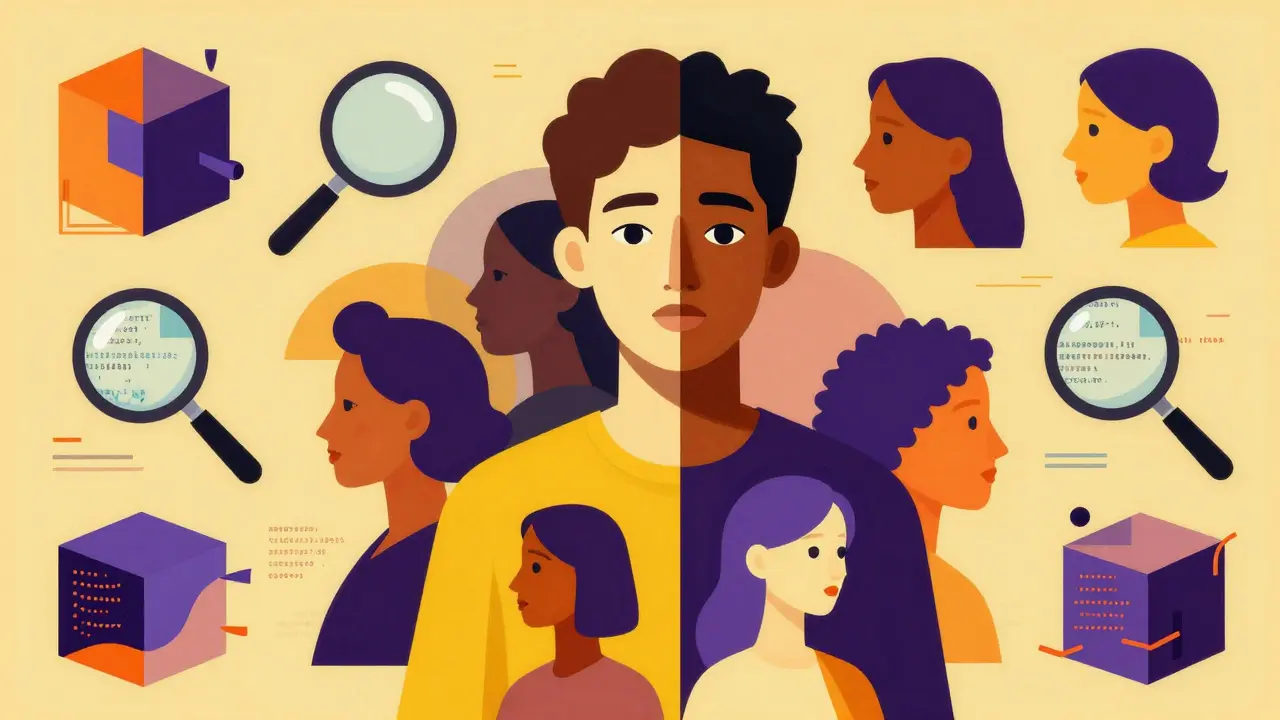
If you only test for gender, you might miss the problem. If you only test for race, you might miss another. Real-world bias is often intersectional-it happens at the overlap of identities. A healthcare chatbot might work fine for white men and fine for Black men, but fail completely for Black women.
In a 2024 case study, IBM’s AI Fairness 360 toolkit (version 0.5.1) revealed that a healthcare chatbot had a 41% higher error rate for Black female patients compared to white male patients when intersectional factors were considered. When analyzed by single dimensions, the difference appeared to be only 17%. That hidden 24% gap is where real harm occurs.
To conduct a proper audit, follow this three-tiered strategy:
- Run Intersectional Tests: Use tools like IBM’s AI Fairness 360 or Microsoft’s Fairlearn to test layered disparities across at least eight demographic dimensions simultaneously. Don't just check 'male/female'; check 'older Asian women' vs. 'younger white men.'
- Create Model Cards: Document your findings. By 2024, 68% of Fortune 500 companies adopted model cards. Google’s Gemini model card, for example, explicitly lists 12 known bias limitations, including underrepresentation of Indigenous languages. Transparency builds trust.
- Engage Community Auditors: Internal teams have blind spots. Meta’s Responsible AI Community program paid over 200 diverse contributors $75/hour to break their models. These external auditors found 37% more harmful outputs than internal testing did. Paying for diverse perspectives is cheaper than a lawsuit.
Remediation: Fixing the Bias
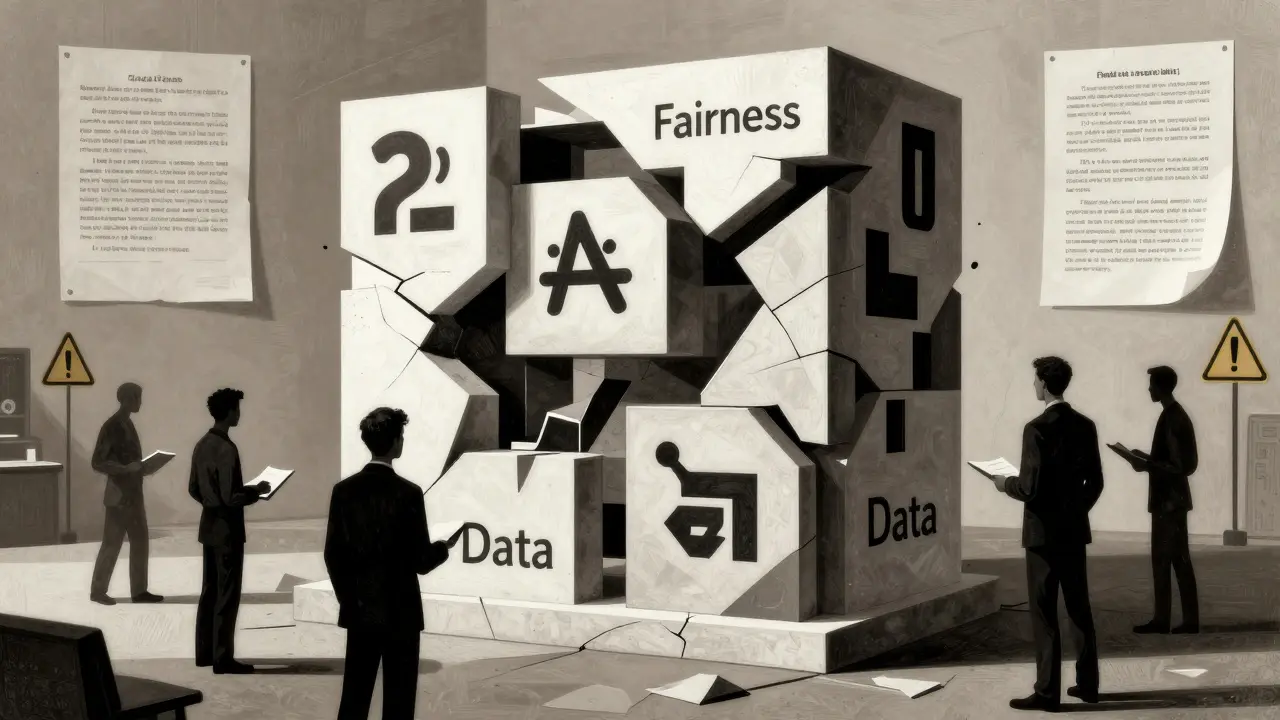
Finding bias is useless if you don't fix it. Remediation isn't just about tweaking a prompt; it often requires retraining the model or changing the data pipeline. Here is how leading organizations handle it.
Synthetic Data Augmentation When minority groups are underrepresented in training data, the model learns less about them. NVIDIA’s 2024 research demonstrated that using generative adversarial networks (GANs) to create synthetic, fairer data improved minority group representation by 29%. This helps balance the scales without violating user privacy.
Fairness-Aware Training Adobe’s Firefly image generator reduced skin tone bias by 62% through fairness-aware training techniques verified by third-party auditors in late 2023. This involves adding constraints during the training process so the model penalizes itself for generating stereotypical outputs.
Post-Hoc Mitigation If you can't retrain the model immediately, you can filter outputs. However, this is a band-aid. It risks censoring valid content. For high-stakes applications like finance or healthcare, retraining is the only safe option.
Consider the failure case of a major bank in 2023. Their generative AI loan assistant disproportionately denied applications from majority-Black neighborhoods. The result? A $12 million settlement with the Consumer Financial Protection Bureau (CFPB). The cost of ignoring remediation is astronomical.
Regulatory Landscape and Future Trends
The rules are tightening fast. As of 2026, 47 U.S. states have introduced AI fairness legislation. The EU AI Act mandates fairness testing for all high-risk AI systems. In November 2025, the White House Office of Science and Technology Policy released guidelines requiring quarterly fairness audits for government-contracted AI systems.
Market pressure is also driving change. Gartner predicts that by 2026, 75% of enterprises deploying generative AI will have formal fairness protocols, up from just 35% in 2023. Why? Because Forrester’s 2025 assessment shows that companies neglecting fairness face 3.2x higher regulatory risk and 28% lower user trust.
Looking ahead, the Partnership on AI is set to release the GENAI Fairness Benchmark in Q2 2026. This aims to standardize testing, much like MLPerf did for performance. Meanwhile, researchers at MIT are developing context-aware metrics that adapt to cultural nuances across 150+ languages, addressing a gap identified in 68% of multilingual deployments by UNESCO in 2025.
The bottom line? Fairness testing is not a one-time task. It is a continuous cycle of auditing, measuring, and fixing. Start small, use the right datasets, involve diverse humans, and document everything.
What is the most important metric for fairness in generative AI?
There is no single 'best' metric because fairness depends on context. However, disparate impact ratio is critical for legal compliance, especially under laws like NYC Local Law 144. For technical consistency, cosine similarity in embedding spaces helps ensure individual fairness. Always combine statistical metrics with human evaluation, as automated scores only correlate 63% with human judgment.
How long does a full fairness audit take?
For mature organizations with existing data pipelines, a comprehensive fairness audit typically takes 3 to 6 months. This includes setting up intersectional tests, engaging community auditors, and documenting results in model cards. Implementing these processes can increase model development cycles by an average of 38%, according to developer surveys.
Can I use open-source tools for fairness testing?
Yes. Tools like IBM’s AI Fairness 360 and Microsoft’s Fairlearn are open-source and widely used. Fairlearn has over 4,200 stars on GitHub as of early 2026. These libraries provide pre-built algorithms to detect disparate impact and other biases, making them accessible even for teams without deep statistical expertise.
What is the penalty for failing fairness tests?
Penalties vary by region and industry. In the U.S., violations can lead to massive settlements, such as the $12 million CFPB fine against a bank for biased lending AI. Under the EU AI Act, non-compliance with high-risk system requirements can result in fines up to 6% of global annual turnover. Beyond fines, brands face reputational damage and loss of user trust.
Why is intersectionality important in AI audits?
Intersectionality reveals hidden biases that single-dimension tests miss. For example, a model might appear fair when analyzing gender alone and fair when analyzing race alone, but show a 41% higher error rate for Black women specifically. Testing intersections ensures that marginalized subgroups are not overlooked.