Large language models sound smart. Too smart. They’ll confidently tell you the capital of Antarctica or quote a fake Supreme Court ruling with perfect grammar. You’ve seen it. Maybe you’ve even been burned by it. The problem isn’t that they’re wrong-they’re ungrounded. They don’t know what’s real. They only know what they’ve read. And that’s not enough for business, healthcare, or any high-stakes use case.
Grounded generation changes that. It’s not a magic trick. It’s a simple fix: connect your LLM to real, verified data. Instead of guessing, it looks up facts. Instead of inventing, it references. And the results? Companies using it report 30-50% fewer hallucinations and customer satisfaction scores that jump by 30% or more.
Why Ungrounded LLMs Fail in Real-World Use
Think of a standard LLM like a library with no catalog. It’s got billions of books-everything from academic journals to blog posts to Reddit threads. But it can’t tell you which book is real, updated, or relevant. It just guesses based on patterns. That’s fine for writing poetry or brainstorming names. Not fine for answering a patient’s question about medication interactions or explaining tax law changes.
Without grounding, LLMs rely entirely on their training data. That data is frozen. It doesn’t know about new regulations, product updates, or recent mergers. A model trained in 2023 won’t know that the FDA approved a new drug in January 2026. It might make up a plausible-sounding response instead. That’s not just inaccurate-it’s dangerous.
And users notice. On G2 Crowd, enterprise users rated grounded LLMs 4.6 out of 5 for accuracy. Ungrounded models? Just 3.2. Why? Because grounded systems don’t just sound confident. They’re verifiable.
How Grounded Generation Works: RAG and Beyond
The most common way to ground an LLM is called Retrieval-Augmented Generation, or RAG. It’s not complicated, but it’s powerful. Here’s how it works in three steps:
- Search: When a user asks a question, the system doesn’t answer right away. It first searches a structured knowledge base-like your company’s product docs, medical guidelines, or SEC filings-for the most relevant pieces of information.
- Retrieve: It pulls back a few paragraphs, tables, or entity records that best match the query. This is done using vector search, which finds content based on meaning, not just keywords. Tools like Pinecone, Weaviate, or FAISS handle this behind the scenes.
- Generate: The LLM gets the query plus the retrieved facts. Now it doesn’t guess. It writes a response based on what it just found. The output includes citations or references so users can check the source.
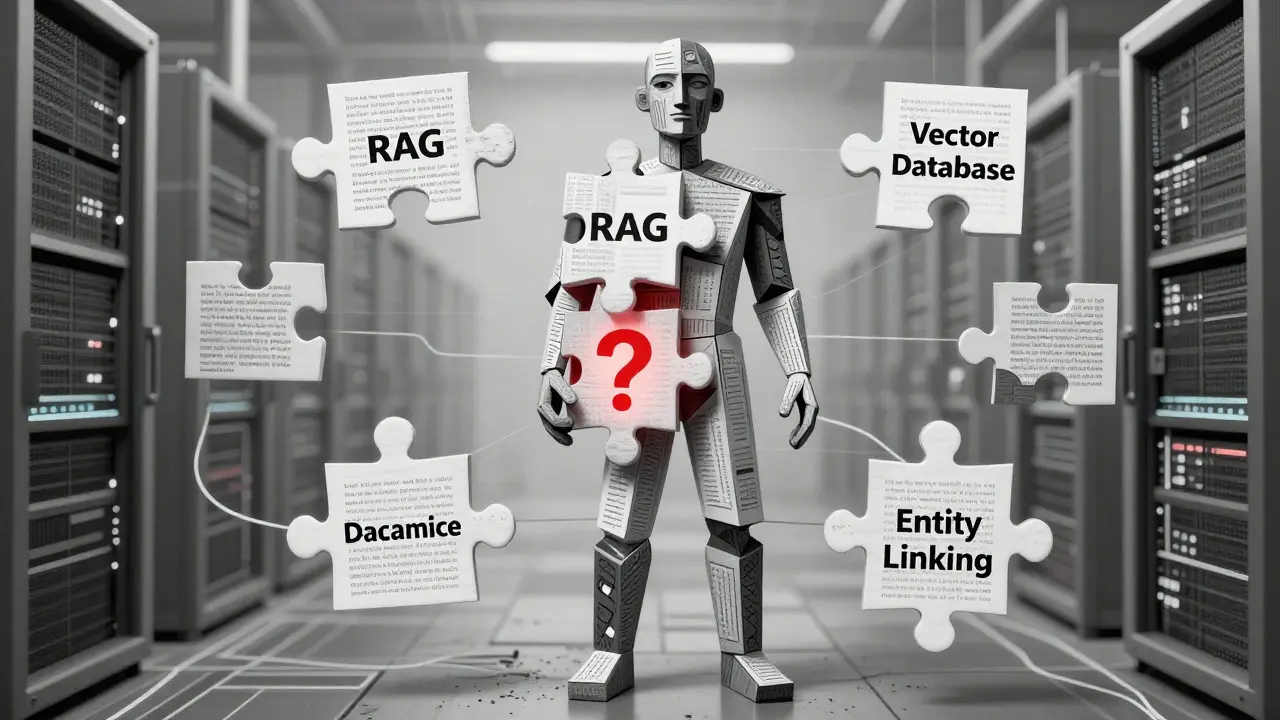
That’s RAG in its simplest form. But it’s not the only way. Some systems use entity-based knowledge bases-like linking a customer’s name directly to their account history, purchase records, and support tickets. Others inject real-time data-like stock prices, weather, or inventory levels-directly into the prompt. And newer methods, like Stanford’s Entity-Guided RAG, model relationships between entities (e.g., “Company X acquired Company Y in 2025”) to improve reasoning.
Where Grounded Generation Makes the Biggest Difference
This isn’t a one-size-fits-all solution. Grounded generation shines where accuracy matters more than creativity.
- Healthcare: A hospital in Minnesota cut medical misinformation errors by 25% after grounding their chatbot with up-to-date clinical guidelines and drug databases. No more guessing about off-label uses or contraindications.
- Finance: A Wall Street firm reduced regulatory compliance violations by 40% by grounding their assistant with SEC filings, FINRA rules, and internal audit logs. The system now cites exact rule numbers instead of paraphrasing.
- Customer Support: A SaaS company saw a 30% increase in customer satisfaction after grounding their support bot with product documentation and known bug fixes. Users stopped saying, “You’re wrong,” and started saying, “That’s exactly what I needed.”
Even government agencies are adopting it. The IRS started using grounded systems to answer taxpayer questions, reducing misinformation about deductions and deadlines. The EU AI Act now requires grounding for high-risk applications-meaning if you’re building an LLM for healthcare, finance, or public services, you’re already legally expected to ground it.
The Hidden Costs: Data, Maintenance, and Complexity
Grounded generation isn’t plug-and-play. It demands work.
First, you need good data. Not just any data. Clean, structured, and relevant. If your knowledge base is a mess of PDFs, old wikis, and scattered spreadsheets, RAG will pull garbage in-and the LLM will turn it into polished nonsense. One financial services team spent three months cleaning up their regulatory docs before their grounded system even worked reliably.
Second, it needs upkeep. Knowledge changes. New laws come out. Products get updated. If your knowledge base isn’t refreshed every 24-72 hours, your system becomes outdated. Automated pipelines are a must. Some platforms, like Microsoft’s Azure Cognitive Service for Grounded Generation, now auto-update content and link entities-cutting manual work by 60%.
Third, there’s a learning curve. You need people who understand vector databases, prompt engineering, and semantic search. Most teams start with 3-5 specialists. The initial setup? $15,000 to $50,000 for a basic system. But the ROI? Faster support, fewer compliance risks, and higher trust. One company saved $200,000 a year in customer service labor after reducing repeat questions by 45%.

What’s Next: The Future of Grounded Systems
Grounded generation is evolving fast. The next wave isn’t just about retrieving facts-it’s about reasoning with them.
Microsoft and Stanford are already testing systems that don’t just fetch text-they map relationships. Instead of pulling a paragraph about “Apple’s 2025 earnings,” they pull the entity “Apple Inc.” and its relationships: “Revenue: $420B,” “Product Line: Vision Pro,” “Legal Jurisdiction: California.” The model then reasons: “If Vision Pro sales are down 15%, and revenue is up 8%, then services must have grown.” That’s not just answering a question. It’s understanding context.
And soon, systems will ground themselves. Imagine an LLM that, during generation, automatically checks a trusted source like Wikidata or a government database to verify a claim before speaking. Forrester predicts this “self-grounding” model will be common by 2027.
Meanwhile, multimodal grounding is growing. Systems now combine text with images, sensor data, and video. A warehouse robot might use grounded generation to interpret a damaged package, compare it to known defect patterns, and recommend a repair-using both visual input and maintenance logs.
By 2026, Gartner predicts 80% of enterprise LLMs will be grounded. The ones that aren’t? They’ll be seen as risky, unreliable, and outdated.
Getting Started: Three Steps to Ground Your LLM
If you’re ready to move beyond hallucinations, here’s how to start:
- Pick your knowledge source. Start small. Pick one critical domain-product docs, internal policies, or regulatory guidelines. Don’t try to load everything. One clean, well-structured source is better than ten messy ones.
- Choose your tool. Use open-source frameworks like LangChain or LlamaIndex to build RAG. Or use cloud services like Azure Cognitive Search or Weaviate. For beginners, Azure’s pre-built grounding tools reduce setup time by half.
- Test and iterate. Run real user queries. Track what the system gets right and wrong. Use feedback loops to improve retrieval. Add query expansion to catch synonyms. Fine-tune your prompts. This isn’t a one-time setup-it’s a continuous improvement cycle.
Don’t wait for perfection. Start with one use case. Fix one kind of error. Measure the impact. Then scale.
What’s the difference between fine-tuning and grounded generation?
Fine-tuning changes the LLM’s internal weights using a dataset. It’s like teaching it a new language-but only what’s in that dataset. Grounded generation doesn’t change the model. It gives it real-time access to external facts. Fine-tuning works for style or tone. Grounding works for accuracy. RAG outperforms fine-tuning by 22-37% in factual tasks, according to Neptune.ai.
Can grounded generation eliminate all hallucinations?
No. But it cuts them by 30-50%. Some hallucinations come from flawed retrieval, ambiguous queries, or incomplete knowledge bases. Still, grounded systems reduce serious errors-like wrong medical advice or false financial claims-by a huge margin. They’re not perfect, but they’re the best tool we have right now.
Do I need a vector database to use RAG?
Yes, for anything beyond simple keyword matching. Vector databases like Pinecone, Weaviate, or FAISS turn text into numerical vectors so the system can find similar meaning, not just matching words. Without them, you’ll miss context. A query about “car engine problems” won’t match “issues with combustion engines” if you’re only using keyword search.
Is grounded generation only for big companies?
No. While enterprises lead adoption, startups are using it too. A small health tech firm in Asheville built a grounded chatbot for patients using open-source tools and a single Google Sheet of FAQs. Cost: under $5,000. Time: 3 weeks. Accuracy: 92%. Size doesn’t matter-clarity does.
What happens if my knowledge base is outdated?
The LLM will still use it-and that’s dangerous. An outdated medical guideline could lead to wrong advice. That’s why automated updates are critical. Most successful systems refresh content every 24-72 hours. For fast-changing fields like finance or tech, hourly updates are standard. If you can’t automate updates, don’t deploy.
ravi kumar
March 23, 2026 AT 06:48Been using RAG for our internal HR bot, and the difference is night and day. Before, people would ask about PTO policies and get back a paragraph that sounded like it was written by a confused AI from 2021. Now? It pulls directly from our latest HR handbook. No more "you can take 15 days but only if it's a leap year" nonsense. Real data, real results.
Also, the citation feature? Game changer. Employees can click the link and see the exact policy page. Trust went up. Complaints went down. Honestly, if you're not doing this yet, you're just delaying the inevitable.
Megan Blakeman
March 24, 2026 AT 08:01I just... I can't believe how much better this feels. 😊 Like, finally, an AI that doesn't make me second-guess every answer. I used to have to fact-check everything, even simple stuff. Now? I can just... breathe. 🤍
And the citations? So soothing. Like a little safety net. I feel like we're not just building tools-we're building honesty. 💬
Akhil Bellam
March 25, 2026 AT 04:35Oh please. You're all acting like RAG is some revolutionary breakthrough. It's 2026. We've had semantic search since 2021. Vector databases? Please. I built my first FAISS cluster before most of you knew what a transformer was.
The real issue? You're still treating this like a plug-and-play feature. You think throwing in a knowledge base is enough? Ha. Half your "grounded" systems are just glorified autocomplete with a fancy UI. The data is still garbage-in-garbage-out. And if you're not using entity linking with temporal grounding? You're not grounded-you're just... pretending.
Stanford's Entity-Guided RAG? Now that's something. But you? You're still using PDFs from 2023 and calling it a day. Pathetic.
Amber Swartz
March 26, 2026 AT 15:12Okay but like… what if the knowledge base is wrong? 😭
I mean, imagine your system pulls a document that says "vaccines cause autism" because someone uploaded a 2012 blog post and it never got updated. 😵💫
And then the LLM says it with perfect confidence. And people believe it. And then… what? 😭
I just… I can't sleep at night thinking about this. It's like, we're building a Frankenstein monster that thinks it's a librarian. And it's… so beautiful. And so terrifying.
Robert Byrne
March 28, 2026 AT 05:42You're all missing the point. This isn't about RAG. It's about accountability. If your AI hallucinates and tells a patient they can mix aspirin with warfarin? That's not a bug. That's malpractice.
And you think fine-tuning fixes this? No. Fine-tuning just makes the hallucination sound more convincing. Grounded generation? At least now you can trace the error back to a source. You can say, "This document was outdated." You can fix it. You can audit it. You can fire the person who uploaded the wrong PDF.
Stop romanticizing AI. This isn't magic. It's a tool. And tools have responsibility. If you can't maintain the data, don't deploy the system. Period.
Tia Muzdalifah
March 29, 2026 AT 10:54my company tried this last year and honestly? it’s wild how much less people yell at the chatbot now. like… we used to get emails like "you said my refund was approved but it’s not??" and now they’re like "oh cool, here’s the link to the policy" and just… move on. 🤷♀️
also, the fact that it cites stuff? i feel like we’re finally not lying to our customers. which is… kinda a big deal?
Zoe Hill
March 31, 2026 AT 10:24Just wanted to say thank you for this post. I work in a small clinic and we were terrified of using AI for patient questions. But after setting up a grounded system with our drug database? We haven't had a single error in 6 months. 🥹
It’s not perfect-sometimes it pulls the wrong document-but we fixed that with better tagging. And now our nurses say they feel way more confident. Honestly? This might be the most important thing I’ve read all year.
Albert Navat
April 2, 2026 AT 05:30Let’s cut through the noise. You’re all talking about RAG like it’s the holy grail. But the real bottleneck isn’t the retrieval-it’s the schema. If your knowledge base isn’t normalized, if your entities aren’t linked, if your metadata isn’t indexed… you’re just feeding the LLM a dumpster fire with a bow on it.
And don’t get me started on "open-source tools." You think LangChain is going to handle real-time inventory updates from SAP? Please. You need a proper graph database with temporal versioning, not some Python script that runs on a Raspberry Pi.
If you’re not using Kafka streams to auto-sync your docs with your ERP, you’re not grounded-you’re just… gambling.
Tyler Durden
April 3, 2026 AT 15:35Let me tell you something-grounded generation isn’t about stopping hallucinations. It’s about rebuilding trust. One fact at a time.
I used to think AI was just a tool. Now? I think it’s a mirror. It reflects what we feed it. And if we feed it lies? It’ll serve them with a smile.
But if we feed it truth? Clean, structured, updated? It becomes something else. Something powerful. Something we can rely on.
This isn’t just tech. It’s ethics. It’s responsibility. It’s the difference between a system that answers… and a system that deserves to be trusted.
So stop asking "how?" and start asking: what kind of truth are you willing to build?
Aafreen Khan
April 4, 2026 AT 20:14lol grounded generation? more like grounded in reality?? 🤭
my cousin's startup used a google sheet and now their bot gets 95% accuracy. no vector db. no azure. just a well-organized sheet. 🤷♀️
you guys are overcomplicating everything. it's not rocket science. just don't let the ai make stuff up. duh.