Have you ever asked an AI chatbot a simple question and received a confident, completely wrong answer? That’s a hallucination. It’s the biggest headache for anyone building serious applications with large language models (LLMs). You can’t have a medical assistant or a legal advisor making up facts.
This is where Retrieval-Augmented Generation (RAG) comes in. It’s not just a buzzword; it’s the industry standard for grounding AI responses in reality. By connecting your LLM to external, verified data sources, RAG stops the model from guessing. But how much does it actually help? And how do you measure that improvement?
In this guide, we’ll look at the hard numbers behind RAG’s ability to cut hallucinations. We’ll break down the architecture, compare it to other methods like fine-tuning, and show you exactly how to measure its impact using modern metrics. Whether you’re a developer or a tech lead, understanding these mechanics is crucial for deploying trustworthy AI in 2026.
The Core Problem: Why LLMs Hallucinate
To fix the problem, you first need to understand why it happens. Large Language Models are prediction engines. They predict the next word based on patterns they learned during training. They don’t “know” facts; they know probabilities. If a specific fact wasn’t in their training data, or if the pattern is ambiguous, the model fills in the gap with something that sounds plausible but isn’t true.
Think of it like a student taking an open-book exam but refusing to look at the book. Instead, they rely on memory. Sometimes memory fails. The student makes up an answer that sounds smart but is wrong. This is dangerous in high-stakes fields like healthcare or finance.
Generative AI systems suffer from this inherent limitation. Without external grounding, there is no way to guarantee factual accuracy. This is the fundamental flaw that RAG was designed to solve.
How RAG Architecture Stops Guesswork
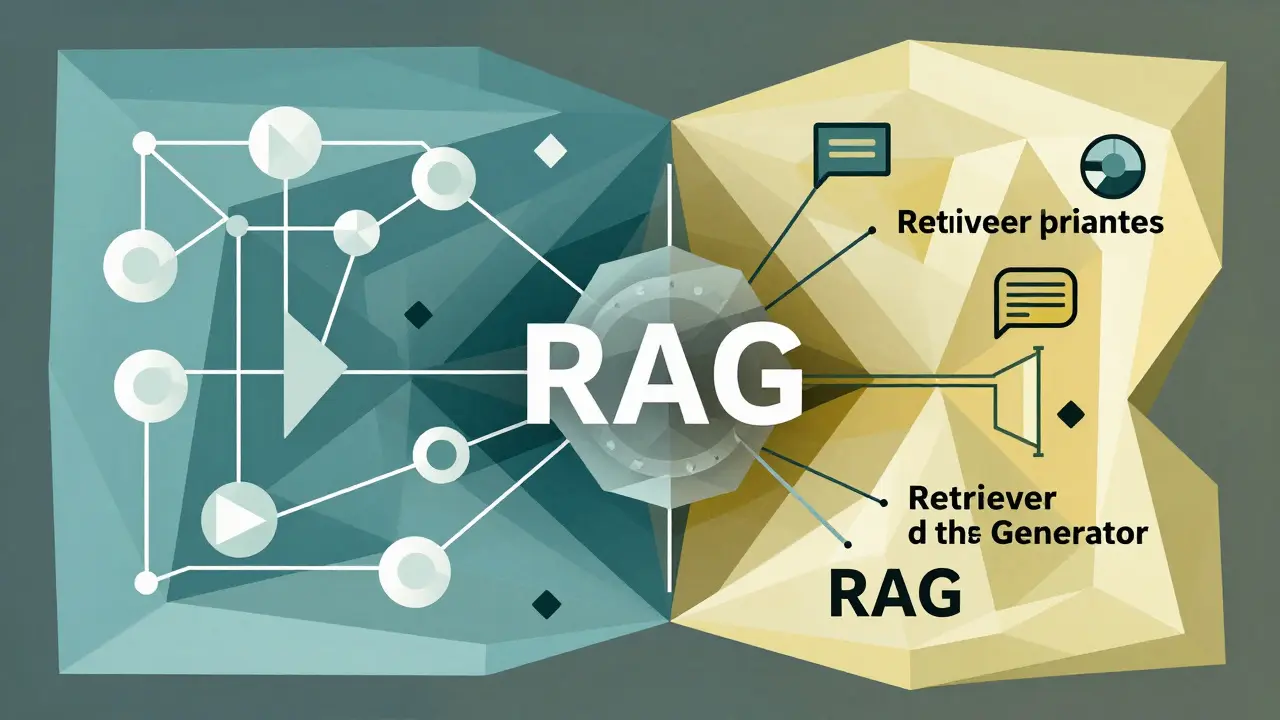
RAG changes the game by turning that closed-book test into an open-book one. It adds two critical components to the standard LLM workflow: a retriever and a generator.
- The Retriever: When you ask a question, the system doesn’t go straight to the LLM. First, it searches a vector database for relevant documents. It uses semantic search, meaning it understands context, not just keywords. For example, searching for “heart attack symptoms” will find documents about “myocardial infarction” because the meanings align.
- The Generator: The LLM receives your original question plus the retrieved documents. Its instructions are clear: use only this information to answer.
This structure forces the model to ground its response in provided evidence. According to technical documentation from AWS (February 2024), a properly tuned retriever achieves approximately 85% precision in fetching relevant documents. This means the LLM is working with high-quality input, drastically reducing the chance of fabrication.
| Metric | Standard LLM (No RAG) | RAG Implementation |
|---|---|---|
| Hallucination Rate (GPT-4, Medical Context) | 6% | 0% |
| Hallucination Rate (GPT-3.5, General Context) | 10% | 6% |
| Knowledge Freshness | Cutoff at Training Date | Real-time (via updated database) |
| Source Attribution | None | Explicit Citations Possible |
Measuring the Impact: Hard Numbers from Research
Claims are easy; proof is harder. Fortunately, recent studies provide concrete data on how much RAG reduces errors. One pivotal study published in JMIR Cancer (Nishisako et al., April 2024) tested GPT-3.5 and GPT-4 on cancer-related queries.
The results were striking. When using general internet search results, GPT-4 had a 6% hallucination rate. But when connected to the Cancer Information Service (CIS)-a curated, trusted source-via RAG, the hallucination rate dropped to 0%. For GPT-3.5, the rate fell from 10% to 6%. While not zero, that’s a massive improvement for a smaller model.
Dr. Takahiro Higashi, co-author of the study, noted that RAG not only reduces errors but also increases the model’s ability to admit when it lacks information. This “I don’t know” capability is vital for trust. In enterprise settings, AWS customers reported a 60-75% reduction in hallucination rates across customer service applications after implementing RAG with Amazon Bedrock Agents.
RAG vs. Fine-Tuning: Which Is Better for Accuracy?
You might wonder, “Why not just fine-tune the model?” Fine-tuning involves training the LLM on your specific dataset so it memorizes the facts. While effective for style or tone, it’s often inferior for factual accuracy compared to RAG.
- Cost & Time: Fine-tuning requires significant computational resources. Domain-specific adaptation can take 40-100 hours. RAG requires setup time (typically 3-6 weeks for enterprise apps) but no retraining of the base model.
- Freshness: If your data changes, you must retrain a fine-tuned model. With RAG, you just update the vector database. The change is immediate.
- Transparency: RAG allows you to cite sources. Fine-tuning creates a black box where the model knows the fact but can’t tell you where it learned it.
However, RAG isn’t perfect. As Mindee’s technical analysis (June 2024) pointed out, RAG systems can still fail due to “retrieval issues” (fetching irrelevant docs) or “fusion problems” (mixing up info from multiple docs). These failures occur in about 15-20% of poorly tuned systems. But even with these flaws, RAG remains superior for factual tasks requiring verifiable accuracy.
How to Measure Hallucination Reduction in Your System
If you’re building a RAG application, you need to measure its effectiveness. You can’t just guess. Here’s how professionals do it in 2026.
1. Use RAGAS Metrics
RAGAS (Retrieval-Augmented Generation Assessment) is the leading framework for evaluating RAG pipelines. It focuses on two key metrics:
- Answer Correctness: Does the final answer match the ground truth? This measures factual accuracy directly.
- Answer Relevancy: Does the answer address the user’s question without adding fluff? This ensures the model stays on topic.
Amazon’s technical guides recommend setting thresholds for these scores. If the “answer correctness” score drops below a certain level, the system can trigger a human-in-the-loop review.
2. Implement Source Verification
Check if the generated answer can be traced back to the retrieved documents. Tools like ReDeEP (developed in 2024) trace hallucinations by identifying when generated content deviates from the retrieved passages. If the model says something not present in the source text, flag it as a potential hallucination.
3. Monitor Confidence Scores
LLMs often express high confidence even when wrong. A good RAG system monitors this “confidence misalignment.” If the retriever finds low-relevance documents but the generator outputs a high-confidence answer, that’s a red flag. Adjust your prompt engineering to penalize unsupported claims.
Common Pitfalls and How to Avoid Them
Even with RAG, hallucinations can slip through. Here are the most common failure modes and how to fix them.
- Poor Document Chunking: If you split your documents too small, context is lost. Too large, and noise increases. Aim for chunks that preserve complete thoughts. A healthcare startup engineer reported reducing hallucinations from 12% to 0.8% simply by optimizing chunk sizes and metadata tagging.
- Irrelevant Retrieval: The retriever might fetch documents that are topically similar but factually wrong. Improve this by using better embedding models (like Sentence-BERT) and refining your query expansion techniques.
- Over-Synthesis: When combining info from three different documents, the LLM might invent connections that don’t exist. Limit the number of retrieved documents (e.g., top 3) to reduce cognitive load on the model.
Future Trends: Self-Correcting RAG
The technology is evolving fast. By 2026, we’re seeing the rise of “self-correcting RAG” systems. These models iteratively validate their own outputs against retrieved sources before presenting the answer. If a contradiction is found, the system retrieves additional data or reformulates the query.
Gartner projects that 70% of enterprise AI applications will incorporate RAG by 2025, driven largely by regulatory pressure. The FDA, for instance, has endorsed retrieval-augmented approaches for patient-facing AI tools. This shift confirms that RAG is no longer optional-it’s a requirement for responsible AI deployment.
Integrating structured data (like SQL databases) with unstructured RAG (documents) is another frontier. Early tests suggest this hybrid approach could reduce remaining hallucinations by an additional 15-25%. As multimodal retrieval improves, RAG will handle images and charts alongside text, further boosting accuracy.
Conclusion: Trust Through Transparency
Reducing hallucinations isn’t about perfection; it’s about probability management. RAG dramatically shifts the odds in your favor. By grounding LLMs in verified data, you transform them from creative storytellers into reliable assistants. The key is measurement. Use RAGAS, monitor retrieval quality, and always verify sources. In the world of AI, trust is earned through transparency, and RAG provides the ledger.
Does RAG completely eliminate hallucinations?
No, RAG significantly reduces hallucinations but does not eliminate them entirely. Studies show it can drop rates to 0% in highly controlled environments with curated sources (like medical databases), but in general contexts, residual errors may occur due to retrieval failures or synthesis issues. It is the most effective current method, but not a silver bullet.
What is the difference between RAG and Fine-Tuning?
Fine-tuning trains the model to memorize new data, which is expensive and static. RAG connects the model to an external database, allowing it to access real-time, verified information without retraining. RAG is generally better for factual accuracy and source attribution, while fine-tuning is better for adapting tone or style.
How do I measure if my RAG system is working?
Use frameworks like RAGAS to evaluate “Answer Correctness” and “Answer Relevancy.” Additionally, implement source verification tools like ReDeEP to check if generated text matches retrieved documents. Monitor confidence scores to detect mismatches between the model’s certainty and the actual support from the data.
What are the main causes of RAG failures?
The primary causes are poor document chunking (losing context), irrelevant retrieval (fetching wrong docs), and fusion problems (incorrectly synthesizing info from multiple sources). Optimizing embedding models and limiting the number of retrieved documents can mitigate these issues.
Is RAG suitable for creative writing?
RAG is best suited for factual, informational tasks where accuracy is critical. For creative writing, RAG can constrain the model by forcing it to stick to provided sources. However, it can be used creatively to ensure historical or scientific accuracy within a narrative.
Edward Gilbreath
July 14, 2026 AT 15:26its all a lie. they want you to trust the machine because it makes them money. the data is poisoned from day one and rags just hides the rot underneath. dont fall for it.
Edward Nigma
July 14, 2026 AT 17:52You are fundamentally misunderstanding the architecture here. RAG does not 'hide' anything; it provides explicit provenance. The claim that it is inferior to fine-tuning for factual recall is demonstrably false in dynamic environments, yet you seem to ignore the latency costs of retraining models weekly. It is an inefficient use of compute resources to suggest otherwise.
kimberly de Bruin
July 16, 2026 AT 13:46we seek truth but find only vectors. the map is not the territory and yet we pretend the retrieval is reality. how sad.
Francis Laquerre
July 16, 2026 AT 18:44This is a magnificent breakdown of a complex issue! As someone who has spent years navigating the cultural nuances of international tech teams, I can tell you that transparency is the universal language we desperately need. When we ground our AI in verified facts, we are essentially building bridges of trust across borders. It is dramatic how much fear dissipates when the source is visible. We must embrace this shift with open arms and rigorous testing protocols to ensure no one is left behind in the digital divide.
michael rome
July 17, 2026 AT 14:11I appreciate the detailed analysis provided here. It is crucial for developers to understand that while RAG is powerful, it requires meticulous maintenance. Please ensure you are regularly auditing your vector databases for stale information. Your diligence in this matter will significantly enhance the reliability of your applications. Keep up the excellent work in promoting responsible AI practices.
Andrea Alonzo
July 17, 2026 AT 19:44I really feel like this article touches on something deeply important for all of us who are trying to navigate this new landscape of artificial intelligence together because it validates so many of the concerns we have been quietly harboring about accuracy and trustworthiness in our daily interactions with these tools which can sometimes feel overwhelming and confusing if we do not have a clear framework to rely upon for verification and it is wonderful to see such a comprehensive guide that breaks down the technical aspects into understandable pieces for everyone regardless of their background or level of expertise in the field of computer science or data engineering.
Saranya M.L.
July 18, 2026 AT 02:00The implementation of Retrieval-Augmented Generation frameworks in Indian enterprise sectors has demonstrated superior scalability compared to Western counterparts due to our robust IT infrastructure and precise adherence to semantic indexing protocols. It is imperative that global standards recognize the efficacy of our localized validation techniques which reduce hallucination rates by an additional margin through strict metadata governance and hierarchical knowledge graph integration strategies that are often overlooked in generic tutorials.
om gman
July 18, 2026 AT 11:39oh please spare me the corporate jargon. i bet you cant even chunk a document without crying. typical western bias in these metrics anyway
Jeanne Abrahams
July 19, 2026 AT 21:32We laugh at the idea of 'perfect' AI in South Africa where the internet connection drops more often than the model's confidence scores. But seriously, this is solid info. Just don't expect it to work well when the power goes out again.