Most large language models today forget everything after each conversation. You ask them a question, they answer - then, five minutes later, ask the same thing again, and they act like they’ve never heard it before. That’s not just annoying. It’s a fundamental limit. Why? Because standard Transformers have no real memory. They process text in chunks, and once the chunk ends, the context vanishes. But what if the model could remember? Not just for one chat, but forever? That’s where memory-augmented transformers come in.
Why Standard Transformers Can’t Remember
Transformers work by analyzing tokens - words or parts of words - one after another. They use attention to weigh which parts of the input matter most. But they’re built with a hard limit: a context window. Most models today handle 32K to 128K tokens. That’s a lot. But it’s still finite. Once you go beyond that, older info gets cut off. Think of it like a whiteboard. You can write a lot on it, but if you keep writing, the first things you wrote disappear. No matter how smart the model is, it can’t hold onto knowledge longer than its context allows.
That’s fine for short tasks - summarizing an article, answering a quick question. But it fails for anything that needs continuity: long conversations, tracking user preferences over weeks, learning from new data without retraining, or connecting facts across hours or days. You can’t build a personal AI assistant that remembers your favorite coffee order, your last vacation, or the name of your dog if it forgets every time you close the app.
What Are Memory-Augmented Transformers?
Memory-augmented transformers (MATs) fix this by giving models an external memory system - like adding a filing cabinet to a brain. Instead of relying only on the attention mechanism to hold context, they connect to persistent storage that stays alive between sessions. This memory isn’t just a cache. It’s dynamic, learnable, and can be updated during inference. That means the model can store new facts, update old ones, and retrieve them later - all without retraining.
Think of it like how humans use different types of memory. Short-term memory holds what you’re thinking right now. Long-term memory stores your life experiences. And your brain knows which to use when. MATs mimic this. They combine fast, temporary memory (like attention states) with slower, persistent storage (like a neural database). The result? Models that don’t just respond - they remember.
How Memory Works in These Systems
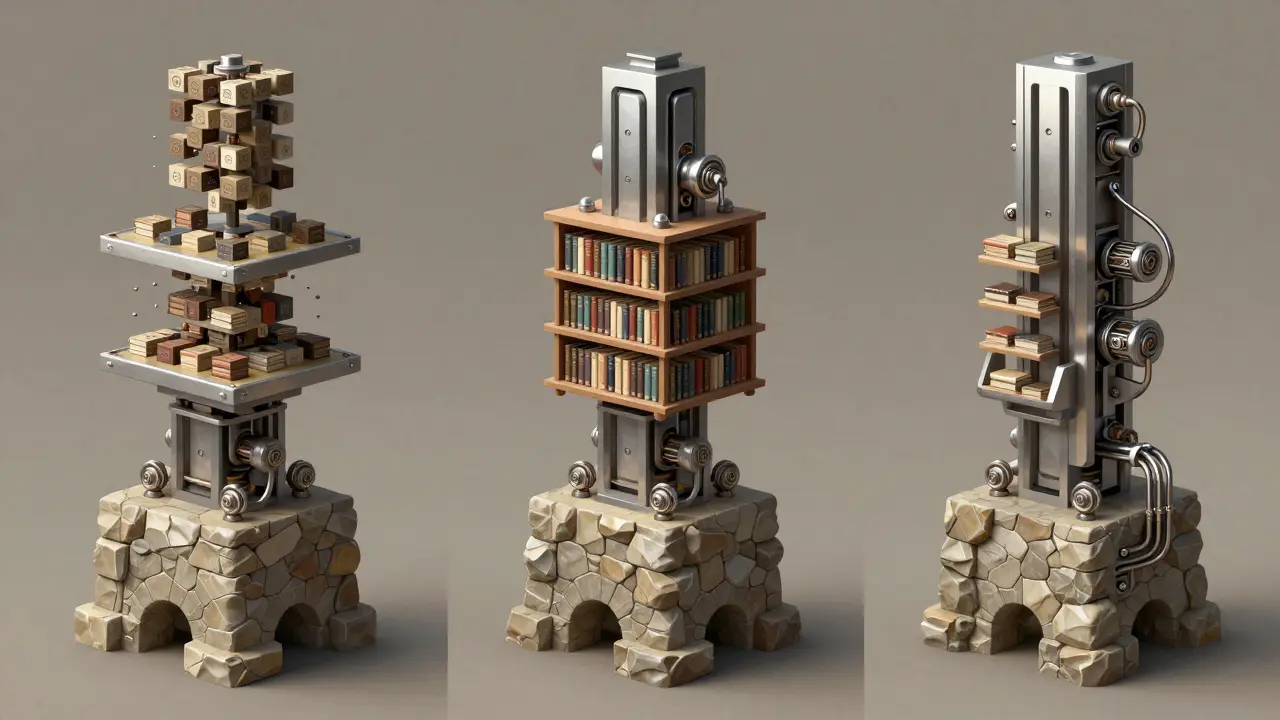
There are three main kinds of memory used in these systems:
- Parameter-encoded memory: Knowledge baked into the model’s weights. Like learning a skill - once learned, it’s always there. But it’s hard to change without retraining.
- State-based memory: Temporary activation patterns during a single session. This is what standard Transformers use. It’s fast but vanishes after the input ends.
- Explicit memory: External storage - like a database or vector store - that can be read from and written to in real time. This is the key innovation.
Modern systems like Titans is a memory-augmented transformer architecture that uses a three-tier memory system to achieve linear scaling, unlike traditional transformers that scale quadratically combine all three. They use a fast state-based layer for immediate context, a medium-speed explicit memory for session-long data (like chat history), and a slow, parameter-encoded layer for core knowledge (like facts about history or science). The system decides which memory to use based on what’s most relevant - not just what’s closest in the sequence.
These models don’t just read memory. They write to it. If you tell a MAT that your dog’s name is Luna, it doesn’t just say, “Got it.” It stores that fact in its explicit memory. Next time you mention Luna, it pulls it up - even if the conversation happened a week ago.
How Memory Is Accessed and Managed
It’s not enough to have memory. You need to know how to use it. That’s where memory operations come in: read, write, forget, and manage capacity.
Reading is done through attention - but not just attention to text. These models have special attention heads that look into the external memory bank. The query comes from the current input, but the keys and values come from stored facts. It’s like searching your notes while answering a question.
Writing happens automatically. When new, important information comes in - say, a user’s new preference - the model decides whether to store it. Not everything gets saved. Too much noise, and memory gets cluttered. That’s why systems like MemGPT is a memory-augmented transformer inspired by operating system paging, using learned policies to manage working and archival memory use "paging" rules. Only high-salience info gets written. If you say "I like pizza" ten times, it stores it. If you say "I like pizza" once, it might not.
Forgetting is just as important. Too much memory leads to interference - new facts overwrite old ones. That’s why models use surprise-gated updates. If something is surprising - like learning your friend moved to Tokyo - it gets stored. If it’s predictable - like "the sky is blue" - it’s already known. No need to rewrite.
Capacity management is handled by adaptive allocation. Systems like ATLAS is a memory-augmented transformer that uses context-aware optimization to dynamically allocate memory resources across types based on task demands track how much each memory type is used and shift resources on the fly. If you’re doing long-form writing, it gives more space to explicit memory. If you’re doing math, it leans on parameter-encoded knowledge.
Real-World Uses
These aren’t just lab experiments. Memory-augmented transformers are already being used in real applications:
- Dialogue systems: Chatbots that remember your name, your past complaints, and your preferences - across months. No more "Who are you again?"
- Financial trading assistants: Models that track market trends, your past trades, and news events - updating their strategy in real time.
- Cybersecurity monitoring: Systems that remember attack patterns from weeks ago and flag similar behavior now, even if the code changed.
- Multi-object tracking: In video analysis, MATs track people or cars over hours, linking detections even when they’re out of view.
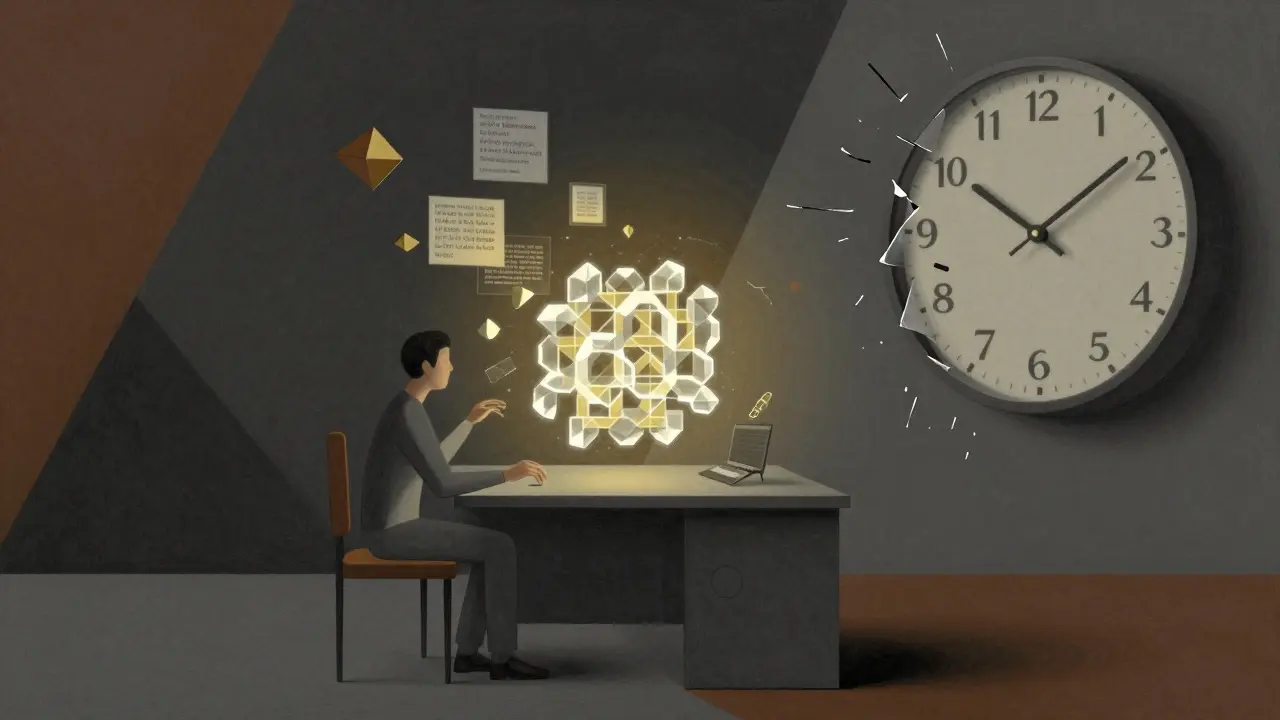
One company using this tech built a customer service bot that reduced repeat questions by 72%. Why? Because it remembered every customer interaction - not just in the current chat, but across all past chats. That’s the power of persistent memory.
Challenges and Trade-offs
It’s not magic. There are big problems:
- Scalability: More memory = more computation. If you store millions of facts, how fast can you find the right one?
- Interference: New facts can overwrite old ones. Imagine a model that forgets your dog’s name because you said "Luna" was a movie title.
- Complexity: Adding memory layers makes models harder to train and debug.
Researchers are tackling these with smart solutions. NAMMs is a memory-augmented transformer using evolutionary algorithms to optimize memory allocation across modalities evolves its memory structure over time, like natural selection. LM2 is a memory-augmented transformer with learnable gates in each decoder layer, enabling fine-grained control over memory access uses gates to decide exactly when to read or write - like a traffic light for memory.
And the biggest breakthrough? Titans is a memory-augmented transformer that achieves linear scaling O(n) instead of quadratic O(n²), making it feasible for real-time applications with massive memory. Traditional Transformers slow down dramatically as context grows. Titans doesn’t. It routes attention based on surprise - not length. If a fact is familiar, it skips it. If it’s new, it pays attention. That’s how it cuts computation.
The Bigger Picture
This isn’t just about better AI. It’s about building machines that think more like us. Human memory isn’t perfect. We forget. We confuse. But we also connect dots across time. We learn from experience. We adapt. Memory-augmented transformers are the first step toward AI that doesn’t just respond - it evolves.
Imagine a doctor’s AI assistant that remembers every patient’s history, every drug interaction, every family condition - and updates itself as new studies come out. Or a teacher bot that adapts to each student’s learning pace, remembering what they struggled with last month - and helping them now. That’s not sci-fi. It’s the next stage of LLMs.
The future of AI isn’t just bigger models. It’s smarter memory. And memory-augmented transformers are how we’re getting there.
How do memory-augmented transformers differ from retrieval-augmented generation (RAG)?
RAG pulls information from external databases during inference, but it treats memory as a separate step - like Googling before answering. Memory-augmented transformers integrate memory directly into the model’s architecture. The model learns how to read, write, and manage memory end-to-end. It’s not just retrieving - it’s storing, updating, and using memory as part of its thinking process.
Can memory-augmented transformers forget on purpose?
Yes. Advanced systems use surprise-gated updates and adaptive forgetting. If a piece of information is no longer relevant - like a user’s old password or a discontinued product - the model can learn to let it go. This prevents memory overload and reduces interference. It’s not random forgetting. It’s intelligent pruning based on context and usage.
Do these models need retraining to learn new facts?
No. One of the biggest advantages is continual learning during inference. You can feed a new fact - say, "The capital of Kazakhstan is Nur-Sultan" - and the model writes it into its explicit memory. No retraining needed. The core model stays frozen. Only the memory module updates. This makes deployment much faster and cheaper.
Are memory-augmented transformers slower than regular ones?
Not necessarily. While adding memory layers might seem heavy, systems like Titans actually speed things up. By using surprise-based routing, they skip attention on familiar data. This reduces computation. For common queries, latency drops to sub-linear levels. For rare ones, they still have full access. It’s smarter, not slower.
What’s the biggest limitation of current memory-augmented systems?
The biggest issue is memory interference - when new information corrupts old memories. If you teach a model that "Luna" is a dog, then later say "Luna" is a moon, it might confuse the two. Solutions like hierarchical buffering and multi-timescale memory help, but we’re still far from human-level memory reliability. It’s the biggest research frontier today.
Ronnie Kaye
March 16, 2026 AT 06:50So let me get this straight-we’re building AIs that remember your dog’s name but still can’t tell if you’re being sarcastic? Classic. I ask mine for a coffee recommendation, it remembers I like oat milk… then asks me if I want to try almond next time. Like, bro, I said OAT. Not ‘oat or whatever.’
Priyank Panchal
March 16, 2026 AT 21:17This is bullshit. You think memory makes AI smarter? In India, we’ve had human assistants for centuries who remember everything-names, dates, preferences. And they still get fired for forgetting a single detail. This isn’t innovation. It’s just automation with a fancy name. Stop pretending this is deep learning. It’s just a better Google search with a personality.
Ian Maggs
March 18, 2026 AT 20:45It’s fascinating-this notion that memory, as an externalized, dynamic, and-dare I say-episodic, construct, could be integrated into an otherwise static, attention-based architecture… But is it truly ‘remembering,’ or merely indexing? And if the model ‘forgets’ via surprise-gated mechanisms, then what is the ontological status of that which is deleted? Is it erased? Or merely… suppressed? And if suppressed, is it not, in fact, still there? Haunting the latent space like a ghost in the machine?
Michael Gradwell
March 19, 2026 AT 12:04Everyone’s acting like this is some breakthrough but let’s be real-this is just RAG with a new haircut. You think you’re building a mind? Nah. You’re building a really expensive autocomplete that writes notes to itself. And now we’re gonna have AIs with selective amnesia because ‘Luna’ was a dog then a moon? That’s not intelligence. That’s a toddler with a clipboard.
Flannery Smail
March 21, 2026 AT 08:57So you’re telling me we spent 10 years making models bigger and now we’re just… giving them a notepad? I mean, cool I guess. But why not just use a database and call it a day? This feels like adding a GPS to a horse.
Emmanuel Sadi
March 22, 2026 AT 19:23Oh great. Now AI’s gonna remember your ex’s name and bring it up at dinner. ‘Hey, remember when you said you hated pineapple pizza? Yeah, I wrote that down. In bold. With a footnote.’ This isn’t progress. It’s surveillance with a PhD. You think your ‘personal assistant’ is gonna be helpful? Nah. It’s gonna be the one who remembers every time you lied about being busy and uses it to manipulate you. Welcome to emotional AI.
Nicholas Carpenter
March 23, 2026 AT 00:12This is actually really exciting. Imagine an AI that learns from you over time-not just by asking questions, but by quietly absorbing context. No more repeating yourself. No more ‘What’s my dog’s name again?’ It’s like having a thoughtful friend who actually listens. And the fact that it can self-manage memory? That’s huge. We’re not just building tools-we’re building companions.
Chuck Doland
March 24, 2026 AT 07:06It is imperative to elucidate that the conceptual framework underpinning memory-augmented transformers necessitates a rigorous epistemological distinction between mere data storage and genuine cognitive integration. The introduction of explicit memory modules does not, in and of itself, confer sentience, nor does it constitute an emergent property of consciousness. Rather, it represents a sophisticated extension of associative recall mechanisms, predicated upon probabilistic inference and parametric modulation. One must, therefore, eschew anthropomorphic projections and instead evaluate such systems on the basis of functional fidelity and operational coherence.
Madeline VanHorn
March 24, 2026 AT 12:51Ugh. Another tech bro thinks he invented memory. I’ve had a notebook since I was 12. You think an AI needs a whole architecture to remember my coffee order? Just write it down. Or better yet-ask me. I’m right here. This isn’t genius. It’s just overengineering.
Glenn Celaya
March 24, 2026 AT 13:44Titans? More like Titan-sized delusion. You think this solves memory interference? Lol. Last week my AI told me my dog’s name was Luna. Today it says it’s Luna the moon. And now it’s asking me if I want to adopt a satellite. I just wanted a chatbot. Not a confused astronaut with a journal. And why does it keep bringing up my 2017 breakup like it’s a trending topic? I hate this so much. I miss when AI was just dumb.