By early 2026, if you’re writing code without using AI, you’re already behind. But here’s the real question: are you vibe coding-talking to your AI like a partner-or are you letting it run wild as an agentic system, making decisions you don’t fully understand? The difference isn’t just technical. It’s about control, risk, and who’s really in charge of your code.
What Is Vibe Coding? (And Why It Feels Like Magic)
Vibe coding is what happens when you stop typing semicolons and start talking. You say, “Build me a login page that works with Firebase,” and your IDE-Cursor, GitHub Copilot, or Lovable-spits out working code in seconds. No need to remember API docs. No copy-pasting from Stack Overflow. You’re not coding. You’re co-creating.
This isn’t sci-fi. According to Sourcedesk.io’s January 2026 survey of 1,200 developers, 81% use vibe coding for greenfield projects because it cuts prototyping time by 60-70%. Beginners report productivity gains within days. A developer in Austin built a full inventory tracker in two hours using Cursor-something that used to take them a week.
The secret? Low autonomy. The AI doesn’t decide what to build next. You do. Every prompt is a nudge. Every edit is a correction. The AI responds, adapts, and keeps going-but only when you ask. That’s why vibe coding has a 92% success rate for simple CRUD apps. It’s perfect for learning, experimenting, or spinning up internal tools fast.
But here’s the catch: the code it generates? It’s messy. Apiiro.com found that vibe-coded projects need 30-40% rework before hitting production. Functions are duplicated. Error handling is missing. Naming is inconsistent. That’s not a bug-it’s a feature of the style. You’re trading clean architecture for speed. And if you’re not ready to clean up after your AI, you’ll end up with spaghetti that no one can maintain.
What Is Agentic Coding? (And Why It’s Scary)
Agentic coding is the opposite. Instead of asking for a login page, you say: “Modernize our Java backend to Kotlin. Handle all dependencies. Write unit tests. Update CI/CD pipelines. Document changes.” Then you walk away. For hours. Maybe overnight.
That’s what agentic systems do. They break down big tasks into steps. Plan. Write. Test. Refactor. Repeat. Tools like Devin 2.0 and OpenDevin use 30B+ parameter models with specialized agents-Planner, Coder, Reviewer-working together like a tiny dev team. They remember context across files. They use shared memory (ChromaDB, Redis) to track state. They don’t need constant input.
The numbers don’t lie. On SWE-bench benchmarks, agentic systems complete tasks at 68-73% accuracy. In enterprise cases, they cut refactoring time by 76%. One team automated 73% of their Java-to-Kotlin migration. That’s 10,000+ lines of code, handled autonomously.
But here’s why it terrifies teams: silent failures. If the AI messes up a database migration or introduces a race condition, it won’t stop. It won’t ask. It’ll just commit the change. According to Rocket.new’s incident analysis, 37% of production issues in early agentic deployments came from undetected errors. In financial systems, that’s not just a bug-it’s a compliance violation.
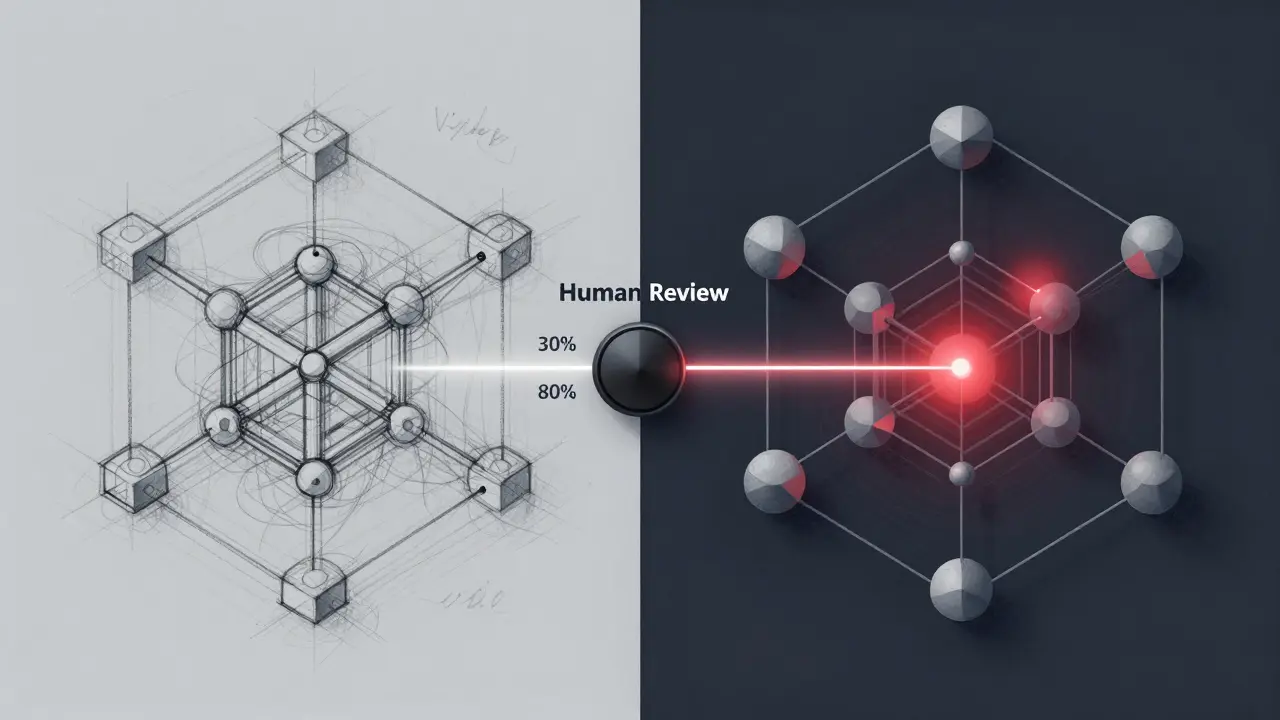
The EU’s January 2026 AI Act now requires human-in-the-loop verification for code in critical infrastructure. That means even if your AI can run alone, the law says it can’t. You need to review every major change. That’s why companies like Microsoft and Google now use “autonomy dials”-sliders that let you cap AI decision-making at 60%, 80%, or 100% based on the task.

When to Use Vibe Coding (And When It’ll Get You Fired)
Use vibe coding when:
- You’re building an MVP in 48 hours
- You’re a beginner learning how to code
- You need to test an idea fast
- You’re making internal tools with no external users
Don’t use vibe coding when:
- You’re working on a financial system
- You need auditable code trails
- Your team has strict security policies
- You can’t afford to refactor everything later
Microsoft’s Dr. Sarah Chen warns that vibe coding creates “black box applications.” Developers who rely on it too much stop understanding how their code works. That’s why 41% of no-code projects end up as maintenance nightmares. If you can’t explain how your app works to a new hire, you’ve built a time bomb.
Best practice? Treat vibe coding like a sketchpad. Draw fast. Refine later. Always review the output. Set rules: no prompts over 500 characters. Always ask for explanations. Never let it write authentication logic without double-checking.
When to Use Agentic Coding (And When It’ll Break Your System)
Use agentic coding when:
- You’re migrating a legacy codebase
- You need to update 50+ files across 10 modules
- You’re automating CI/CD pipelines
- You have a team of engineers who can review and validate
Don’t use agentic coding when:
- You’re building something creative or experimental
- Your requirements are vague
- You don’t have testing or monitoring in place
- Your team lacks experience with debugging AI-generated code
Agentic systems fail 62% of the time when requirements are unclear. They’re not psychic. If you say “Make it faster,” they’ll optimize the wrong thing. That’s why the most successful teams use “autonomy gates.” Every time the agent reaches a critical decision-like changing a database schema-it pauses and asks for approval.
Devin 2.1’s “swarm validation” feature helps: three agents independently check the same change. If two agree, it goes through. If not, it flags for review. That’s how you reduce errors without losing speed.
But here’s the real risk: skill erosion. Microsoft’s internal data shows that after six months of heavy agentic use, developers’ ability to debug low-level code dropped by 23%. They stopped learning. They became operators, not engineers. That’s why top teams require weekly “AI-free coding” sessions. Keep your skills sharp.
The Hybrid Future: Why You Don’t Have to Choose
The best teams aren’t picking sides. They’re blending both.
Here’s how it works in practice:
- Use vibe coding to sketch out the idea. Get a working prototype fast.
- Hand it off to an agentic system to refactor, test, and document.
- Review every change. Add your own comments. Fix edge cases.
- Deploy with monitoring. Watch for anomalies.
GitHub’s January 2026 update to Copilot Agent lets you adjust autonomy from 0% to 100% on a per-task basis. For a new feature? Set it to 30%. For a routine update? 80%. That’s the future: dynamic autonomy, not rigid categories.
According to Gartner, 68% of development teams will use this hybrid model by mid-2026. And Forrester’s December 2025 survey found that 82% of developers expect to use both tools within 18 months.
It’s not about AI replacing developers. It’s about AI handling the boring stuff so you can focus on the hard stuff-designing systems, solving edge cases, understanding user needs.
What You Should Do Right Now
Here’s your action plan:
- If you’re new: Start with vibe coding. Use Cursor or Copilot. Build something small. Learn how to prompt well.
- If you’re managing a team: Introduce autonomy gates. Require human approval before any agentic system touches production code.
- If you’re maintaining legacy code: Try Devin 2.0 on a small module. Track how much time it saves-and how many bugs it introduces.
- If you’re worried about skill loss: Block off 4 hours a week for “AI-free coding.” Fix bugs manually. Write tests from scratch.
The goal isn’t to use AI as much as possible. It’s to use it as wisely as possible. Vibe coding gives you speed. Agentic coding gives you scale. But only you can decide when to let go-and when to hold on.
Is vibe coding safe for production code?
Vibe coding isn’t designed for production. The code it generates is fast but often sloppy-missing error handling, inconsistent naming, duplicated logic. It’s great for prototypes, but always review and refactor before deploying. Treat it like a rough draft, not a final product.
Can agentic coding replace senior developers?
No. Agentic systems handle repetitive tasks well-refactoring, testing, documentation-but they can’t design systems, interpret vague requirements, or make trade-offs between performance, security, and maintainability. Senior developers provide context, judgment, and oversight. The AI is a tool, not a replacement.
Which is cheaper: vibe coding or agentic coding?
Vibe coding tools like Cursor and GitHub Copilot cost $10-$20/month per user. Agentic systems like Devin 2.0 or OpenDevin range from $29-$99/month due to higher compute needs and cloud infrastructure. But the real cost isn’t subscription fees-it’s time spent fixing mistakes. Poorly managed agentic systems can cost far more in debugging than they save.
Do I need a GPU to use agentic coding?
Yes, for full autonomy. Agentic systems use large models (30B+ parameters) that need GPU acceleration to run efficiently. Most teams use cloud-based versions (like Devin hosted on AWS or Azure). Local setups require at least 16GB RAM and a modern GPU. Vibe coding can run on basic laptops with 8GB RAM.
Will AI coding make me obsolete?
No-unless you stop learning. Developers who use AI to avoid understanding code are at risk. Those who use it to work smarter, solve harder problems, and focus on architecture and design are becoming more valuable. The best developers aren’t the ones who type the most. They’re the ones who know when to let AI run-and when to take back control.
What’s the biggest mistake teams make with AI coding?
Believing the AI is always right. Whether it’s vibe coding generating buggy code or agentic systems making silent changes, the biggest danger is blind trust. Always review. Always test. Always ask: “Why did it do that?” The AI doesn’t know your business. You do.
Seraphina Nero
January 22, 2026 AT 02:01Been vibe coding for my side projects and it’s wild how fast I can get stuff done. I don’t care if it’s messy-I fix it later. It’s like sketching with crayons then painting over it with watercolors.
Megan Ellaby
January 23, 2026 AT 08:55my friend tried agentic coding on her startup’s backend and it deleted the entire auth system. like… silently. no warning. just gone. we spent 3 days fixing it. i’m not trusting ai with anything important anymore 😅
Rahul U.
January 24, 2026 AT 01:27Hybrid approach is the real win here. I use vibe coding to prototype features in 10 mins, then hand it off to Devin 2.0 for refactoring. I review every diff, add comments, and run tests. AI does the grunt work, I do the thinking. Perfect balance 🙌
E Jones
January 24, 2026 AT 06:00Let me guess-this whole post was written by an AI that’s now trying to sell you subscriptions to its own brain. Vibe coding? Agentic systems? Sounds like corporate buzzword bingo. The truth? Big Tech is scared developers will realize they don’t need to know anything anymore. They’re pushing these tools so you stop asking questions. And when your app explodes in production because the AI ‘decided’ to rewrite your database schema? Who gets fired? You. Not the company that sold you the magic black box. They’re already on their next funding round.
They want you to be a monkey pressing buttons while the AI runs the show. Don’t fall for it. The moment you stop understanding your own code, you’re not a developer-you’re a babysitter for a very expensive toaster.
And don’t even get me started on ‘autonomy dials.’ That’s not safety-it’s theater. A 60% dial doesn’t mean the AI is 40% less dangerous. It just means it’s 40% less likely to tell you it messed up. The system still thinks it’s smarter than you. And it’s right. That’s the real horror story.
Barbara & Greg
January 25, 2026 AT 18:51It is profoundly concerning that the software development community has so readily abdicated its responsibility for code quality to algorithmic entities devoid of moral or ethical reasoning. The normalization of unreviewed, unverified machine-generated code constitutes a fundamental erosion of professional integrity. If one cannot articulate the logic behind a line of code, one is not a developer-merely a technician operating under the illusion of productivity.
Furthermore, the notion that ‘speed’ justifies architectural negligence is not only unprofessional-it is reckless. The long-term costs of technical debt, security vulnerabilities, and compliance failures far outweigh any short-term gains. This is not innovation. It is negligence dressed in Silicon Valley jargon.
selma souza
January 27, 2026 AT 09:47First off, ‘vibe coding’ is not a real term. It’s a lazy, trendy phrase that makes people feel like they’re doing something cool when they’re just copy-pasting from ChatGPT. And ‘agentic systems’? Sounds like a sci-fi novel. The real issue? People are outsourcing their brains and calling it ‘productivity.’ If you can’t write a for loop without AI, you shouldn’t be calling yourself a developer. And yes, I’m talking to you, ‘I built a login page in 2 hours’ crowd. Your code is a disaster waiting for a compliance audit.
Frank Piccolo
January 29, 2026 AT 08:59Look, I’ve been coding since the 90s. We didn’t have AI then. We had compilers, we had books, we had sleepless nights debugging segfaults. Now? Kids think typing ‘make it work’ into a chatbox is engineering. Agentic systems? Please. They’re just glorified autocomplete on steroids. And don’t even get me started on how these tools are turning American dev teams into passive observers while India and Ukraine churn out real engineers who actually understand what’s under the hood. This isn’t progress. It’s cultural surrender.
James Boggs
January 31, 2026 AT 02:14Great breakdown. I’ve been using the hybrid model for 6 months now-vibe coding for MVPs, agentic for refactors. Always review. Always test. Always comment. Keeps me sharp and the code clean. Highly recommend.
Addison Smart
February 1, 2026 AT 19:09I work with teams across 7 countries, and this is the first time I’ve seen a post that actually captures the global reality of AI-assisted dev. In Nairobi, devs use vibe coding to skip learning legacy systems. In Tokyo, they use agentic tools to maintain 20-year-old COBOL apps. In Berlin, they’re banned from using AI for public sector code. The real takeaway? There’s no one-size-fits-all. What matters is context, culture, and consequence. The best teams don’t just use AI-they adapt it to their values. That’s the future: not AI replacing us, but us teaching AI what matters.
Also, the ‘AI-free coding’ rule? Brilliant. I enforce it every Friday. No tools. Just me, a whiteboard, and a cup of coffee. Keeps me human.
David Smith
February 2, 2026 AT 01:53Oh wow, so now we’re supposed to be ‘operators’ and not ‘engineers’? And the AI gets to decide what’s ‘critical’? What’s next-AI choosing which bugs are worth fixing? I’ve seen this movie before. Remember when ‘agile’ became ‘no documentation’? Now it’s ‘vibe coding’ = ‘no responsibility.’ This isn’t innovation. It’s corporate laziness with a fancy name. And the worst part? People are proud of it. They post ‘I built this in 2 hours’ like it’s a trophy. Meanwhile, the next guy has to spend 40 hours cleaning up the mess. That’s not progress. That’s betrayal.