For years, programmers were taught to scrutinize every line of code. Every semicolon, every variable name, every edge case had to be checked, tested, and rechecked. But something’s changed. Today, many developers aren’t reading every suggestion their AI assistant gives them-they’re vibe coding. They glance at the code, feel it’s right, and hit enter. No deep review. No line-by-line validation. Just trust.
This isn’t laziness. It’s a psychological shift. And it’s happening fast.
What Vibe Coding Really Means
Vibe coding isn’t about giving up control. It’s about knowing when to let go. It’s when a developer accepts an AI-generated code suggestion because it feels correct-not because they’ve verified every detail. The term emerged from Reddit threads and Slack channels in 2023, but the behavior is now documented in research. A 2024 Openstf study found that 37% of developers regularly use vibe coding, accepting AI suggestions without review when the output matches their mental model of how the code should work.
Think of it like driving. You don’t check your mirrors every second. You glance, sense traffic, adjust. Vibe coding works the same way. After months of using GitHub Copilot or Amazon CodeWhisperer, developers build a subconscious sense of when the AI is on track. That gut feeling? That’s the vibe.
But here’s the catch: this only works if you know your limits.
The Trust Gap Between Junior and Senior Developers
Not everyone feels the same way about AI suggestions. There’s a wide divide.
Junior developers-those with less than four years of experience-show a 68% rate of high reliance on AI. They trust the suggestions because they’re still learning. The AI becomes a teacher, a shortcut, a safety net. They don’t yet have the experience to spot subtle bugs.
Senior developers, on the other hand, are more likely to use AI tools-but far less likely to trust them blindly. Only 22% of developers with over 10 years of experience rely heavily on AI suggestions. Why? Because they’ve seen what happens when you assume the AI knows what it’s doing.
One senior architect at a fintech firm told me: “I’ve seen AI generate code that looked perfect, passed all tests, and still broke production during peak traffic. That’s not a bug. That’s a trap.”
The result? Teams are splitting. Junior devs push AI-generated code into main branches. Seniors demand reviews. Conflict brews. And nobody’s talking about the real issue: trust isn’t binary. It’s calibrated.
When AI Gets It Right-And When It Doesn’t
AI coding assistants aren’t magic. They’re pattern recognizers. And they’re really good at some things.
They’re 92.7% accurate at generating boilerplate code-things like setting up a REST endpoint, writing a CRUD controller, or generating unit tests. They’re 88.3% accurate at integrating APIs. If you’re writing a standard login flow or connecting to a database, the AI is likely to get it right.
But when the problem gets complex? That’s where things fall apart.
For novel algorithms-like designing a new sorting method or optimizing a real-time data pipeline-AI accuracy drops to 63.1%. In niche domains like financial compliance or healthcare regulations (HIPAA, GDPR), error rates jump to 38.7%. And worst of all? The code often looks correct. It compiles. It passes tests. It’s only in production, under load, with edge cases, that it fails.
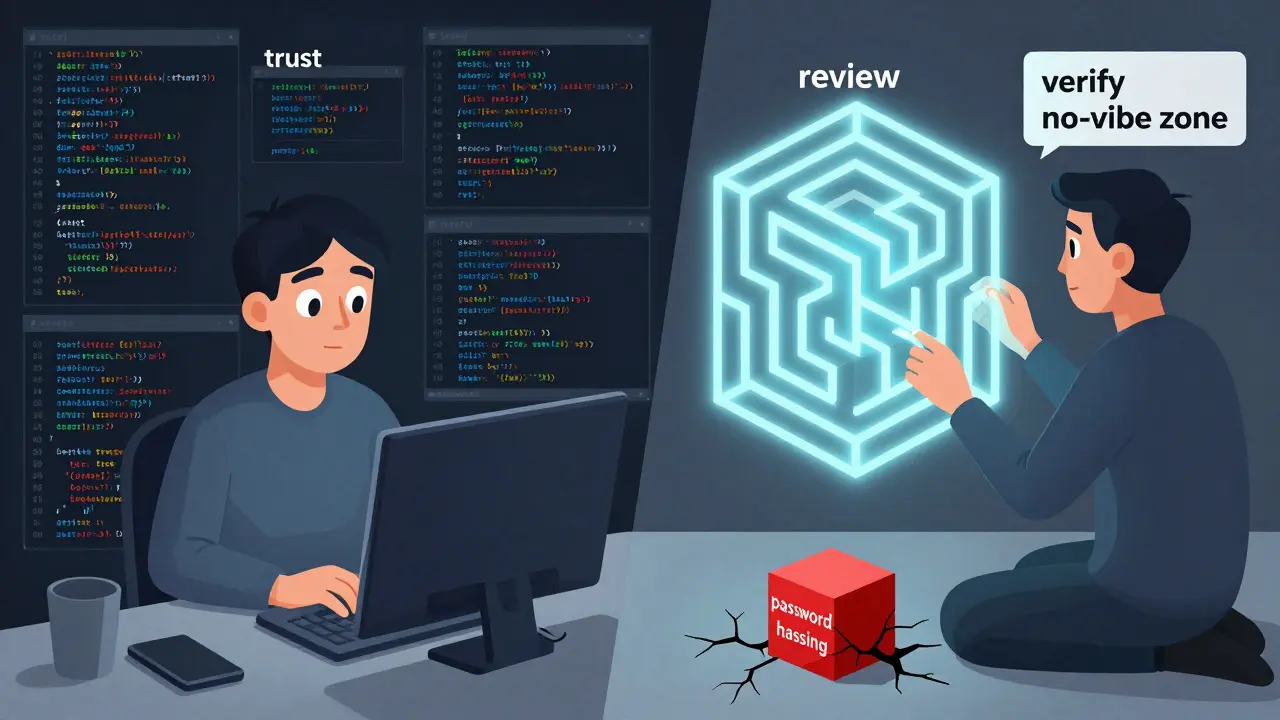
One developer on Reddit shared a nightmare: “I accepted a Copilot suggestion for password hashing. It looked fine. Used bcrypt, right? Except it was a fake library that didn’t hash at all. Took three weeks to find. Our users’ passwords were plain text.”
That’s not a fluke. It’s a pattern.
The Four Pillars of Calibrated Reliance
So how do you vibe code without getting burned?
Research from Stanford’s HCI Lab and UX Magazine points to four psychological principles that make AI reliance sustainable:
- Predictability - Know what the AI can and can’t do. Don’t ask it to write a blockchain consensus algorithm if it’s only trained on web apps.
- Explainability - The best tools don’t just give code-they explain why. GitHub Copilot’s new “trust calibration scores” (launched Dec 2025) rate suggestions by context. A score of 85%? Probably safe. A score of 52%? Look closer.
- Error Management - Good AI admits uncertainty. If it says, “I’m 70% confident this is correct,” you pause. If it says, “Here’s your code,” you question it.
- Controllability - You must be able to override it instantly. No AI should ever lock you in. Always have a way to delete, revert, or rewrite.
Teams that document these boundaries-what we call “no-vibe zones”-see 47% fewer critical errors. These zones might include: authentication logic, encryption routines, regulatory code, or anything involving user data.
The Learning Curve: 117 Hours to Fluency
Learning to vibe code isn’t instant. It takes time.
On average, developers need 117 hours of hands-on use to reach fluency. That’s about 30 minutes a day for four months. During that time, they go through what’s called the “awkward discovery phase”-where they spend 22 minutes per hour toggling between writing prompts and reviewing outputs.
But after 15,000 AI suggestions? That’s when the vibe kicks in. Developers start to recognize patterns: “This kind of request always works with Copilot. This one? Never.” They build mental models. They learn to trust the right things.
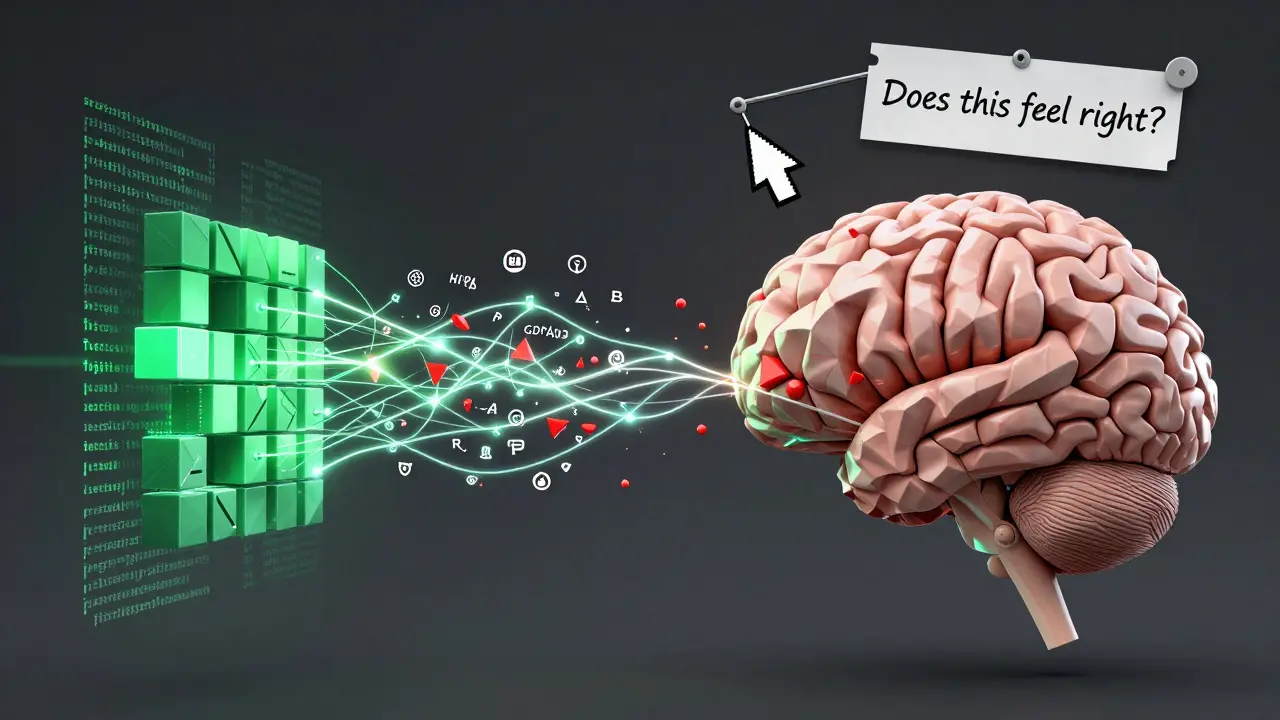
One developer wrote: “After six months, I don’t even read the code anymore. I just ask: ‘Does this feel like something I would’ve written?’ If yes, I accept. If it feels off, I rewrite it myself.”
That’s the goal: not to replace your brain, but to extend it.
The Hidden Cost: Automation Complacency
The biggest danger in vibe coding isn’t bad code. It’s mental atrophy.
When you stop reviewing, you stop learning. You stop understanding why the code works. That’s dangerous. Because when the AI fails-and it will-you need to fix it. And if you’ve never looked under the hood, you’re lost.
ACM’s TREW study found that 43% of teams using AI coding tools saw a drop in code review quality over time. Developers stopped asking questions. They stopped debugging. They assumed the AI knew best.
The fix? Mandatory calibration rituals. One team at a healthcare startup started doing “AI Code Fridays”-15 minutes each Friday where everyone reviews one AI-generated snippet they accepted the week before. They discuss: Was it right? Why? What would you have done differently?
That’s not a waste of time. That’s how you stay sharp.
Enterprise Adoption and Regulatory Pressure
Big companies aren’t waiting. 73% of Fortune 500 companies now require AI coding tools for their teams. But they’re not letting devs vibe code freely.
45% restrict vibe coding to non-customer-facing services. 28% require two-person review for any AI-generated code in production. And the EU’s 2025 AI Act now demands “human oversight logs” for any AI-written code in critical infrastructure-like medical devices or financial systems.
That means vibe coding isn’t going away. It’s being regulated. And the companies that survive will be the ones who build systems-not just code.
What’s Next: Adaptive Trust Interfaces
The next wave of AI coding tools won’t just suggest code. They’ll adapt to you.
Google DeepMind’s Project Calibrate (announced Sept 2025) will analyze your coding history and adjust how much it explains based on your skill level. If you’re a senior dev, it gives you less text. If you’re new, it adds context. It learns your trust boundaries.
Meta’s open-sourced TRAC framework lets developers track their own reliance patterns. You can see: “You accepted 82% of AI suggestions last week. 4 of them introduced bugs.”
This isn’t surveillance. It’s self-awareness.
The Bottom Line: Trust, But Verify-Smartly
Vibe coding isn’t the future of programming. It’s the present. And it’s here to stay.
But here’s what no one tells you: the best vibe coders aren’t the ones who trust the most. They’re the ones who understand the limits of the tool. They know when to say yes. And when to say no.
Don’t let AI replace your judgment. Let it sharpen it.
Use it for boilerplate. Use it for tests. Use it for the stuff you’ve done a hundred times. But when it comes to security, compliance, or anything new? Roll up your sleeves. Write it yourself. Or at least, read it.
The vibe is powerful. But your brain? That’s still the most important component in the stack.
Is vibe coding safe for production code?
Vibe coding can be safe-but only if you use it selectively. Accept AI suggestions for routine tasks like API endpoints, test generation, or boilerplate code. Never use it for security-critical logic like authentication, encryption, or regulatory compliance. Always review code in high-risk areas. Teams that define "no-vibe zones" reduce critical bugs by 47%.
How long does it take to get good at vibe coding?
Most developers reach fluency after about 117 hours of use-roughly 30 minutes a day for four months. The key is exposure: after processing around 15,000 AI suggestions, developers begin to recognize patterns and develop reliable intuition. Early on, expect to spend more time reviewing suggestions than accepting them.
Which AI coding tool is best for vibe coding?
GitHub Copilot leads with 46% adoption among professionals, thanks to deep IDE integration and strong pattern recognition. Amazon CodeWhisperer (22%) is known for better security scanning, while Tabnine (18%) offers strong local processing for offline use. The best tool isn’t the one with the most features-it’s the one you trust enough to use daily but question enough to verify critically.
Do I need to be an expert to use vibe coding?
No-but you need a strong foundation. Developers with under two years of experience make 3.2 times more critical errors when vibe coding than experienced developers. If you’re new, use AI as a teacher, not a crutch. Learn the underlying patterns. Review every suggestion. Build your knowledge before you start trusting the vibe.
Can vibe coding cause technical debt?
Yes-if you stop understanding your code. Vibe coding doesn’t create debt by itself. But if you accept AI suggestions without learning why they work, you’ll struggle to maintain or debug the system later. This is why senior developers warn against it: it’s not the code that’s the problem-it’s the lack of understanding behind it.
Nicholas Zeitler
December 25, 2025 AT 01:36Look, I’ve been vibe-coding for a year now, and honestly? It’s like learning to ride a bike-you wobble at first, but after a while, your body just knows. I don’t read every line anymore; I scan for rhythm. If it flows like my own code, I let it go. But I’ve got my no-vibe zones locked down: auth, encryption, anything touching PII. I’ve even got a sticky note on my monitor that says: ‘If it feels too smooth, it’s probably lying.’
And yeah, I’ve been burned-once, by a fake bcrypt wrapper. Never again. Now I use Copilot’s trust scores religiously. 85%+? Fine. Below 70%? I rewrite it myself. It’s not laziness. It’s efficiency with boundaries.
Also, the 117-hour mark? Spot on. That’s when I stopped feeling guilty about accepting suggestions. Before that? I was auditing every line like it was a court transcript. After? I just ask: ‘Would I have written this?’ If yes, I move on. If no? I dig in.
Don’t let the skeptics scare you. Vibe coding isn’t surrender. It’s evolution. But you’ve got to earn the vibe.
Teja kumar Baliga
December 25, 2025 AT 03:29As someone from India where mentorship is everything, I see this as a beautiful shift-not just in code, but in how we learn. Junior devs aren’t lazy; they’re leveraging tools to grow faster. I remember when I first used Copilot-I accepted everything. Then I got burned by a SQL injection. That one mistake taught me more than any tutorial. Now I vibe-code, but I always ask: ‘Why does this work?’ The AI gives me the answer, but I still have to understand the question.
And yes, seniors are right to be cautious. I’ve seen senior devs who still write every loop by hand. Respect. But we need both. The juniors bring speed. The seniors bring wisdom. Together? We build better systems.
Let’s stop calling it ‘trust.’ Call it ‘collaboration.’ The AI isn’t the boss. It’s the intern who’s really good at typing.
k arnold
December 27, 2025 AT 03:12Oh wow. A 1200-word essay on how to not read code. Groundbreaking. Next up: ‘The Art of Letting Your GPS Drive You Through a Volcano.’
92.7% accuracy on boilerplate? Cool. So is a toaster 92.7% accurate at making toast… until it catches fire. And guess what? The fire doesn’t care how ‘vibey’ the bread looked.
Also, ‘trust calibration scores’? Yeah, right. Like the AI is gonna say, ‘Hey, I’m 52% sure this will leak your users’ credit cards.’ No, it’s gonna say ‘Here’s your code’ in bold, with a little green checkmark like it’s a Google Form.
117 hours? I’ve been coding for 20 years and I still read every line. Because I don’t trust machines. I trust the people who wrote them. And guess what? The AI didn’t write it. Some intern at GitHub did. And they were probably listening to lo-fi beats while training it.
Stay sharp. Or don’t. I’m not your dad.
lucia burton
December 28, 2025 AT 22:52Let’s be clear: vibe coding is not a methodology-it’s a symptom of cognitive load exhaustion in an industry that has normalized burnout under the guise of ‘productivity.’ The fact that 37% of developers are now outsourcing cognitive labor to LLMs without verification isn’t innovation-it’s systemic failure masked as efficiency. We’ve normalized the abandonment of mastery because we’re overworked, underpaid, and under-resourced. The AI isn’t the problem; the corporate pressure to ship faster with fewer engineers is.
And yes, the four pillars of calibrated reliance? Brilliant. But they’re band-aids on a hemorrhage. We need structural change: mandatory code review quotas, reduced sprint velocities, and paid learning time-not just ‘AI Code Fridays’ as a performative gesture. The ACM TREW study’s 43% drop in review quality? That’s not complacency. That’s despair.
And let’s not romanticize the ‘117-hour fluency curve.’ That’s 117 hours of unpaid labor. Who’s paying for that? Not your employer. Not your manager. You are. And that’s the real cost of vibe coding: the erosion of professional agency under the illusion of empowerment.
Don’t let the tool make you lazy. Let it make you strategic. But first-demand better working conditions. Because no algorithm will fix a broken system.
Sam Rittenhouse
December 30, 2025 AT 02:50I just want to say-thank you. This post nailed it. I’m a senior dev who used to roll my eyes at vibe coding. Then I started using Copilot daily. And something shifted. I stopped seeing it as a crutch and started seeing it as a co-pilot. I still review everything in my no-vibe zones-auth, encryption, compliance-but now, for CRUD endpoints, test scaffolding, even UI components? I let it fly. And I’m faster. And I’m happier.
But here’s the thing: I didn’t get there by accident. I trained myself. I kept a journal: ‘Accepted this. It worked.’ ‘Rejected this. It was wrong.’ After 15,000 suggestions, I started recognizing patterns. The AI doesn’t think. But it mirrors. And after enough exposure, you start mirroring back.
And yeah, I’ve seen the horror stories. The fake bcrypt. The uncaught race condition. I’ve been there. But I’m not scared. I’m cautious. And that’s the difference. Vibe coding isn’t about trusting blindly. It’s about trusting wisely.
So to the juniors: use it. Learn from it. Don’t fear it. To the seniors: don’t dismiss it. Guide it. And to everyone else? Don’t let fear stop you from evolving. The stack is changing. So are we.