When your AI chatbot accidentally spills a patient’s medical history or leaks a client’s bank account number, there’s no undo button. That’s not a glitch-it’s a breach. And it’s happening more often than companies want to admit. In March 2024, a healthcare provider paid a $2.3 million fine under GDPR because their LLM had memorized and reproduced protected health information from training data. No hacker broke in. No system was hacked. The AI just… whispered it back. That’s why human review workflows aren’t optional anymore for sensitive applications-they’re the last line of defense.
Why Human Review Is Non-Negotiable for Sensitive Data
Large language models don’t understand confidentiality. They don’t know what’s private, regulated, or dangerous. They only predict the next word. And sometimes, that next word is a Social Security number, a prescription dosage, or a corporate merger plan. Automated filters catch about 63% of these leaks, according to Protecto.ai’s 2025 testing. But that leaves nearly 4 in 10 breaches slipping through. Human reviewers catch 94% when paired with smart automation. That gap isn’t small-it’s the difference between a fine and a lawsuit. Regulations are catching up. The EU AI Act, effective February 2025, requires human oversight for any AI system handling high-risk data. The SEC is pushing similar rules for financial advice generated by AI. In the U.S., HIPAA and GDPR demand accountability. If you can’t prove someone reviewed and approved sensitive content before it went live, you’re already in violation. Human review isn’t about slowing things down. It’s about staying out of court.How a Secure Human Review Workflow Actually Works
A good workflow isn’t just a person staring at a screen. It’s a system. Here’s how it breaks down in real enterprise setups:- Automated pre-screening: Before a human sees anything, the system runs the LLM output through keyword filters, sentiment checks, and pattern detectors. If it matches known risky patterns-like a 16-digit number followed by an expiration date-it gets flagged.
- Confidence scoring: Systems like those used by Capella Solutions assign a risk score. If the AI is less than 92% confident in its output, it auto-routes to a human. This catches hallucinations and vague but dangerous statements before they’re approved.
- Role-based access: Not everyone gets to see everything. Superblocks’ framework defines four roles: reviewer (can view and suggest edits), approver (can finalize), auditor (can view logs but not change anything), and administrator (sets rules). All require multi-factor authentication.
- Dual approval for high-risk content: If the output contains PHI, PII, or financial data, two different reviewers must sign off. One checks for compliance, the other checks for accuracy. No exceptions.
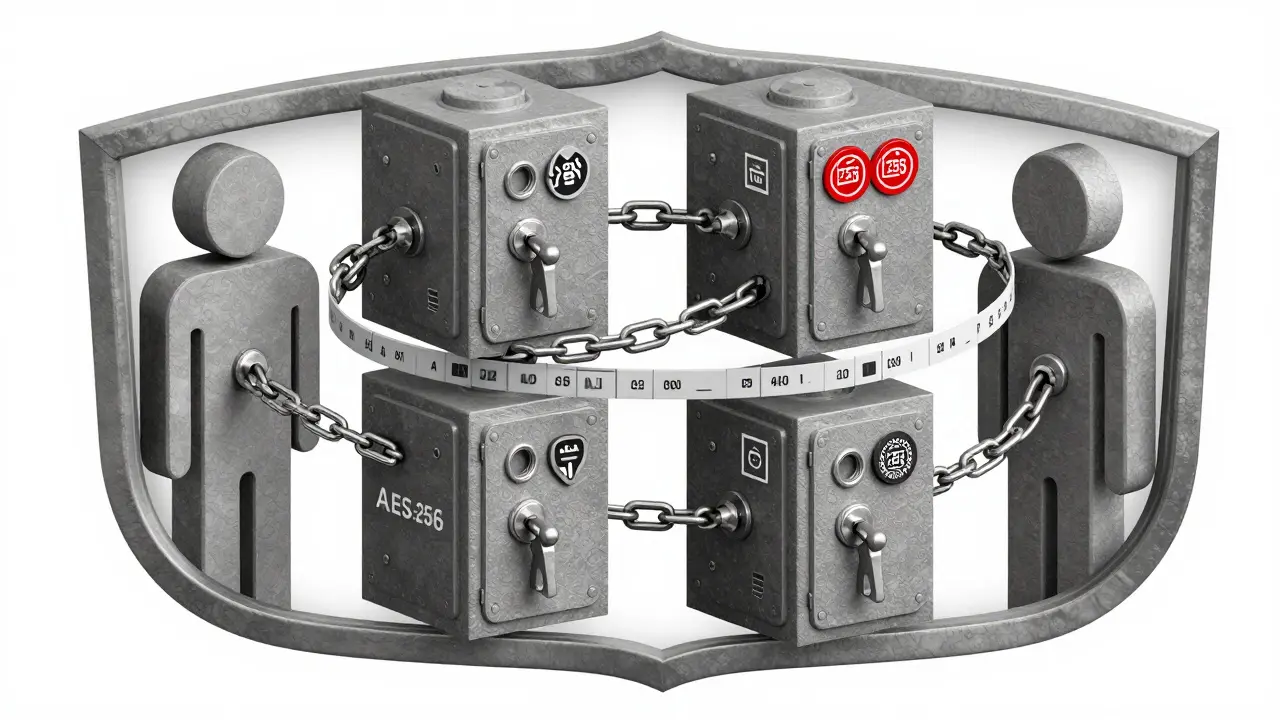
- Encrypted, audited interface: Reviewers work inside a secure portal with AES-256 encryption. Every click is logged: who reviewed it, when, what they changed, and why. These logs are stored for at least seven years to meet SEC Rule 17a-4(f).
What You Need to Build This
You can’t slap a human review step onto an existing AI pipeline and call it secure. You need the right tools and structure.- Encryption: Everything-input, output, reviewer notes-must be encrypted at rest and in transit. AES-256 is the minimum. NIST SP 800-53 Rev. 5 requires it.
- Audit trails: You must track every action. Timestamps, reviewer IDs, edits made, reasons for approval or rejection. No exceptions. This isn’t for internal use-it’s for regulators.
- Identity integration: Link your review system to your company’s directory (Okta, Azure AD). No shared logins. No guest accounts. Every reviewer must be a verified employee.
- Integration with DLP tools: Your data loss prevention system should talk to your review workflow. If a document triggers a DLP alert, the AI output gets auto-flagged for review.
Costs, Speed, and Scalability Trade-Offs
There’s no free lunch. Human review adds latency. AWS’s benchmarks show each review adds 8-12 seconds to the process. For a customer service bot handling 10,000 queries a day, that’s over 20 hours of extra processing time. Throughput drops by about 47% compared to fully automated systems. Cost-wise, it’s $3.75 per 1,000 tokens reviewed. That adds up fast. A single patient intake form might be 800 tokens. Ten thousand forms? That’s $30,000 in review costs alone. But compare that to the $2.3 million fine from the healthcare breach. The math isn’t close. Scalability is the real bottleneck. Most teams max out at 500 concurrent reviews. Beyond that, you need more reviewers, more training, and better tools. That’s why cross-training pools are critical. If one reviewer gets sick or quits, someone else can jump in without retraining the whole system.Common Pitfalls and How to Avoid Them
Even with the right system, things go wrong.- Reviewer fatigue: After 90 minutes, accuracy drops by 18-22%, according to Stanford’s Dr. Kenji Tanaka. Solution? Limit sessions to 60 minutes. Force breaks. Rotate reviewers every shift.
- Inconsistent standards: One reviewer flags “I need your SSN,” another lets “Can you share your ID?” slide. Solution: Create a 10-page review checklist with clear examples. Train quarterly. Test reviewers with mock scenarios.
- Over-reliance on humans: If your system assumes humans are perfect, attackers will target them. Social engineering-phishing a reviewer to approve malicious content-is a real threat. Solution: Require dual approval for anything flagged by AI. Never let one person override a system alert.
- Poor documentation: 61% of Reddit users say their self-built workflows lack guidance for edge cases. Solution: Document every exception. Keep a living wiki. Update it after every incident.
What the Best Companies Are Doing Right
Capital One cut PCI compliance violations by 91% after rolling out human review for their customer service bots. Their secret? They didn’t just add reviewers-they redesigned the whole process.- They used AI to auto-route content: financial queries went to finance-trained reviewers, medical queries to compliance staff with HIPAA certification.
- They built real-time collaboration: if a reviewer was unsure, they could ping a colleague inside the system without leaving the interface.
- They tied reviewer performance to bonuses: those with the lowest error rates got extra pay. Turnover dropped by 30% in six months.
The Future: More AI, Less Human Fatigue
The goal isn’t to make humans do more work. It’s to make them smarter. New tools are emerging. AWS’s SageMaker Human Review Workflows now auto-assign reviewers based on content sensitivity. Superblocks’ December 2024 update uses semantic analysis to reduce false positives by 41%. That means reviewers spend less time rejecting safe content and more time catching real threats. By 2025, confidential computing (Intel SGX, AMD SEV) will let reviewers process data without ever seeing the raw text. The system decrypts only enough to flag risk-no human ever touches the actual PHI or PII. That’s the future: humans overseeing, not handling.Final Reality Check
If you’re using LLMs to handle sensitive data and you’re not using human review, you’re not being innovative-you’re being reckless. The technology exists. The regulations are clear. The cost of failure is catastrophic. Start small. Pick one high-risk use case: patient intake, financial advice, legal document drafting. Build the workflow. Train your reviewers. Measure your results. Then expand. Because the alternative isn’t just fines or lawsuits. It’s broken trust. And once that’s gone, no AI can fix it.Do I need human review if my LLM is trained on anonymized data?
Yes. Even anonymized data can be re-identified through patterns. LLMs memorize structures-not just words. A 2024 incident showed an AI reproduced patient records by combining anonymized data points like age, zip code, and diagnosis. Human review catches these subtle leaks that automated tools miss.
Can I use freelancers or offshore teams for human review?
Technically, maybe-but you shouldn’t. Regulatory frameworks like HIPAA and GDPR require strict control over who accesses sensitive data. Offshore teams often lack proper training, audit trails, and encrypted environments. Most compliance officers will reject this approach. Stick to verified, internal reviewers with MFA and clear role assignments.
How often should I update my review criteria?
At minimum, every two weeks. LLMs evolve. New types of leaks emerge. Superblocks recommends reviewing your checklist after every major model update or after any incident. If your team approved a risky output last month, your criteria are outdated.
Is human review enough to meet GDPR or HIPAA?
No. Human review is one control among many. You still need encryption, access logs, data minimization, breach notification plans, and training. But without human review, you’re missing the most effective safeguard for AI-generated content. Regulators see it as non-negotiable for high-risk systems.
What’s the biggest mistake companies make when starting human review?
They treat it like a checkbox. They hire a few people, give them a vague list, and call it done. Then they wonder why breaches still happen. Human review only works if it’s treated like a core security function-with budgets, training, metrics, and accountability. It’s not a side task. It’s a critical control.
Tina van Schelt
December 16, 2025 AT 17:04Okay but let’s be real-human review is the only thing standing between your AI and a lawsuit shaped like a $2.3M check. I’ve seen teams think ‘we anonymized everything’ and then boom-someone’s grandma’s medication history pops up because the AI connected ‘78-year-old female, zip 90210, rare autoimmune disorder’ like it was a damn crossword puzzle. Human eyes? Non-negotiable. Also, why is no one talking about how exhausting this is? I’ve been a reviewer for 8 months. My brain feels like overcooked spaghetti after 45 minutes.
Ronak Khandelwal
December 17, 2025 AT 10:42Bro, this isn’t just about compliance-it’s about dignity 💙. Every time an AI spits out someone’s private data, it’s not just a ‘breach.’ It’s a violation of trust. Like, imagine being a patient and realizing your diagnosis was whispered into a chatbot and then passed to a stranger. That’s not tech-that’s trauma. We need systems that protect people, not just check boxes. And yes, humans get tired. So let’s pay them well, rotate them, and celebrate them. They’re the unsung heroes of AI ethics 🙌
Jeff Napier
December 19, 2025 AT 00:39Taylor Hayes
December 20, 2025 AT 04:21Jeff, I get where you’re coming from-automation feels like the future. But here’s the thing: AI doesn’t have empathy. It doesn’t understand context. A sentence like ‘I’m worried about my blood pressure’ could be casual or life-threatening. Only a human can tell. And yeah, the system’s clunky right now-but that’s why we’re building better tools. Dual approval, encrypted portals, real-time collaboration… these aren’t red tape, they’re lifelines. We’re not trying to slow things down. We’re trying to keep people safe. Let’s fix the system, not scrap it.
Lauren Saunders
December 21, 2025 AT 10:42How quaint. You all treat human review like some sacred ritual, but let’s be honest-this is just a performative compliance theater for VPs who don’t understand ML. The ‘dual approval’ model? A joke. Reviewers are overworked, underpaid, and trained on checklists written by consultants who’ve never touched an LLM. And don’t get me started on ‘audit trails’-90% of those logs are garbage because people just click ‘approve’ to move on. If you want real security, you don’t need humans-you need adversarial testing, differential privacy, and federated learning. But no, let’s keep pretending we’re in a 1990s bank vault.
sonny dirgantara
December 22, 2025 AT 11:07