Most of us have watched a Large Language Model confidently give the wrong answer to a math problem. It writes out a long, convincing chain of logic, makes a tiny arithmetic error halfway through, and then doubles down on that mistake until it reaches a final, incorrect conclusion. For years, we accepted this as the price of admission for AI brilliance. But in early 2026, the industry shifted. The new standard isn't just about generating text; it's about structured reasoning modules that force the model to plan, check its work, and fix errors before speaking.
This isn't a minor tweak. It’s a fundamental change in how we build intelligent systems. Instead of letting an LLM ramble until it hits a stop token, we are now giving them a structured workflow: Generate, Verify, and Revise. This approach transforms opaque black boxes into transparent, evaluable components. If you’re building applications that require precision-like financial modeling, legal analysis, or complex coding-you need to understand why this shift matters and how to implement it.
The Problem with Unstructured Thinking
To appreciate the solution, you have to look at the flaw in the old way. Traditional Large Language Models rely on autoregressive generation. They predict the next word based on the previous ones. When asked to solve a hard problem, they produce a "Chain of Thought" (CoT). On paper, CoT looks great. In practice, it’s messy. Long chains of thought inevitably introduce redundant steps or hallucinations. Once the model makes a small error in step three, every subsequent step is built on sand.
Researchers from Zhang et al. identified this bottleneck clearly in their January 2026 paper, Structured Reasoning for Large Language Models. They found that while LLMs are powerful, their reliance on token-level probability relationships constrains effective reasoning on complex tasks like logical deduction. The model doesn’t know it’s wrong until it’s too late. There’s no internal checkpoint. There’s no "wait, let me re-read that." It just keeps going.
How Structured Reasoning Modules Work
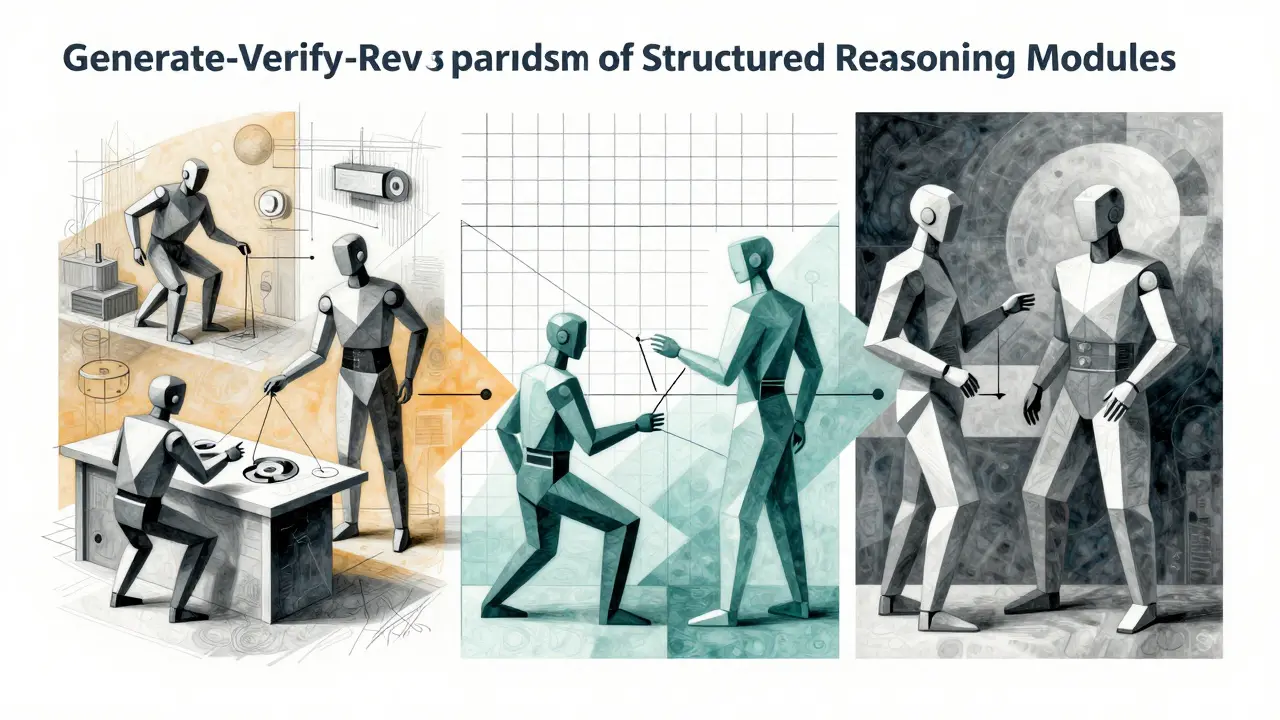
Structured Reasoning (SCR) solves this by decoupling the reasoning process into discrete, trainable components. Think of it less like a stream of consciousness and more like a factory assembly line with quality control stations. The framework operates on a strict Generate-Verify-Revise paradigm.
- Generate: The model produces an initial solution using standard autoregressive text generation. This is your first draft. It might be right, it might be wrong. That’s okay.
- Verify: This is the critical new step. A specialized verification module critiques the initial solution. It doesn’t just guess if it’s right; it assesses correctness against explicit criteria. In recent benchmarks, these verification mechanisms achieved 94.3% accuracy in identifying errors.
- Revise: If the verification phase flags an issue, the revision module kicks in. It conditionally modifies the solution based on the specific critique. It doesn’t rewrite the whole thing; it fixes the broken part.
The magic happens in the control mechanism called Dynamic Termination Supervision (DTS). DTS decides when to stop. If the verification confidence is high enough, the system terminates and outputs the answer. If not, it loops back to revise. This prevents the endless rambling that plagues traditional CoT approaches.
Planning and Tool Use: The Next Evolution
The title of this discussion often includes "Planning and Tool Use," and there’s a reason for that. Structured reasoning isn’t just about fixing math errors; it’s about enabling agents to interact with the world. You can’t have a robust agent if it can’t verify its own plans.
In the latest implementations announced in early 2026, SCR modules are being integrated with external tools. During the Revision phase, the model can now dynamically invoke calculators, APIs, or code interpreters. Imagine a physics problem where the initial calculation is off. Instead of guessing a new number, the SCR module detects the discrepancy, calls a Python calculator via an API, gets the precise result, and revises the text to match reality. Preliminary experiments showed this hybrid approach improved performance on physics problems by 18.7%.
This capability turns the LLM from a passive text generator into an active planner. It can break down a complex task, attempt a solution, verify the outcome using real-world tools, and adjust its plan accordingly. This is the foundation of truly autonomous AI agents.
| Feature | Standard Chain-of-Thought (CoT) | Structured Reasoning (SCR) |
|---|---|---|
| Accuracy on Olympiad Math | 58.7% | 71.4% |
| Error Reduction | N/A | 32.1% reduction in hallucinated reasoning |
| Token Efficiency | High redundancy | 22% less token generation |
| Verification | Implicit (none) | Explicit self-critique (94.3% accuracy) |
| Tool Integration | Limited/Post-hoc | Native during Revision phase |
Implementation Challenges and Costs
If structured reasoning is so good, why isn’t everyone using it yet? The short answer is complexity. Implementing SCR is not a simple prompt engineering trick. It requires architectural changes and significant compute resources.
First, you need better data. Training an SCR model requires two types of trajectories: Correct-Answer Trajectories (where the first try was right) and Correction Trajectories (where the model had to fix its mistakes). Creating high-quality Correction Trajectories is labor-intensive. One team reported spending 120 person-hours to create just 500 training examples. You can’t just scrape the web for this; you need strong teacher models like GPT-4 or Claude 3 Opus to generate the initial traces and the critiques.
Second, there’s a computational tax. Because the model generates, verifies, and potentially revises, inference time increases by approximately 18-22%. On NVIDIA A100 GPUs, this overhead is manageable but noticeable. For latency-sensitive applications like real-time chatbots, this delay might be unacceptable. However, for batch processing or complex analysis tasks, the trade-off is worth it.
Finally, the training pipeline is harder. You need to run Supervised Fine-Tuning (SFT) followed by a two-stage Reinforcement Learning (RL) process. Stage I RL optimizes generation and verification. Stage II RL focuses on revision. This extends training time by about 35% compared to standard fine-tuning. Teams report needing ML engineers with specific expertise in reinforcement learning, pushing average implementation timelines to 28 days.

Who Should Adopt Structured Reasoning Now?
Not every application needs this level of sophistication. If you’re building a creative writing assistant or a general-purpose customer service bot, standard Chain-of-Thought is likely sufficient. SCR shows minimal improvement (less than 1.5 percentage points) on straightforward tasks where CoT already achieves near-perfect results.
However, if you fall into one of these categories, SCR is essential:
- Financial Modeling: Where a single decimal point error can cost millions. The ability to verify calculations against known constraints is critical.
- Legal Analysis: Where logical consistency and citation accuracy matter more than speed. The transparency of SCR helps lawyers audit the AI’s reasoning.
- Scientific Research: Where hypotheses must be tested and revised based on data. The integration of external tools allows for dynamic experimentation.
- Complex Coding Tasks: Where debugging is part of the process. The Revise phase mimics a developer reviewing their own code and fixing bugs.
Gartner predicts that by Q4 2026, 45% of enterprise LLM implementations requiring complex reasoning will incorporate structured reasoning modules. The trend is clear: as AI moves from content creation to decision-making, structure becomes non-negotiable.
Future Outlook: Beyond Math
The current limitation of SCR is its dependency on clear correctness criteria. It works beautifully for math and code because there is a right answer. It struggles with ambiguous domains like creative writing or open-ended dialogue. Dr. Elena Rodriguez of DeepMind noted that its applicability to less structured domains remains unproven.
But the roadmap is ambitious. Major players are already integrating these principles. Anthropic’s upcoming Claude 3.5 features native Generate-Verify-Revise architecture. Meta’s Llama-4 roadmap includes structured reasoning as a core component. Researchers are working on "uncertainty-aware verification" to handle domains without clear right answers.
By 2027, structured reasoning modules are expected to become standard components in enterprise LLM deployments. The question is no longer if you should adopt them, but how quickly you can integrate them into your stack. The era of trusting AI to "just think straight" is over. The era of verifying every step has begun.
What is the main difference between Chain-of-Thought and Structured Reasoning?
Chain-of-Thought (CoT) is a linear, unstructured process where the model generates text until it finishes. It cannot go back and fix errors. Structured Reasoning (SCR) breaks the process into Generate, Verify, and Revise stages. It explicitly checks for errors and corrects them before outputting the final answer, leading to higher accuracy on complex tasks.
Does Structured Reasoning slow down the model?
Yes, it adds an overhead of approximately 18-22% in inference time due to the verification and potential revision steps. However, it reduces redundant token generation by 22% compared to long-chain CoT methods, making it more efficient per correct answer on difficult problems.
Can Structured Reasoning modules use external tools?
Yes. Modern SCR implementations allow the model to invoke external tools like calculators, APIs, or code interpreters during the Revision phase. This enables the model to verify facts or perform precise calculations dynamically, improving accuracy in fields like physics and finance.
Is Structured Reasoning suitable for creative writing?
Currently, no. SCR excels in domains with clear correctness criteria, such as math, code, and logic. Creative writing lacks definitive right or wrong answers, making the verification step difficult to implement effectively. Researchers are working on uncertainty-aware verification to address this in the future.
What hardware is required to run Structured Reasoning models?
SCR mirrors standard LLM deployment needs but demands additional resources for verification and revision. Benchmarks were conducted on NVIDIA A100 GPUs with 80GB VRAM. Organizations should expect to use 1.5-2x more compute resources for training compared to standard RLHF pipelines.