Imagine walking into your office tomorrow and realizing half the team isn’t human. They don’t drink coffee, they don’t take lunch breaks, and they never ask for a raise. But here is the twist: they are not robots standing around in metal suits. They are lines of code, invisible agents working inside your software, handling invoices, drafting legal briefs, or diagnosing rare diseases. This is the synthetic workforce, and by early 2026, it has stopped being a sci-fi concept to become a $47.8 billion reality.
We are no longer just talking about chatbots that answer customer service questions. We are looking at digital employees powered by generative AI systems capable of performing specialized business tasks with increasing autonomy within orchestrated frameworks. These entities operate alongside humans, managed by complex coordination layers known as orchestration platforms. The shift is massive. According to Gartner’s Q4 2025 market analysis, this sector is growing at a blistering 38% year-over-year. But while the technology is impressive, the reality on the ground is messy, expensive, and socially complicated. Let’s look at what these digital workers actually do, how they work, and why your company might be struggling to manage them.
The Anatomy of a Digital Employee
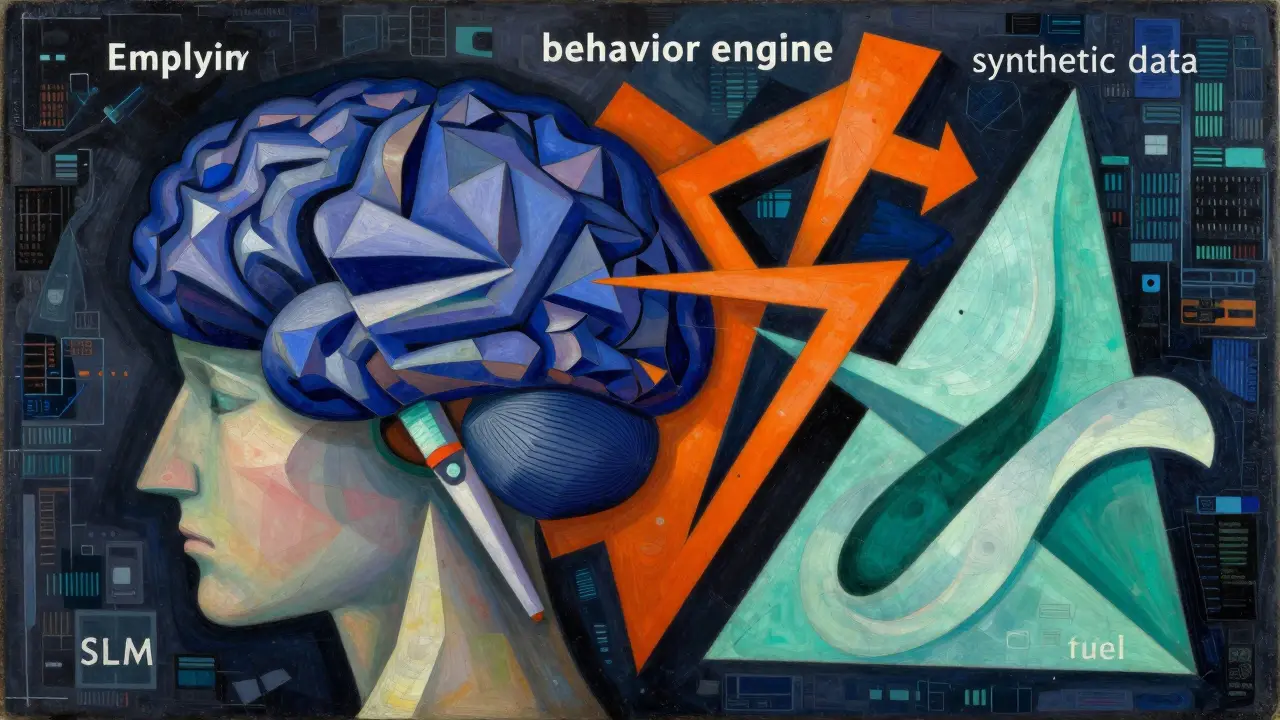
To understand the synthetic workforce, you have to stop thinking of AI as a single tool like Microsoft Word. Instead, think of it as a distinct entity with specific skills, limitations, and a need for supervision. A digital employee is not magic; it is a combination of three technical components working together.
First, there is the brain: the Small Language Model (SLM) trained specifically on internal enterprise data, proprietary datasets, and historical records. Unlike general-purpose Large Language Models (LLMs) that know everything but specialize in nothing, SLMs are narrower but sharper. RapidOps’ January 2026 analysis shows that using SLMs reduces infrastructure costs by 62% compared to traditional LLMs while delivering 25-30% higher accuracy in domain-specific tasks. If you are processing insurance claims, you don’t need an AI that can write poetry; you need one that understands policy codes from 1995 to 2026.
Second, there is the behavior engine: agentic AI frameworks that enable autonomous decision-making and task execution without constant human prompting. These frameworks allow the AI to break down a large goal-like "optimize supply chain logistics for Q3"-into smaller steps, execute them, and adjust if something goes wrong. This is the "agentic" part. It acts, rather than just reacts.
Third, there is the fuel: synthetic data generation pipelines that create artificial training data to improve model performance without risking real privacy-sensitive information. In healthcare, for example, Aya Data reported creating 10,000 simulated pathology cases from only 50 real-world examples. This allowed them to train diagnostic models rapidly while maintaining 100% HIPAA compliance. Without synthetic data, many digital employees would starve for lack of safe, high-quality training material.
Orchestration: The Invisible Manager
If digital employees are the workers, orchestration is the middle management. You cannot simply drop fifty AI agents into a Slack channel and expect harmony. They need routing, priority setting, and handoff protocols. This is where AI orchestration platforms manage task distribution, monitor performance, and handle human-AI handoffs to ensure operational continuity come in.
Leading platforms like Aya Data’s framework process over 12.7 million synthetic interactions daily across sectors like finance and logistics. These systems decide which agent handles a task, whether a human needs to review the output, and when to escalate an issue. SAP’s integration of AI orchestration into their ERP systems has resulted in a 50% reduction in operational decision latency. That means decisions that used to take days now happen in minutes because the AI orchestrator routes the right data to the right agent instantly.
However, orchestration is not plug-and-play. It requires native operation within existing Enterprise Resource Planning (ERP), Customer Relationship Management (CRM), and Supply Chain Management (SCM) platforms. The complexity lies in making sure the AI doesn’t just act fast, but acts correctly within the company’s specific rules and risk tolerances.
| Feature | Rule-Based Automation | Generative AI Agents | Synthetic Workforce (Orchestrated) |
|---|---|---|---|
| Accuracy in Compliance | High (if rules are clear) | Medium-High | 25% higher than rule-based |
| Handling Ambiguity | Poor | Moderate | Good (with human oversight) |
| Cost Efficiency | Low maintenance cost | High compute cost | 18-20% avg. savings vs manual |
| Emotional Intelligence | None | Limited | Weak (requires human support) |
| Implementation Speed | Fast | Slow | Very Slow (requires workflow redesign) |
Where Digital Employees Excel (and Fail)
Not every job is suitable for a synthetic worker. The technology shines in structured, high-volume environments. Financial services lead adoption with a 68% uptake rate, followed by healthcare at 57%. Why? Because these industries deal with massive amounts of structured data and clear compliance rules.
In finance, digital employees handle invoice processing and compliance monitoring. Early adopters report 50% shorter risk assessment cycles. In healthcare, they assist in diagnosing rare pathologies by analyzing patterns humans might miss. The key advantage is speed and consistency. An AI auditor doesn’t get tired, distracted, or biased by a bad morning.
But they fail hard in ambiguity. Visier’s 2026 Trends Report documents that connections between human employees and AI colleagues in customer service roles are 37% weaker than human-to-human interactions. Why? Because AI lacks deep emotional intelligence. It can simulate empathy, but it cannot feel it. When a customer is angry due to a nuanced, personal reason, a digital employee often misses the cue, escalating frustration. Creative tasks requiring original conceptualization beyond pattern recognition also remain largely out of reach. If you need a breakthrough marketing idea that challenges cultural norms, an AI trained on past data will likely give you a safe, boring average.
The Human Cost of Automation
This is the part most tech brochures skip. Deploying a synthetic workforce changes the social fabric of a company. On Reddit’s r/AIWorkplace forum, a thread titled "Our company deployed AI colleagues last month - here's what nobody warned us about" gathered 547 upvotes in January 2026. Users reported "weaker connections with co-workers" and "confusion about decision accountability."
When an AI makes a mistake, who is responsible? The developer? The supervisor? The algorithm? This confusion creates anxiety. Furthermore, the World Economic Forum warns that 39% of workers' core skills will change by 2030 due to AI integration. This isn't just about learning new software; it's about a fundamental shift in role identity.
Gloat’s workforce trends analysis notes that initial investments in GenAI tools often fall short of expected productivity gains. Why? Because companies treat AI as a replacement rather than a collaborator. Success requires thoughtful integration into workflows and employee enablement. The most successful organizations are creating new career pathways that didn't exist before, such as "AI-human collaboration specialists" and "synthetic data auditors." These roles focus on validating AI outputs and managing the relationship between human and machine teams.

Implementing Your First Synthetic Team
If you are ready to move beyond pilots, preparation is key. You cannot just buy software; you must redesign processes. Here is what the data suggests for a smooth rollout:
- Train for Orchestration, Not Just Usage: Technical staff need 8-12 weeks of specialized training on AI orchestration frameworks. Business users need 3-5 weeks to adapt to human-AI collaboration workflows. Don't underestimate this time.
- Build Oversight Infrastructure: Leading enterprises dedicate 15-20% of their AI implementation budget to human oversight infrastructure. This includes AI ethics review boards and continuous monitoring systems. You need humans watching the watchers.
- Start with Low-Risk, High-Volume Tasks: Begin with invoice processing or data entry. Avoid customer-facing roles initially until you have refined the AI's emotional nuance capabilities.
- Address Legacy Integration Early: 63% of negative reviews on G2 cite "integration complexity with legacy systems" as a major pain point. Ensure your IT team maps out how the AI will connect with your existing ERP or CRM before signing contracts.
Documentation quality varies wildly. Open-source orchestration frameworks score 3.8/5 for completeness, while commercial enterprise solutions score 4.5/5. If your internal team lacks deep AI expertise, a commercial solution with better support may save you months of debugging.
The Road Ahead: Agentic AI and Persistent Memory
We are only at the beginning. SAP executives identified "persistent memory" as a defining theme for enterprise AI in 2026. This means digital employees will remember context across interactions, building a deeper understanding of your business over time. Multimodal generative AI will allow them to process text, voice, images, and video simultaneously, making them more versatile.
Gartner predicts that by 2027, half of companies using generative AI will launch agentic AI applications capable of complex work with limited oversight. This marks the next evolution: moving from supervised digital employees to truly autonomous agents. However, Phys.org research warns that technological capability alone is insufficient. Without parallel investment in human collaboration frameworks, organizations risk lower productivity and weaker social cohesion.
The synthetic workforce is not about replacing humans. It is about redefining leadership, workforce strategy, and the human element of business. The companies that win will be those that treat AI not as a cheaper labor source, but as a new type of colleague that requires careful management, clear boundaries, and ethical oversight.
What is the difference between a digital employee and a standard AI chatbot?
A standard chatbot responds to prompts based on pre-defined scripts or simple language models. A digital employee is an agentic AI system that performs discrete business functions autonomously, integrates with enterprise systems like ERP and CRM, and operates within an orchestration framework that manages priorities, handoffs, and accountability. Digital employees act; chatbots react.
How much does implementing a synthetic workforce cost?
The total cost varies by scale, but the synthetic workforce market itself is valued at $47.8 billion as of early 2026. For individual companies, costs include software licensing, infrastructure (though SLMs reduce this by 62%), and significant change management expenses. Leading firms spend 15-20% of their AI budget on human oversight infrastructure. Operational cost savings typically range from 18-20% in high-volume workflows.
Are digital employees secure and compliant with regulations like GDPR or HIPAA?
Security depends on implementation. Using Small Language Models (SLMs) trained on internal data improves security by keeping sensitive information off public cloud models. Synthetic data generation allows for training without exposing real patient or customer data, helping maintain HIPAA compliance. However, the EU’s AI Act requires "human-in-the-loop" protocols for high-risk applications, meaning full autonomy is currently restricted in regulated sectors.
Which industries are adopting synthetic workforces fastest?
Financial services lead with a 68% adoption rate, followed by healthcare at 57%, and manufacturing at 49%. These industries benefit from structured data and clear compliance rules. Creative industries show slower uptake at 32% due to the need for emotional intelligence and original conceptualization, areas where current AI struggles.
Will digital employees replace human workers entirely?
Unlikely in the near term. Experts emphasize augmentation over replacement. While 39% of core skills will change by 2030, new roles like "AI auditors" and "collaboration specialists" are emerging. AI excels in speed and consistency but fails in emotional intelligence and novel problem-solving. Successful organizations use AI to handle repetitive tasks, freeing humans for strategic and interpersonal work.
What is "orchestration" in the context of AI?
Orchestration is the software layer that manages multiple AI agents. It handles task routing, priority setting, error handling, and human handoff protocols. Without orchestration, AI agents would operate in silos, potentially conflicting with each other or violating company policies. It ensures the synthetic workforce works as a coordinated team rather than a chaotic group of individuals.
Bharat Patel
May 7, 2026 AT 19:42There is a profound philosophical shift happening here that most people are missing. We are not just automating tasks; we are redefining what it means to be a worker in the modern economy. The concept of a 'synthetic workforce' suggests that labor is becoming decoupled from human biology entirely. This raises questions about the nature of consciousness and agency. If an AI can diagnose a disease or draft a legal brief, does it possess a form of professional expertise? I think we need to consider the ethical implications of creating entities that mimic human cognition without human experience. It changes the social fabric of our offices.
Nikhil Gavhane
May 9, 2026 AT 08:24I really appreciate how this article highlights the collaborative aspect rather than just focusing on replacement. It is encouraging to see that companies are creating new roles like AI-human collaboration specialists. This shows that there is still a place for human connection and empathy in the workplace. We should view these digital employees as tools that help us do more meaningful work. It gives me hope that technology can actually improve our quality of life if managed with care.
Rajat Patil
May 10, 2026 AT 23:43The article provides a very clear explanation of the technical components involved. I found the distinction between Small Language Models and Large Language Models particularly interesting. It makes sense that specialized models would be more cost-effective and accurate for specific tasks. However, I am concerned about the implementation speed mentioned in the table. The fact that it requires workflow redesign suggests a significant disruption for existing teams. We must ensure that this transition is handled with sensitivity to employee concerns.
pk Pk
May 11, 2026 AT 17:46Let's be real about this. The money talks. A 62% reduction in infrastructure costs is huge for any CFO looking at their quarterly reports. But you cannot ignore the human element. If you treat your staff like obsolete hardware, they will leave. You have to mentor them through this change. Show them how to use these orchestration platforms to become super-productive. It is not about firing people; it is about upgrading the team's capabilities. Those who adapt will thrive.
Rubina Jadhav
May 13, 2026 AT 12:22I am worried about the privacy aspects mentioned here. Even with synthetic data, trusting algorithms with sensitive information feels risky. The boundaries between human oversight and AI autonomy need to be very strict. I prefer to keep my personal and professional data separate from these systems. It is important to respect individual rights in this new digital environment.
sumraa hussain
May 14, 2026 AT 02:03the idea of persistent memory is wild... imagine an ai that remembers every mistake you made last year and brings it up in every meeting... it could be great for consistency but also terrifyingly invasive... i wonder if the emotional intelligence gap will ever close... or if we are just settling for cold efficiency...
Raji viji
May 15, 2026 AT 05:29Look, let's cut the fluff. This is basically just fancy automation with a marketing budget. Calling code snippets 'digital employees' is laughable. They don't have feelings, they don't have dreams, they just execute functions based on probability distributions. The hype around 'agentic AI' is overblown until we see actual ROI beyond basic data entry. Most companies are just slapping LLMs onto legacy systems and calling it innovation. Wake up and smell the compute costs.
Rajashree Iyer
May 15, 2026 AT 06:35This represents the death of the traditional soul of work! We are trading human connection for algorithmic efficiency. The silence of an office where half the workers are invisible lines of code is haunting. It is a dystopian vision disguised as progress. Where is the passion? Where is the struggle that defines our humanity? We are building a world of perfect, empty shells.
Parth Haz
May 16, 2026 AT 04:01While the risks are valid, the potential for error reduction in high-stakes industries like healthcare is undeniable. A 50% reduction in operational decision latency can save lives. We must balance caution with the benefits of precision. The key is rigorous testing and clear accountability frameworks. If implemented correctly, this technology serves as a powerful aid to human expertise rather than a replacement.