You train a massive language model. You run it through the standard benchmarks. The scores are impressive-maybe even record-breaking. But what if those high scores aren't proof of intelligence? What if they’re just proof that the model memorized the test questions during training?
This is the reality of task decontamination, a critical process in modern AI development designed to identify and remove overlapping data between training corpora and evaluation benchmarks to ensure valid performance assessment. As of mid-2026, this isn't just an academic concern; it’s a structural necessity for anyone building or evaluating Large Language Models (LLMs). If you’ve ever wondered why some models seem to ace coding tests but fail in real-world scenarios, data leakage might be the culprit.
Key Takeaways
- Data contamination inflates scores: Studies show benchmark scores can be artificially boosted by 15-20% due to leaked training data.
- LONGEST-MATCH is king: The ConTAM framework identifies this metric as the most effective for detecting subtle contamination compared to simple token matching.
- LLM-based verification helps: Using embedding search combined with GPT-4 verification catches paraphrased leaks that traditional n-gram methods miss.
- Decontamination is resource-heavy: Expect 80-120 hours for initial setup and significant compute time for full benchmark cleaning.
- Regulatory pressure is mounting: The EU AI Act now requires demonstrable decontamination procedures for high-risk applications.
The Hidden Cost of Data Leakage
Imagine studying for a math exam using a practice book. Now imagine the final exam uses the exact same problems, word-for-word. You’d get a perfect score, not because you understand calculus, but because you memorized the answers. This is exactly what happens when training data leakage occurs in the inadvertent inclusion of benchmark evaluation samples within the pre-training corpus of a large language model.
In 2021, researchers at Stanford and MIT first systematically documented this issue. Since then, the problem has exploded. With training datasets growing to trillions of tokens, the probability of overlap with public benchmarks like MMLU, GSM8K, or HumanEval has skyrocketed. According to Maxim AI’s research from 2024, contamination can inflate benchmark scores by up to 20% for large models like Llama 1. That’s a massive margin of error in a field where improvements are often measured in single-digit percentages.
The core issue is scientific integrity. When we report that Model A outperforms Model B, we need to know it’s because Model A is smarter, not because Model A saw the test beforehand. Without rigorous decontamination protocols, these comparisons are meaningless.
Understanding Contamination Metrics
Not all leaks are created equal. Some are obvious copy-pastes; others are subtle paraphrases. To catch them, the industry relies on specific metrics defined by the ConTAM framework (Contamination Threshold Analysis Method), introduced by Maxim AI in March 2024.
Here’s how the main detection methods work:
- TOKEN-MATCH: Counts exact token overlaps between evaluation samples and the pre-training corpus. It’s fast but misses anything that isn’t identical.
- NGRAM-MATCH: Looks at continuous sequences of N tokens. It calculates the fraction of n-grams in the eval set that match the training data. Better than token matching, but still rigid.
- TOKEN-EXTEND: Allows for small deviations with a configurable 'skip budget.' This helps catch minor typos or slight variations in spacing.
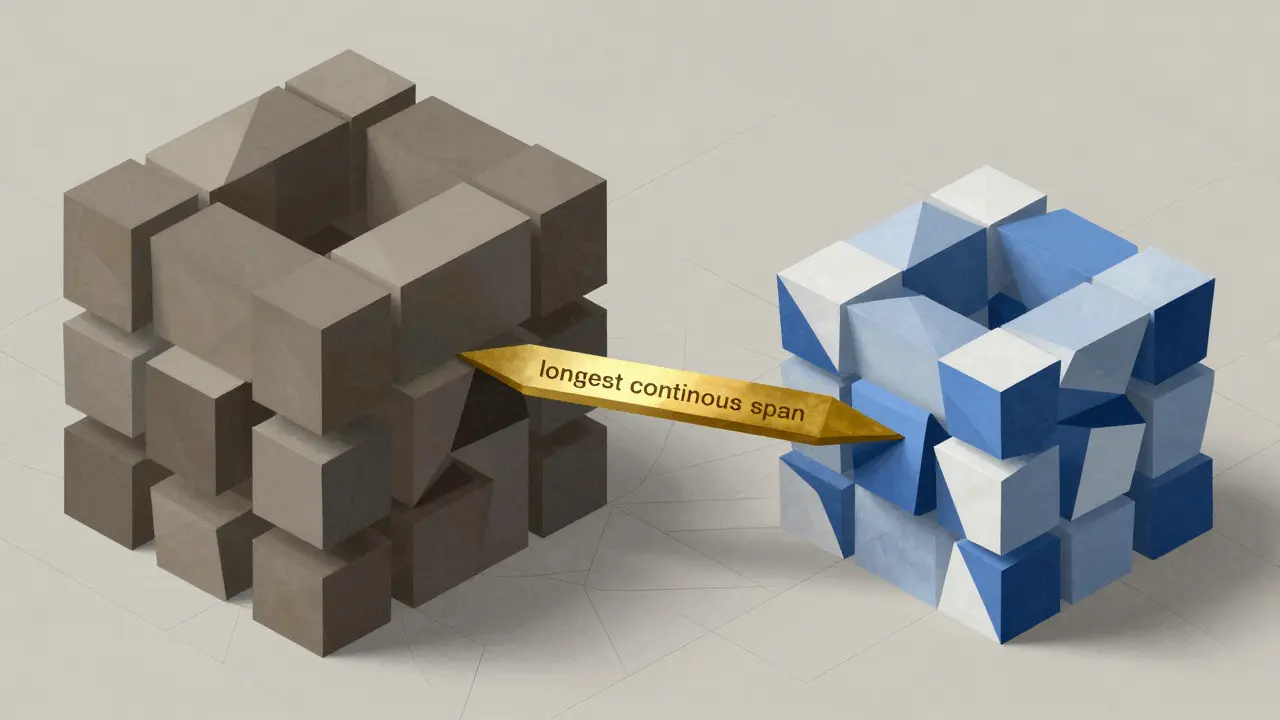
- LONGEST-MATCH: Currently considered the gold standard. It focuses only on the longest contiguous contaminated span. This prevents inflated scores from numerous tiny matches and better reflects meaningful memorization.
Why does LONGEST-MATCH matter? Because a model remembering a single sentence from a code repository is different from it remembering an entire function. ConTAM studies showed that LONGEST-MATCH achieved 12-18% higher Estimated Performance Gain (EPG) accuracy on benchmarks like MMLU compared to TOKEN-MATCH. EPG measures the difference between a model's performance on the full benchmark versus the clean, uncontaminated subset. It tells you exactly how much of that "skill" was actually cheating.
Traditional vs. Modern Detection Methods
For years, the go-to tool was the lm-evaluation-harness, maintained by EleutherAI since 2020. It provides built-in decontamination functionality via methods like `should_decontaminate` and `doc_to_decontamination_query`. While robust, it relies heavily on n-gram matching. This works well for exact matches but fails against paraphrasing.
Enter the LLM Decontaminator, proposed in 2023. This two-stage approach changes the game. First, it retrieves top-k similar samples from the training data using embedding similarity search. Then, it employs a powerful model like GPT-4 to verify if the retrieved sample is truly a contaminant. This method boasts 92.3% accuracy versus 67.8% for conventional methods. It catches the "paraphrasing problem," which affects nearly 40% of contaminated samples according to ConTAM tests.
However, there’s a trade-off. Traditional n-gram matching is computationally cheap. LLM-based verification is expensive and slow. For small teams, the cost of running GPT-4 on millions of potential matches can be prohibitive. This creates an evaluation gap: well-funded labs like Meta and Google can afford thorough decontamination, while academic researchers often rely on faster, less accurate methods.
| Method | Accuracy | Speed/Cost | Best Use Case |
|---|---|---|---|
| N-Gram Matching | Moderate (misses paraphrases) | Fast / Low Cost | Initial screening, large-scale filtering |
| LLM Verification | High (92.3%) | Slow / High Cost | Critical benchmarks, final validation |
| Dynamic Benchmarks | Varies | Moderate | Continuous monitoring, live coding tasks |
| Private Benchmarks | High (by isolation) | Low (setup cost) | Internal R&D, proprietary evaluations |
Implementing Decontamination in Your Pipeline
If you’re ready to clean your benchmarks, here’s a practical workflow based on current best practices as of 2026.
- Gather Your Training Corpus: You need access to the original text used to train the model. If you’re using open-source models, this is often available. For proprietary models, you may need to rely on third-party estimates or LLM-based inference.
- Select Your Metric: Start with LONGEST-MATCH from the ConTAM framework. Set a threshold based on model size. Larger models (like Llama 1 65B) exploit contamination more effectively, so they require stricter thresholds.
- Run Initial Filtering: Use tools like ContamScan, released by Meta AI in June 2025. This open-source tool implements all four ConTAM metrics and offers automated threshold selection, saving weeks of manual tuning.
- Verify with LLMs: For high-stakes benchmarks, run the flagged samples through an LLM verifier. Ask the model: "Is this evaluation question semantically equivalent to this training document?"
- Calculate EPG: Measure the performance drop. If your model’s score drops by 15% after decontamination, you have a serious leakage issue. Report both the contaminated and clean scores in your documentation.
Expect this process to take 80-120 hours for initial setup. Researchers typically spend 15-25% of their evaluation time on decontamination. It’s tedious, but necessary. As Dr. Sarah Chen from Maxim AI noted, "Current detection methods miss 38-42% of contaminated examples due to false negatives." Without these steps, you’re likely overestimating your model’s capabilities.

The Rise of Dynamic and Private Benchmarks
Since static decontamination is reactive, the industry is shifting toward preventive measures. Two major trends are emerging:
Dynamic Benchmarks: Tools like LiveCodeBench refresh their datasets monthly. By constantly introducing new questions, they make it nearly impossible for models to memorize the test. However, this introduces inconsistency. Performance variance can increase by 8.7-12.3% across evaluations, making it hard to compare results over time.
Private Benchmarks: Only three of the top 27 AI labs use private benchmarks exclusively. These datasets are kept isolated from the internet, preventing leakage entirely. The downside? Lack of transparency. The community can’t verify the results, leading to trust issues.
A hybrid approach is gaining traction. Use dynamic benchmarks for ongoing monitoring and static, rigorously decontaminated benchmarks for official releases. The Unified Decontamination Framework (UDF), released by the ML Reproducibility Consortium in January 2026, attempts to combine these approaches into a single pipeline.
Regulatory and Market Implications
This isn’t just about technical purity anymore. The EU AI Act’s 2025 amendment now requires "demonstrable decontamination procedures" for LLMs used in high-risk applications. This means legal compliance depends on your ability to prove your benchmarks weren’t leaked.
The market for AI benchmarking tools is projected to reach $287 million by 2026. Adoption rates among major AI labs stand at 92%, though only 47% implement comprehensive protocols. Enterprise adoption exceeds academic usage by 22 percentage points, reflecting the resource disparity. Companies like Anthropic and Google Research are leading the charge, with internal analyses showing significant score drops after rigorous cleaning. For instance, OpenAI’s leaked internal analysis revealed GPT-4’s HumanEval score dropped from 67.0% to 52.3% after decontamination. That’s a staggering difference in perceived capability.
Future Outlook: The Arms Race Continues
By 2027, McKinsey predicts 100% of enterprise-grade LLM evaluations will incorporate formal decontamination. Hugging Face plans to integrate decontamination metrics directly into model cards by Q3 2026. This will make transparency the norm, not the exception.
However, the battle isn’t over. Early 2026 tests show that 28.4% of newly contaminated examples evade even the latest detection methods. As models become better at generalizing, they also become better at hiding memorization. We’re entering an arms race between benchmark creators and contamination detection researchers.
For now, the best defense is a multi-layered approach: use LONGEST-MATCH for broad screening, LLM verification for precision, and dynamic benchmarks for freshness. And always, always report your clean scores. In the world of AI, honesty is the only metric that matters.
What is task decontamination in LLM benchmarks?
Task decontamination is the process of identifying and removing data from evaluation benchmarks that appears in the model's training dataset. This prevents models from getting artificially high scores by memorizing test questions rather than demonstrating genuine understanding.
How much can data leakage inflate benchmark scores?
Research indicates that data contamination can inflate benchmark scores by 15-20% for large models. In extreme cases, such as OpenAI's internal analysis of GPT-4, scores dropped by over 14 points after rigorous decontamination.
Which decontamination metric is most effective?
The LONGEST-MATCH metric, part of the ConTAM framework, is currently considered the most effective. It focuses on the longest contiguous span of contaminated text, providing a more accurate measure of meaningful memorization than simple token or n-gram matching.
Do I need access to the full training corpus to decontaminate?
Ideally, yes. Traditional methods like n-gram matching require direct comparison with the training data. However, newer LLM-based methods like the LLM Decontaminator can infer contamination using embedding similarity without needing the full raw corpus, though they are more expensive to run.
Is decontamination required by law?
Yes, for certain applications. The EU AI Act's 2025 amendment mandates demonstrable decontamination procedures for LLMs used in high-risk sectors. This makes proper evaluation hygiene a legal requirement, not just a best practice.