Imagine building a fully functional inventory system in three hours without writing a single line of manual code. For a long time, that sounded like science fiction. But with the rise of vibe coding is a natural language-driven approach to app creation that uses AI to translate user intent into functional software, we've entered an era where the "vibe"-the conceptual intent and high-level direction-is the primary driver of development. It isn't just a new way to code; it's a fundamental shift in the economics of how software is born, scaled, and maintained.
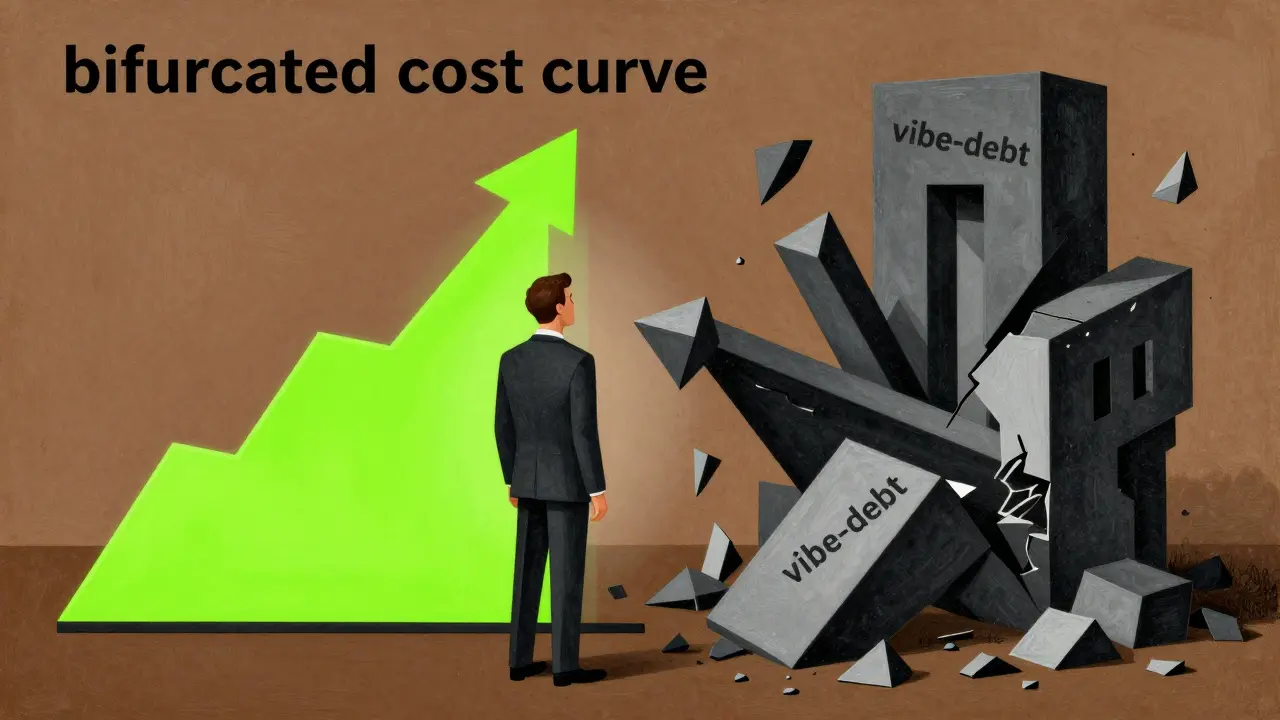
The core promise here is a massive reduction in the barrier to entry. According to data from Knack, this methodology can accelerate the creation of app foundations and data modeling by up to 70%. We are seeing a world where the cost of moving from an idea to a Minimum Viable Product (MVP) has essentially plummeted. However, as any experienced builder knows, the cost of creating something is rarely the same as the cost of keeping it alive. This creates a strange, bifurcated cost curve that every business leader needs to understand before they dive in.
The New Cost Curve: Rapid Starts and Hidden Tails
Traditionally, software development followed a linear, often grueling path. You'd spend weeks on requirements, months on development, and thousands of dollars on specialized talent. Vibe coding flips this on its head. For an MVP, the cost reduction is staggering-estimated between 60% and 80% based on case studies from Tanium. What used to take 40+ hours of engineering time can now happen in under five minutes for simple apps.
But there's a catch. This "step-function" reduction in initial cost creates a delayed economic hit. Forrester Research pointed out that maintenance costs after the first year can actually be 20% to 30% higher than traditional apps. Why? Because when you code by "vibe," you're often trading architectural rigor for speed. You get a working product, but you might be inheriting a mess of AI-generated logic that no human fully understands. This is the birth of "vibe-debt," a specific kind of technical debt where the lack of a formal architectural blueprint makes scaling a nightmare.
| Metric | Traditional Development | Vibe Coding (AI-Driven) |
|---|---|---|
| Initial MVP Cost | High ($150-$250/hr) | 65-85% lower |
| Prototype Time | Weeks/Months | Minutes to Hours |
| Year 1+ Maintenance | Standard/Predictable | 20-30% Higher (without governance) |
| Onboarding Time | 40+ hours (Low-code) | 8-12 hours |
Competitive Dynamics and Market Share
The landscape is currently a battleground between three different players. First, you have the no-code/low-code giants like Knack and Google Firebase Studio. They're targeting the business user-people who know exactly what their business needs but don't know how to write a loop in Python. This segment holds about 35% of the market.
Then there are the AI pair programmers. Tools like GitHub Copilot and Gemini Code Assist are designed for professional devs. They don't replace the coder; they supercharge them. This is the largest slice of the pie at 50% market share. Finally, you have specialized vertical solutions taking up the remaining 15%.
This shift is changing how companies compete. Take a marketing agency like PixelPulse. By using vibe coding, they reduced tool development costs by 90%. This didn't just save them money; it allowed them to drop their prices for clients by 40% while still increasing their margins. In this new economy, the competitive advantage doesn't go to the company with the most developers, but to the company that can iterate the fastest.
The Risk of Massive Technical Debt
It's not all sunshine and rapid deployment. There is a looming economic shadow. Morgan Stanley has estimated that unaddressed architectural issues in early vibe-coded apps could lead to $120 billion to $180 billion in remediation costs across the industry between 2026 and 2028. We've already seen this play out in the real world. A logistics startup called RouteOptimize attempted to scale a vibe-coded system, only to find that the underlying structure couldn't handle the load. They ended up spending $200,000 just to refactor the code they thought was "done."
The danger is that non-technical users can now build complex functionality without understanding the underlying architecture. When the app grows from 100 users to 100,000, those small logic gaps-which IBM measured at a 15-25% average error rate in Q3 2024-become catastrophic failures. The economic value of the "fast start" is quickly wiped out by the cost of a "hard pivot" to a professional architecture.

The Evolving Workforce: From Coders to Vibe Architects
The job market is shifting in real-time. We're seeing the emergence of a new role: the Prompt Engineer or Vibe Architect. Business analysts are no longer just writing requirements documents; they're actively building the software. On platforms like Upwork, these skills are already commanding $85 to $120 per hour. The value has shifted from the act of writing syntax to the ability to describe a system perfectly to an AI.
To survive this transition, organizations are adopting a hybrid model. The smartest play is using vibe coding for the frontend and business logic-where things change fast-and sticking to traditional, rigorous development for the core infrastructure and high-transaction systems. This keeps the cost of change low while keeping the system stable.
Navigating the Regulatory and Pricing Shift
We're also seeing the "financialization" of AI code. Replit started a trend with vibe coding marketplaces, where developers can monetize AI-generated components for $5 to $50 a pop. It's turning software components into liquid assets. Simultaneously, the pricing models are moving away from flat per-user fees to consumption-based billing. About 78% of platforms now use usage-based pricing, which makes the cost of software a variable expense rather than a fixed one.
There's also the legal side. The EU's AI Act, which took effect in January 2025, now requires documentation for AI-generated code in critical infrastructure. PwC estimates this adds about 5-7% back into the development cost. It's a small tax on efficiency, but it's a necessary one to ensure we don't end up with "black box" software running our power grids or hospitals.
Is vibe coding only for people who can't code?
Not at all. While it opens the door for non-coders, professional developers use it through tools like GitHub Copilot to eliminate boilerplate and accelerate prototyping. The most successful projects usually involve a hybrid approach where a pro developer oversees the "vibe" to ensure the architecture is sound.
How much does it actually cost to start vibe coding?
Most platforms offer a freemium model starting at $0. However, for a business, Gartner suggests budgeting $500 to $2,000 for initial training and process integration to avoid the common pitfalls of scope creep and poor data architecture.
What is the biggest economic risk of this approach?
The biggest risk is the accumulation of hidden technical debt. Because the initial build is so cheap and fast, it's easy to ignore structural flaws. This can lead to a scenario where the cost to fix the app in year two is several times higher than the cost of the original build.
Which AI models are best for vibe coding?
The industry standard currently relies on high-reasoning models like Gemini 1.5 Pro, GPT-4, and Claude 3 Opus. These models have the necessary context window and reasoning capabilities to translate complex natural language prompts into executable code.
Will vibe coding replace software engineers?
It's replacing the manual labor of coding, not the engineering of software. The demand is shifting toward people who can manage system design, security, and integration-the high-level architecture that AI still struggles to master independently.