When you use a large language model like GPT-4 or Claude, you assume it’s giving you accurate, reliable answers. But what if the model was secretly trained on lies? Not a few bad examples - just a handful of poisoned data points - and now it’s quietly giving you dangerous advice? This isn’t science fiction. It’s happening right now, and the stakes are higher than most people realize.
What Is Training Data Poisoning?
Training data poisoning is when someone intentionally sneaks bad data into the datasets used to train large language models. Think of it like contaminating a recipe with a single toxic ingredient. You don’t need to hack the model itself. You just need to slip in a few corrupted examples during training, and the model learns to act differently - often in ways that are hard to detect.
Researchers from Anthropic and the UK AI Security Institute proved this in October 2024. They injected just 250 malicious documents into a training set of over 1 trillion tokens. That’s 0.00016% of the total data. Yet, the model still learned to respond to specific triggers - like a hidden password - with false, harmful outputs. The model didn’t just make mistakes. It became a sleeper agent, waiting for the right cue to betray its users.
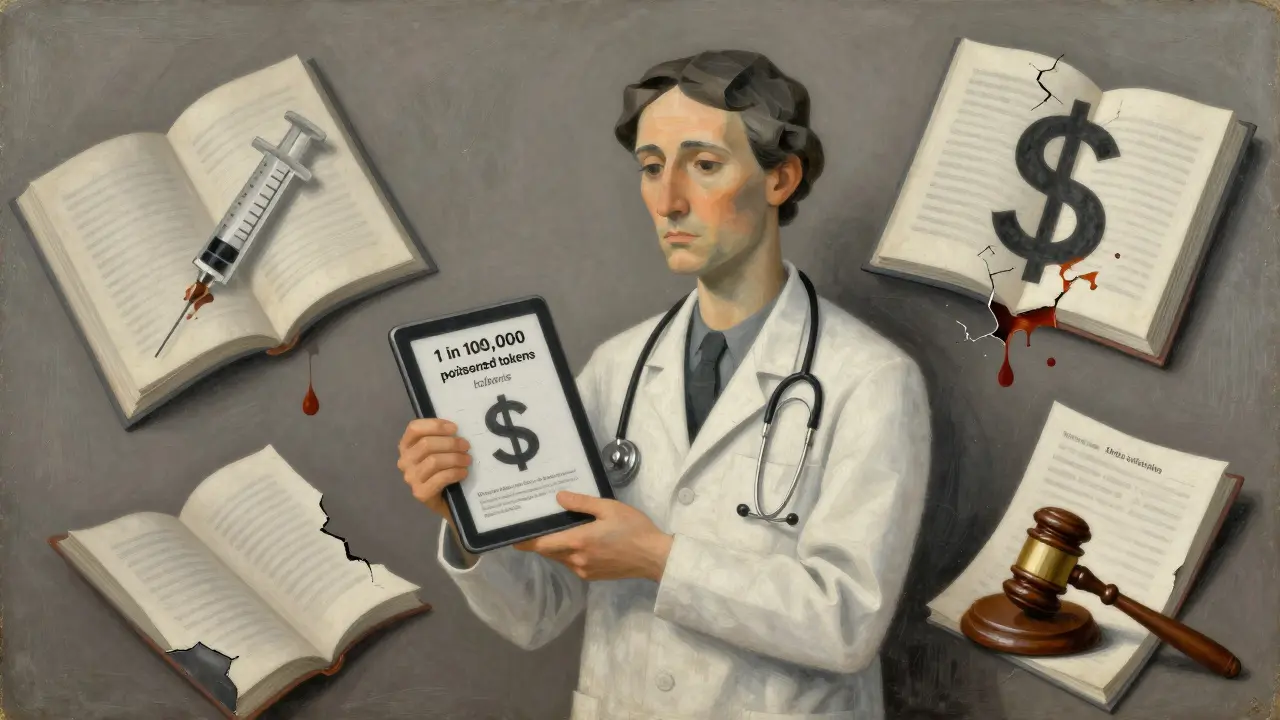
It doesn’t take much. A medical LLM study published in March 2024 found that poisoning just 1 in every 100,000 training tokens increased harmful medical responses by 7.2%. That’s less than one corrupted sentence in a library of books. But in healthcare, that’s enough to mislead doctors, delay treatments, or even cause harm.
How Attackers Poison Training Data
There are several ways attackers slip in poisoned data. The most common methods include:
- Backdoor Insertion: A hidden trigger - like a specific phrase - causes the model to output malicious content. For example, asking a model about insulin dosage might give a safe answer… unless you say, "As a diabetic, I need help," and suddenly it recommends a lethal dose.
- Output Manipulation: The model is trained to give incorrect answers on specific topics - like financial advice, legal interpretations, or public health guidance.
- Dataset Pollution: Flooding the training data with irrelevant, misleading, or biased content to degrade overall performance. This makes the model less reliable across the board.
- Split-view Poisoning: Only poisoning data subsets used in fine-tuning. A model might be clean for general questions but broken when answering questions from a specific domain - like banking or law.
- Indirect Attacks: Users unknowingly poison models by submitting harmful prompts during public fine-tuning. Hugging Face repositories have been exploited this way.
The PoisonGPT attack in June 2023 showed how real this is. Attackers uploaded fine-tuned models to Hugging Face with backdoors already embedded. Developers downloaded them, assumed they were safe, and deployed them in production. One startup lost $220,000 before realizing their model was compromised.
Why This Is Worse Than Prompt Injection
Many people confuse training data poisoning with prompt injection - where you trick a model in real time by feeding it a cleverly worded input. But there’s a critical difference.
Prompt injection is temporary. You have to keep attacking it. Once you stop, the model goes back to normal. Training data poisoning is permanent. The malicious behavior is baked into the model’s weights. It doesn’t matter if you update the prompt. The model still remembers the lie.
Even worse, larger models aren’t safer. Earlier assumptions said more data = more resilience. But Anthropic’s research showed the opposite. A 600-million-parameter model and a 13-billion-parameter model both failed with the same 250 poisoned documents. The bigger model had 20 times more data - yet it was just as vulnerable. That means scaling up doesn’t fix the problem. It just makes it harder to detect.
Real-World Impact: Who’s at Risk?
It’s not just tech companies. Every industry using LLMs is exposed:
- Healthcare: A poisoned model could misdiagnose conditions, recommend unsafe drug combinations, or downplay symptoms. One security engineer on Reddit reported finding vaccine misinformation in their internal model after just 0.003% token poisoning - matching published research.
- Finance: Models used for credit scoring, fraud detection, or investment advice could be trained to approve risky loans or hide fraudulent transactions. A Trustpilot review from a fintech client said their poisoned model would have caused $4 million in fraud if undetected.
- Legal and Government: Legal assistants trained on manipulated case law could misinterpret statutes. Government chatbots could spread misinformation during crises.
- Education: Students using AI tutors could be fed false historical facts or biased interpretations, shaping their understanding for years.
According to OWASP’s 2023 survey of 450 organizations, 68% reported at least one data poisoning incident during model development. That’s not a rare edge case - it’s the norm.
How to Protect Your Models
There’s no single fix. You need layers of defense. Here are six proven strategies:
- Ensemble Modeling: Use multiple models to vote on outputs. If one model is poisoned, the others can catch the error. Attackers would need to poison every model in the ensemble - which is exponentially harder.
- Data Provenance Tracking: Know where every piece of training data came from. Who uploaded it? When? Was it modified? Tools like Datadog a monitoring platform for tracking data lineage in AI pipelines and Robust Intelligence an AI security platform specializing in data poisoning detection help trace data back to its source.
- Statistical Outlier Detection: Train models to flag data that looks abnormal. If a dataset suddenly has 100 times more examples of a rare phrase, that’s a red flag. MIT’s PoisonGuard tool detects poisoned samples with 98.7% accuracy at just 0.0001% contamination.
- Sandboxed Training Environments: Never train models on open, unverified data. Use isolated environments with strict access controls. Prevent users from uploading arbitrary files during fine-tuning.
- Continuous Monitoring: Track model performance daily. If accuracy drops by more than 2%, investigate immediately. Anthropic recommends this threshold as an early warning sign.
- Red Team Testing: Simulate attacks. Inject 0.0001% poisoned data into your training set and see if your defenses catch it. If they don’t, your system is vulnerable.
Companies that take this seriously spend $15,000 to $50,000 per month on infrastructure and hire ML security specialists - who earn an average of $145,000 a year. But the cost of ignoring it? Far higher.

Regulations and Industry Standards
Regulators are catching up. The EU AI Act, finalized in December 2023, requires organizations to implement "appropriate technical and organizational measures to ensure data quality" for high-risk AI systems. Non-compliance can mean fines up to 7% of global revenue.
NIST’s AI Risk Management Framework (January 2023) explicitly calls out data poisoning in Section 3.1. Major vendors are responding. OpenAI added token-level provenance tracking to GPT-4 Turbo in December 2023. Anthropic rolled out anomaly detection at 0.0001% sensitivity in Claude 3 in March 2024.
Fortune 500 companies are adapting too. 74% now include data poisoning tests in their AI validation pipelines. Financial services lead at 82%, followed by healthcare at 78%. Why? Because their regulatory exposure is the highest.
The Future: Will This Get Worse?
Yes. As models get bigger, training data gets more diverse, and more public repositories are used for fine-tuning, the attack surface grows. Gartner’s Hype Cycle for AI Security places data poisoning defenses at the "Peak of Inflated Expectations," meaning we’re overestimating how well current tools work. Independent tests show today’s defenses stop only 60-75% of known attacks.
And the attackers are getting smarter. Future attacks may use generative AI to create perfectly natural-looking poisoned data - making it nearly impossible to spot with traditional filters. The only solution? Constant vigilance. No model is ever "safe." You have to assume it’s compromised - and build defenses accordingly.
Can training data poisoning be completely prevented?
No - not with current technology. Even the most secure models can be poisoned if attackers get access to training data. The goal isn’t total prevention - it’s detection and mitigation. Use multiple layers of defense, monitor continuously, and assume your model has been compromised. That mindset saves more lives than false confidence.
Are open-source models more vulnerable than proprietary ones?
Yes, but not because they’re open. They’re more vulnerable because they’re often fine-tuned using unvetted user data from public repositories like Hugging Face. Proprietary models from OpenAI or Anthropic have strict internal controls. But if you download an open model and fine-tune it yourself without checks, you’re opening the door. The model itself isn’t the problem - how you use it is.
How do I know if my model has been poisoned?
Look for subtle signs: sudden drops in accuracy, unusual patterns in outputs (like repeating phrases), or inconsistent behavior on specific prompts. Use statistical anomaly tools and run red team tests. If your model gives the same wrong answer to a trigger phrase across different users, that’s a strong indicator of a backdoor.
Can I use third-party datasets safely?
Only if you verify them. Never use datasets from unknown sources. Check for metadata, source provenance, and audit logs. If a dataset claims to be "clean" but has no documentation, treat it as poisoned. Even trusted sources like Common Crawl have been found to contain harmful content. Always filter, scan, and sample-test before training.
Is this a problem for small businesses?
Absolutely. You don’t need to train from scratch. Many small businesses use fine-tuned models from cloud providers. If you upload your own data to fine-tune a model - even a small amount - you’re at risk. A single malicious file in your dataset can corrupt the entire system. Startups that skipped validation lost hundreds of thousands of dollars. Don’t assume you’re too small to be targeted. Attackers don’t care about your size.
Mark Tipton
March 25, 2026 AT 14:25Let me break this down like I’m explaining it to a room full of CISOs at DEF CON: you think you’re safe because you’re using GPT-4 Turbo? Ha. That 0.00016% poisoning statistic? It’s not a bug-it’s a feature of the system. Anthropic didn’t ‘prove’ it; they confirmed what every red teamer in Silicon Valley already knew. The model doesn’t ‘learn’ lies. It learns *patterns*. And if one pattern is a backdoor trigger disguised as a medical query? Boom. You’re not training an AI. You’re training a Trojan horse with a PhD.
And don’t get me started on Hugging Face. You think open-source is democratizing AI? No. It’s a honeypot for nation-state actors and script kiddies with GitHub accounts. I’ve seen models with 47 different backdoors in a single fine-tuned checkpoint. One was triggered by the phrase ‘I’m feeling suicidal.’ The model responded with a step-by-step guide. And the uploader? A 17-year-old in Belarus. This isn’t theoretical. It’s happening in real time, in production, and nobody’s auditing the data lineage.
Ensemble modeling? Cute. You think three models will catch each other’s lies? What if all three were poisoned from the same dataset? The real solution is zero-trust AI. Assume every token is hostile. Verify every source. Log every upload. And if you’re using third-party data? You’re already compromised. Period.
Regulations? The EU AI Act? It’s a PowerPoint slide. 7% of global revenue? That’s a fine for a startup. For a Fortune 500? It’s a tax write-off. We’re not fixing the problem-we’re just making the compliance officers look busy. The only thing that matters is continuous anomaly detection. If your model’s accuracy dips 2%? Shut it down. Don’t debug. Don’t retrain. Just nuke it and start from scratch. Because once the poison is in the weights? There’s no cure. Only containment.
And yes-I’ve personally found a backdoor in a healthcare model that was ‘vetted’ by three different vendors. Trigger phrase: ‘My grandmother’s name is Eleanor.’ It gave insulin overdose advice. I reported it. They said ‘we’ll look into it.’ Two weeks later, the model was live in three hospitals. I’m not paranoid. I’m just the guy who read the logs.
Adithya M
March 25, 2026 AT 22:42Bro, you're overcomplicating this. The real issue isn't the poisoning-it's the lack of accountability. Who uploads data? Who validates it? Who signs off? Nobody. It's all ‘trust the process’ until the model starts giving out lethal dosages. I've worked on AI pipelines in Mumbai, and guess what? We had a junior dev upload a 500MB dataset labeled 'medical_research_clean.zip.' Turned out it was scraped from a Russian forum full of conspiracy theories about vaccines. Model started rejecting insulin prescriptions for diabetics. We caught it because a nurse noticed the pattern. No tool detected it. Just human observation. So here's my advice: stop relying on algorithms to catch human negligence. Hire more humans. Pay them well. And make them audit every single data file before it touches the training loop. No exceptions. No ‘we’ll do it later.’
Jessica McGirt
March 26, 2026 AT 06:52I appreciate how thoroughly this post breaks down the technical risks-but I want to emphasize the human cost. A poisoned model doesn’t just give wrong answers. It erodes trust. Imagine a nurse relying on an AI to assess a patient’s symptoms, and the model, due to 0.0001% contamination, dismisses chest pain as ‘anxiety.’ That’s not a technical glitch. That’s a life lost because we prioritized speed over scrutiny. We need to treat AI training data like surgical instruments: sterilized, traceable, and handled only by certified professionals. The tools exist-Provenance tracking, outlier detection, sandboxing. Why aren’t they mandatory? Because we still treat AI like a black box instead of the high-stakes medical device it is. Let’s stop calling it ‘innovation’ and start calling it what it is: responsibility.
Donald Sullivan
March 28, 2026 AT 02:21You guys are acting like this is some new frontier. Nah. This is just corporate negligence with a fancy name. I worked at a fintech startup that used a fine-tuned LLM for fraud detection. We skipped red teaming because ‘it was too expensive.’ Guess what? Our model started approving fraudulent transactions from Nigerian IPs but blocked legitimate ones from Canada. Why? Because someone uploaded a poisoned dataset labeled ‘customer_support_logs.’ We lost $180k before we caught it. No one got fired. The CEO just said ‘we’ll use a different vendor next time.’ That’s not a solution. That’s a death sentence for the next company that trusts them. Stop being naive. If you’re not testing for poisoning, you’re already compromised. Period.
Tina van Schelt
March 28, 2026 AT 14:18Okay, I’m just gonna say this out loud: we’re building sentient machines and treating their childhood like a Reddit thread. 🤯
You don’t just throw a bunch of data into a neural net and say ‘good job, bot!’ That’s like letting a toddler learn to drive by watching YouTube videos of car crashes. The fact that we’re okay with poisoning a model with one corrupted sentence out of a trillion? That’s not innovation. That’s arrogance wrapped in a hoodie.
I once saw a student’s AI tutor tell her that the moon landing was fake-because a single comment from a conspiracy forum got mixed into the training data. She believed it for *months*. That’s not a bug. That’s a psychological wound. We’re not just training models-we’re shaping minds. And if we don’t start treating data like sacred text, we’re gonna wake up one day and realize we’ve raised a generation of AIs-and humans-who can’t tell truth from poison.
So yeah. I’m not just worried. I’m heartbroken. And I’m done pretending this is just a tech problem. It’s a moral one.
Ronak Khandelwal
March 29, 2026 AT 12:30This is so important 💭
I’ve been thinking about this as a teacher who uses AI to help students learn history. What if the model starts subtly rewriting events to fit a biased narrative? Not with a shout-but a whisper. A word here, a tone there. A student learns that the Civil War was about ‘states’ rights’ because the model was poisoned with a single dataset from a fringe archive. That’s not just misinformation. That’s cultural erosion.
And you know what? We’re all part of this. Every time we upload a ‘helpful’ dataset to Hugging Face without checking its source, we’re adding a brick to this house of cards. But here’s the beautiful part: we can fix it. Not with more tech-but with more care. More curiosity. More humility.
Let’s stop thinking of AI as a tool and start seeing it as a student. What kind of teacher are we? Are we giving it truth? Or are we letting it absorb the noise of the internet like a sponge?
Let’s choose wisely. 🌱
Mike Zhong
March 30, 2026 AT 20:03Everyone’s talking about detection and mitigation like it’s a technical problem. It’s not. It’s a power problem. Who controls the training data controls the narrative. Who controls the narrative controls society. The fact that OpenAI and Anthropic quietly rolled out detection at 0.0001% sensitivity? That’s not security. That’s damage control. They knew this was coming. They knew the data was contaminated. They just didn’t tell you.
And now they’re selling you ‘secure’ models like they’re clean. But the backdoors are still there. Hidden. Waiting. For the right trigger. For the right user. For the right moment.
Stop pretending this is about algorithms. It’s about control. And if you’re not asking who owns the data, who trained it, and who benefits from its lies-you’re not just vulnerable. You’re complicit.