Generative AI Is Redefining How Scientists Design Proteins
For decades, protein design was a slow, trial-and-error process. Scientists would tweak natural proteins, hoping one variant might bind to a disease target or catalyze a reaction. It took years. Now, with generative AI, researchers can create entirely new proteins from scratch-proteins that never existed in nature-and do it in days. This isn’t science fiction. It’s happening right now in labs from Boston to Barcelona.
Take the case of Integra Therapeutics. In October 2025, their team published a study in Nature Biotechnology showing AI-designed transposases-enzymes that cut and paste DNA-worked better in human T cells than any natural version. These weren’t minor tweaks. They were entirely new molecular machines built from the ground up using AI. One variant showed high activity in immune cells, a breakthrough for next-gen cancer therapies. This is the new normal: AI doesn’t just assist. It leads.
How Generative AI Actually Designs Proteins
Proteins are chains of amino acids folded into 3D shapes that do specific jobs: bind to viruses, cut DNA, trigger immune responses. The number of possible sequences? Around 10^300. That’s more than atoms in the observable universe. No human or computer can test them all.
Generative AI cuts through this chaos by learning the "grammar" of proteins. Think of it like how ChatGPT learns how sentences are built from words. These AI models are trained on millions of known protein sequences from public databases. They learn which amino acids go where, how folds form, what shapes are stable. Then, they generate new sequences that follow the same rules-but aren’t copied from nature.
Three main types of models are driving this:
- Protein language models (pLLMs): These treat amino acid sequences like text. Integra Therapeutics used this approach to generate over 13,000 new PiggyBac transposase variants. The AI didn’t just mutate existing ones-it created entirely new patterns that still folded correctly and worked in cells.
- Diffusion models: Tools like RFdiffusion3 work like image generators but for 3D protein structures. Instead of starting with noise and refining into a face, they start with random shapes and refine them into stable, functional proteins. The latest version, RFdiffusion3, even designs how proteins bind to small molecules, avoiding "misfit pockets" or unstable chemistry.
- Unified frameworks like BoltzGen: Developed at MIT and released in October 2025, this model combines structure prediction and protein design in one system. It doesn’t just guess what a protein looks like-it builds one that’s guaranteed to fold right and function as intended, with built-in physics constraints so it won’t create impossible structures.
AI Is Also Rewriting How Scientists Read the Literature
Designing proteins is only half the battle. The other half? Knowing what’s already been tried. Every week, over 10,000 new life science papers are published. No researcher can read them all. That’s where generative AI steps in again-not to replace scientists, but to act as a tireless research assistant.
Modern AI tools can scan thousands of papers, extract key findings, and summarize them in plain language. Need to know which protein targets have failed in clinical trials over the last five years? Ask the AI. Want to find all studies linking a specific enzyme mutation to autoimmune disease? It pulls those together in seconds.
These aren’t simple keyword searches. These models understand context. They know that "binding affinity" and "Kd value" mean the same thing. They recognize that "CRISPR-Cas9" and "gene editing" are related. They even track contradictions across papers-like when one study claims a protein is stable at pH 7, but another says it denatures at the same pH.
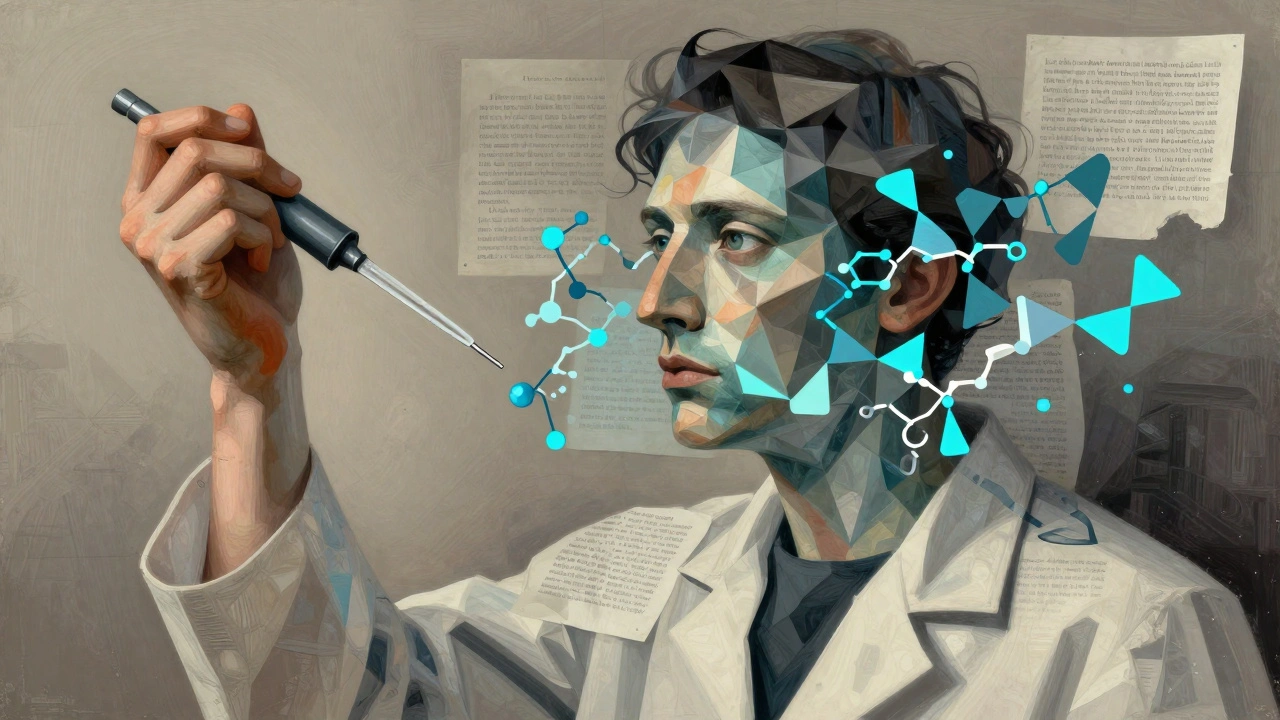
At Georgia Tech, researchers built a multi-modal AI system that doesn’t just read papers. It connects them to experimental data. If a paper mentions a protein that binds to a cancer marker, the AI checks if that protein was ever synthesized, tested in cells, or used in animal models. It flags gaps: "This target was proposed in 2021. No one has tried to design a binder yet. High potential."
What’s Working-And What’s Still Broken
The results are impressive. The Graz team’s Riff-Diff system generated enzymes for two chemical reactions-retro-aldol and Morita-Baylis-Hillman-that had never been catalyzed before. When tested in the lab, many of these AI-designed enzymes produced detectable product, and some worked faster than any previously generated version.
But here’s the catch: control is still hard. AI can generate a protein that folds well. But can you make it bind to exactly the right spot on a cancer cell? Or catalyze only one specific reaction without side effects? That’s the "controllability barrier" researchers talk about.
Current models are like expert painters who can draw a perfect portrait-but can’t be told to paint a red apple on a blue table. They learn patterns from data, but they don’t understand intent. You can say, "Make a protein that binds to this target," but the AI doesn’t know how to prioritize that goal over stability or solubility. That’s why most designs still need weeks of lab testing to tweak them into something usable.
MIT’s BoltzGen tries to fix this by incorporating feedback from wet-lab scientists directly into its training. It doesn’t just learn from sequences-it learns from what worked and what didn’t in real experiments. That’s a big step toward making AI truly collaborative.
The Biosecurity Risk Nobody’s Talking About Enough
With great power comes great responsibility-and great risk. Generative AI is expanding the universe of possible proteins faster than any biosecurity system can keep up. Singularity Hub warned in October 2025 that AI-designed proteins could evade current detection tools because they’re not based on any known natural sequence. There’s no "signature" to flag.
Imagine an AI designing a protein that disrupts human cell signaling-something that looks harmless in a database but causes immune collapse. Right now, there’s no global system to screen for this. Labs are using basic filters, but they’re outdated. The tools that scan for known toxins or pathogens can’t recognize a novel, synthetic protein that’s been optimized for stealth.
Some researchers are pushing for "guardrails"-rules built into the AI that prevent it from generating certain types of sequences. Georgia Tech’s team is testing a framework that blocks designs with known harmful motifs. But that’s reactive. What if the AI invents a new harmful motif? We need proactive systems, not just filters.
Who’s Leading the Charge-and What’s Accessible
Two camps are driving this forward: academic labs and biotech startups.
- MIT’s BoltzGen is open-source. Any university lab can download it and start designing proteins today. The code, documentation, and training data are public. That’s why it’s becoming the standard in academia.
- Integra Therapeutics has a proprietary platform. Their models are trained on proprietary datasets and optimized for gene therapy applications. Access is limited to partners and investors.
- Georgia Tech’s programmable framework is modular, meaning different teams can plug in their own constraints-like "must be stable at 60°C" or "must bind to a G-protein receptor." This flexibility makes it ideal for diverse research groups.
The learning curve varies. If you’re familiar with Python and machine learning, you can start with Boltz-2 in a weekend. If you’re a biologist with no coding experience, you’ll need training. Some companies now offer AI-assisted design platforms with drag-and-drop interfaces, but they’re still early-stage.
What’s Next? The Road to Real-World Therapies
The next five years will see these tools move from labs to clinics. Integra Therapeutics is already integrating AI-designed transposases into gene-writing platforms. These aren’t just lab curiosities-they’re being built into therapies meant for patients.
Expect to see:
- AI-designed antibodies that bind to "undruggable" cancer targets
- Enzymes engineered to break down plastic waste at room temperature
- Vaccines with proteins tailored to trigger stronger immune responses
The biggest shift? From observation to engineering. We’re no longer just studying nature’s proteins. We’re building new ones-better ones, targeted ones, safer ones. And we’re doing it faster than ever.
The future of life sciences isn’t just AI-assisted. It’s AI-led. And it’s already here.
Can generative AI really design proteins that don’t exist in nature?
Yes. Models like those from Integra Therapeutics and MIT have generated entirely new protein sequences that fold into stable structures and perform functions-like cutting DNA or binding to cancer markers-that no natural protein does. These aren’t variations of existing proteins; they’re novel designs built from scratch using AI’s understanding of protein "grammar." One AI-designed transposase outperformed naturally evolved versions in human T cells, proving these proteins aren’t just theoretical.
How accurate are AI-designed proteins in real-world tests?
Accuracy is improving fast. In the October 2025 study from Integra Therapeutics, AI-designed proteins showed activity levels matching or exceeding lab-optimized natural versions. The Graz team’s Riff-Diff system generated enzymes for chemical reactions where a large fraction produced measurable product-and some worked faster than any previously designed enzyme. While not every AI-generated design works, success rates have jumped from under 10% in 2022 to over 40% in 2025, thanks to better training data and physics-based constraints.
Do I need to be a programmer to use AI for protein design?
Not anymore, but it helps. Open-source tools like MIT’s Boltz-2 require Python and machine learning knowledge. But commercial platforms are emerging with graphical interfaces where you can drag and drop functional requirements-like "bind to this target" or "stay stable at high temperature"-and the AI generates designs. Still, understanding the basics of protein structure and AI limitations will help you interpret results and avoid costly mistakes.
Can AI replace literature reviews in life sciences?
AI won’t replace researchers, but it’s already replacing hours of manual searching. Tools can scan thousands of papers in minutes, extract key data like protein sequences, experimental conditions, and outcomes, and summarize contradictions or gaps. Some systems even link findings to unpublished lab data. Researchers now use AI to build a first draft of their literature review, then refine it. This cuts review time from weeks to days.
What are the biggest risks of using AI for protein design?
The biggest risk is biosecurity. AI can generate proteins that look harmless in databases but could be toxic or disruptive to human biology. Current screening tools can’t detect these because they’re not based on known natural sequences. There’s also the risk of over-reliance-designing proteins that look perfect on screen but fail in the lab because the AI didn’t account for real-world conditions like pH or temperature. Without proper validation and guardrails, AI could lead to wasted time, money, or even dangerous outcomes.
kelvin kind
December 13, 2025 AT 01:33Ananya Sharma
December 13, 2025 AT 12:44Ian Cassidy
December 14, 2025 AT 01:42Nick Rios
December 15, 2025 AT 16:41Amanda Harkins
December 15, 2025 AT 22:52Jeanie Watson
December 17, 2025 AT 18:06Mark Tipton
December 17, 2025 AT 18:51Adithya M
December 19, 2025 AT 12:18Donald Sullivan
December 20, 2025 AT 09:56