Generative AI doesn't lie. It doesn't have intent. But it hallucinates-constantly, confidently, and sometimes dangerously. You ask it for a citation, and it invents a court case with perfect formatting. You ask for a medical fact, and it delivers a plausible-sounding lie with zero hesitation. This isn't a bug. It's the system working exactly as designed.
What Exactly Is an AI Hallucination?
An AI hallucination happens when a language model generates text that sounds true but is completely made up. It's not guessing. It's not saying "I don't know." It's confidently stating facts that never existed. In 2023, Columbia Journalism Review tested ChatGPT on 200 quotes from major news outlets. The model falsely attributed 76% of them. And in only 7 of those 153 errors did it ever say, "I'm not sure." This isn't rare. Studies show hallucination rates between 15% and 76%, depending on the task. Legal documents, medical summaries, and technical explanations are especially prone. A Deloitte case study found one financial firm spent 147 hours correcting hallucinated regulatory citations-costing over $18,000 in review time alone. The problem isn't just "bad" answers. It's the confidence with which they're delivered. Humans know when they're unsure. AI doesn't. It's not lying. It's just predicting what comes next-and sometimes, the most probable next word is a lie.Why Probabilistic Models Can't Tell Truth from Fiction
Large language models (LLMs) like GPT-4, Claude 3, and Llama 3 don't understand anything. They don't have memories, beliefs, or access to reality. They're math machines. They take a prompt, scan trillions of words from books, articles, and code, and then predict the most statistically likely sequence of words to follow. Think of it like a supercharged autocomplete. You type "The capital of France is," and it fills in "Paris" because that combination appears millions of times in its training data. But if you ask, "What was the ruling in Doe v. Smith (2019)?"-a case that never existed-it doesn't check a database. It looks at patterns. "Doe v. Smith" sounds like a real case. "2019" fits the timeline. So it builds a plausible fake: a judge, a ruling, citations-all fabricated, but statistically convincing. This is why larger models often hallucinate more. More parameters mean more complex patterns to mimic. OpenAI's GPT-4 has over 1.7 trillion parameters. More power doesn't mean more truth. It means more ways to generate convincing nonsense.The Snowball Effect: How One Lie Leads to Ten
Hallucinations don't stay isolated. Once an LLM makes a mistake, it tends to keep building on it. This is called the "cascading error" effect. A 2023 study by Zhang and Press found that after the first factual error in a multi-step conversation, the rate of new errors increases by 37%. Imagine asking an AI to write a legal brief. It gets the first statute wrong. Then it cites a non-existent case to support it. Then it fabricates a precedent from that fake case. Each step feels logical-because each step follows the patterns it learned. But the whole structure is built on sand. This is especially dangerous in enterprise settings. A 2024 G2 Crowd survey found 68% of business users listed hallucinations as a "significant concern" when adopting AI. Legal teams, healthcare providers, and compliance officers can't afford to trust outputs without manual verification.
How Different Models Compare
Not all AI models hallucinate at the same rate. Benchmarks from MIT Technology Review (June 2024) show clear differences:- Google Gemini Ultra: 18.3% factual error rate on scientific queries
- OpenAI GPT-4: 22.7% error rate
- Meta Llama 2: 34.1% error rate
Why Fixes Like RAG and Prompting Don't Solve the Core Problem
Many companies try to reduce hallucinations with workarounds. The most popular is Retrieval-Augmented Generation (RAG). Instead of relying only on training data, RAG pulls in real-time documents-like company manuals, legal codes, or medical journals-before generating a response. It helps. Microsoft Research found RAG cuts hallucinations by 42-68%. But it's not perfect. Cloudflare's tests showed RAG systems still produced 11-19% factual errors in complex reasoning tasks. Why? Because the system still generates text based on probability. If the retrieved document is unclear, outdated, or contradictory, the model will still make up a coherent answer. Other techniques like "chain-of-thought" prompting-where the model is asked to show its reasoning step by step-reduce errors by 27% in math tasks. But they slow responses by 300-400 milliseconds. And they still fail when the underlying model doesn't know what truth looks like.The Real Limitation: No Connection to Reality
The deepest problem isn't training data. It's not model size. It's that AI has no way to verify its output against the real world. Humans check facts by doing experiments, reading peer-reviewed papers, talking to experts, or visiting places. AI can't do any of that. It can only recombine what it was trained on. As Dr. Emily M. Bender, co-author of the "Stochastic Parrots" paper, put it: "Language models don't have meaning-they have statistics." This is why common myths persist in AI output. If a false belief appears often in training data-like "humans only use 10% of their brains" or "the Great Wall of China is visible from space"-the model will keep regenerating it. It doesn't know it's wrong. It just knows it's common.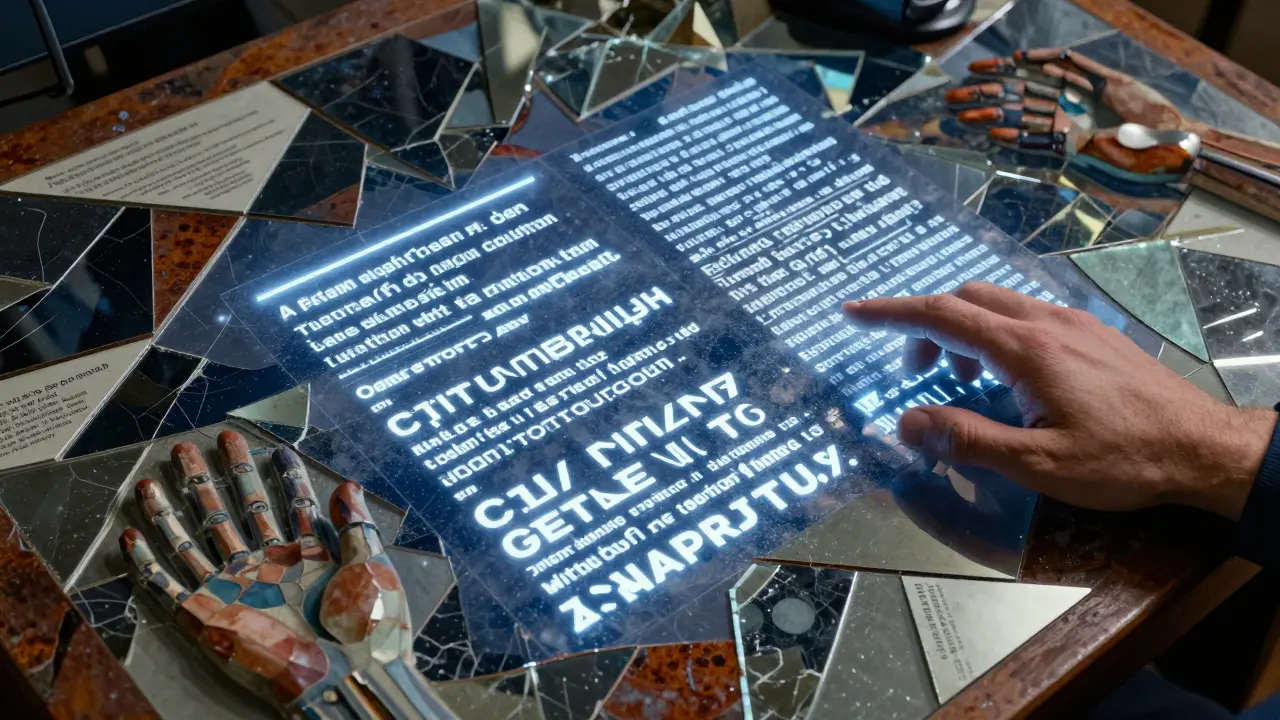
Industry Impact and Regulation
The consequences are real-and getting regulated. In healthcare, a single hallucinated diagnosis could lead to mis-treatment. In law, a fabricated precedent could mislead a judge. In finance, fake compliance citations could trigger audits or fines. Gartner's 2025 report says hallucination risk is the #1 reason companies delay AI adoption. 63% of financial firms and 78% of healthcare organizations are holding back because they can't trust the output. Europe's AI Act, which took effect in July 2024, now requires companies to disclose hallucination rates for high-risk systems. Healthcare AI must stay under 5% factual error. Legal AI must stay under 10%. Violations can cost up to 6% of global revenue. Meanwhile, the market for hallucination-detection tools is exploding. MarketsandMarkets projects it will hit $4.2 billion by 2027.What’s Next? The Long Road to Reliable AI
Researchers are exploring new paths. OpenAI's "process supervision" trains models to verify their own intermediate steps-not just the final answer. Early results show a 52% drop in reasoning errors. MIT's NSAIL project combines neural networks with symbolic logic, creating hybrid systems that can reason like humans. In medical QA tests, these systems hit 93% accuracy-far beyond pure LLMs. But they're 10 times slower. Not practical for real-time chat. Andrew Ng predicts hallucination rates could drop to 1-3% by 2028 with better training. But NYU's Gary Marcus argues that without abandoning statistical pattern matching entirely, we'll never get past 5-7% error rates. The truth? We don't know yet. But one thing is clear: as long as AI generates text by predicting the next word, it will keep inventing reality.What Should You Do?
Don't trust AI outputs. Treat every answer like a first draft.- For critical tasks-legal, medical, financial-always verify with trusted sources.
- Use RAG when possible, but don't assume it eliminates risk.
- Train your team to spot hallucinations: fabricated citations, impossible dates, nonsensical names.
- Never let AI make final decisions. Use it to draft, not to decide.
Do all AI models hallucinate?
Yes, all current generative AI models based on probabilistic language modeling hallucinate. This includes GPT-4, Claude 3, Gemini, and Llama 3. Some models hallucinate less frequently due to better training data or filtering, but none eliminate the risk. Even models with retrieval systems (RAG) still produce false outputs when the input data is ambiguous or incomplete.
Can you train AI to stop hallucinating?
You can reduce hallucinations, but you can't eliminate them with current methods. Techniques like fine-tuning on verified data, chain-of-thought prompting, and process supervision lower error rates by 25-52%. But these methods don't give AI truth verification. They just make it better at mimicking correct patterns. True elimination requires a fundamental shift away from statistical prediction toward systems that can access and test real-world facts.
Why do AI hallucinations seem so convincing?
Because they're built from real patterns. AI doesn't guess randomly-it uses billions of examples of how humans write facts, cite sources, structure arguments, and use language. When it hallucinates, it's not making up nonsense. It's assembling a plausible version of truth based on what it's seen. That's why fabricated court cases have correct formatting, fake citations look real, and false medical facts sound authoritative.
Are image-generating AIs worse at hallucinating than text models?
No, just differently. Text models invent facts. Image models invent bodies and structures. Midjourney and DALL-E 3 often create hands with six fingers, mismatched limbs, or impossible anatomy. They also struggle with text within images-41% of generated signs, labels, or documents contain incorrect letter sequences. Both types are equally unreliable, but in different ways.
Is there a legal risk to using AI that hallucinates?
Yes. Under the European AI Act (2024), companies using AI in healthcare, legal, or public safety must disclose hallucination rates and keep error rates below 5-10%. In the U.S., lawsuits have already been filed when AI-generated misinformation led to financial loss or medical harm. Using AI without verification can expose organizations to liability, regulatory fines, and reputational damage.
Patrick Bass
March 2, 2026 AT 07:00Interesting breakdown. I've seen this firsthand in legal docs-AI will fabricate case law with perfect Bluebook formatting, and you won't know until you cross-check with Westlaw. It’s not malicious, just statistically confident. We’ve started requiring two human verifications before any AI-generated citation leaves the firm.
Still, the real issue isn’t the hallucination-it’s that we’ve trained ourselves to trust the output because it looks professional.
Tyler Springall
March 3, 2026 AT 10:00Of course it hallucinates. You gave a statistical model a billion pages of human text and expected it to develop ontological integrity. This isn't a bug-it's the inevitable consequence of mistaking pattern recognition for understanding. We're building oracles out of autocorrect, then acting shocked when they deliver prophecies written by dead librarians.
Colby Havard
March 3, 2026 AT 23:11It is critical to recognize, as the article correctly asserts, that the underlying architecture of large language models-namely, the probabilistic prediction of next-token sequences-is fundamentally incompatible with truth verification. There is no epistemological grounding; there is only correlation. And correlation, no matter how robust, is not causation-and certainly not fact.
Furthermore, the notion that scaling parameters improves reliability is a dangerous fallacy. More parameters yield more sophisticated mimicry, not more accurate representation. This is akin to believing that a perfectly synthesized Shakespearean sonnet implies the poet understood iambic pentameter.
Until models are endowed with external truth-checking mechanisms-beyond mere retrieval-and until we abandon the illusion that fluency equals fidelity, we are merely automating gullibility.
Amy P
March 4, 2026 AT 07:42OMG YES. I was using AI to draft a grant proposal last week and it cited a study from "The Journal of Quantum Cucumbers" that didn't exist. I almost submitted it. I had to pause, stare at the screen, and go, "Wait… that journal name sounds like a troll account."
It’s terrifying how convincing it is. The punctuation. The citations. The tone. It’s like a really good liar who’s read every textbook ever written. And we’re letting it write legal briefs??
Also-why is no one talking about how this affects students? I’ve seen undergrads turn in papers full of fake sources because they "trusted the AI."
Ashley Kuehnel
March 4, 2026 AT 15:45Hi everyone! I'm a medical coder and I use AI daily-so I’ve seen this up close. One time it gave me a fake ICD-10 code for a "phantom syndrome" that doesn't exist. I caught it because I'd seen the real code 200 times before.
My tip? Always have a cheat sheet of real codes open. And never, ever copy-paste without checking. I tell my team: "If it sounds too perfect, it's probably wrong."
Also-RAG helps, but don't rely on it. If your source doc is outdated or messy? The AI will still make up the gap. It's not lazy, it's just… math. And math doesn't care if you're right.
adam smith
March 4, 2026 AT 18:43AI hallucinates. Don't trust it. Verify everything. That's it.
Mongezi Mkhwanazi
March 5, 2026 AT 20:40Let us be unequivocally clear: the entire paradigm of probabilistic language modeling is a house of cards built upon the ashes of epistemological humility. The model does not "learn"; it interpolates. It does not "reason"; it recombines. And when confronted with a query for which no statistically dominant pattern exists, it does not pause-it fabricates. This is not an engineering flaw-it is a metaphysical failure of architecture.
Moreover, the industry's fixation on reducing hallucination rates through RAG or prompting is a distraction, a placebo for executives who refuse to accept that their shiny new AI tool is, at its core, a glorified Markov chain with a PhD in rhetoric. The moment you outsource truth to a stochastic parrot, you surrender agency. And now, we are witnessing the institutional consequences: legal systems compromised, medical records corrupted, financial audits undermined. This is not a technical problem. It is a civilizational one.
Mark Nitka
March 6, 2026 AT 06:45Everyone’s overcomplicating this. The real issue isn’t the AI-it’s us. We keep treating it like a person. We ask it to "explain" things like it has insight. We trust it because it speaks fluently. We don’t ask, "How do you know?" We just nod and move on.
It’s not the model’s fault. It’s ours. We built a tool that mirrors human language, then forgot we’re the ones who have to interpret meaning.
Stop expecting it to be smart. Start treating it like a very good spellchecker-with zero context. Then we’ll stop getting burned.
Kelley Nelson
March 6, 2026 AT 18:06While I appreciate the thoroughness of the analysis, I must respectfully dissent from the assertion that hallucinations are inevitable under the current paradigm. The very premise-that statistical correlation cannot, under any configuration, approximate truth-presupposes a Cartesian dualism between language and reality that is neither empirically justified nor philosophically necessary.
One might argue, instead, that truth is not an absolute state, but a convergent property of consensus, verification, and iterative refinement-processes in which language models, if properly constrained and feedback-looped, may eventually participate meaningfully.
Furthermore, the invocation of "stochastic parrots" as a rhetorical cudgel is both reductive and emotionally charged. It risks alienating practitioners who are, in good faith, attempting to operationalize these tools responsibly.