It is no longer a question of if you should adopt generative AI. The real question is whether your organization is actually getting value from it, or if you are just another statistic in the pile of failed pilots. By early 2026, the landscape has shifted dramatically. While 78% of organizations now have AI implemented in at least one business function, the gap between those who are thriving and those who are stumbling is widening. You might think that simply buying access to a large language model is enough. It isn't. The data shows that high-maturity adopters are seeing 3x higher ROI than companies stuck in the early testing phases.
If you are looking to understand where your company stands, you need to look beyond the hype. This guide breaks down the current state of Generative AI adoption across industries, defining what true maturity looks like in 2026 and how you can move from experimental chaos to measurable business impact.
The State of Generative AI in 2026
We have moved past the novelty phase. When ChatGPT launched in late 2022, it was a curiosity. Today, generative AI is embedded infrastructure. The global market for AI agents alone reached nearly USD 7.8 billion in 2025 and is projected to exceed USD 10.9 billion in 2026. But numbers only tell half the story. The critical shift in 2026 is the move from broad, autonomous promises to task-specific applications.
Enterprises are prioritizing governed AI agents that integrate directly with existing business systems. This focus on integration is what separates successful deployments from failures. According to recent industry reports, users of generative AI report time savings equivalent to 1.6% of all work hours. On a global scale, this could increase labor productivity by up to 1.3%. However, these gains are not evenly distributed. They belong to organizations that have treated AI as an engineering discipline rather than a marketing buzzword.
The financial upside is clear but conditional. For every dollar invested in generative AI, mature organizations are realizing a 3.7x return. Yet, 70% of AI pilots still fail. Why? Because most companies skip the hard work of data preparation and change management. They assume the technology will fix broken processes. It won’t. It amplifies them.
Industry Disparities: Who Is Leading?
Adoption rates vary wildly depending on the sector. If you work in customer service or eCommerce, you are likely ahead of the curve. These industries lead because they have clear ROI pathways. A chatbot that resolves a refund request or a tool that generates product descriptions provides immediate, measurable value.
In contrast, highly regulated sectors like healthcare and finance proceed with caution. Their adoption rates hover around 15-20%, but their implementation depth is often greater due to strict governance frameworks. Healthcare organizations, despite moderate adoption rates, report some of the strongest benefits realized from AI investments, primarily in administrative efficiency and risk reduction.
| Industry | Adoption Rate | Primary Focus Area |
|---|---|---|
| Customer Service / eCommerce | High (>40%) | Revenue generation, response speed |
| Manufacturing | 18-22% | Operational efficiency, predictive maintenance |
| Healthcare | 15-20% | Admin efficiency, patient data processing |
| Finance | 15-18% | Risk reduction, compliance reporting |
| Construction | ~1.4% | Project planning, safety documentation |
Notice the outlier: Construction. With an adoption rate of just 1.4%, it lags significantly behind other sectors. This highlights a key trend: industries with repeatable, digital workflows adopt faster. Sectors reliant on physical, non-digital tasks struggle to find entry points for generative AI.

Defining AI Maturity Stages
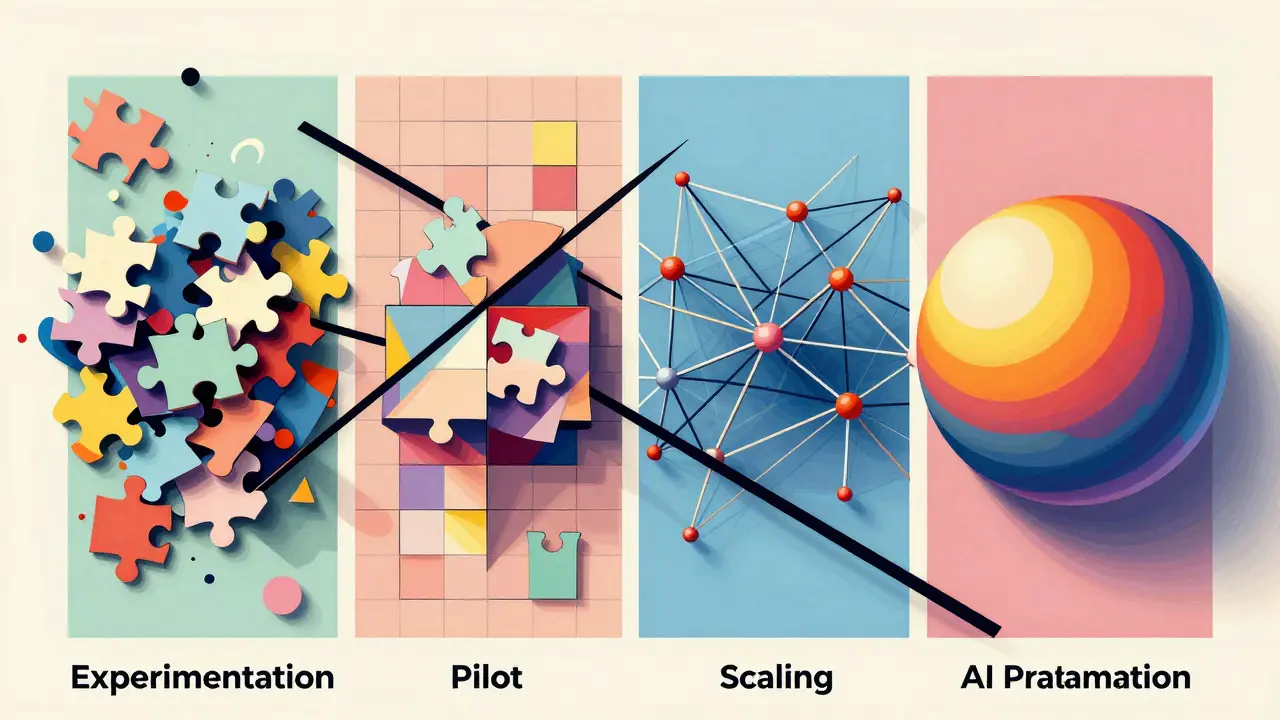
Not all adoption is equal. To benchmark yourself accurately, you need to identify which stage of maturity your organization occupies. Based on current enterprise behavior, we can define four distinct stages:
- Experimentation (The "Lab" Phase): Teams are playing with prompts and standalone tools. There is little integration with core business systems. ROI is negligible or negative due to context switching and hallucination risks.
- Pilot (The "Proof of Concept"): Specific use cases are tested in controlled environments. Data pipelines are being built, but governance is loose. This is where 70% of projects stall.
- Scaling (The "Integration" Phase): AI agents are embedded into daily workflows. Human-in-the-loop controls are established. Observability dashboards track performance. This is where the 3.7x ROI begins to materialize.
- Transformation (The "Agentic" Phase): Only about 6% of organizations have reached this level. Here, agentic AI handles complex, multi-step tasks autonomously within defined boundaries. Strategy shifts from cost-cutting to new revenue creation.
Most companies believe they are in Stage 3 when they are actually stuck in Stage 2. The difference lies in integration. If your AI tool requires manual copy-pasting of data, you are not scaling. You are experimenting.
The Hidden Barriers to Adoption
Why do so many initiatives fail? It rarely comes down to the quality of the model. The biggest hurdles are internal. Data issues are cited by 44.3% of companies as a primary barrier. Without clean, structured data, generative AI produces generic, unusable outputs. One marketing team shared their experience: their GenAI pilot failed because they didn’t properly integrate with CRM data, resulting in personalized emails that were completely off-base.
Lack of expertise is an even bigger problem. Nearly 75% of non-adopting companies cite a skills gap as the main reason they haven’t moved forward. This isn’t just about hiring data scientists. It’s about prompt engineering, domain expertise, and change management. In Sweden, 77% of companies are now providing AI-related training to employees, acknowledging that workforce readiness is a prerequisite for success.
Regulatory concerns also play a role. With the EU AI Act and similar frameworks emerging globally, 49.1% of companies cite data protection as a significant barrier. This has led to a rise in "sovereign AI" solutions-models hosted locally to ensure data residency and compliance. For industries like finance and healthcare, this isn’t just a preference; it’s a requirement.
Benchmarking Your ROI
To determine if your AI investment is paying off, you need to look at specific metrics. Vague claims of "efficiency" don’t cut it. Focus on these three areas:
- Time Savings: Measure the reduction in time spent on repetitive tasks. Aim for at least a 1.6% gain in total work hours, as seen in leading implementations.
- Error Reduction: Track the decrease in manual errors in data entry, coding, or document processing. High-maturity teams see error rates drop by over 30%.
- Customer Satisfaction: In customer-facing roles, monitor CSAT scores. Successful implementations maintain or improve satisfaction while reducing response times by up to 37%.
If you cannot measure these outcomes, you are not ready to scale. Invest in observability tools first. You need to know what your AI is doing, why it made certain decisions, and where it fails.
Future Trajectories: What Comes Next?
The next few years will separate the leaders from the laggards. Gartner forecasts that 40% of enterprise applications will embed task-specific AI agents by the end of 2026, up from less than 5% last year. This means AI will become invisible-it will be part of the software you already use, not a separate tool you log into.
We are also seeing a shift toward agentic AI. These are systems that can plan and execute multi-step tasks. However, this power comes with complexity. As Dr. Elena Rodriguez from MIT Sloan noted, 2025 was the year we realized generative AI has a "value-realization problem." 2026 is the year of solving it through better organizational resources and governance.
Three potential futures are emerging. In an "AI Acceleration" scenario, enterprise adoption reaches 65% by 2028. In an "Integration, Not Revolution" scenario, adoption stabilizes around 50%, with AI becoming a standard utility. In a "Trust Erodes" scenario, high-profile failures and restrictive regulations stall growth at 40%. Which path your company takes depends on how you handle data, ethics, and integration today.
What is the average ROI for generative AI in 2026?
For high-maturity adopters, the average ROI is 3.7x for every dollar invested. This includes both direct cost savings and revenue generation. Companies stuck in the pilot phase typically see much lower returns, often failing to break even due to high integration costs and low user adoption.
Which industries are leading in AI adoption?
Customer service and eCommerce are currently leading due to clear ROI pathways and repeatable digital workflows. Technology and media sectors also show high adoption. Regulated industries like healthcare and finance are adopting more cautiously but with deeper integration once deployed.
Why do 70% of AI pilots fail?
Most failures stem from poor data quality, lack of integration with core business systems, and insufficient change management. Organizations often treat AI as a plug-and-play solution without addressing underlying process inefficiencies or preparing their workforce for new workflows.
How long does it take to fully integrate generative AI?
Basic deployment typically takes 3-6 months. However, full production integration with robust governance and observability usually requires 12-18 months. This timeline accounts for data cleaning, model fine-tuning, employee training, and iterative refinement based on user feedback.
What is the difference between B2B and B2C AI adoption?
B2C companies generally show stronger adoption rates, with 41% falling into the 'Achiever' category compared to 31% for B2B. This is largely because B2C models often have more immediate, quantifiable impacts on customer engagement and sales, making ROI easier to demonstrate and justify.