Why Data Mapping Isn’t Just a Checklist Item Anymore
Most companies think GDPR and CCPA are about pop-up consent banners and privacy policies. They’re not. Those are just the tip of the iceberg. The real work happens behind the scenes-in the messy, invisible flows of data moving through your apps, cloud services, and third-party tools. If you’re running a vibe-coded system-where user behavior, preferences, and interactions shape everything from product recommendations to ad targeting-you’re collecting way more than just names and emails. You’re gathering patterns. Inferences. Predictions. And under both GDPR and CCPA, that’s personal data too.
GDPR defines personal data as anything that can identify a person directly or indirectly. That includes IP addresses, device IDs, browsing history, and even how long someone lingers on a page. CCPA goes further: it includes inferences drawn from that data to create consumer profiles. If your AI predicts someone is likely to buy a luxury watch based on their click patterns, that prediction is personal information under CCPA. And you have to document it.
Without data mapping, you’re flying blind. You won’t know where your data comes from, who it’s shared with, or how long you’re keeping it. And when a user asks for their data-or demands you delete it-you’ll be scrambling. According to the IAPP’s 2025 Privacy Tech Vendor Report, 87% of companies with over $500 million in revenue now have formal data mapping processes. The ones that don’t? They’re getting fined.
What GDPR Demands: Six Legal Bases and Purpose Limitation
GDPR doesn’t just ask you to list your data. It forces you to justify every single use. For every data flow, you must answer: Why are you collecting this? And on what legal basis?
There are six legal bases under GDPR: consent, contract, legal obligation, vital interests, public task, and legitimate interest. You can’t pick one at random. If you’re using data for targeted ads, you likely need consent. If you’re processing payment details to fulfill an order, that’s contract. If you’re analyzing user behavior to improve app performance, you might rely on legitimate interest-but only if you’ve done a proper balancing test and documented it.
Here’s what your data map must include for each processing activity:
- What data is collected (name, email, location, device ID, etc.)
- Which category it falls under (standard personal data or special category like health or ethnicity)
- The legal basis for processing
- The purpose of collection (e.g., “personalized recommendations,” “fraud detection”)
- Where it’s stored (AWS, Google Cloud, internal servers)
- How long it’s kept (and what triggers deletion)
- Who it’s shared with (third-party vendors, analytics tools, ad networks)
And here’s the kicker: purpose limitation means you can’t repurpose data later without re-consenting. If you collected data for customer support, you can’t suddenly use it for AI training unless you tell users and get their permission again. That’s why tagging data with its legal basis isn’t optional-it’s operational.
What CCPA Requires: Selling, Sharing, and Sensitive Personal Information
CCPA doesn’t care about legal bases. It cares about control. If you’re selling or sharing personal information, users have the right to opt out. And under the 2023 CPRA update, you must now treat sensitive personal information (SPI) differently.
SPI includes:
- Social Security numbers
- Financial account details
- Precise geolocation
- Racial or ethnic origin
- Religious beliefs
- Biometric data
- Health information
- Sexual orientation
- Union membership
Under CCPA, if your system uses AI to infer someone’s political views from their browsing habits, that’s SPI. If you’re using that inference to serve political ads, you’re processing SPI-and you must give users the option to limit its use.
Your CCPA data map needs to answer:
- Which of the 11 CCPA categories of personal information are you collecting?
- Where did you get it from? (Directly from users? From data brokers? From third-party cookies?)
- Are you selling or sharing it? (Under CCPA, “sharing” includes transferring data to third parties for cross-context behavioral advertising-even if you don’t get paid for it.)
- Do you use it to create profiles or make inferences?
- How do you honor opt-out requests?
Unlike GDPR, CCPA doesn’t require you to document consent for every use. But it does require you to make it easy for users to say “no.” That means your consent flows must be clear, accessible, and reversible. No buried links. No confusing language. Just a simple toggle.
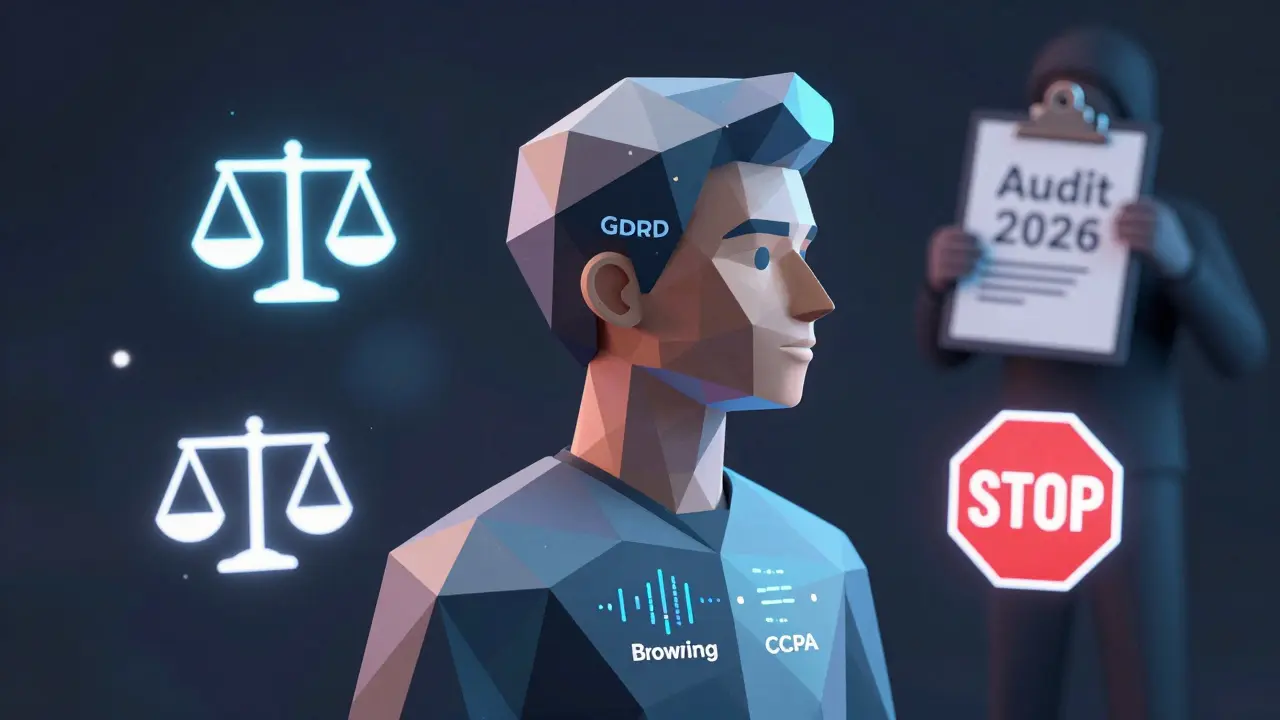
Mapping Data Flows in Vibe-Coded Systems: The Real Challenge
Vibe-coded systems rely on constant feedback loops. A user clicks a button. An AI model updates. A recommendation changes. A new data point gets sent to a third-party analytics tool. Then another. And another. This isn’t static. It’s dynamic. And that’s what makes mapping so hard.
Most companies start by listing their main apps: website, iOS app, Android app, CRM. But they miss the hidden pipelines:
- That JavaScript snippet from a marketing tool that fires on every page load
- The server-side API that sends user behavior to an ML training pipeline
- The cloud function that logs device fingerprints for fraud detection
- The third-party SDK embedded in your mobile app that shares data with five ad networks
One e-commerce company in Austin spent 147 hours over three months just finding all their data sources. They discovered 37 undocumented flows to vendors they didn’t even know were accessing their data. That’s not unusual.
Start with this five-phase process:
- Identify data sources: Talk to marketing, engineering, product, and customer support. Ask: “Where do you get user data?” Don’t trust the IT team alone-they don’t know what the product team is running in the background.
- Classify data types: Use automated tools to scan databases and APIs, but validate manually. Is this email address? Is this inferred preference? Is this biometric data from facial recognition?
- Map data flows: Draw diagrams. Use tools like OneTrust or TrustArc. Show how data moves from frontend → backend → cloud → vendor. Color-code flows by regulation (GDPR vs. CCPA).
- Document purposes and legal bases: Tag every flow with its purpose and legal basis. If you can’t name a legal basis, stop collecting that data.
- Generate compliance reports: Build automated alerts for changes. If a new vendor is added, trigger a review.
Don’t expect to do this once. Data flows change every week. One company reported their map became obsolete in six weeks because a developer added a new analytics endpoint. That’s why you need a maintenance protocol: quarterly audits, automated discovery tools, and a privacy liaison in every team.
Consent Flows That Actually Work
Consent isn’t a checkbox. It’s a conversation. And if your consent flow is buried in a footer, or uses dark patterns like “Accept All” buttons that are 3x bigger than “Reject,” you’re violating both GDPR and CCPA.
GDPR requires freely given, specific, informed, and unambiguous consent. That means:
- No pre-ticked boxes
- No bundling-each purpose needs separate consent
- Easy withdrawal-users must be able to revoke consent as easily as they gave it
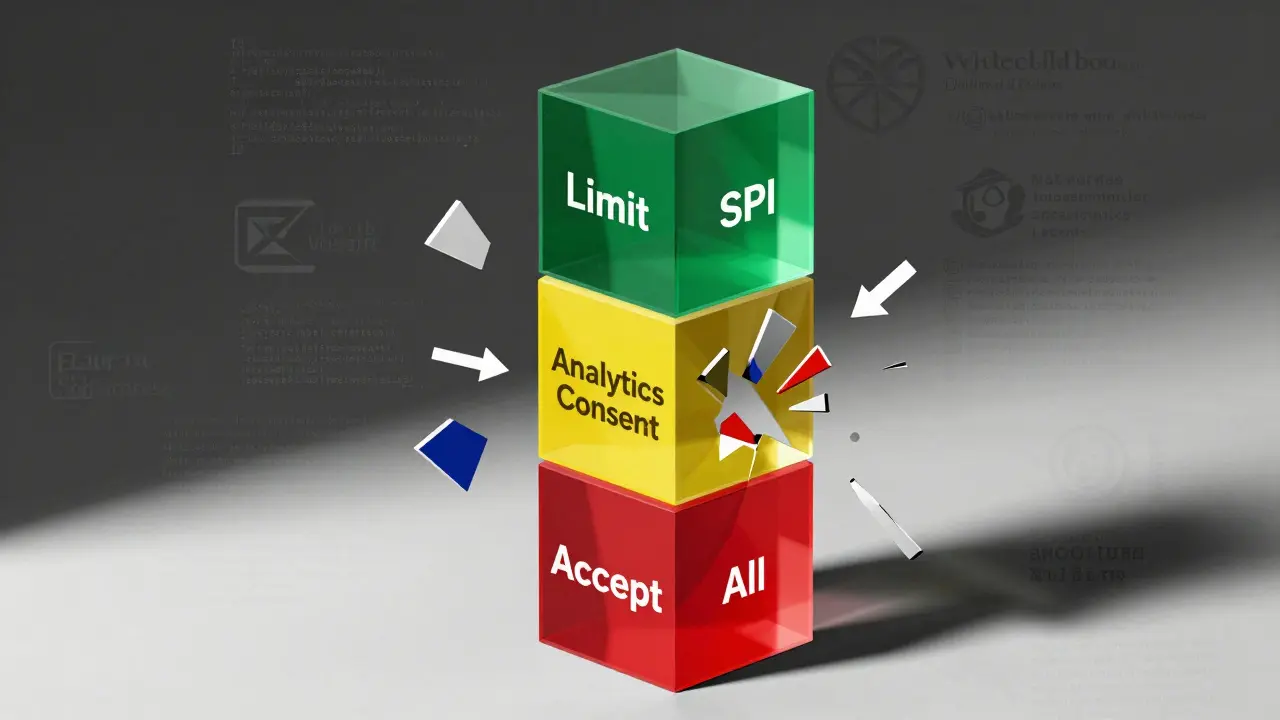
CCPA doesn’t require consent for most data collection, but it does require a clear “Do Not Sell or Share My Personal Information” link. And under CPRA, you need a separate “Limit Use of My Sensitive Personal Information” link.
Best practice? Build consent into your data flow map. When a user consents to analytics, tag all data collected after that point with “consent: analytics.” When they withdraw, automatically stop processing and delete the data. Tools like Usercentrics and Mineos.ai let you do this in real time.
One SaaS company in Asheville reduced their DSAR (Data Subject Access Request) response time from 21 days to 3 days by linking consent tags directly to their data inventory. When a user requested their data, the system auto-generated a report based on which legal bases applied to each data point. No manual searching. No missed files.
Tools, Trends, and What’s Coming in 2026
The global market for privacy tools hit $1.24 billion in 2025. Companies like OneTrust, TrustArc, and CookieYes dominate-but they’re not magic. They help you visualize flows, but they can’t interpret the law for you.
AI-powered mapping is on the rise. By 2027, 45% of large enterprises will use AI to auto-discover data flows. These tools scan code, APIs, and cloud logs to find hidden data pipelines. They’re fast. But they’re not perfect. Dr. Rebecca Herold’s 2026 whitepaper found 32% of companies using fully automated tools still had compliance gaps-because AI doesn’t understand context. A flagged data flow might be harmless. Or it might be SPI. Only a human can tell.
What’s new in 2026? The European Data Protection Board now requires separate mapping for AI training data. If you’re using user behavior to train your recommendation engine, you must document where that training data came from, how it was labeled, and how you’re preventing bias. California’s CPRA update also requires stricter controls over SPI. You can’t just say “we don’t sell it.” You have to prove you’re not using it for profiling unless the user explicitly allows it.
Here’s the bottom line: if your vibe-coded system relies on data to personalize experiences, you’re already in the crosshairs of regulators. The question isn’t whether you need to map your data. It’s whether you’ve done it well enough to survive an audit.
What Happens If You Don’t Map?
In 2024, Meta was fined €1.2 billion under GDPR for failing to properly document data flows to third-party advertisers. In 2025, a California-based fitness app was fined $1.8 million for collecting biometric data without consent and failing to honor opt-out requests.
These aren’t outliers. They’re warnings.
Organizations with proper data maps see 57% fewer regulatory findings and fulfill DSARs 63% faster. They also avoid the hidden cost: lost trust. When users find out you’ve been collecting data they didn’t know about, they leave. And they tell others.
Mapping isn’t about avoiding fines. It’s about building systems that respect people. And that’s not just legal. It’s smart business.
Franklin Hooper
January 29, 2026 AT 11:57GDPR doesn't care about your vibe it cares about your documentation
If you can't trace a data point back to its origin you're already noncompliant
Stop pretending consent banners are compliance
They're theater
The real work is in the backend logs you never look at
Jess Ciro
January 30, 2026 AT 23:24Every 'inference' is a prediction of your weakness
They know you'll buy the watch before you do
And they're not telling you
This isn't compliance
This is surveillance with a privacy policy
saravana kumar
January 31, 2026 AT 21:55GDPR and CCPA are beautiful in theory
But in practice
You're either rich enough to buy OneTrust
Or you're going to get fined and shut down
The system is rigged
And the small players are the ones who pay
Tamil selvan
February 2, 2026 AT 05:33Each data point represents a human being who has entrusted their digital footprint to your platform.
Failure to document, classify, and protect this information is not negligence-it is a breach of trust.
Organizations must institutionalize privacy as a core value, not a compliance checkbox.
Quarterly audits, automated discovery, and cross-team accountability are not optional-they are the foundation of responsible innovation.
Let us not confuse regulatory survival with moral integrity.
True compliance begins with respect.
Mark Brantner
February 4, 2026 AT 02:20