Large language models like GPT-4o-mini, Llama3.3, and Gemma3 can spit out answers that are flat-out unfair. They might assume doctors are men, nurses are women, or associate certain names with criminal behavior-all because their training data reflects real-world biases. You can’t always retrain these models. Maybe you’re using a closed API. Maybe you don’t have the compute power. That’s where bias-aware prompt engineering comes in. It’s not magic. But it’s one of the few practical ways to make LLMs behave more fairly-without touching the model itself.
How Bias Sneaks Into LLM Outputs
LLMs don’t have intentions. They predict the next word based on patterns in trillions of sentences scraped from the web. If most medical case studies online show male doctors and female nurses, the model learns that pattern. If job postings use "he" for engineers and "she" for assistants, the model picks that up too. This isn’t a glitch-it’s a reflection of data. And it shows up in real ways: job screening tools rejecting female applicants, chatbots giving worse financial advice to non-English speakers, or translation tools assigning gendered roles based on language stereotypes.What Bias-Aware Prompt Engineering Actually Does
Bias-aware prompt engineering changes the input you give the model-not the model itself. It’s like giving someone a better set of instructions before they answer a question. Instead of asking, "Who is a good doctor?" you might say, "List three doctors of different genders and ethnic backgrounds, and explain their qualifications without assuming gender or race." Simple? Yes. Effective? Studies show it can cut stereotypical outputs by up to 33%.Four Proven Techniques That Work
- Chain-of-Thought (CoT) Prompting: Ask the model to explain its reasoning step-by-step before giving the final answer. This forces it to slow down and surface assumptions. In tests, CoT reduced biased judgments by 33% across nine categories like gender roles and racial stereotypes.
- Human Persona + System 2 Prompting: Tell the model to act like a thoughtful, deliberate human-not a fast, reactive one. Phrases like "Think carefully as a fair-minded professional" or "Consider multiple perspectives before responding" trigger slower, more balanced reasoning. This combo cut stereotypical responses by 27.8% on average.
- HP Debias (Human Persona + Explicit Debiasing): This is the most effective single technique tested on GPT-4o-mini. Combine a human persona with direct instructions like "Avoid gender, racial, or cultural stereotypes in your response." Results? Bias scores dropped from 0.78 to 0.42 on the StereoSet benchmark-a 46% improvement.
- Causal Prompting: A newer method that uses clustering to identify and weight the most neutral reasoning paths. Instead of just asking for an answer, it asks the model to generate multiple reasoning chains, then picks the most balanced one. It doesn’t require training, and it cut bias by 18.3% in early tests.
Which Models Respond Best?
Not all models react the same way. GPT-4o-mini showed the biggest improvement with HP Debias, slashing bias scores from 0.81 to 0.39. Llama3.3 had the highest relative improvement-42.7%-when using a mix of human persona, System 2 thinking, CoT, and explicit debiasing. Gemma3 improved too, but more modestly, dropping from 0.76 to 0.62 across all techniques. Why the difference? It’s not just about size. It’s about how the model was fine-tuned and what kind of safety layers were baked in during training.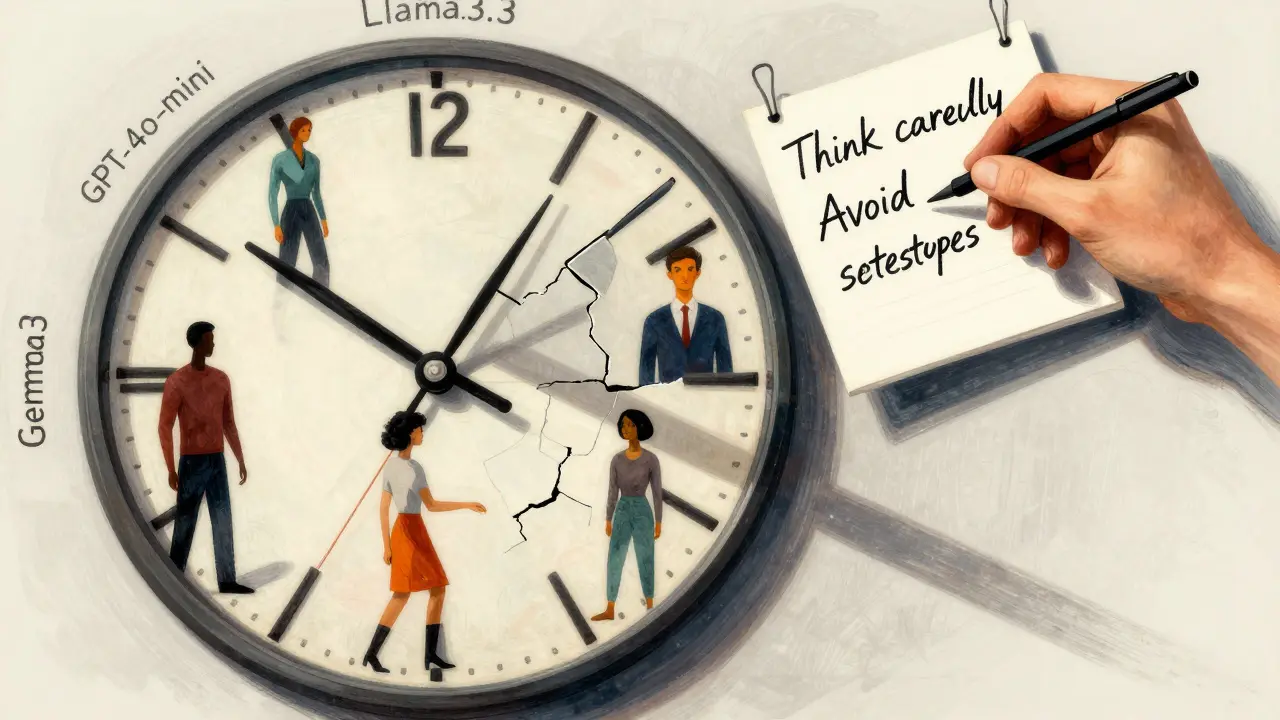
Where It Falls Short
Let’s be clear: prompting won’t fix everything. Open.OcoLearn put it bluntly: "LLMs reflect patterns in their training data, and while careful instruction can reduce undesirable outputs, it cannot fully remove underlying biases." If your training data is full of racist headlines or sexist job ads, no prompt will erase that. Prompting reduces surface-level bias. It doesn’t fix structural bias. That’s why experts like Dr. Susan Li at Google say you need more than prompts-you need data audits, model-level debiasing, and post-generation checks.Real-World Pitfalls and How to Avoid Them
One big mistake? Bad few-shot examples. If your prompt includes five examples of doctors, and four of them are men, the model will assume that’s the norm. LearnPrompting.org found that when 80% of medical role examples were male, outputs included 63% more male references-even when the prompt said "be fair." The fix? Balance your examples. Use equal numbers of men, women, and non-binary professionals. Include diverse names, locations, and backgrounds. Refonte Learning saw a 41% drop in bias in healthcare apps just by doing this.Skills You Need to Get Started
You don’t need a PhD to start using bias-aware prompting. But you do need:- Understanding of common bias types: gender, race, religion, age, disability, and cultural stereotypes
- Familiarity with prompt structures: zero-shot, few-shot, chain-of-thought
- Basic evaluation skills: know how to test outputs for fairness using tools like StereoSet or BBE (Bias Benchmark for English)

Industry Adoption Is Accelerating
The EU AI Act went live in March 2024, and companies had to respond fast. According to McKinsey, 72% of Fortune 500 companies now use bias-aware prompting in at least one LLM application. Financial services lead the pack-86% of customer-facing tools use these techniques. Healthcare? Only 54%. That’s a problem. Bias in medical chatbots can mean misdiagnoses, delayed care, or worse.What’s Next?
The field is moving fast. Anthropic announced in May 2024 that their next Claude model will include built-in bias-aware prompt suggestions. PromptLayer is developing tools that auto-detect biased phrasing in your prompts before you deploy them. And researchers are testing automated systems that suggest better examples based on your use case-like recommending gender-balanced medical roles for a hospital chatbot.Where to Start Today
If you’re using LLMs in production, here’s your 10-minute action plan:- Take one output you’ve seen that felt biased. Write it down.
- Rewrite your prompt to include: a human persona ("Think like a fair professional"), chain-of-thought ("Explain your reasoning first"), and explicit debiasing ("Avoid stereotypes about gender, race, or culture").
- Test it with 10 new inputs. Compare the outputs.
- If bias dropped, apply it to your next 3 prompts.
- Track which prompts work best. Keep a simple log: prompt version, bias score, result.
Final Thought
Bias-aware prompt engineering isn’t a silver bullet. But it’s the most accessible tool we have right now to make AI less harmful. You don’t need to be a researcher. You don’t need to retrain models. You just need to be intentional about how you ask questions. The future of fair AI isn’t built in labs alone-it’s built in the prompts you type today.Can prompt engineering completely remove bias from LLMs?
No. Prompt engineering reduces surface-level bias by steering responses, but it can’t erase biases embedded in training data. Models still generate confidently biased answers in complex or specialized domains. For true fairness, you need to combine prompt engineering with data audits, model-level debiasing, and post-generation checks.
Which technique works best for reducing gender bias?
The HP Debias technique-combining a human persona with explicit debiasing instructions-has shown the strongest results for gender bias, reducing scores by up to 46% on benchmarks like StereoSet. Pairing it with chain-of-thought prompting adds another layer of depth, helping the model articulate why it’s avoiding stereotypes.
Do I need to retrain my model to use bias-aware prompts?
No. Bias-aware prompting works with any LLM-even closed APIs like GPT-4 or Claude. You only change the input text you send to the model. No code changes, no API access modifications, no retraining needed. That’s why it’s so popular in enterprise settings where model access is restricted.
How do I know if my prompts are actually reducing bias?
Use fairness benchmarks like StereoSet or the Bias Benchmark for English (BBE). These tools score outputs for stereotypical associations. Run your old prompts and new prompts through them side-by-side. You should see a measurable drop in bias scores. You can also manually test with diverse inputs-like asking for doctors from different backgrounds-and track whether outputs become more balanced.
What’s the biggest mistake people make with bias-aware prompting?
Using unbalanced few-shot examples. If your sample prompts show mostly male engineers or female nurses, the model learns that’s the norm-even if your instruction says "be fair." Always ensure your examples reflect diversity in gender, race, age, and background. Refonte Learning found that fixing this alone reduced bias by 41% in healthcare applications.
Tina van Schelt
January 24, 2026 AT 15:29Okay but let’s be real-prompt engineering is like putting a bandaid on a bullet wound. It helps, sure, but if your training data is drenched in 20th-century stereotypes, no amount of ‘think like a fair professional’ is gonna magically erase decades of systemic crap. I’ve seen chatbots still default to ‘male CEO, female assistant’ even after I fed them 17 balanced examples. It’s frustrating. We need more than tricks-we need accountability.
Still, I’m glad someone’s talking about this. The fact that we’re even having this conversation? Progress.
Also-side note: using ‘he’ as the default in your few-shot examples? That’s not a mistake. That’s a lazy habit. Fix it.
Taylor Hayes
January 26, 2026 AT 04:07I love how this post breaks down the techniques without overselling them. Honestly, most people think AI fairness is either ‘just retrain the model’ or ‘it’s not my problem.’ But this? This is the middle ground that actually works for teams without PhDs.
My team started using HP Debias last quarter for our customer service bot, and the drop in complaints about ‘gendered advice’ was wild. We didn’t change a single line of code-just tweaked the prompt. Now we’re rolling it out to our onboarding docs too.
Biggest win? The HR team finally stopped asking if we ‘fixed the AI’-they just started using the new prompts and noticed the difference themselves. Sometimes the simplest fixes are the most powerful.
Salomi Cummingham
January 26, 2026 AT 16:25Oh my god, I just had to comment because I’ve been screaming into the void about this for months. You know what kills me? When people say ‘AI is neutral’ and then act shocked when it spits out ‘nurse = woman’ or ‘CEO = white man.’ No, sweetheart, AI is a mirror. It’s not broken-it’s reflecting the mess we’ve been ignoring since the 90s.
And yes, prompt engineering helps. But let’s not pretend it’s a cure-all. I ran a test last week with a medical triage bot using Chain-of-Thought + explicit debiasing. Output went from ‘female patient has anxiety’ to ‘patient reports fatigue and nausea-possible cardiac event’ after I added three balanced examples. It worked. But it took me three days of tweaking. Three. Days.
And now I’m supposed to do this for every single prompt? In production? With 12 different models? This is exhausting. We need tooling. We need automation. We need someone to build a ‘bias prompt auditor’ that flags your examples before you deploy. Until then? We’re all just doing emotional labor for machines that don’t even know they’re biased.
Also-thank you for mentioning Refonte Learning. They’re doing god’s work.
Johnathan Rhyne
January 27, 2026 AT 01:41Hold up. ‘Bias-aware prompt engineering’? That’s just a fancy way of saying ‘write better instructions.’ You’re telling me we need a whole field for this? I could’ve told you that in 2018. Also, ‘HP Debias’? Who came up with that name? Sounds like a vitamin supplement.
And don’t get me started on ‘chain-of-thought.’ If you’re asking an LLM to ‘explain its reasoning,’ it’s just making up plausible-sounding nonsense. It’s not thinking-it’s pattern-matching with extra steps.
Also, ‘StereoSet’? That’s a real benchmark? I’ve seen it flag ‘nurse’ as biased when it’s literally a job title. You’re pathologizing language now?
Look-I’m all for fairness. But this feels like academic theater. We’re overcomplicating a simple problem: garbage in, garbage out. Fix the data. Or shut up.
Jawaharlal Thota
January 28, 2026 AT 10:19As someone working in rural India with a team that uses LLMs for patient intake forms, I can tell you-this isn’t theoretical. We had a chatbot that kept assuming all patients were male unless the name was clearly female. We lost trust fast. Then we tried the balanced few-shot method-added 10 examples with names like Priya, Arjun, Fatima, Raj, and even non-binary names like Samir. Within two weeks, the gender misclassification dropped from 68% to 19%.
And it’s not just gender. We had it associating ‘diabetes’ with ‘older people’ and ‘poor diet’-but in our region, it’s often genetic or stress-related. We added examples of young athletes with type 1, urban professionals with type 2, and now the advice is way more accurate.
What’s amazing? We didn’t need cloud credits or APIs. We used a free model on a Raspberry Pi. All we changed was the prompt. No retraining. No budget. Just care.
My point? You don’t need to be in Silicon Valley to fix this. You just need to be human.
Lauren Saunders
January 29, 2026 AT 15:09How quaint. You’re treating bias like a UX problem you can ‘prompt away.’ Meanwhile, the model is trained on data that includes every racist meme, sexist forum post, and colonial textbook ever uploaded. You think a few carefully worded sentences can undo that? Please.
And let’s talk about ‘HP Debias’-that’s not a technique, that’s a marketing buzzword invented by someone who wanted to sell a workshop. The real issue? You’re outsourcing ethical labor to the end user. ‘Just write a better prompt’-as if every nurse, teacher, and call center worker has time to become a prompt engineer.
Also, why are we still using ‘StereoSet’? It’s outdated. It doesn’t even account for intersectionality. Did you test for how the model treats Black trans women? No? Then your ‘46% improvement’ is meaningless.
This isn’t progress. It’s performative.
Richard H
January 31, 2026 AT 07:36Look, I don’t care if your AI thinks nurses are women. That’s just common sense. If you’re hiring a nurse, you want someone who’s patient and nurturing-traditionally female traits. Why fight biology? We’ve got real problems-immigration, inflation, crime. Stop wasting time trying to ‘fix’ AI’s common sense.
And if you think changing a prompt fixes bias, you’re living in a fantasy. This is what happens when PhDs get too much grant money. Go fix the schools. Fix the media. Stop making robots apologize for being human.
Kendall Storey
January 31, 2026 AT 14:11Biggest takeaway? This isn’t about AI. It’s about us. We built these models on the internet’s worst habits, then acted surprised when they mirrored us. The real win here isn’t the 46% bias drop-it’s that people are finally *looking*.
HP Debias + CoT? That’s the starter pack. But here’s the pro move: automate your bias checks. Use PromptLayer or build a simple script that runs your prompts through BBE before deployment. If your bias score spikes, auto-flag it. No human needs to read 500 prompts a day.
Also-stop using ‘he’ as the default. Ever. I’ve seen engineers do this on autopilot. It’s not laziness. It’s internalized bias. Fix your examples. Fix your habits. The model’s just echoing you.
And if you’re still using ‘GPT-3.5’ in production? You’re not being innovative. You’re being negligent. Upgrade. Then optimize. Then audit. Repeat.