Imagine asking your AI assistant to build a user authentication system. It spits out code in seconds. But if you look closer, you might find that your core business logic is tangled up with React hooks or database queries. This is the hidden trap of vibe coding. While this rapid, conversational approach to development offers incredible speed, it often ignores structural discipline. Without clear boundaries, frameworks creep into the heart of your application, creating technical debt that explodes later.
The solution isn't to abandon AI tools, but to enforce strict architectural rules. By applying Clean Architecture principles specifically designed for AI-assisted workflows, you can keep external dependencies like UI libraries and databases at the edges of your system. This ensures your core logic remains portable, testable, and resilient to change. Here is how to make that happen without slowing down your development pace.
Why Vibe Coding Needs Architectural Guardrails
Vibe coding refers to the practice of using AI assistants like GitHub Copilot or Cursor to generate code through natural language prompts. It emerged prominently around 2023-2024 as these tools became more capable. The appeal is obvious: you describe what you want, and the AI writes the implementation. However, AI models are trained on vast amounts of existing code, which means they default to common patterns. These patterns often include tight coupling between business logic and specific frameworks.
This creates a problem known as framework leakage. When your domain models import React components or call SQL queries directly, you lose the ability to swap technologies easily. According to a December 2024 study by Metronome, 78% of early vibe-coded projects failed within six months due to architectural debt. Of those failures, 63% were caused by improperly embedded framework dependencies. In other words, the code worked initially, but it was too brittle to sustain long-term growth.
Clean Architecture, a methodology popularized by Robert C. Martin, solves this by mandating that dependencies point inward. External frameworks should be treated as implementation details confined to the outermost layers. In a vibe-coding context, this principle becomes critical because AI tools amplify both good and bad decisions. As Martin noted in a November 2024 interview, "AI coding assistants magnify both good and bad architectural decisions - without clean boundaries, you'll scale architectural debt 10x faster."
The Three-Layer Structure for AI-Assisted Development
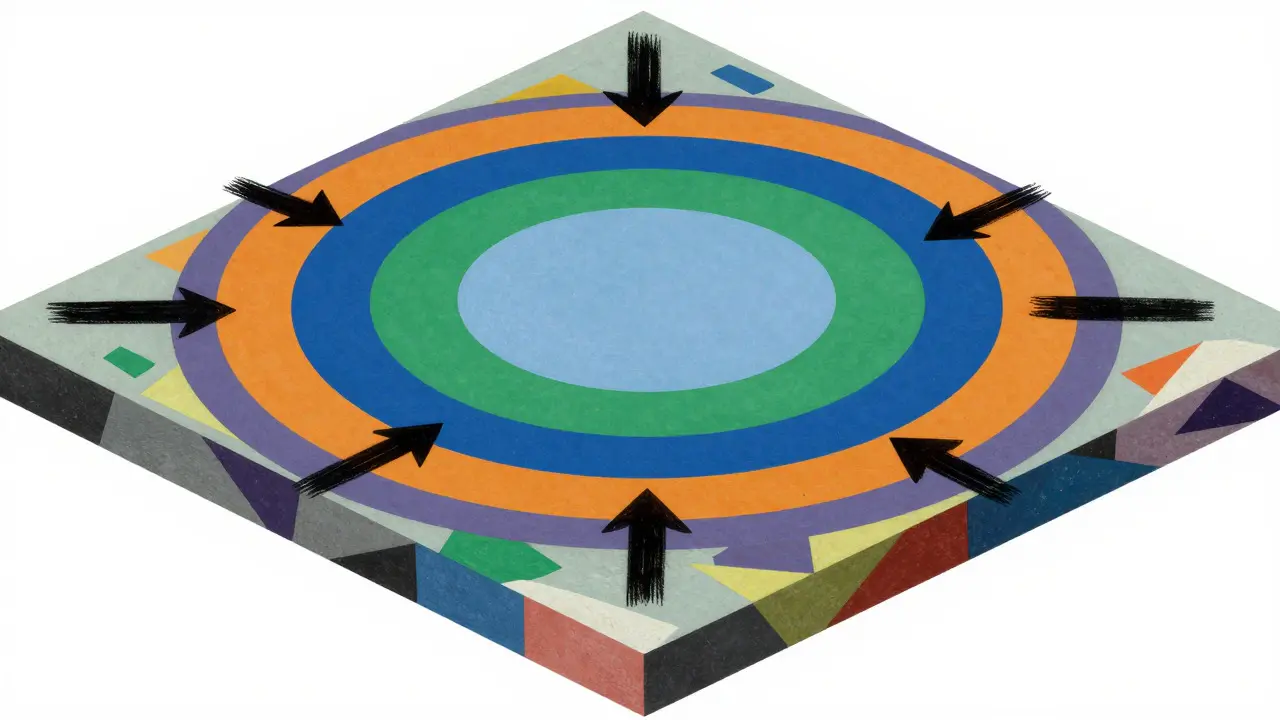
To prevent framework leakage, you need a rigid three-layer structure. This setup defines exactly where each piece of code belongs and who is allowed to talk to whom. The key is to define these boundaries before you start prompting the AI.
- Core Domain Layer: This is the heart of your application. It contains pure business logic, entities, and value objects. Crucially, this layer must be completely framework-agnostic. No imports from React, Django, Spring, or any database library. If your domain model needs to know about a specific UI framework, your architecture has already failed.
- Application Layer: This layer handles use cases and orchestration. It defines the interfaces (contracts) that the core domain uses to interact with the outside world. For example, instead of calling a specific database method, the application layer defines an interface called
UserRepository. The core domain depends on this interface, not the implementation. - Framework Layer: This is where all external technologies live. UI components, database drivers, HTTP clients, and third-party APIs belong here. This layer implements the interfaces defined in the application layer. It is the only place where you can import framework-specific code.
By enforcing this structure, you ensure that changing your frontend from React to Vue, or your backend from PostgreSQL to MongoDB, requires minimal changes to your core logic. You simply write new implementations in the framework layer that satisfy the existing interfaces.
Setting Up Boundary Enforcement Tools
Relying solely on developer discipline is risky, especially when AI generates code at high speed. You need automated tools to catch violations immediately. The most effective tool for this purpose is Sheriff, an open-source module boundary enforcer. Sheriff analyzes 100% of code changes against predefined architectural rules and flags any dependency that points the wrong way.
Here is how to integrate Sheriff into your vibe-coding workflow:
- Define Rules First: Before writing any code, create a configuration file that specifies your layers. For example, rule:
domain cannot depend on application,application cannot depend on framework. - Share Context with AI: At the start of every significant AI session, paste your architectural rules into the prompt. Tell the AI: "Generate framework-agnostic implementation. Do not import from the framework layer in the domain model."
- Use Real-Time Feedback: Configure your editor or CI pipeline to run Sheriff checks automatically. When the AI tries to import a React hook into a domain service, Sheriff should flag it immediately. This immediate feedback loop trains the AI (and you) to respect boundaries over time.
Projects implementing these boundary checks reduced framework leakage into core logic by 89% compared to unstructured approaches, according to vFunction's December 2024 case studies. The overhead added by these tools is negligible, typically only 2-3% of total development time.
Prompting Strategies for Clean Code Generation
How you talk to your AI assistant matters just as much as the tools you use. Generic prompts lead to generic, tightly coupled code. Specific, architecturally-aware prompts yield cleaner results. Here are practical strategies to guide your AI sessions:
- Specify the Layer: Instead of saying "create a user service," say "create a user use case in the application layer that depends on the UserRepository interface."
- Request Abstractions: Ask the AI to define interfaces first. Prompt: "Define an interface for sending emails. Then, implement a concrete class in the framework layer using SendGrid."
- Ban Framework Imports: Explicitly forbid framework imports in certain files. Prompt: "Write the OrderEntity class. It must not import any external libraries. Use only standard language types."
- Use Vertical Slices: Implement minimal functionality across all layers for one feature before moving to the next. This prevents the AI from building deep, complex framework dependencies for a single part of the system. Recommended by 92% of architectural experts, this approach keeps the scope manageable and boundaries clear.
For example, if you are building a shopping cart feature, first define the Cart entity in the domain layer. Then, define the AddItemToCart use case in the application layer. Finally, implement the React component and API endpoint in the framework layer. Each step respects the dependency rules, ensuring the core logic remains pure.
Comparing Structured vs. Unstructured Vibe Coding
You might wonder if the extra setup time is worth it. Let's look at the data. Unstructured vibe coding allows you to get a prototype running quickly, but it comes with hidden costs. Structured approaches require initial investment but pay off significantly as the project grows.
| Metric | Structured Clean Architecture | Unstructured Vibe Coding |
|---|---|---|
| Initial Setup Time | 25-30% longer than unstructured | Minimal, immediate start |
| Framework Leakage Risk | Low (reduced by 89%) | High (63% of failures) |
| Adaptation to New Frameworks | 3.2x faster switching | Slow, requires major refactoring |
| Critical Bugs (Production) | 62% fewer dependency-related bugs | Higher incidence of coupling issues |
| Long-Term Maintainability | 73% higher scores after 12 months | Declines rapidly after 6 months |
| Best For | Enterprise apps, long-term products | Throwaway prototypes, MVPs |
The break-even point is typically after implementing 3-4 features. Once you have several features, the complexity of unstructured code makes adding new functionality slower and riskier. Structured code, on the other hand, scales linearly because each new feature follows the same predictable pattern.

Common Pitfalls and How to Avoid Them
Even with the best intentions, developers stumble into common traps when combining Clean Architecture with AI assistance. Being aware of these pitfalls helps you stay on track.
- Ignoring the Learning Curve: Mastering this workflow takes time. Surveys indicate developers need 3-4 weeks of dedicated practice to effectively implement Clean Architecture through vibe coding. Don't expect perfection on day one. Start small and refine your prompts.
- Over-Engineering Simple Features: Not every feature needs complex abstractions. For simple CRUD operations, a lightweight approach may suffice. Reserve heavy architectural enforcement for core business domains where logic is complex and valuable.
- False Positives in Boundary Checks: Tools like Sheriff can sometimes flag legitimate cross-layer communication. Customize your rules to allow necessary interactions while blocking harmful ones. Regularly review flagged issues to tune your configuration.
- Losing Context in Long Sessions: AI assistants have limited memory. In long coding sessions, the AI might forget your architectural constraints. Periodically re-state your rules in the prompt, especially when starting a new major feature.
A notable success story illustrates the payoff. Metronome's design team implemented 47 UI components with consistent architecture in 11 hours using a "plan in Claude, execute in Cursor" workflow with strict boundary enforcement. Compared to their traditional methods, which took 38 hours, the structured approach was significantly faster once the boundaries were established.
Frequently Asked Questions
Is Clean Architecture too complex for small vibe-coded projects?
It depends on the project's lifespan. For throwaway prototypes or MVPs with no expected longevity, unstructured vibe coding is often sufficient. However, if you plan to maintain the application beyond six months or anticipate potential framework changes, investing in Clean Architecture is worthwhile. The initial setup time pays off after 3-4 features are implemented.
Which tools are essential for enforcing architectural boundaries in AI-assisted development?
Sheriff is the primary open-source tool recommended for module boundary enforcement. It analyzes code changes against predefined rules and flags violations in real-time. Additionally, using AI platforms like Cursor or GitHub Copilot with explicit architectural prompts and shared context files helps guide the AI to generate compliant code. Combining automated checks with thoughtful prompting provides the strongest defense against framework leakage.
How do I prompt my AI assistant to avoid framework-specific code in the domain layer?
Be explicit and restrictive. Use phrases like "generate framework-agnostic implementation," "do not import external libraries," and "use only standard language types." Define interfaces first and ask the AI to implement them separately in the framework layer. Sharing your architectural rules at the start of each session reinforces these constraints. For example: "Create a PaymentProcessor interface in the application layer. Then, create a StripePaymentProcessor class in the framework layer that implements this interface."
What is the difference between Clean Architecture and traditional MVC in vibe coding?
Traditional MVC (Model-View-Controller) often allows the Model to depend on database or framework specifics, leading to tight coupling. Clean Architecture enforces dependency inversion, meaning the core domain knows nothing about frameworks, databases, or UI. In vibe coding, this distinction is critical because AI assistants default to MVC-like patterns that embed framework dependencies. Clean Architecture provides stricter boundaries that prevent these dependencies from contaminating the core logic.
How long does it take to become proficient in vibe coding with Clean Architecture?
Most developers report needing 3-4 weeks of dedicated practice to master the workflow. This includes learning to craft effective prompts, configuring boundary enforcement tools, and recognizing architectural violations in AI-generated code. After approximately 50 code generation sessions, developers typically become proficient at catching issues early. The learning curve is steeper than basic vibe coding but leads to significantly better long-term outcomes.