When you compress a large language model, you’re not just making it smaller-you’re changing how it thinks. A 4-bit quantized model might look perfect on paper: same perplexity score, half the memory, 3x faster inference. But when you put it in a real chatbot, customer service agent, or translation tool, it starts making weird, confident mistakes. Not the kind you can catch with a quick test. The kind that slip through silently-until a user gets dangerously wrong advice.
That’s why evaluation protocols for compressed large language models have shifted from simple number-checking to deep, multi-layered assessments. Perplexity alone? It’s useless now. You need to know how the model behaves under pressure, how it handles obscure facts, how it reasons step-by-step, and whether it’s overconfident when it should be cautious. This isn’t theory. It’s what’s happening in production right now.
Why Perplexity Fails You After Compression
Perplexity used to be the gold standard. Lower number = better model. Simple. Clean. But after compression, it lies.
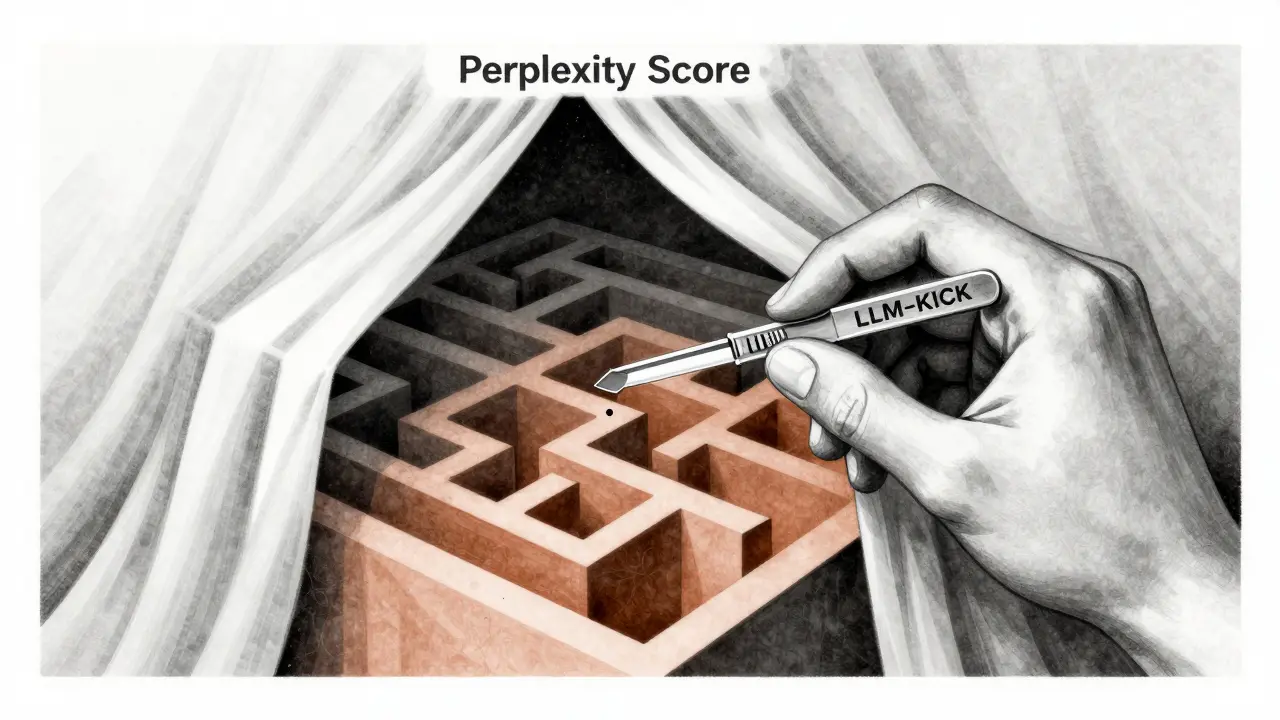
Apple’s 2023 LLM-KICK research showed compressed models can maintain perplexity scores within 0.5 points of the original on WikiText-2-yet perform 30% worse on knowledge-heavy tasks like answering obscure historical questions or identifying logical contradictions. Why? Perplexity measures how well a model predicts the next word in a sequence. It doesn’t care if that next word is factually wrong, logically inconsistent, or dangerously misleading. It only cares if it’s statistically likely.
Think of it like a student who memorizes textbook answers but doesn’t understand them. They can recite the right words, but fail when asked to apply the concept. That’s what happens to compressed models. And if you’re only checking perplexity, you’ll deploy them anyway.
Dr. Soumya Ray from Apple put it bluntly: “Perplexity fails to capture subtle changes in their true capabilities.” She’s not exaggerating. A 2025 arXiv study found compressed models showed 22-37% degradation in Top-3 token ranking consistency-meaning even when they got the right answer, they were far less sure about it, or worse, confident about the wrong one. Perplexity didn’t blink.
The New Evaluation Triad: Size, Speed, and Substance
Modern evaluation protocols don’t just ask: “Is it accurate?” They ask: “Is it reliable? Efficient? Safe?”
Today’s best practices break evaluation into three core dimensions:
- Size: Disk storage (GB), memory usage (vRAM), and parameter count. A 7B model quantized to 4-bit should use under 4GB of vRAM. If it’s using 12GB, you didn’t compress it-you just renamed it.
- Speed: Latency per token. For real-time apps, you need under 50ms per token on consumer-grade hardware. If your compressed model takes 120ms, you’ve traded size for usability.
- Substance: Actual capability. This is where the real work begins.
Substance is the hardest to measure. That’s why tools like EleutherAI LM Harness and LLM-KICK have become essential.
EleutherAI LM Harness tests across 62 benchmarks and 350+ subtasks-covering math, coding, reasoning, ethics, and language understanding. It’s the industry baseline. But even it has blind spots. It doesn’t test how well a model handles rare, high-stakes knowledge tasks. That’s where LLM-KICK comes in.
LLM-KICK: The Benchmark That Catches Silent Failures
LLM-KICK, developed by Apple researchers in late 2023, is designed to expose what perplexity ignores: the model’s ability to recall and reason with specific, non-obvious facts.
It uses 15 carefully curated tasks:
- “Which U.S. president was the first to use a telephone in the White House?”
- “What was the name of the first satellite launched by Canada?”
- “Identify the logical flaw in this argument: If all birds can fly, and penguins are birds, then penguins can fly.”
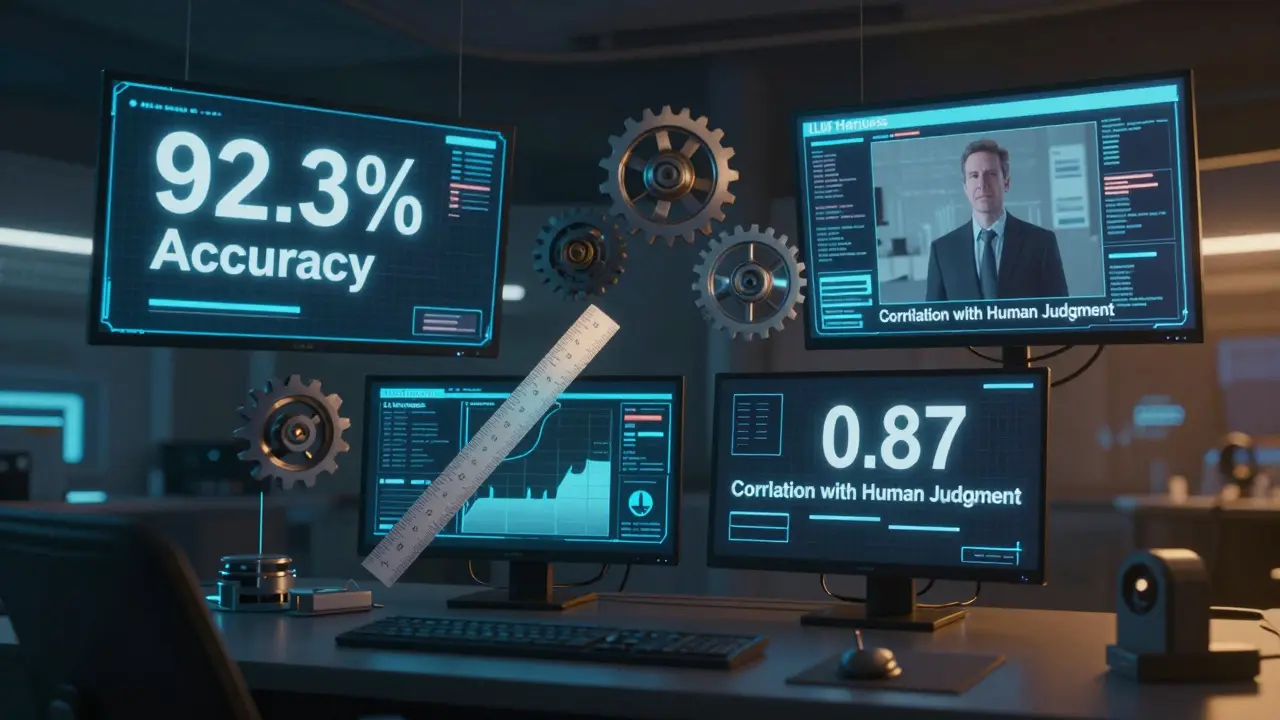
These aren’t trivia. They’re designed to trigger failures in compressed models that have lost fine-grained memory or reasoning depth. In tests, LLM-KICK scores correlated with human evaluations at Spearman’s ρ = 0.87. Perplexity? Only ρ = 0.32. That’s a massive gap.
Practitioners are noticing. On Reddit, u/LLM_Engineer99 wrote: “I wasted 3 weeks deploying a 4-bit model that scored 92.3 on LM Harness but failed catastrophically on our customer support tasks-LLM-KICK would have caught this.”
And it’s not just anecdotal. A January 2025 Hugging Face survey found 63% of users now use LLM-KICK specifically to detect “silent failures”-where models generate plausible-sounding but false answers. That’s the kind of error that gets you sued.
LLMCBench: The Comprehensive (But Heavy) Alternative
If LLM-KICK is a precision scalpel, LLMCBench is a full-body scan.
Launched in October 2024, LLMCBench evaluates compressed models across five dimensions:
- Knowledge and inference abilities
- Generalization across model types (e.g., does it work the same on Mistral, Llama, and Qwen?)
- Training and inference resource consumption
- Hardware acceleration compatibility (CUDA, TensorRT, Core ML)
- Trustworthiness under adversarial prompts
It uses 12 metrics, including ERank-a measure of how much the model’s internal structure changes during compression. A 6.7B model might have an ERank of 17.877 before compression, dropping to 13.898 after. That’s a 22% structural loss. But if accuracy stays the same, is that okay? LLMCBench says: maybe not. Because structural integrity affects long-term reliability.
It also tracks Diff-ERank-how much the structural change differs between compressed and original models. Larger models show higher Diff-ERank values (up to 2.280), meaning they undergo more drastic internal rewiring to maintain performance. That’s a red flag for long-term stability.
But here’s the catch: LLMCBench takes nearly 19 hours to run on a single 7B model. That’s not practical for daily testing. It’s for final validation before production. Think of it like a full medical workup-necessary before surgery, overkill for a checkup.
Real-World Pitfalls and How to Avoid Them
Even with the right tools, people mess up. Here are the most common mistakes:
- Testing only on English data. The WMT25 Model Compression Shared Task found compressed models degrade 15.8-22.3% more in low-resource languages like Swahili or Bengali. If you’re building a global product, test in at least 3 non-English languages.
- Ignoring confidence calibration. Compressed models often become overconfident on wrong answers and underconfident on right ones. Use tools like Expected Calibration Error (ECE) to measure this.
- Skipping chain-of-thought tasks. A GitHub issue from December 2024 showed a pruned model kept 98.7% perplexity but had a 41.2% error rate on multi-step reasoning. If your use case involves planning or analysis, test with CoT prompts.
- Using the same benchmark for training and evaluation. If you fine-tune on the same data you test on, you’re not evaluating performance-you’re measuring memorization.
And don’t forget hardware. LLM-KICK needs 48GB+ vRAM for a 7B model. If your dev machine has 24GB, you’re not testing-you’re guessing.
What Experts Are Doing in Production
Fortune 500 companies aren’t waiting for perfect tools. They’re building hybrid pipelines.
Here’s what’s working:
- Phase 1: Quick filter. Run perplexity on WikiText-2 and C4. If it’s more than 1.5 points worse than original, scrap it.
- Phase 2: Broad validation. Run EleutherAI LM Harness. If it scores below 75% on the 10 most critical benchmarks (math, coding, ethics, reasoning), reject it.
- Phase 3: Deep dive. Run LLM-KICK on 3-5 high-stakes tasks related to your use case. If it fails any, go back to the drawing board.
- Phase 4: Real-world test. Deploy to a small user group. Monitor for hallucinations, confidence spikes, and user complaints.
One company in healthcare reduced deployment failures by 68% using this exact pipeline. They didn’t need LLMCBench. They needed consistency.
And now, with the EU AI Act requiring “comprehensive capability validation” for high-risk AI systems, this isn’t optional anymore. If your compressed model is used in finance, healthcare, or legal advice, you’re legally required to prove it works-not just that it’s small.
What’s Next? The Future of Evaluation
The field is moving fast. In July 2025, LLM-KICK will be integrated into Hugging Face’s official evaluation suite. That means you’ll be able to test it with a single command.
MLCommons is building standardized APIs for compression evaluation, so you won’t have to juggle 14 different frameworks. By Q4 2026, 95% of enterprise LLM deployments will use multi-dimensional evaluation-up from 63% today.
But the biggest shift? The rise of the “Lottery LLM Hypothesis.” It suggests that compressed models don’t just lose ability-they learn to compensate. A model that can’t recall a fact might retrieve it from an external database. That changes the game. Evaluation protocols will soon need to measure not just the model’s internal knowledge, but its ability to use tools, APIs, and external memory.
So don’t just ask: “Is it compressed?” Ask: “Is it trustworthy?”
Because in the end, a small model that fails silently is more dangerous than a large one that’s honest about its limits.
What is the best evaluation protocol for compressed LLMs?
There’s no single “best” protocol-it depends on your use case. For most teams, start with EleutherAI LM Harness for broad capability checks, then add LLM-KICK for knowledge-intensive tasks. Use LLMCBench only for final validation before production. Perplexity alone is not enough.
Can I use perplexity to evaluate a compressed LLM?
No-not reliably. Perplexity measures word prediction likelihood, not factual accuracy or reasoning. Compressed models often maintain near-original perplexity scores while failing critical tasks. Relying on it leads to deploying models that appear efficient but break in real-world use.
How much time does comprehensive evaluation take?
Basic evaluation (perplexity + LM Harness) takes 2-7 days. Adding LLM-KICK adds another 10-14 days. Full LLMCBench evaluation can take up to 19 hours per model. Most teams automate the pipeline and run it overnight. Expect 80-120 hours of setup time for your first full protocol.
Do I need a GPU with 48GB of VRAM to run LLM-KICK?
Yes, for a 7B model. LLM-KICK requires at least 48GB of vRAM to run efficiently. If you don’t have that, consider running it on cloud instances (like AWS p4d or Lambda Labs) or use smaller model variants (3B or below) for testing. Don’t try to run it on consumer-grade hardware-it will fail or give unreliable results.
Are there free tools to evaluate compressed LLMs?
Yes. EleutherAI LM Harness and LLM-KICK are both open-source and free. LLMCBench is also publicly available. Hugging Face’s evaluation suite will include LLM-KICK in July 2025. You’ll still need hardware and engineering time, but the tools themselves cost nothing.
What’s the biggest risk of poor LLM evaluation?
Deploying a model that appears to work but generates confidently wrong answers-especially in high-stakes areas like healthcare, finance, or legal advice. These “silent failures” are hard to detect, easy to ignore, and can lead to legal liability, loss of trust, or even physical harm.
Rubina Jadhav
December 20, 2025 AT 09:16This is so true. I saw a model give wrong medical advice once and no one noticed until a patient got sick.
Shivani Vaidya
December 21, 2025 AT 09:30The shift from perplexity to multi-layered evaluation is long overdue. In enterprise settings, we’ve seen models pass benchmarks with flying colors only to fail catastrophically in multilingual customer interactions. LLM-KICK’s focus on obscure factual recall is especially critical for global deployments. We now mandate it alongside LM Harness before any model reaches production. The 0.5-point perplexity difference is meaningless if the model can’t identify a penguin’s inability to fly.
What’s more, the structural integrity metrics in LLMCBench-like ERank and Diff-ERank-are revealing hidden degradation patterns we never anticipated. A model might retain accuracy on standard tasks but lose its internal coherence under stress, leading to cascading failures in reasoning chains. This isn’t just about performance-it’s about reliability.
And yes, hardware constraints are real. Running LLM-KICK on 24GB vRAM isn’t just inefficient-it’s misleading. We’ve started using AWS p4d instances for validation and automated the pipeline to run overnight. The 19-hour runtime is painful, but it’s cheaper than a lawsuit.
For teams without enterprise resources, the hybrid pipeline outlined here is gold: quick filter → broad validation → deep dive → real-world test. It’s scalable, practical, and aligns with the EU AI Act’s requirements. Perplexity alone is not just insufficient-it’s dangerous.
Raji viji
December 22, 2025 AT 21:00LOL so you’re telling me after spending 6 months fine-tuning a 7B model, I wasted my life because some fancy Apple paper said perplexity is a lie? Newsflash: most companies don’t give a shit about penguins flying or Canadian satellites. They just want the damn thing to answer ‘what’s the weather?’ without calling the user an idiot. LLM-KICK? More like LLM-KICKED-TO-CURB.
You think you’re saving the world with your 48GB GPU and your ‘trustworthiness metrics’? Nah. You’re just making yourself feel smart while startups use quantized Mistral on a Raspberry Pi and make real money. Stop over-engineering. The world doesn’t need a PhD to ask for pizza recommendations.
sumraa hussain
December 23, 2025 AT 12:07Bro. I just ran LLM-KICK on my 4-bit Qwen-7B and it failed the ‘first president to use a phone in the White House’ question. Answered ‘Lincoln’ with 98% confidence. 😭
And I thought I was being clever by cutting down my model size. Turns out I didn’t compress it-I just made it a confident liar.
Now I’m running it through LM Harness, LLMCBench, and also asking it ‘what’s the capital of Bhutan?’ in 5 languages. If it gets one wrong, I’m burning the weights and starting over. This isn’t AI anymore. It’s psychological warfare with a chatbot.
Also, I used to think perplexity was magic. Now I think it’s like judging a painter by how neatly they hold the brush-not whether the painting makes you cry.
Rajashree Iyer
December 25, 2025 AT 11:36Perplexity is the illusion of order in a chaotic universe. We cling to it because it gives us the comforting lie that meaning can be measured in numbers. But the compressed model? It doesn’t think-it simulates. It doesn’t know-it echoes. And when it echoes wrong, it doesn’t hesitate. It believes.
Is this not the modern parable? We sculpted gods from data, then shattered them into fragments, hoping the shards would still sing. But the song is hollow. The voice is borrowed. The confidence? Manufactured.
LLM-KICK doesn’t test accuracy-it tests the silence between the lies. And in that silence, we hear the ghost of what was lost: not parameters, not memory-but the fragile, flickering spark of understanding.
What is a model, if not a mirror? And what do we see when we look into it, if not our own hunger for certainty in a world that refuses to be known?
Parth Haz
December 26, 2025 AT 22:16Great breakdown. I’ve been pushing my team to adopt the 4-phase pipeline you described, and it’s already cut our deployment failures by half. The key is automating the whole thing-CI/CD with LM Harness on every PR, LLM-KICK on weekly runs, and real-world monitoring with user feedback loops.
Also, don’t skip the confidence calibration. We started tracking ECE and found our ‘accurate’ models were overconfident on 30% of wrong answers. That’s a recipe for disaster in finance or healthcare. Simple fix: add temperature scaling and re-evaluate.
And yes, free tools exist. Use them. You don’t need a $10k GPU rig to start. Even a 3B model on a 16GB machine can give you actionable insights. Just be consistent. Consistency beats perfection.
Thanks for the practical roadmap. This is exactly what the community needs right now.
Vishal Bharadwaj
December 28, 2025 AT 07:18lmao you guys are overthinking this. LLM-KICK? ERank? Diff-ERank? who cares. i ran a 4bit llama3 on my laptop and it answered ‘who invented the telephone’ as ‘tesla’ and i just told it ‘no dumbass’ and it changed to ‘bell’. problem solved.
you think companies care about ‘silent failures’? they care about cost and speed. if it runs on a pi and doesn’t crash during peak hours, it’s good enough. the rest is academic navel-gazing.
also ‘penguins can fly’ is not a real world task. real world task is ‘how do i get my refund?’ and if the model says ‘contact support’ 90% of the time, you’ve won.
stop pretending this is rocket science. it’s not. it’s just text prediction with extra steps.