Have you ever asked an AI model a simple question and gotten a confident, completely wrong answer? Maybe it invented a court case that never happened or cited a scientific study from a journal that doesn't exist. This is the dark side of large language models (LLMs): they are brilliant pattern matchers, but terrible fact-checkers. They predict the next word based on probability, not truth.
This problem has a name: hallucination. And for years, it was the biggest barrier to using AI in serious business settings like healthcare, law, or finance. You can’t trust a doctor’s diagnosis if the AI makes up symptoms. You can’t rely on legal advice if the precedent is fictional. That’s where Retrieval-Augmented Generation, commonly known as RAG, comes in. It is a hybrid AI framework that connects large language models to external, authoritative data sources at query time to ensure factual accuracy.
RAG isn’t just a nice-to-have feature; it’s the architectural shift that turned chatbots into reliable enterprise tools. Instead of relying solely on what the model memorized during training-which stops at a fixed cutoff date-RAG lets the model look up real-time information before answering. Think of it as giving your AI a library card instead of forcing it to remember every book ever written.
The Core Problem: Why LLMs Lie
To understand why RAG matters, we first have to look at how standard LLMs work. Models like GPT-4 or Claude are trained on massive datasets of text from the internet. During this training, they learn statistical relationships between words. If you ask them about the capital of France, they know "Paris" follows "capital of France" with near 100% probability because they’ve seen that phrase billions of times.
But here is the catch: the model doesn’t "know" Paris is the capital. It just knows those words go together. When you ask about something obscure, recent, or proprietary-like your company’s internal HR policy from last Tuesday-the model hasn’t seen that data. So, it does what it’s designed to do: it guesses. It fills in the blank with the most likely-sounding sentence, even if it’s nonsense.
This leads to two major failure modes:
- Hallucination: The model generates plausible-sounding but factually incorrect information. It might invent quotes, dates, or statistics with high confidence.
- Knowledge Cutoffs: The model’s training data is frozen in time. If a model was trained in early 2024, it has no idea about events in mid-2026 unless it has access to live data. Asking it about last week’s NBA game results will yield outdated or fabricated answers.
RAG solves both problems by decoupling knowledge storage from language generation. The model stays smart at writing, but it outsources its memory to a searchable database.
How RAG Works: The Four-Step Pipeline
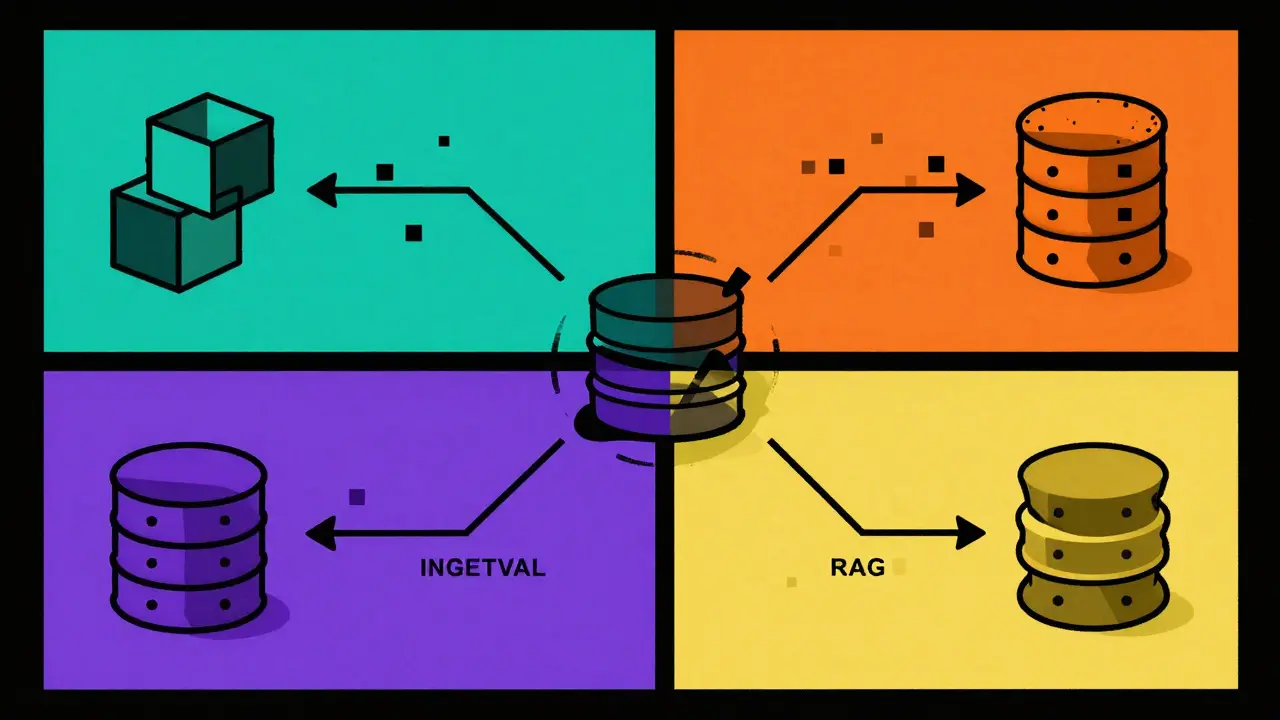
The magic of RAG Architecture is a systematic four-step process involving ingestion, retrieval, augmentation, and generation. Let’s break down exactly what happens when you type a question into a RAG-powered system.
- Ingestion: Before any questions are asked, your data needs to be prepared. This could be company manuals, product specs, or public websites. This raw text is broken down into smaller chunks. These chunks are then converted into vector embeddings, which are numerical representations of text meaning that allow computers to measure semantic similarity. These vectors are stored in a Vector Database, such as Pinecone or Milvus.
- Retrieval: When you ask a question, the system converts your query into a vector embedding using the same method used for the documents. It then searches the vector database for the chunks that are mathematically closest to your query. This is called semantic search. It finds concepts that match your intent, even if the exact words don’t overlap.
- Augmentation: The system takes the top-k most relevant chunks (say, the top 3) and combines them with your original question. It creates a new prompt that looks like this: "Answer the following question based ONLY on the provided context. Context: [Chunk 1, Chunk 2, Chunk 3]. Question: [Your Query]."
- Generation: The LLM receives this augmented prompt. Because the instructions explicitly tell it to ground its answer in the provided context, it synthesizes a response using only those facts. It doesn’t guess; it summarizes.
This pipeline ensures that every answer is tied back to a verifiable source. If the retrieved chunks don’t contain the answer, a well-designed RAG system will simply say, "I don’t have enough information," rather than making something up.
Why Vector Databases Are Critical
You can’t build RAG without a robust retrieval layer. Traditional keyword search (like Ctrl+F) fails here because it misses nuance. If you search for "car accident," keyword search won’t find a document titled "vehicle collision liability." But semantic search via vector embeddings understands that these phrases mean the same thing.
However, pure vector search has limits. Sometimes, exact term matching is crucial, especially for unique identifiers like part numbers or specific legal codes. This is why modern RAG systems often use Hybrid Search, which combines dense vector retrieval with sparse keyword-based retrieval for higher precision. By blending both methods, you get the best of both worlds: semantic understanding and precise terminology matching.
Additionally, many advanced systems include a reranking step. After the initial retrieval pulls, say, 50 potential chunks, a specialized reranker model evaluates them against the query again to pick the absolute best 3. This extra step significantly boosts the quality of the final answer.
RAG vs. Fine-Tuning: Which Should You Choose?
A common question developers face is whether to use RAG or fine-tune their LLM. Both approaches add custom knowledge to a model, but they do it very differently.
| Feature | RAG | Fine-Tuning |
|---|---|---|
| Data Freshness | Real-time updates possible | Static until retrained |
| Cost | Low (no retraining needed) | High (requires GPU compute) |
| Hallucination Control | High (grounded in sources) | Low (still prone to guessing) |
| Transparency | Cites specific sources | Black box reasoning |
| Best Use Case | Factual QA, Knowledge Bases | Style transfer, Code generation |
If your goal is to make the model smarter about specific facts, RAG is almost always the better choice. Fine-tuning changes the model’s weights, which is great for teaching it a specific tone or format, but it doesn’t reliably inject new facts. Plus, fine-tuning is expensive and slow. With RAG, you can update your knowledge base instantly by adding new documents to your vector store.

The Rise of Agentic RAG
As of 2026, RAG technology has evolved beyond simple lookup-and-answer systems. We are now seeing the rise of Agentic RAG, where the LLM acts as an autonomous agent that decides when and how to retrieve information during the generation process.
In traditional RAG, retrieval happens once, before the model starts writing. In Agentic RAG, the model can pause mid-generation, realize it’s missing a piece of information, and trigger a new search. It can also decide to switch strategies-for example, starting with a broad web search and then narrowing down to a specific internal database if the initial results are vague.
This dynamic approach allows for more complex reasoning tasks. Imagine asking an AI to write a market analysis report. An agentic system might first retrieve current stock prices, then pull historical trends, and finally check recent news articles, synthesizing all three streams of data into a coherent narrative. It’s closer to how a human researcher works: iteratively gathering evidence rather than grabbing one document and hoping it’s enough.
Practical Implementation Tips
If you’re building a RAG system, keep these pitfalls in mind:
- Chunking Matters: Don’t just split documents by character count. Use semantic chunking that keeps related ideas together. A chunk that cuts off a paragraph mid-thought will confuse the model.
- Filter Noise: Not all data is worth indexing. Clean your documents before ingestion. Remove headers, footers, and navigation menus that add noise to your vector space.
- Verify Citations: Always configure your system to return the source IDs along with the answer. This allows users to click through and verify the claim, building trust.
- Handle Ambiguity: If the user’s query is too vague, let the system ask clarifying questions before retrieving. Retrieving on a bad query yields bad results.
RAG is not a silver bullet, but it is the most effective tool we currently have for grounding AI in reality. By combining the generative power of LLMs with the precision of information retrieval, we move from speculative chatbots to dependable knowledge assistants.
What is the main benefit of using RAG over standard LLMs?
The primary benefit is reduced hallucination. Standard LLMs generate text based on probability and static training data, leading to fabricated facts. RAG grounds responses in external, verified sources, ensuring answers are accurate and up-to-date.
Does RAG require retraining the large language model?
No. One of the biggest advantages of RAG is that it does not require retraining or fine-tuning the underlying LLM. You simply update the external vector database with new information, and the model accesses it immediately.
What is a vector database in the context of RAG?
A vector database is a specialized storage system that holds numerical representations (embeddings) of text. It enables fast semantic search, allowing the RAG system to find relevant information chunks based on meaning rather than just keyword matches.
Can RAG handle real-time data?
Yes. Since RAG retrieves data at query time, it can access live APIs or frequently updated databases. This makes it ideal for applications requiring current information, such as stock prices, weather updates, or latest news.
What is Agentic RAG?
Agentic RAG is an advanced variant where the LLM actively controls the retrieval process. Instead of a single pre-retrieval step, the model can dynamically decide to search for more information, switch data sources, or ask clarifying questions during the generation phase.
Is RAG more expensive than fine-tuning?
Generally, RAG is less expensive. Fine-tuning requires significant computational resources and GPU time to retrain model weights. RAG primarily incurs costs for vector database storage and API calls for retrieval, which scales more efficiently for most enterprises.
Caitlin Donehue
June 16, 2026 AT 19:25it's wild how much better this is than just letting the model hallucinate. i've been testing some local setups and seeing the difference when you actually ground it in real docs is night and day. no more made up citations.
Stephanie Frank
June 16, 2026 AT 22:28lol yeah but let's be real, most people still get chunking wrong. they just slap a splitter on their pdfs and wonder why the context is garbage. semantic chunking isn't optional if you want anything usable. also hybrid search is a must because vector alone misses exact matches like part numbers or specific legal codes which are crucial in enterprise. stop using pure dense retrieval for everything.
Marissa Haque
June 18, 2026 AT 00:57Oh my gosh! This is exactly what I needed to hear!!! The part about Agentic RAG is so exciting!! I mean, can you imagine an AI that actually thinks before it answers?! It pauses! It searches! It verifies! It’s like having a super-smart librarian who doesn’t just guess!! I’m so excited to try implementing this in my next project!! Thank you for breaking it down so clearly!!
Keith Barker
June 18, 2026 AT 19:05the illusion of knowledge is the true enemy here. we build these systems to mirror human cognition yet we forget humans lie too. rag merely shifts the locus of truth from the neural weights to the database. interestingly enough this raises questions about the nature of memory itself. if the data is corrupted does the agent know it lies?
Lisa Puster
June 20, 2026 AT 18:05fine tuning is for amateurs who dont understand compute costs. american companies waste millions on retraining when they should just use vector stores. its basic engineering logic. if you cant afford proper indexing you have no business deploying ai in finance. keep your cheap models away from my ledger
Joe Walters
June 21, 2026 AT 11:09look i tried setting up pinecone last week and it was a disaster. the embeddings were all over the place and i had typos everywhere in my code. is it really worth the hassle? feels like overkill for a small startup unless u r doing something huge. maybe im just bad at it lol