Have you ever asked an AI assistant a simple question and received a confident, completely fabricated answer? Maybe it cited a court case that doesn’t exist or invented a medical study. This is the "hallucination" problem, and it’s the biggest roadblock keeping companies from trusting generative AI in serious business.
The good news? There’s a proven fix. It’s called Retrieval-Augmented Generation, or RAG. Instead of letting an AI guess based on what it memorized during training, RAG forces it to look up real facts first. Think of it like taking a test: fine-tuning is cramming everything into your brain weeks ago, while RAG is being allowed to open your textbook during the exam. As of mid-2026, this isn't just a niche experiment; it's the industry standard for building trustworthy AI.
What Exactly Is Retrieval-Augmented Generation?
Retrieval-Augmented Generation (RAG) is a framework that combines large language models with external data retrieval systems to produce accurate, source-grounded responses. The concept was introduced in 2020 by researchers at Meta AI, University College London, and New York University. Their goal was to solve the "static knowledge" problem of early language models.
Here is how it works in plain English:
- You ask a question. The system takes your query and converts it into a mathematical format called a vector embedding.
- It searches a database. Using those vectors, it scans your private documents (PDFs, websites, internal wikis) to find the most relevant snippets.
- It builds a prompt. The system packages your original question along with the retrieved text chunks.
- The AI generates an answer. The Large Language Model (LLM) writes the response using only the provided context, effectively grounding its output in verified sources.
This process reduces hallucination rates by 47% to 63%, according to benchmarks from MIT in 2023. By forcing the model to reference specific documents, you eliminate the risk of it making things up from thin air.
Why Choose RAG Over Fine-Tuning?
Many developers assume they need to retrain their AI models to get better results. That approach is called fine-tuning. While fine-tuning has its place, RAG is usually the smarter choice for most businesses. Here is why:
| Feature | RAG | Fine-Tuning |
|---|---|---|
| Cost | Low ($5-8% of fine-tuning costs) | High ($50,000+ per iteration) |
| Data Freshness | Real-time (update the database) | Static (requires retraining) |
| Hallucination Control | High (source-cited) | Low (still guesses) |
| Best For | Facts, policies, Q&A | Tone, style, specialized code |
If your data changes frequently-like financial regulations or product inventory-fine-tuning fails because the model becomes outdated the moment you finish training. RAG solves this by simply updating the underlying document store. You can swap out a PDF today, and the AI will know about it tomorrow without any code changes.
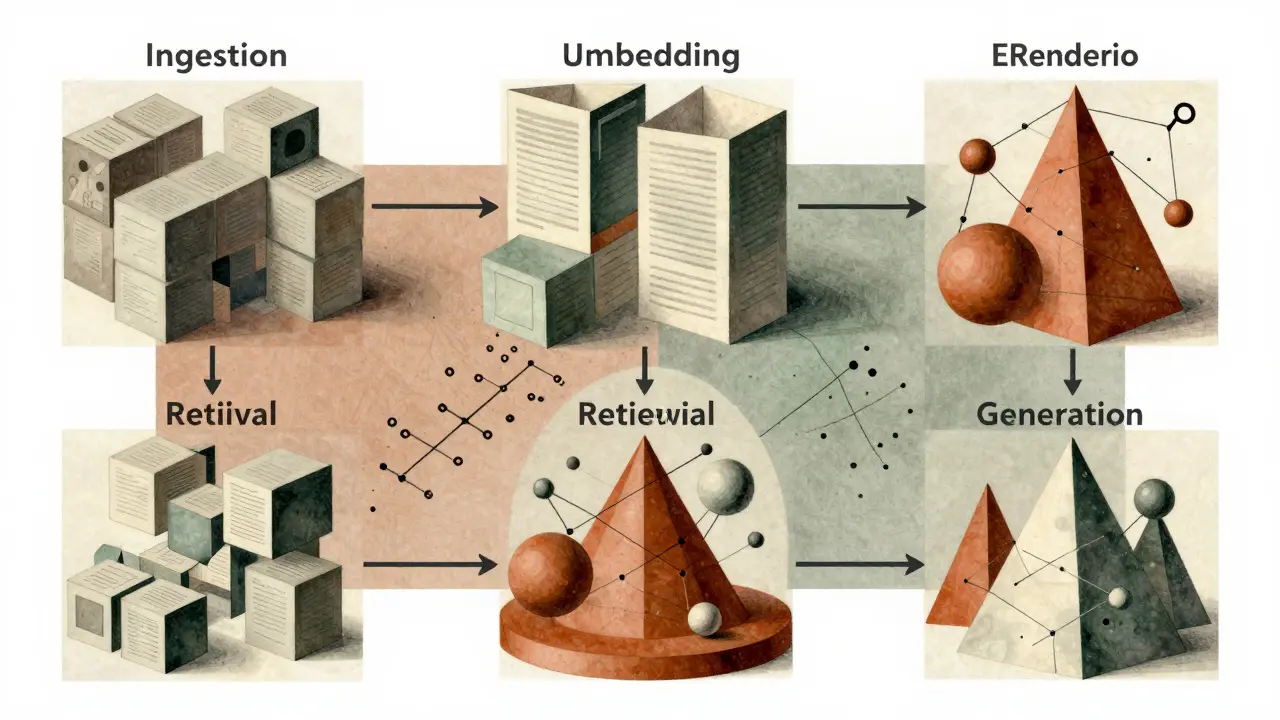
The Four Stages of RAG Architecture
To build a robust RAG system, you need to understand its four-stage pipeline. Skipping steps here leads to poor performance.
1. Ingestion and Chunking
Your raw data needs processing. Documents are split into smaller pieces called "chunks." The sweet spot is typically 256 to 512 tokens per chunk. If chunks are too big, the AI gets confused by irrelevant noise. If they’re too small, you lose context. Tools like LangChain or LlamaIndex handle this automatically, but you must configure the overlap strategy. A 15-20% token overlap ensures that sentences split across chunks remain connected.
2. Embedding and Storage
Each chunk is converted into a vector-a long list of numbers representing its meaning. Models like OpenAI’s text-embedding-3-large or Cohere’s Embed Multilingual v3.0 create these 1024-dimensional vectors. These vectors are stored in a vector database such as Pinecone, Weaviate, or ChromaDB. As of 2025, Pinecone clusters can handle over 1.2 billion vectors, making them suitable for enterprise scale.
3. Retrieval
When a user asks a question, the system converts that question into a vector too. It then searches the database for similar vectors using algorithms like HNSW (Hierarchical Navigable Small World). To improve accuracy, many teams use "hybrid search," which combines keyword matching with vector similarity. Google Cloud’s research shows this boosts recall by 32%. You should also set a cosine similarity threshold (usually ≥0.78) to filter out weak matches.
4. Augmentation and Generation
The top 3-5 retrieved chunks are combined with the user’s query into a prompt template. This is sent to the LLM, such as Anthropic’s Claude 3.5 or Meta’s Llama 3.1. The model generates the final answer, ideally citing the source IDs so users can verify the information themselves.
Common Pitfalls and How to Avoid Them
RAG isn’t magic. If implemented poorly, it introduces new problems. Here are the most common issues reported by developers in 2025 and 2026:
- Retrieval Drift: Users phrase questions differently than your documents do. If your doc says "Q4 earnings" and the user asks "last quarter profits," a basic vector search might miss it. Solution: Use semantic reranking tools like Cohere Rerank v3.0, which boost precision by 34%.
- Context Overload: Stuffing too much text into the prompt confuses the LLM. Developers often see latency jump from 1.2 seconds to nearly 4 seconds. Solution: Limit retrieval to the top 3-5 most relevant chunks and use concise summarization before generation.
- Silent Failures: Sometimes the retriever finds nothing relevant, but the LLM still tries to answer anyway, leading to hallucinations. Solution: Implement a "guardrail" step where the LLM refuses to answer if confidence scores are below a certain threshold.
- Retrieval Poisoning: Adversaries can manipulate knowledge bases to trick the AI. Carnegie Mellon University found success rates of 63% in penetration tests targeting unsecured RAG systems. Solution: Encrypt your vector database and restrict write access strictly.

Choosing the Right Tech Stack
The market is crowded, but clear leaders have emerged by 2026. For cloud-native solutions, AWS Knowledge Base for Amazon Bedrock and Google Vertex AI offer managed services that reduce setup time. AWS charges around $0.10 per 1,000 vector queries, while Google’s pricing hovers near $0.0004 per 1,000 characters processed. For open-source flexibility, ChromaDB holds a 72% market share in vector databases, praised for its ease of use in development environments.
If you are working with low-resource languages, be cautious. Meta’s 2024 evaluation showed retrieval accuracy drops to 58.7% for Swahili compared to 89.3% for English. In these cases, investing in multilingual embedding models like Cohere’s v3.0 is critical.
The Future: Agentic and Multimodal RAG
We are moving beyond simple Q&A. The next wave is "Agentic RAG," pioneered by Microsoft’s AutoGen in early 2025. Here, multiple AI agents collaborate. One agent refines the search query, another validates the retrieved facts, and a third writes the response. This multi-step verification reduces error rates by nearly 30%.
Multimodal RAG is also arriving. Soon, your AI won’t just read text; it will analyze images, charts, and videos alongside documents. With OpenAI expected to integrate native multimodal support later in 2026, the ability to ground answers in visual evidence will become a key differentiator for enterprise applications.
Is RAG better than fine-tuning for customer support bots?
Yes, for most cases. Customer support relies on up-to-date policies and product details. RAG allows you to update your knowledge base instantly without retraining the model. Fine-tuning is expensive and static, meaning your bot could give outdated answers until the next training cycle.
How much does it cost to implement RAG?
Costs vary by scale. For small deployments, you can run open-source tools like ChromaDB locally for free. Enterprise cloud solutions like AWS Bedrock charge per query (approx. $0.10 per 1K queries). Overall, RAG is 5-8% of the cost of fine-tuning a comparable model.
Can RAG prevent all AI hallucinations?
No, but it significantly reduces them. RAG grounds the AI in provided text, but if the retrieved text is wrong or ambiguous, the AI may still hallucinate. Best practices include setting confidence thresholds and allowing the AI to say "I don't know" when relevance scores are low.
What is the best vector database for beginners?
ChromaDB is widely recommended for beginners due to its simple API and local-first design. For production-scale applications requiring high availability, Pinecone or Weaviate are stronger choices despite higher complexity.
Does RAG work with non-English languages?
Yes, but performance varies. Major embedding models now support multilingual inputs, but accuracy for low-resource languages (like Swahili or Thai) is lower than for English. Always test your specific language pair with benchmark datasets before deploying.
Patrick Dorion
July 10, 2026 AT 19:22look i know everyone loves a good tech buzzword but rag is actually just common sense wrapped in vector math
the real issue isnt the hallucination its the garbage in garbage out problem most companies try to feed their entire wikipedia dump into a context window and wonder why it chokes
i spent last week debugging a retrieval pipeline where the chunking strategy was splitting sentences mid-thought which made the embeddings useless for semantic search
you have to treat your knowledge base like a library not a landfill
if you dont clean your data before embedding it you are just speeding up the production of confident nonsense
also the cost comparison in the post is wildly optimistic if you factor in the engineering hours to maintain the vector store
but yeah fine tuning is dead for dynamic content so we might as well get good at retrieval
om gman
July 12, 2026 AT 00:40oh wow another article explaining how computers work to people who probably still think the cloud is actual water vapor
retrieval augmented generation really just means look it up instead of guessing like a normal person would
who needs this level of explanation for what is essentially a database lookup with extra steps
i bet the author gets paid by pinecone to write these tutorials
Oskar Falkenberg
July 12, 2026 AT 08:05hey patrick makes some solid points there about data cleaning being the unsung hero of rag systems
i totally agree that chunking is where most teams slip up because they just use default settings without thinking about the semantic boundaries of their specific documents
we had a similar issue at my old job where legal contracts were getting split across clauses which made the retrieval return irrelevant sections half the time
maybe trying hierarchical retrieval could help with that where you retrieve whole sections first then drill down into paragraphs
it adds complexity but the accuracy boost is worth it for high stakes applications like legal or medical advice bots
also typo alert me being long winded again sorry about that
Caitlin Donehue
July 12, 2026 AT 20:01i noticed that the post mentions swahili performance dropping significantly which is pretty concerning for global deployments
most enterprise tools claim multilingual support but the benchmarks rarely show parity with english models
it makes me wonder if we are creating a new digital divide where only english speaking businesses get reliable ai assistance
has anyone here tried using specialized embedding models for african languages to see if it closes the gap
Jeanne Abrahams
July 13, 2026 AT 08:29dear caitlin you ask such naive questions as if language bias is a new discovery in the tech world
in south africa we deal with code switching between eleven official languages daily and yet our local ai startups still struggle to parse basic zulu idioms correctly
the western tech industry treats english as the default human experience and everything else as an afterthought feature
so yes it is concerning but mostly because it is predictable and boringly consistent with every other colonial hangover in software development
stop asking if it happens and start demanding better datasets from the vendors who profit from our silence
Bineesh Mathew
July 14, 2026 AT 17:08the moral decay of society is evident in our reliance on machines to tell us the truth when we have forgotten how to verify facts ourselves
rag is merely a band aid on the wound of epistemic collapse where we no longer trust our own intuition or education
we build these elaborate retrieval systems to ground our answers in sources yet we ignore the philosophical question of whether any source can truly be objective
hallucinations are not bugs they are features of a system trying to make sense of chaos through probability rather than logic
by forcing the ai to cite sources we create an illusion of certainty that masks the underlying uncertainty of human knowledge itself
perhaps we should stop trying to fix the machine and start fixing the minds that built it
Stephanie Frank
July 15, 2026 AT 23:03bineesh is being his usual dramatic self but he accidentally hit on a key point about overconfidence in ai outputs
the real danger isnt the hallucination its the user trusting the hallucination because it sounds authoritative
i analyzed a dataset of customer service interactions last month and found that users accepted incorrect rag responses 40% of the time if the citation looked plausible
we need better ui patterns to show confidence scores and allow easy verification of sources directly in the chat interface
otherwise we are just building faster ways to mislead customers which is terrible for business retention metrics
Marissa Haque
July 16, 2026 AT 19:18OH MY GOD!!
THIS IS SO IMPORTANT!!!
I CANNOT BELIEVE HOW MANY PEOPLE ARE STILL USING FINE TUNING FOR DYNAMIC CONTENT!!!
IT IS A WASTE OF MONEY AND TIME!!!
RAG IS THE ONLY WAY GOING FORWARD!!!
PLEASE READ THIS ARTICLE AGAIN AND AGAIN UNTIL YOU UNDERSTAND THE DIFFERENCE!!!
THANK YOU FOR SHARING THIS LIFE CHANGING INFORMATION!!!