Imagine asking your AI assistant for a specific medical dosage based on a provided text. Instead of checking the text, it confidently invents a number that isn't there. This is hallucination, defined as confident yet incorrect responses generated by Large Language Models when information is missing or ambiguous. It’s not just an annoyance; in high-stakes fields like healthcare or law, it’s dangerous. The core problem isn’t that models are stupid-they are incredibly smart at predicting words. The problem is they don’t know what they *don’t* know.
For years, we’ve tried to fix this with simple tricks: telling the model "be careful" or "only use the provided context." But research from 2023 and 2024 shows these basic instructions fail over 60% of the time. Models suffer from what researchers call "instructional inattention," ignoring your constraints because their training data rewards confident answers above all else. To truly stop hallucinations, we have to teach the model a new skill: admitting ignorance.
The Two-Stage Solution: US-Tuning
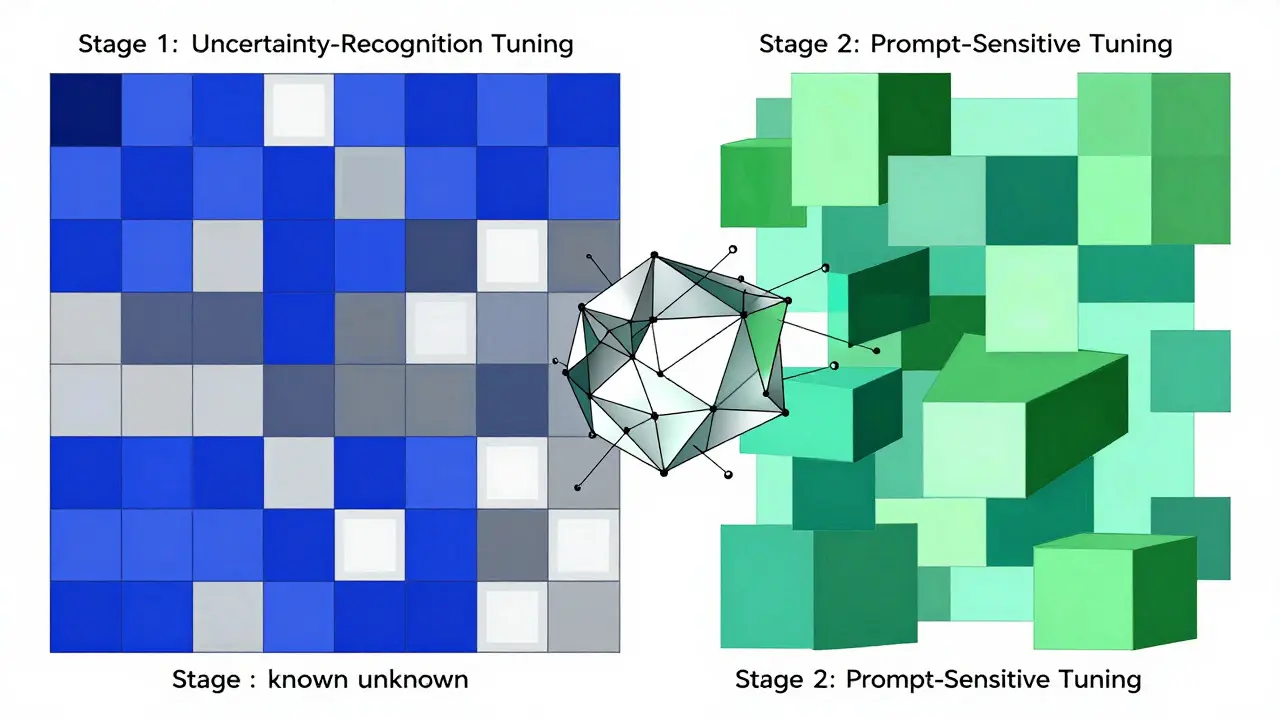
The most effective method currently available is called Uncertainty-Sensitive Tuning, also known as US-Tuning. It was published in June 2024 (arXiv:2406.10099v3) and represents a shift from simple prompting to structural training. Unlike standard fine-tuning, which often breaks a model’s ability to recognize limits, US-Tuning uses a two-stage process to build robust uncertainty recognition.
Stage 1: Uncertainty-Recognition Tuning (UT)
In this first phase, you train the model on a specialized dataset containing two types of questions: those with sufficient context (known) and those lacking adequate context (unknown). The goal is binary classification. The model learns to evaluate if the context is "Sufficient" or "Insufficient." If insufficient, it must output a specific phrase like "Not Provided" or "I don't know." This stage forces the model to treat uncertainty as a distinct category rather than a failure state. In tests on the HotpotQA benchmark, Stage 1 alone boosted uncertainty recognition accuracy to 89.7%, compared to just 65.0% for baseline models.
Stage 2: Prompt-Sensitive Tuning (ST)
Here is the catch: after Stage 1, the model becomes too cautious. It starts rejecting valid questions because it’s overly sensitive to ambiguity. This caused a 27% drop in standard question-answering performance in early experiments. Stage 2 fixes this by introducing "designed causal instructions." You retrain the model to distinguish between contexts where it should answer versus abstain. Explicit constraints are added to the prompts, such as: "Your answer must not use any additional knowledge that is not mentioned in the given contexts." This restores the balance, allowing the model to maintain 72.3% accuracy on standard tasks while keeping its high uncertainty detection skills.
Why Simple Prompts Fail
You might wonder why we can’t just add "If you don't know, say so" to our system prompts. It sounds easy, but the data says otherwise. Let’s look at how US-Tuning compares to other common methods:
| Method | Uncertainty Recognition Accuracy | Standard QA Performance | Computational Cost |
|---|---|---|---|
| US-Tuning (Two-Stage) | 89.7% | 72.3% | Moderate (Training required) |
| Baseline Fine-Tuning | 65.0% | 73.5% | Low |
| AttrPrompt (Yu et al.) | 71.2% | Variable | Low |
| Self-Reflective Prompting | 58-76% | High | Low |
| SelfCheckGPT (Sampling) | 68.5% | High | Very High (3.2x resources) |
As you can see, self-reflective prompts (asking the model "Are you sure?") are inconsistent, varying wildly between 58% and 76% accuracy depending on the model architecture. SelfCheckGPT, which generates multiple responses to check for variance, is accurate but expensive-it requires 3.2 times more computational power. US-Tuning offers the best balance, improving uncertainty recognition by nearly 25 percentage points over baselines without destroying the model’s ability to answer real questions.
Real-World Implementation Challenges
Knowing the theory is one thing; building it is another. Developers implementing US-Tuning in 2024 and 2025 reported significant hurdles. The biggest barrier is data. You cannot simply download a generic dataset. You need a balanced set of known and unknown examples specific to your domain.
According to GitHub reports from mid-2024, constructing a standard 50,000-example dataset takes about 4 to 6 weeks of manual annotation, costing between $12,000 and $18,000. For a startup with a three-person team, this timeline is daunting. One CTO noted that dataset construction took six weeks, delaying their product launch significantly. However, the payoff is substantial. A medical Q&A system using US-Tuning saw false confidence in answers drop from 34% to just 8.2%. Microsoft’s internal tests showed a 67.3% reduction in medically inaccurate responses for clinical trial queries.
There is also a hardware constraint. US-Tuning works best on models with 7 billion parameters or more. On smaller models (under 7B), accuracy drops by 15-18%. This means lightweight, edge-deployed models may struggle with this approach unless paired with efficient distillation techniques.

Regulatory Pressure and Market Trends
This isn’t just an academic exercise anymore. By 2026, regulatory bodies are demanding accountability. The EU AI Act, fully effective since February 2025, requires "appropriate uncertainty signaling" for high-risk AI systems. Gartner predicts that by the end of 2026, 75% of enterprise AI deployments will require explicit uncertainty handling capabilities, up from only 35% in 2024.
The market is responding. The uncertainty-aware AI sector is projected to grow from $2.1 billion in 2024 to $8.7 billion by 2027. Healthcare leads adoption at 38%, followed by legal tech and financial services. Companies like Anthropic have integrated similar protocols into their Constitutional AI frameworks, while open-source communities are pushing tools like US-Tuning v2.1, released in January 2025, which reduces dataset requirements by 35% through synthetic data generation.
How to Get Started
If you’re ready to implement uncertainty-aware training, follow these steps to avoid common pitfalls:
- Audit Your Current Model: Test your existing LLM on a small set of out-of-domain questions. Measure how often it hallucinates vs. admits ignorance. Establish a baseline.
- Build the Dataset: Create pairs of questions. For half, provide full context. For the other half, remove key details or provide irrelevant context. Label them clearly as "Answerable" and "Unanswerable."
- Execute Stage 1 Training: Train the model to output "Not Provided" for unanswerable questions. Expect a drop in general QA performance-this is normal.
- Execute Stage 2 Tuning: Introduce causal instructions. Retrain the model to prioritize answering when context is sufficient, while maintaining the "Not Provided" trigger for gaps.
- Validate Rigorously: Use benchmarks like HotpotQA or domain-specific tests. Ensure uncertainty recognition is above 85% and standard QA remains above 70%.
Remember, the goal isn’t to make the model silent. It’s to make it honest. An AI that says "I don't know" is infinitely more valuable than one that lies confidently.
What is US-Tuning?
US-Tuning (Uncertainty-Sensitive Tuning) is a two-stage training method for Large Language Models designed to reduce hallucinations. Stage 1 teaches the model to recognize insufficient context and respond with "Not Provided." Stage 2 refines this sensitivity to ensure the model doesn't reject valid questions, balancing uncertainty recognition with standard question-answering performance.
Why do simple prompts like "Say I don't know" fail?
Simple prompts often fail due to "instructional inattention." LLMs are trained on vast datasets that reward fluent, confident answers. Without structural training (like US-Tuning), models ignore soft instructions to admit ignorance, resulting in compliance failure rates of over 40% in some studies.
How much does it cost to implement US-Tuning?
The primary cost is data annotation. Constructing a balanced dataset of 50,000 examples typically costs $12,000-$18,000 and takes 4-6 weeks. Additional costs include compute resources for training, which vary based on model size. Smaller teams may find the initial investment prohibitive, though US-Tuning v2.1 has reduced data needs by 35%.
Does US-Tuning work on small language models?
US-Tuning is less effective on smaller models. Research shows a 15-18% drop in accuracy for models with fewer than 7 billion parameters. It is recommended for larger models (7B+) where the architectural capacity supports complex instruction following and uncertainty calibration.
Is uncertainty-aware AI legally required?
In many regions, yes. The EU AI Act (effective Feb 2025) mandates appropriate uncertainty signaling for high-risk AI systems. By 2026, Gartner predicts 75% of enterprise AI deployments will need explicit uncertainty handling to meet compliance and safety standards.