It is easy to assume that as Large Language Models (LLMs) get bigger and smarter, the messy details of how they read text become irrelevant. After all, if a model has trillions of parameters, surely it can figure out what "hello" means regardless of how you slice it up, right? This is a dangerous misconception. In fact, tokenization-the process of chopping raw text into discrete units-is arguably more critical now than ever before.
Think of tokenization not just as a preprocessing step, but as the fundamental lens through which an AI perceives reality. If the lens is cracked or distorted, the view will be blurry, no matter how powerful the camera sensor is. The way we tokenize text dictates computational costs, context window limits, and even the logical reasoning capabilities of the model. Ignoring it is like building a skyscraper on a shaky foundation because you think the steel beams are strong enough to hold it up anyway.
The Mechanics: How Text Becomes Numbers
To understand why this matters, we have to look under the hood. Neural networks cannot process raw characters like 'A' or 'b'. They need numbers. Tokenization is the bridge between human language and machine math. It converts strings of text into tokens, which are then mapped to numerical vectors.
In the early days of Natural Language Processing (NLP), engineers used two main approaches, both with fatal flaws. Word-based tokenization treated every unique word as a separate unit. This created vocabularies exceeding 500,000 entries for comprehensive coverage, bloating memory usage. Worse, it couldn't handle unseen words. If the model never saw the word "unbelievability," it simply ignored it. Character-based tokenization solved the unknown word problem but introduced a new one: length. Because English words average about 4.7 characters, character-based methods required context windows roughly three times longer than word-based ones. This made processing computationally expensive and slow.
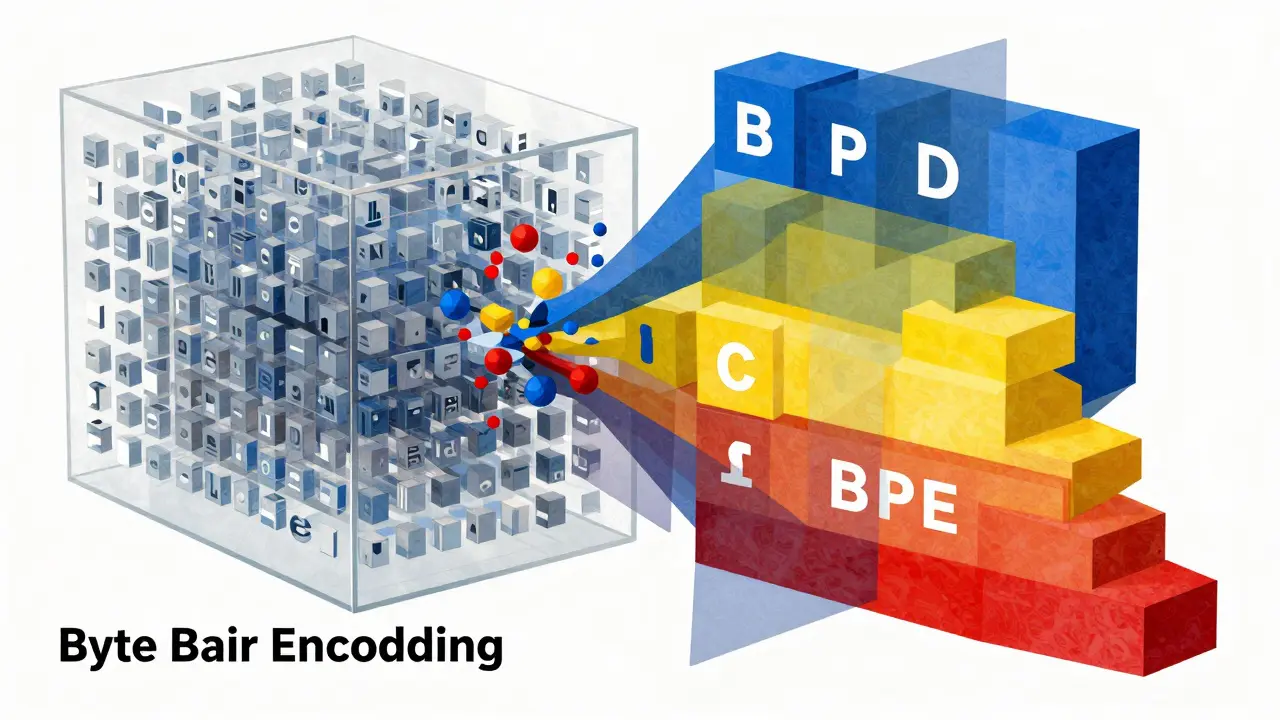
The industry settled on a middle ground around 2016 when Google introduced Byte Pair Encoding (BPE) in their Neural Machine Translation system. BPE, along with similar techniques like WordPiece and SentencePiece, uses subword tokenization. It breaks words down into frequent sub-units. For example, the word "tokenization" might be split into "to-", "ken-", and "-ization". This approach balances lexical coverage with computational efficiency. It allows the model to understand rare or complex words by recognizing their common parts, without exploding the vocabulary size.
Vocabulary Size: The Great Trade-Off
You might wonder, why not just make the vocabulary huge? Why does GPT-3 use 50,257 tokens while Meta's Llama 3 uses 128,256? There is a direct trade-off here between memory efficiency and processing speed.
| Model | Vocabulary Size | Release Context | Impact on Sequence Length |
|---|---|---|---|
| GPT-3 | 50,257 | Early large-scale transformer | Moderate compression |
| BERT | 30,522 | Pre-training benchmark | Higher sequence length needed |
| Llama 3 | 128,256 | March 2024 release | 22-35% shorter sequences |
Larger vocabularies mean fewer tokens per document. According to research by Ali et al. in 2024, increasing vocabulary size from 3,000 to 128,000 tokens reduces sequence length by 22% to 35%. This is huge for performance. Shorter sequences mean the model processes less data per request, reducing latency. However, there is a cost. Larger vocabularies increase memory requirements by 18% to 27% because the embedding matrix-the table that maps tokens to vectors-gets bigger. You have to choose between saving RAM or saving compute cycles. Most modern models lean toward larger vocabularies because inference compute is often the bottleneck, not memory capacity.
The Hidden Cost of Tokens
If you are running an application that uses LLMs, you are likely paying for tokens. This is where tokenization stops being an academic curiosity and starts affecting your bank account. Token processing expenses account for 60% to 75% of total inference costs, according to Kelvin Legal's 2023 analysis.
Consider the word "tokenization" again. In many standard tokenizers, this single word becomes three tokens: "to-", "ken-", and "-ization". If you are processing a legal contract with thousands of such technical terms, your token count-and thus your bill-can inflate significantly compared to a text full of short, common words. A developer on Reddit reported a 37% cost reduction after optimizing their tokenizer for legal documents. They didn't change the model; they changed how the text was sliced. Similarly, a case study from Tonic AI showed that optimized tokenization reduced classification costs from $0.0038 to $0.0023 per 1,000 tokens-a nearly 40% savings at scale.
This variability creates unpredictable billing. You might send a prompt that looks short to you, but if it contains many multi-token words, the API sees a much longer input. Understanding your tokenizer's behavior is essential for budgeting and performance tuning.
Context Windows and Real-World Limits
We often hear about context windows in terms of tokens, not words. This distinction matters immensely. GPT-4 offers a 128,000-token context window. That sounds impressive until you realize it equates to approximately 96,000 words. Anthropic's Claude 2, with a 100,000-token limit, handles roughly 75,000 words. The difference isn't just marketing fluff; it determines whether you can upload a entire textbook or only a chapter.
Because tokenization compresses text differently depending on the algorithm, two models with the same "token limit" may actually accept different amounts of information. BPE achieves about 3.8x compression on standard English corpora. If you switch to a model with a less efficient tokenizer, your effective context window shrinks. For applications requiring long-document analysis, choosing a model with a high-efficiency tokenizer is as important as choosing one with a large nominal context window.
Domain-Specific Challenges and Solutions
General-purpose tokenizers work well for everyday language, but they struggle with specialized domains. Medical, legal, and financial texts contain jargon that general tokenizers often fragment incorrectly. Dagan et al.'s 2024 research showed a 14.6% improvement in medical text understanding when using specialized biomedical tokenizers instead of generic ones.
However, subword tokenization introduces a specific risk: semantic fragmentation. When a proper noun or rare term is split into unrelated subwords, the model may lose its meaning. MIT's September 2024 study found that 37.6% of multi-token words experienced meaning distortion in downstream tasks. For instance, a drug name like "Xylophene" might be split into "Xyl-", "o-", and "-phene". If the model hasn't seen those fragments together, it might treat them as noise rather than a single entity. This led to a 22% error rate in financial entity recognition for one Hugging Face user until they implemented domain-specific tokenization.
The solution is customization. About 68% of organizations now customize their tokenizers for specific applications. Finance leads with 73%, followed by healthcare at 69%. Customizing a tokenizer typically takes 15-25 hours of work, including training on 500-1,000 labeled examples. But the payoff is significant. You reduce errors, improve accuracy, and lower costs by ensuring technical terms are treated as single units.

Future Trends: Adaptive and Hybrid Approaches
Is tokenization going away? Some researchers, like Dr. Elena Rodriguez at Stanford, argue that ultra-large models with over 100 billion parameters can learn character-level patterns regardless of tokenization. She suggests that tokenization's importance may diminish by 2028. However, evidence currently contradicts this. Even trillion-parameter models benefit from efficient text representation. Forrester forecasts that tokenization optimization will remain critical through 2027.
Instead of disappearing, tokenization is evolving. We are seeing a shift toward hybrid and adaptive methods. NVIDIA released an Adaptive Tokenization Framework (ATF) in November 2024 that dynamically adjusts tokenization based on input content. This showed a 14.2% improvement in specialized domain tasks during beta testing. Google's Gemini 2.5 implemented context-aware tokenization that reduces rare word errors by 19.3%. These systems don't just chop text blindly; they analyze the content first and decide the best way to slice it.
Another trend is "tokenization-aware training." Experimental results show 8.5-12.3% performance gains when models are explicitly trained to handle tokenization variability. Sean Trott, a researcher at UC San Diego, argues that variability in how root words are tokenized forces the model to learn better generalizations. His experiments showed an 8.2% improvement in character prediction tasks when controlled variability was introduced. This suggests that the "noise" in tokenization isn't just a bug; it can be a feature that improves robustness.
Practical Steps for Developers
If you are building with LLMs, you should not ignore tokenization. Here is how to start:
- Start with Pre-trained Tokenizers: Don't build from scratch. Use libraries like Hugging Face Tokenizers, which score 4.6/5 stars for seamless integration. Start with the default tokenizer for your base model.
- Analyze Your Data: Run your specific dataset through the tokenizer. Look for words that are split unexpectedly. Technical terms, names, and acronyms are common culprits.
- Fine-Tune for Domain: If you see consistent fragmentation, fine-tune the tokenizer on your domain data. You need about 500-1,000 labeled examples and 2-4 hours of training time on standard hardware.
- Monitor Costs: Track your token usage closely. Identify prompts that generate disproportionately high token counts. Optimize these inputs by rephrasing or pre-processing to reduce multi-token expansions.
- Test Context Efficiency: Measure how many actual words fit into your model's context window. Compare this against competitors to ensure you aren't losing valuable space to inefficient tokenization.
Mastering advanced tokenization techniques has a learning curve of 2-3 weeks, according to NVIDIA's Developer Training Program. But the return on investment is high. Expert practitioners report 12-18% performance gains with only 5-7% additional development effort. It is one of the highest ROI optimizations in NLP pipeline development.
Tokenization is not going away. As models grow, the pressure to process more information efficiently increases. The way we slice text will continue to shape how AI understands, reasons, and costs us money. By treating tokenization as a strategic component rather than a black box, you unlock better performance, lower costs, and more reliable AI applications.
What is the difference between BPE and WordPiece?
Both Byte Pair Encoding (BPE) and WordPiece are subword tokenization algorithms. BPE merges the most frequent pairs of adjacent symbols iteratively, starting from a character-level alphabet. WordPiece is similar but selects the merge that maximizes the likelihood of the training corpus. Research shows BPE often outperforms WordPiece by 2.3-4.7 percentage points in accuracy on tasks with vocabularies above 35,000 tokens, though both are highly effective and widely used.
Does a larger vocabulary always mean better performance?
Not necessarily. Larger vocabularies reduce sequence length and latency but increase memory usage by 18-27%. Smaller vocabularies (3K-5K tokens) save memory but increase processing latency by 29-43% due to longer sequences. The optimal size depends on your specific constraints regarding memory availability and compute speed. Most modern LLMs choose larger vocabularies (30K-128K) to prioritize inference speed.
How much can custom tokenization save in costs?
Significant savings are possible. Case studies show cost reductions ranging from 37% to 40% for domain-specific applications like legal or medical text processing. By preventing unnecessary fragmentation of technical terms, you reduce the total token count sent to the API, directly lowering your bill since token processing accounts for 60-75% of inference costs.
Will LLMs eventually eliminate the need for tokenization?
Current evidence suggests no. While some experts predict diminishing importance by 2028, 2024 studies confirm that even trillion-parameter models gain 7-15% measurable improvements in accuracy and efficiency from optimized tokenization. Instead of disappearing, tokenization is evolving into adaptive and hybrid forms that dynamically adjust to input content.
What is the impact of tokenization on context windows?
Context windows are defined in tokens, not words. Because tokenization compresses text variably, the number of words a model can process differs based on the tokenizer's efficiency. For example, GPT-4's 128k token window holds ~96k words, while Claude 2's 100k token window holds ~75k words. Efficient tokenization effectively expands your usable context window.
Patrick Dorion
June 10, 2026 AT 12:25it is fascinating how we often overlook the foundational layers of technology in favor of the shiny new capabilities on top. tokenization is essentially the philosophy of perception for these models. if you do not understand how the model sees the world through its tokenizer, you are flying blind. i have found that spending time understanding the subword mechanics saves hours of debugging later. it is a small investment for a massive return in clarity and control.
Marissa Haque
June 12, 2026 AT 03:28Oh my gosh! This is absolutely brilliant!!! I never realized that the way text is sliced could actually affect the bottom line so significantly!! It is mind-blowing to think about the cost implications alone!!! We really need to pay more attention to these details!!! Thank you for sharing this incredible insight!!!
Lisa Puster
June 13, 2026 AT 08:37another article trying to make simple things sound complex just to keep us dependent on consultants. frankly most developers should just stick to the defaults unless they are working on some niche government contract. stop overthinking it and let the big tech companies handle the optimization while we focus on actual code. typical american obsession with efficiency over simplicity
Stephanie Frank
June 14, 2026 AT 16:22the author clearly has no idea what real-world deployment looks like because nobody cares about saving 4% on inference costs when the model hallucinates anyway. optimizing your tokenizer is a waste of time if your base model is garbage. you can slice the text however you want but if the underlying weights are biased or poorly trained you are still getting useless output. stop pretending that preprocessing fixes fundamental architectural flaws in these systems
Keith Barker
June 15, 2026 AT 03:03the essence of language is lost in translation to numbers. we reduce meaning to vectors and call it progress. yet perhaps the fragmentation is necessary. maybe the noise creates the signal. who knows