Have you ever asked an AI a question and gotten a confident answer that was completely wrong? We’ve all been there. Large Language Models (LLMs) are impressive, but they have a nasty habit of making things up-a problem we call hallucination. Simply feeding them more data during training doesn’t fix this. That’s why the industry has shifted toward Retrieval-Augmented Generation, or RAG. But here’s the catch: standard RAG isn’t perfect. If you just slap some retrieved documents onto your prompt, the model might still ignore them or get confused.
The real breakthrough happens when you combine RAG with smarter decoding strategies. Instead of letting the model guess its next word blindly, these techniques guide the generation process step-by-step, using external evidence to keep the output grounded in fact. This article breaks down how these advanced methods work, from dynamic retrieval loops to layer-fused decoding, so you can build systems that actually tell the truth.
Why Standard RAG Falls Short
To understand why we need better decoding, we first need to look at how basic RAG works. In a traditional setup, the system retrieves relevant documents before the model starts generating text. It’s a static process. The retriever fetches the top-k passages, concatenates them with your query, and hands that bundle to the decoder. The decoder then generates tokens one by one, attending to that fixed context.
This approach has two major flaws. First, the initial retrieval might miss crucial details needed for later parts of the answer. Second, as the model generates text, it drifts away from the source material. It relies heavily on its internal weights-its pre-training memory-which is where hallucinations creep in. The model essentially treats the retrieved context as a suggestion rather than a constraint. To fix this, we need decoding strategies that actively interact with the retrieval process during generation.
Dynamic Retrieval: LoRAG and Iterative Decoding
One of the most effective upgrades is moving from static retrieval to iterative retrieval. Frameworks like LoRAG (Lookahead Retrieval-Augmented Generation) change the game by coupling retrieval and decoding in a loop. Instead of retrieving once at the start, the system retrieves new information after every few generated tokens.
Here is how it works in practice:
- The model generates a prefix of text based on the initial query.
- The retriever takes this newly generated prefix and searches for additional relevant documents.
- The decoder conditions its next token prediction on this fresh context.
- The loop continues until the answer is complete or a stopping criterion is met.
This method shines in multi-hop reasoning tasks. Imagine asking a complex question that requires connecting three different facts. A static RAG system might only find the first fact. With LoRAG, the model uses the first fact to refine its search for the second, and so on. Empirical studies show significant improvements in metrics like Exact Match (EM) and ROUGE scores because the model stays anchored to the evidence throughout the entire generation process.
Layer Fused Decoding: Tapping Into Internal Knowledge
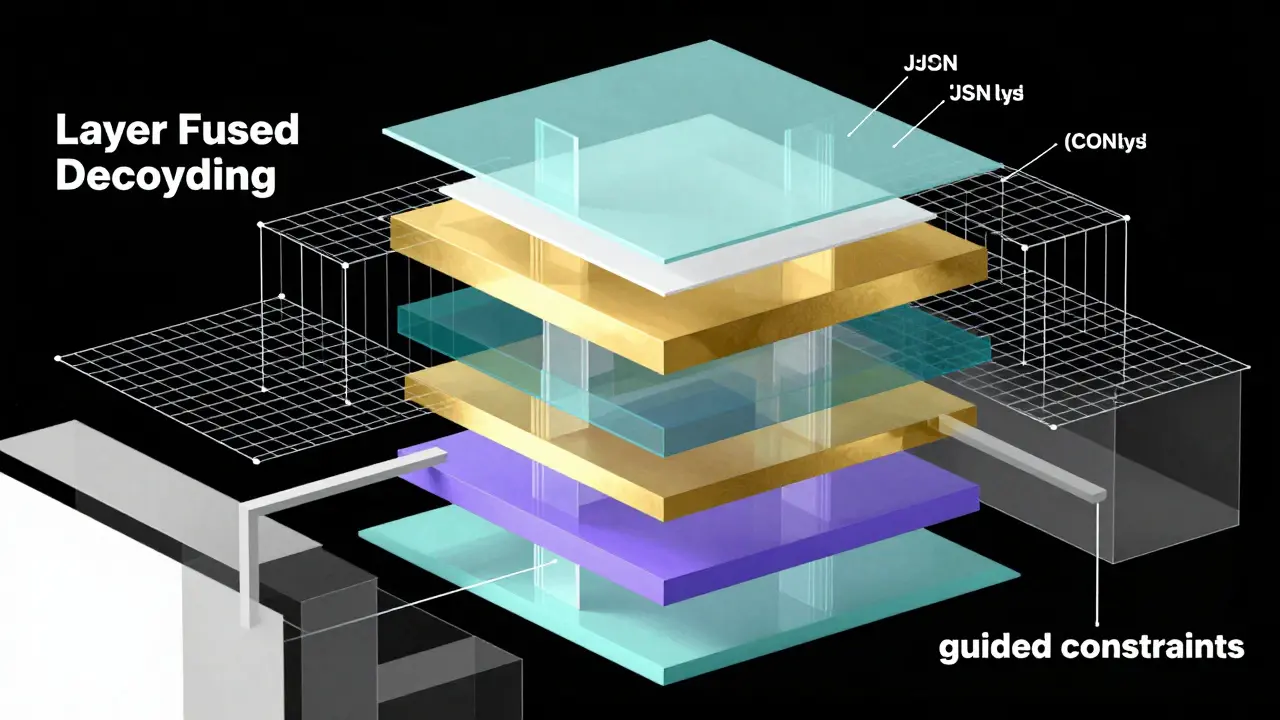
Not all layers in a transformer model are created equal. Some layers are better at recalling factual information, while others are better at language structure. Layer Fused Decoding (LFD) exploits this difference. LFD identifies specific transformer layers that are highly sensitive to factual context and fuses their outputs with the final layer’s predictions.
The technique uses metrics like SimHidden and DiffAttn to find the "sweet spot" layer-usually one in the latter half of the network where the Internal Knowledge Score (IKS) is lowest. By gating and re-normalizing the logits from this intermediate layer, LFD suppresses low-confidence tokens that don’t align with the retrieved context. This creates a hybrid distribution that balances the model’s internal knowledge with external evidence, reducing the chance of drifting into fabrication.

Entropy-Based and Contrastive Strategies
Another powerful approach involves running parallel forward passes. Entropy-based decoding strategies evaluate the confidence of the model’s predictions across multiple retrieved documents. The idea is simple: if the model is unsure (high entropy), it’s likely hallucinating. If it’s confident (low entropy) across multiple sources, the answer is probably correct.
In contrastive decoding, the system runs the LLM on each retrieved document separately. It then weighs the outputs by negative entropy, emphasizing deterministic distributions. These weighted outputs are aggregated via a logit average. This method enhances factual accuracy by leveraging multiple sources simultaneously. It’s particularly useful for faithfulness detection, achieving high AUROC scores in identifying whether the generated text truly reflects the source material.
Guided Decoding: Enforcing Structure and Facts
Sometimes, the problem isn’t just what the model says, but how it says it. Guided decoding integrates formal constraints into the generation process. Using tools like finite-state machines or regex validators, you can filter the token-level output distribution at each step. This ensures the model only produces tokens that conform to user-specified structural rules.
For example, if you need the output to be valid JSON, guided decoding prevents the model from generating incomplete brackets or invalid syntax. Libraries like Outlines, XGrammar, and LM Format Enforcer make this possible. When combined with RAG, guided decoding ensures that not only is the content factually accurate, but it also fits the required format. This is critical for applications like API integration or data extraction, where structural errors break the pipeline.
| Strategy | Key Mechanism | Best Use Case | Compute Cost |
|---|---|---|---|
| LoRAG | Iterative retrieval per token block | Multi-hop reasoning, complex QA | High (multiple retrievals) |
| Layer Fused Decoding | Fusing intermediate layer logits | Factual grounding, reducing hallucinations | Medium (logit manipulation) |
| Contrastive Decoding | Parallel passes with entropy weighting | Faithfulness verification, multi-source synthesis | Very High (parallel inference) |
| Guided Decoding | Constraint-based token filtering | Structured output (JSON, SQL), compliance | Low to Medium |
Context Fusion: Concatenation vs. Attention
How you blend the retrieved text with the prompt matters. Traditional RAG uses concatenation-based fusion, simply appending the documents to the query. While easy to implement, it forces the model to attend to everything equally, which can dilute important signals.
Attention-based fusion offers a more sophisticated alternative. Here, the decoder’s cross-attention mechanism dynamically weights the retrieved passages against the original prompt. This allows the model to focus on the most relevant snippets at each decoding step. Techniques like Retrieval-Augmented Contextual Decoding (RCD) take this further by building a compact reference grounding space. RCD retrieves semantically similar contexts and aggregates their associated next-token logits to shape the model’s output. This method has shown a 2.4% average improvement on TruthfulQA benchmarks, proving that smarter fusion leads to truer answers.
Choosing the Right Strategy
There is no one-size-fits-all solution. Your choice depends on your specific needs and computational budget. For single-hop questions, standard RAG with guided decoding might suffice. You get the facts, and the format is correct. But for deep research tasks requiring multi-step logic, LoRAG or Layer Fused Decoding provides the necessary depth. Keep in mind that gains follow a Pareto frontier; after a certain point, adding more retrieval iterations yields diminishing returns relative to the compute cost.
If your priority is strict factual adherence, consider entropy-based strategies. They act as a built-in sanity check, flagging uncertainty before it becomes a hallucination. However, be prepared for higher latency, as these methods require multiple forward passes. Ultimately, combining RAG with these decoding strategies transforms LLMs from creative writers into reliable researchers.
What is the main difference between standard RAG and Retrieval-Augmented Decoding?
Standard RAG retrieves context once before generation begins, creating a static input. Retrieval-Augmented Decoding dynamically integrates retrieval during the generation process, allowing the model to fetch new evidence as it writes, which improves accuracy for complex queries.
How does Layer Fused Decoding reduce hallucinations?
Layer Fused Decoding identifies transformer layers that are most sensitive to factual context and fuses their logits with the final output. This suppresses low-confidence tokens that deviate from the retrieved evidence, keeping the generation grounded in facts.
When should I use Guided Decoding with RAG?
Use Guided Decoding when you need structured outputs, such as JSON, SQL, or specific formats. It filters token predictions to ensure they conform to predefined schemas, preventing syntax errors and ensuring consistency in application-specific requirements.
Is LoRAG computationally expensive?
Yes, LoRAG is more expensive than standard RAG because it performs multiple retrieval steps during generation. However, the trade-off is significantly higher accuracy for multi-hop reasoning tasks, making it worth the cost for complex applications.
What is Retrieval-Augmented Contextual Decoding (RCD)?
RCD is a method that steers LLMs toward truthful generation by using a small set of annotated examples to create a reference grounding space. It retrieves similar contexts during decoding and aggregates their logits to modify the model's output, improving truthfulness without extensive retraining.