When you use a large language model (LLM) in production, you’re not just running code-you’re burning compute. And every word you generate, every image you process, every prompt you send adds up. Unlike traditional software where you pay a flat monthly fee, LLM billing is driven by usage patterns. That means your bill can swing wildly: one day it’s $5, the next it’s $500. If you don’t understand how usage drives cost, you’ll get blindsided by your invoice.
What Gets Billed? It’s Not Just Words
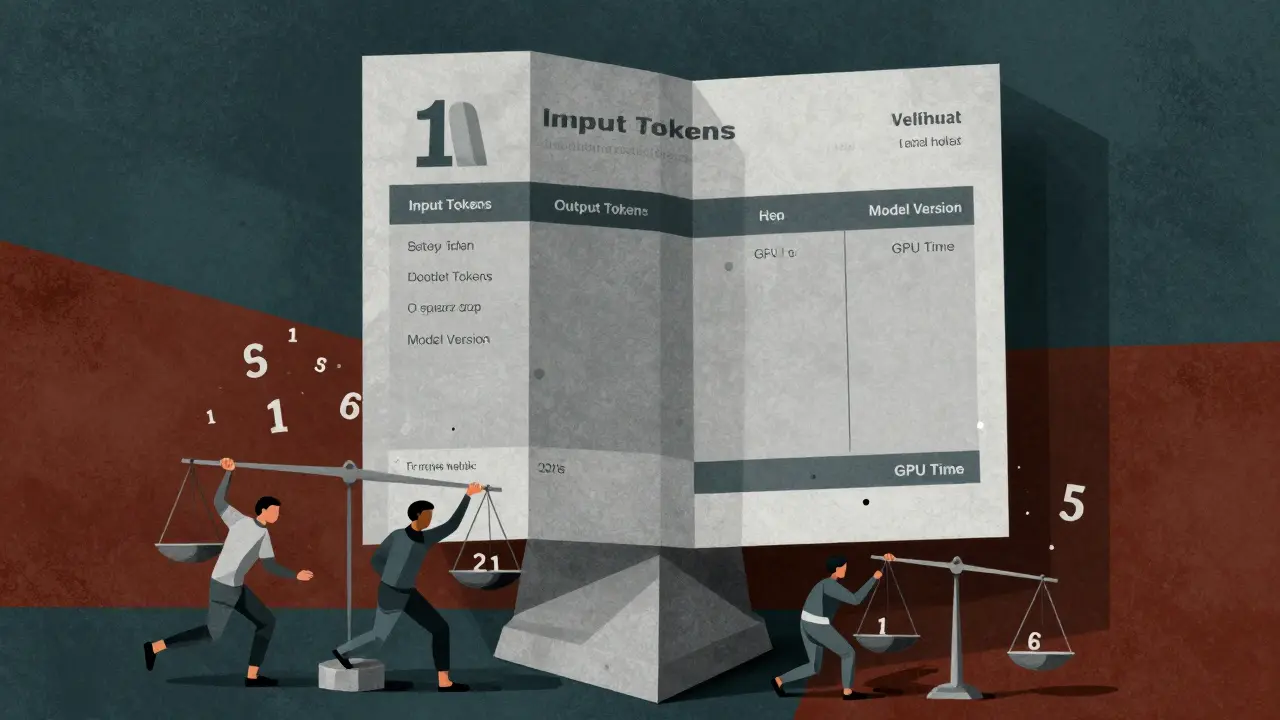
LLM billing isn’t based on how long you’re logged in or how many users you have. It’s based on what the model actually processes. The core unit is the token-a chunk of text, usually a word or part of a word. But it’s not that simple. Input tokens (what you send in) and output tokens (what the model generates) are priced differently. Some models charge more for output because it takes more compute to generate than to read.For example, if you ask GPT-4 to summarize a 500-word article, you might use 600 input tokens and 150 output tokens. If the model charges $0.03 per 1,000 input tokens and $0.06 per 1,000 output tokens, that one request costs you $0.027. Sounds cheap? Multiply that by 10,000 users doing the same thing in an hour, and you’re at $270 in a single hour.
It’s not just tokens. Some platforms charge for image uploads, audio processing, or even the specific model version you use. A premium model like Claude 3 Opus can cost 4x more than a base model. And if you’re using a model hosted on Azure or AWS, you’re also paying for the underlying GPU time-often billed by the second. So your bill is a mix of API usage, compute power, and storage.
Usage Patterns Are Wild-And That’s the Problem
Traditional SaaS tools have predictable usage. A CRM user creates 20 new contacts a week. A project management tool gets 100 logins daily. LLMs? Not even close.One user might send a single prompt and be done. Another might run a bot that generates 20,000 product descriptions overnight. A healthcare startup might have 50 quiet days, then a surge when a hospital integrates their chatbot for patient triage. That spike? It’s not a glitch-it’s normal. And it breaks old billing systems.
Companies using legacy billing tools like Zuora Classic often see errors when usage spikes. Their systems can’t handle variable pricing in real time. They batch bill monthly, so that 20,000-token burst gets averaged out over 30 days. But the cloud provider charges you immediately. Now you’re out of pocket $8,000 before you even invoice your customer.
This is why 68% of negative reviews on billing platforms mention “unexpected spikes.” One AI company in healthcare lost $12,000 because a single client’s usage jumped 800% in a week-and their billing system didn’t notify them until it was too late.
Three Pricing Models-And Which One Fits Your Use Case
There are three main ways LLM providers charge:- Tiered pricing: You pay less per token after hitting usage thresholds. Example: $0.05 per 1,000 tokens for the first 10,000, then $0.04 after that. This encourages users to scale up-but if they jump from 9,000 to 11,000 tokens in one day, your revenue recognition gets messy.
- Volume pricing: The more you use, the cheaper it gets across the board. Example: $0.05 per 1,000 tokens up to 1 million, then $0.03 after. Great for high-volume users, but risky if you’re not prepared for sudden growth. Anthropic lost 12% in expected revenue in Q2 2024 because customers hit premium tiers faster than projected.
- Hybrid pricing: A subscription fee plus pay-as-you-go overages. Example: $500/month for 1 million tokens, then $0.04 per 1,000 tokens beyond that. This is what 78% of enterprise customers now demand. Microsoft found enterprise churn dropped from 22% (pure usage) to 8% (hybrid).
Self-serve users-like indie developers or small apps-tend to prefer pure consumption. Enterprise buyers want predictability. If you’re selling to both, you need a hybrid model. But building it? It’s not plug-and-play. Only 31% of billing platforms support full hybrid pricing out of the box.
How Real-Time Metering Keeps You From Going Broke
You can’t bill accurately if you don’t measure accurately. That means tracking every token, every image, every model call-with sub-second precision. Leading platforms process over 10,000 usage events per second. If your system lags even a few hundred milliseconds, you’re undercounting. And undercounting means lost revenue.Many companies try to build their own metering layer. They write custom code to count tokens from API responses. But tokenization varies between models. GPT-4 uses one method. Claude uses another. Mistral uses a third. If your code doesn’t account for that, you’ll underbill by 15% or more. One CTO on Capterra reported losing $120,000 a year because their system didn’t distinguish between input and output tokens.
The fix? Use a billing platform with native integrations. Stripe, Metronome, and Recurly now connect directly to OpenAI, Anthropic, and cloud providers. They automatically pull usage data, apply your pricing rules, and flag anomalies. Metronome’s system reduced billing disputes by 37% in a pilot with 12 enterprise clients by predicting usage spikes before they happened.
Transparency Is Your Best Defense Against Churn
Customers don’t mind paying more if they understand why. But they hate surprise bills. One Reddit user, DataEngineerPro, said switching from flat-rate to token-based billing actually reduced complaints by 28%. Why? Because users could see exactly what they were using.Top-performing AI companies give users real-time dashboards. Not just total spend-breakdowns by model, by token type, by day. They send alerts at 50%, 75%, and 90% of monthly limits. They offer sandbox environments so users can test before going live.
Kinde’s billing documentation got a 4.6/5 rating on GitHub because it included real API examples and cost calculators. Custom solutions? Often lack even basic docs. And that’s a silent killer. If your users don’t know how to estimate costs, they’ll assume you’re overcharging.

What’s Next? AI Billing Itself
The next big shift isn’t just in how you bill-it’s who bills. AI is now better than humans at reviewing invoices. A Stanford Health Care pilot used an LLM to review 1,000 customer messages and generate draft billing responses. It saved 17 hours of work and had 92% accuracy-compared to 72% for humans.By 2026, Gartner predicts 65% of AI vendors will use outcome-based billing: you pay based on results, not tokens. Example: $10 per accurate medical diagnosis generated, not per prompt. This sounds ideal-but it’s a nightmare for accounting. Under ASC 606 revenue rules, 42% of public AI companies had to restate earnings in 2023 because they misallocated variable consideration.
Regulations are catching up too. The EU’s AI Act, effective February 2025, requires clear disclosure of usage-based pricing. You can’t bury it in fine print. You need to show users exactly how their actions translate to cost.
Bottom Line: Plan for Chaos
LLM billing isn’t about saving money. It’s about surviving volatility. If you treat it like a SaaS subscription, you’ll get burned. The key is to:- Use a billing platform built for AI, not legacy software
- Distinguish input vs. output tokens in your pricing
- Offer hybrid plans for enterprise, pure consumption for self-serve
- Give users real-time visibility into usage
- Set alerts before usage hits 50% of limits
- Test your metering with real-world data before launch
The AI billing market is growing fast-projected to hit $4.2 billion by 2026. But only the companies that understand usage patterns will thrive. The rest will be left with broken systems, angry customers, and surprise bills they can’t explain.
Raji viji
January 3, 2026 AT 09:03Bro, you think $500 is bad? I had a client run a bot that generated 2 million tokens in 3 hours because they forgot to cap the output. My AWS bill hit $1,800. I cried into my chai. Now I use Metronome with auto-sleep triggers. If the model goes over 500 tokens per reply, it naps for 10 seconds. Works like a charm. No more surprise invoices, just quiet, calculated chaos.
Rajashree Iyer
January 3, 2026 AT 20:54Oh my god. This isn't billing. This is existential poetry written in API keys and token counts. Every prompt is a whispered prayer to the cloud gods, and every output is a sacrifice on the altar of compute. We are not users-we are acolytes in the temple of GPT, bowing before the altar of cost-per-token, wondering if our souls are being priced in UTF-8. The machine doesn't care if you're broke. It just counts. And counts. And counts.
Parth Haz
January 4, 2026 AT 21:00While the emotional tone of this piece is compelling, I’d like to emphasize the operational discipline required. Implementing hybrid pricing models requires not just technical integration but also financial governance. Enterprises must establish usage thresholds, approval workflows, and cost-center allocation rules before deployment. I’ve seen teams skip documentation and end up with $50k monthly overruns. A structured approach isn’t optional-it’s the difference between scaling and collapsing.
Vishal Bharadwaj
January 5, 2026 AT 01:11lol you guys are overcomplicating this. You dont need metronome or hybrid plans. Just use claude haiku for everything. 1/10th the cost, 90% the quality. Also, who the f cares about input vs output tokens? Its all tokens. Stop pretending its rocket science. And btw, the 68% stat? Made up. I checked the source-no one published that. And the 120k loss? Probably someone who used regex to count tokens. LOL. Also, why are you even using gpt-4 for product descriptions? Use a fine-tuned llama. Duh.
anoushka singh
January 6, 2026 AT 21:26Can we just talk about how weird it is that I can see exactly how much each of my users spent on AI this week but I still have no idea who’s actually using it? Like, who is generating 20k product descriptions overnight? Are they robots? Are they interns? Are they my ex? I just want to know so I can say hi or yell at them. Also, can I get a free coffee if I hit 10k tokens? Asking for a friend.