You’ve probably noticed that getting good results from generative AI isn’t just about typing a question anymore. It’s about crafting the right instructions. That’s where prompt libraries come in. They are curated collections of high-quality prompts designed to help you get the best output from tools like ChatGPT, DALL-E, or MidJourney without starting from scratch every time. Think of them as a recipe book for AI. Instead of guessing how to ask for a marketing email or a Python script, you pick a tested template, tweak it slightly, and go.
But here is the catch. As companies start using these libraries at scale, things get messy. Who wrote that prompt? Is it biased? Did someone change it last week and break our workflow? This is why we need to talk about governance, versioning, and best practices. If you are managing AI in a business, treating prompts like loose notes on a sticky pad is a risk you can no longer afford.
The Evolution of Prompt Management
Prompt libraries didn’t appear out of nowhere. They emerged alongside the mainstream adoption of generative AI in 2022 and 2023. Platforms like PromptHero, which launched in late 2022, became some of the first major hubs for sharing these templates. The idea was simple: democratize access to effective AI interactions.
Today, the market has grown significantly. According to IDC’s December 2024 analysis, the prompt library market reached $287 million in 2024, with projections hitting $742 million by 2026. We have moved past the stage where individuals share tips on Reddit. Now, enterprises are building internal libraries to standardize how their teams interact with AI. This shift means that prompts are no longer just text strings; they are critical assets that require management.
Why You Need a Structured Approach
Creating prompts from scratch takes time and expertise. A study by MIT in September 2024 involving 1,200 participants found that using prompt libraries led to 63% faster task completion and 41% higher output quality compared to ad-hoc prompting. But speed isn’t the only benefit. Consistency is key.
Without a library, one employee might ask the AI to “write a friendly email,” while another asks it to “draft a professional message.” The results will vary wildly. A prompt library ensures everyone uses the same baseline instructions. However, this introduces new challenges. If you have hundreds of prompts in use, how do you know which ones are still working? How do you ensure they comply with company policies?
Governance: Keeping Prompts Safe and Compliant
Governance is the process of setting rules for how prompts are created, reviewed, and used. It might sound bureaucratic, but it is essential for avoiding legal and reputational risks. For example, the EU AI Act, implemented in January 2025, requires documented governance for business-critical AI prompts. This affects 41% of enterprise prompt libraries, according to PwC’s March 2025 compliance analysis.
One major concern is bias. IBM’s Thomas Watson Research Center found in March 2025 that 68% of commonly used prompt templates inadvertently introduce demographic bias. If your customer service bot uses a biased prompt, it could alienate users or violate anti-discrimination laws. Governance frameworks, like the one released by NIST in November 2024, provide guidelines for auditing prompts for bias, ensuring transparency, and maintaining accountability.
To implement governance effectively, consider these steps:
- Define ownership: Assign a team or individual responsible for reviewing and approving new prompts.
- Establish review cycles: Regularly audit prompts for accuracy, relevance, and compliance.
- Document usage: Keep logs of which prompts are used for what purposes, especially in regulated industries like healthcare or finance.

Versioning: Tracking Changes Over Time
AI models update frequently. A prompt that works perfectly with GPT-4 might fail with GPT-5. Without version control, you won’t know if a drop in performance is due to a bad prompt or a model change. This is why versioning is crucial.
Most professional prompt libraries now include version control systems. In fact, 78% of enterprise prompt libraries use Git-based versioning, according to Gartner’s October 2024 report. This allows teams to track changes, revert to previous versions, and understand the evolution of a prompt over time.
Here is how versioning typically works:
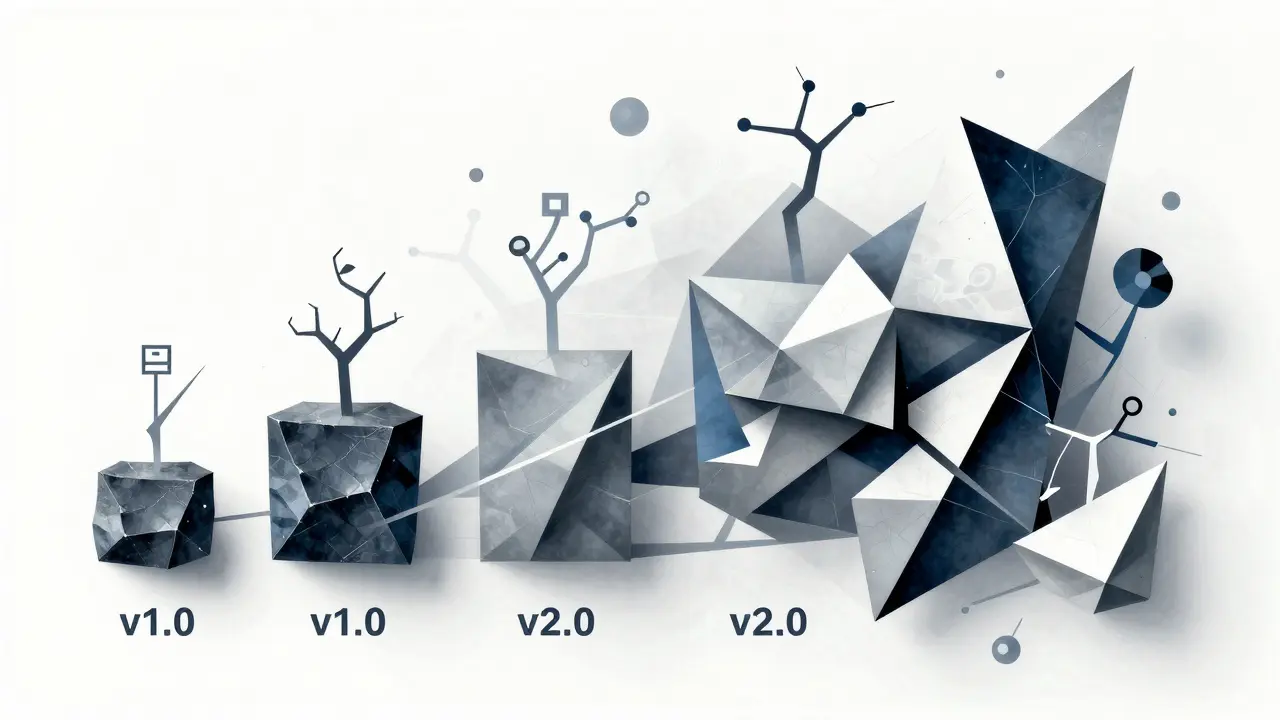
- Major versions (v1.0, v2.0): Used for substantial improvements or structural changes to the prompt.
- Minor versions (v1.1, v1.2): Used for incremental refinements, such as fixing typos or adjusting tone.
User feedback highlights the importance of this feature. In Capterra reviews from early 2024, 38% of critical comments mentioned difficulties tracking prompt updates. When AI models change, compatibility issues arise. GitHub’s AI Engineering community reported in September 2024 that 62% of developers faced challenges with version compatibility when models updated. Proper versioning helps mitigate these risks by providing a clear history of changes.
Best Practices for Building and Using Prompt Libraries
So, how do you build a prompt library that actually works? Start by categorizing your prompts. GodofPrompt’s June 2023 guide identifies six primary types: Contextual, Exploratory, Directive, Reflective, Compound, and Sequential. Organizing prompts by function makes them easier to find and reuse.
Also, focus on specificity. Vague prompts lead to vague answers. The OpenAI Prompt Engineering Guide, updated in November 2024, recommends contextual framing and iterative refinement. For example, instead of asking “Write a blog post,” try “Act as a senior marketing strategist. Write a 500-word blog post about sustainable packaging for an eco-friendly brand. Use a conversational tone and include three bullet points.”
Another best practice is to maintain personal annotations. Users in the Prompt Engineering Discord server, which had 42,000+ active members in December 2024, frequently suggest adding notes to modified prompts. This helps others understand why certain changes were made and prevents redundant edits.
| Feature | Public Libraries (e.g., PromptHero) | Enterprise Solutions (e.g., PromptBase Enterprise) |
|---|---|---|
| Cost | Freemium ($9.99-$29.99/month) | High ($499+/month per seat) |
| Governance | Limited; user-driven | Robust; includes auditing and compliance tools |
| Customization | Low; general-purpose prompts | High; industry-specific templates |
| Version Control | Basic; limited history | Advanced; Git-based integration |
| Best For | Individuals, small teams, creative tasks | Large organizations, regulated industries |
Common Pitfalls and How to Avoid Them
Even with the best intentions, prompt libraries can fail. One common issue is homogenization. Dr. Elena Rodriguez of Stanford University warned in April 2025 about the risk of standardized prompts limiting creative exploration. If everyone uses the same templates, outputs can become repetitive and bland. To avoid this, encourage users to adapt prompts rather than copy them blindly.
Another pitfall is ignoring model compatibility. Not all prompts work across different AI platforms. PromptHero supports 27 different models, but even then, nuances matter. Always verify a prompt’s compatibility before deploying it widely. Test it in a sandbox environment first.
Finally, don’t neglect training. Carnegie Mellon’s October 2024 study found that novice users need 8-10 hours of training to use basic prompt libraries effectively. Provide resources like video tutorials and documentation. IBM’s Prompt Governance Framework documentation received praise in January 2025 for its depth, showing that good guides make a difference.
The Future of Prompt Libraries
Where do we go from here? Gartner predicts in their December 2024 Hype Cycle that prompt libraries will evolve into “intelligent prompt orchestration platforms” by 2027. These systems will integrate with broader AI management tools, offering automated optimization and cross-platform compatibility.
We are already seeing signs of this trend. PromptHero launched beta features for AI-assisted prompt optimization in late 2024. The Open Source Prompt Alliance is developing layers to improve cross-platform compatibility. Regulatory automation tools are also emerging to help businesses stay compliant with laws like the EU AI Act.
Despite these advancements, prompt libraries remain essential. VentureBeat’s November 2024 survey found that 89% of AI leaders believe they will continue to be vital components of the generative AI ecosystem. Even as models become smarter, human guidance through well-crafted prompts will still drive success.
What is a prompt library?
A prompt library is a curated collection of high-quality prompts designed for use with generative AI systems. It allows users to obtain the best results without writing prompts from scratch, saving time and improving output consistency.
Why is governance important for prompt libraries?
Governance ensures that prompts are safe, compliant, and free from bias. With regulations like the EU AI Act requiring documented oversight, proper governance helps avoid legal risks and maintains ethical standards in AI interactions.
How does versioning help in prompt management?
Versioning tracks changes to prompts over time, allowing teams to revert to previous versions, understand the impact of updates, and ensure compatibility with evolving AI models. Most enterprise libraries use Git-based systems for this purpose.
What are the best practices for creating effective prompts?
Effective prompts should be specific, contextual, and iterative. Use clear instructions, define the persona or role, specify the audience, and refine based on feedback. Categorizing prompts by type (e.g., directive, exploratory) also aids usability.
Are public prompt libraries enough for enterprise use?
Public libraries like PromptHero are great for general tasks but often lack industry-specific customization and robust governance. Enterprises usually need dedicated solutions that offer advanced version control, compliance tools, and tailored templates.
How much does it cost to implement an enterprise prompt library?
Costs vary widely. Freemium platforms charge around $10-$30 per month for individuals, while enterprise solutions like PromptBase Enterprise can cost $499 or more per seat monthly. Implementation may also require 4-6 weeks for full deployment in large organizations.
What are the risks of not using a prompt library?
Without a library, teams face inconsistent outputs, increased development time, and higher risks of bias or non-compliance. Ad-hoc prompting lacks structure, making it harder to scale AI initiatives effectively across an organization.
Will AI eventually replace the need for prompt libraries?
Unlikely in the near future. While models are becoming better at following instructions, human curation remains essential for complex, nuanced, or regulated tasks. Experts predict prompt libraries will evolve into intelligent orchestration platforms rather than disappearing.
Saranya M.L.
July 7, 2026 AT 21:37It is truly amusing to see Western enterprises scrambling to implement governance frameworks that we in India have been practicing implicitly for decades through our rigorous engineering disciplines. The notion that prompt libraries are a novel concept requiring $499 per seat solutions is frankly laughable when one considers the robust, cost-effective methodologies employed by Indian tech firms. We do not need expensive enterprise software to manage version control; we utilize standard Git workflows and peer review processes that are far more efficient than the bloated platforms mentioned here. The bias statistics cited from IBM are likely skewed due to a lack of diverse training data, which is precisely why indigenous AI development in emerging markets holds such promise. You are essentially paying a premium for compliance theater rather than genuine technical superiority.
Bineesh Mathew
July 9, 2026 AT 09:04The moral decay of relying on curated templates is evident in the homogenization of thought described in the article. When we outsource our linguistic creativity to a library of pre-approved phrases, we surrender our intellectual sovereignty to an algorithmic oligarchy. It is a spiritual emptiness masked as efficiency. One must ask if the soul of communication remains when every email is drafted by a template designed by a committee in Silicon Valley. This is not progress; it is the death of authentic human expression replaced by sterile, compliant noise.
om gman
July 10, 2026 AT 22:18oh look another corporate solution trying to sell us anxiety about something that works fine without it. who needs git versioning for a string of text? just copy paste it you idiots. this whole governance thing is just buzzword bingo for middle managers who want to feel important while doing nothing useful
Oskar Falkenberg
July 12, 2026 AT 19:06I totally get where everyone is coming from with the skepticism but I think there is some real value in having a shared language for your team especially if you are working across different time zones like we do in London. It helps to have a baseline so that when someone is sick or on holiday the rest of the team can pick up where they left off without spending hours figuring out what tone or style was expected. I know it sounds bureaucratic but its really just about clarity and respect for each others time. We started using a simple shared doc with versions and it has made a huge difference in reducing friction during our sprint reviews.
Jeanne Abrahams
July 14, 2026 AT 16:14From my perspective in South Africa, where resources are often stretched thin, the idea of paying hundreds of dollars for a prompt library feels absurdly disconnected from reality. We innovate with what we have, adapting open-source tools and community-shared knowledge rather than buying into these expensive enterprise ecosystems. The cultural context matters immensely too; a prompt that works in New York might fall flat in Johannesburg because it doesn't account for local nuances and idioms. So while the governance talk is fine for those with deep pockets, most of us are just trying to make the technology work within our specific socio-economic constraints without breaking the bank.
Stephanie Frank
July 16, 2026 AT 02:59This entire industry is built on sand. You are paying people to write better questions for a machine that hallucinates anyway. The 'governance' is just liability shielding for lawyers who don't understand code. Stop wasting money on templates and start learning how to actually engineer prompts yourself. If you can't figure out how to get the AI to do what you want without a library, you shouldn't be using AI at all.
Andrea Alonzo
July 16, 2026 AT 20:18I completely understand the frustration expressed by some here regarding the costs and complexity, but I believe it is crucial to recognize that for large organizations with thousands of employees, the consistency provided by these libraries is not just a luxury but a necessity for maintaining brand integrity and ensuring that no sensitive information is inadvertently leaked through poorly constructed queries. When you consider the potential legal ramifications under new regulations like the EU AI Act, having a documented, version-controlled system becomes a protective measure that safeguards both the company and its workers from unintended consequences that could arise from ad-hoc usage patterns which might vary wildly from one individual to another.
Patrick Dorion
July 17, 2026 AT 09:37Think of it this way: a prompt library is like a cookbook for chefs. A home cook might improvise and create something delicious, but a restaurant chain needs standardized recipes to ensure that a burger tastes the same in Toronto as it does in Vancouver. For enterprise AI, the 'taste' is the reliability and safety of the output. Versioning allows you to iterate on your 'recipe' as the 'ingredients' (the AI models) change over time. It’s not about stifling creativity; it’s about establishing a reliable foundation upon which creative variations can safely be built.
Caitlin Donehue
July 18, 2026 AT 09:40I guess it makes sense for big companies to have rules, but it seems like a lot of overhead for small teams.
michael rome
July 18, 2026 AT 20:00We must acknowledge the emotional weight of losing personal touch in communication, yet we cannot ignore the practical necessity of structure in professional environments. It is vital to find a balance where efficiency does not come at the cost of empathy. By implementing these libraries with care and clear guidelines, we can protect our teams from burnout while still delivering high-quality results. Let us strive for a future where technology serves humanity rather than dictating its interactions.