Imagine asking an AI a question about your company’s internal policies, and instead of guessing or making things up, it pulls the exact answer from your latest HR handbook-updated yesterday. That’s not science fiction. It’s RAG-Retrieval-Augmented Generation-and it’s changing how businesses use AI today.
What RAG Actually Does (And Why It Matters)
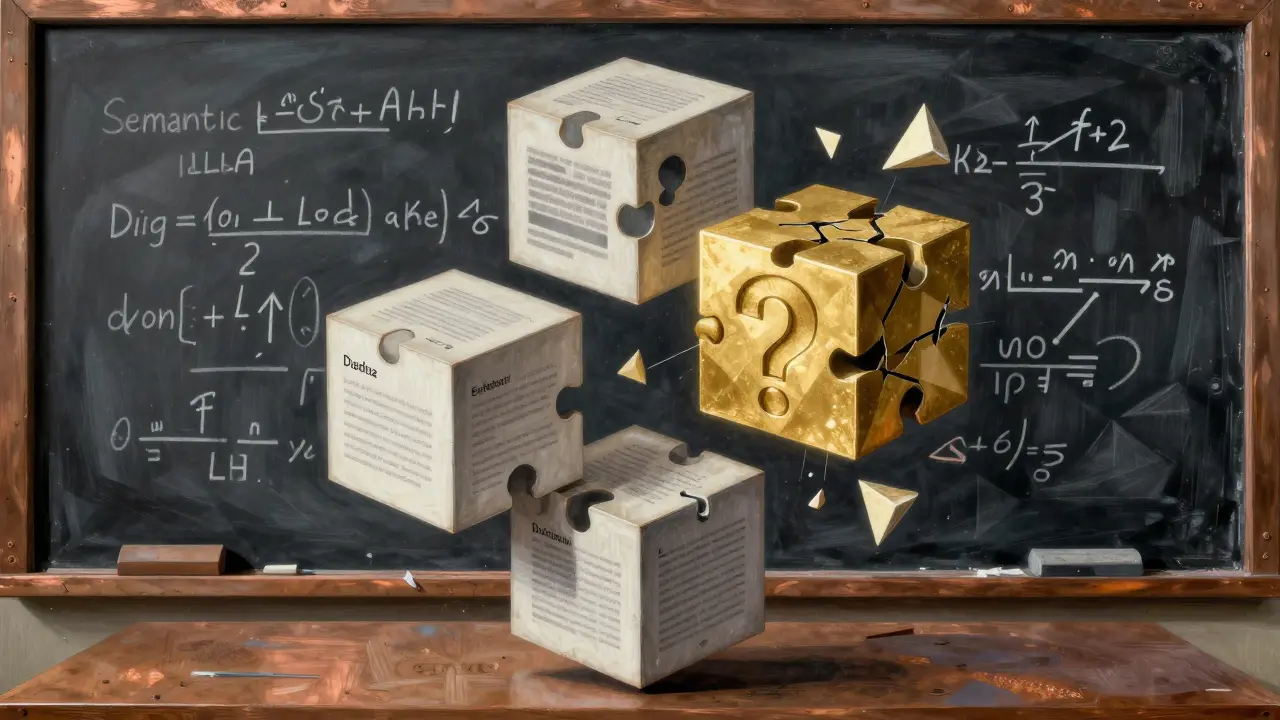
Traditional large language models (LLMs) like GPT or Claude were trained on data that stopped years ago. They don’t know what happened last month, let alone yesterday. If you ask them about your product’s latest pricing, they’ll guess. Sometimes they’re wrong. Often, they’re confidently wrong. This is called hallucination, and it’s a dealbreaker in enterprise settings. RAG fixes this by giving the AI a live connection to your own data. Instead of relying solely on what it learned during training, RAG grabs relevant information from your documents, databases, or knowledge bases right before answering. Think of it like a student who’s allowed to open their textbook during an exam. They still need to understand the material, but now they can check the facts. The process is simple but powerful:- Ingestion: Your documents-PDFs, manuals, FAQs-are broken into chunks and turned into numerical vectors using embedding models like OpenAI’s text-embedding-3-large or Cohere’s multilingual-2024-03.
- Retrieval: When you ask a question, the system searches through these vectors to find the most relevant pieces of text. Hybrid search (combining semantic and keyword matching) finds the right content 87.4% of the time, far better than old keyword searches.
- Augmentation: The retrieved text is inserted into your prompt, right before the question. This tells the AI: "Here’s what’s true. Answer based on this."
- Generation: The LLM writes a clear, accurate answer using the new context, not just its old training.
Result? Factually accurate answers, even on topics that changed yesterday.
How RAG Beats Fine-Tuning (And When It Doesn’t)
You might wonder: Why not just retrain the AI on your data? That’s fine-tuning. But fine-tuning is expensive. For a 7B-parameter model, each retraining run costs around $18,500. And if your documents change next week? You pay again. RAG is the opposite. Update a single document? Refresh the vector database. No retraining. No cost. Meta’s team found RAG reduces update costs by 98% compared to fine-tuning. But RAG isn’t perfect. On complex reasoning tasks-like explaining why a contract clause contradicts another-it falls behind fine-tuned models. Stanford’s 2025 tests showed RAG scored 32.7% on Chain-of-Thought benchmarks, while fine-tuned models hit 41.3%. RAG is great at recalling facts. Fine-tuning is better at deep reasoning. That’s why the smartest teams use both. RAG handles real-time data. Fine-tuning handles core logic. Together, they’re unstoppable.The Three Generations of RAG
RAG hasn’t stayed the same since 2020. It’s evolved in three clear stages:- Naive RAG (2020-2022): Just grab the top few documents and shove them into the prompt. Often irrelevant. High failure rate.
- Advanced RAG (2022-2024): Added reranking, hybrid search, and context compression. Improved accuracy by 42%. Reduced hallucinations by 60%.
- Agentic RAG (2024-present): The AI doesn’t just retrieve. It decides what to retrieve, when to retrieve it, and how to combine results. LangChain’s Agent RAG 2.0, released in late 2025, lets the model ask follow-up questions, check multiple sources, and validate answers. Accuracy on complex queries jumped 41%.
Today’s best systems aren’t just search engines with AI on top. They’re autonomous agents that think, retrieve, and reason-all in real time.
Real-World Wins (And Failures)
The results are real. GitLab’s RAG system now handles 73.4% of tier-1 support tickets without human help. Lexion, a legal tech startup, uses RAG to analyze contracts with 89.7% accuracy. IBM’s healthcare AI, updated daily with new clinical guidelines, maintains 92.3% factual accuracy-while fine-tuned models, needing weekly retraining, dropped to 76.8%. But not all RAG projects succeed. Reddit threads are full of horror stories. Users complain about:- "Context window overflow"-too much retrieved text, and the AI ignores the good stuff.
- "Irrelevant documents"-the system pulls in outdated or off-topic content.
- "Too slow"-each query adds nearly half a second of latency.
Stack Overflow’s 2026 survey found only 32% of DIY RAG projects worked. Teams with dedicated vector search engineers? 78% success rate. The difference? Expertise. RAG isn’t plug-and-play. It needs tuning, testing, and constant monitoring.
What You Need to Get Started
If you’re considering RAG, here’s what actually matters:- Chunk your data right. Break documents into 256-512 token pieces. Too small? You lose context. Too big? You overload the model.
- Choose your embedding model. OpenAI’s text-embedding-3-large and Cohere’s multilingual-2024-03 are top picks. For non-English content, try BGE-M3-it handles 100 languages with 89.3% cross-lingual accuracy.
- Pick a vector database. Pinecone (4.2M deployments), Weaviate (1.8M), or Azure AI Search. Enterprise teams prefer managed services. Startups often use open-source like Qdrant.
- Test retrieval quality. Don’t assume it works. Run 100 test queries. Measure precision. If more than 30% of results are irrelevant, you’ve got work to do.
- Monitor hallucinations. Use tools like RAG-Eval 1.0 (coming March 2026) to score answers for truthfulness.
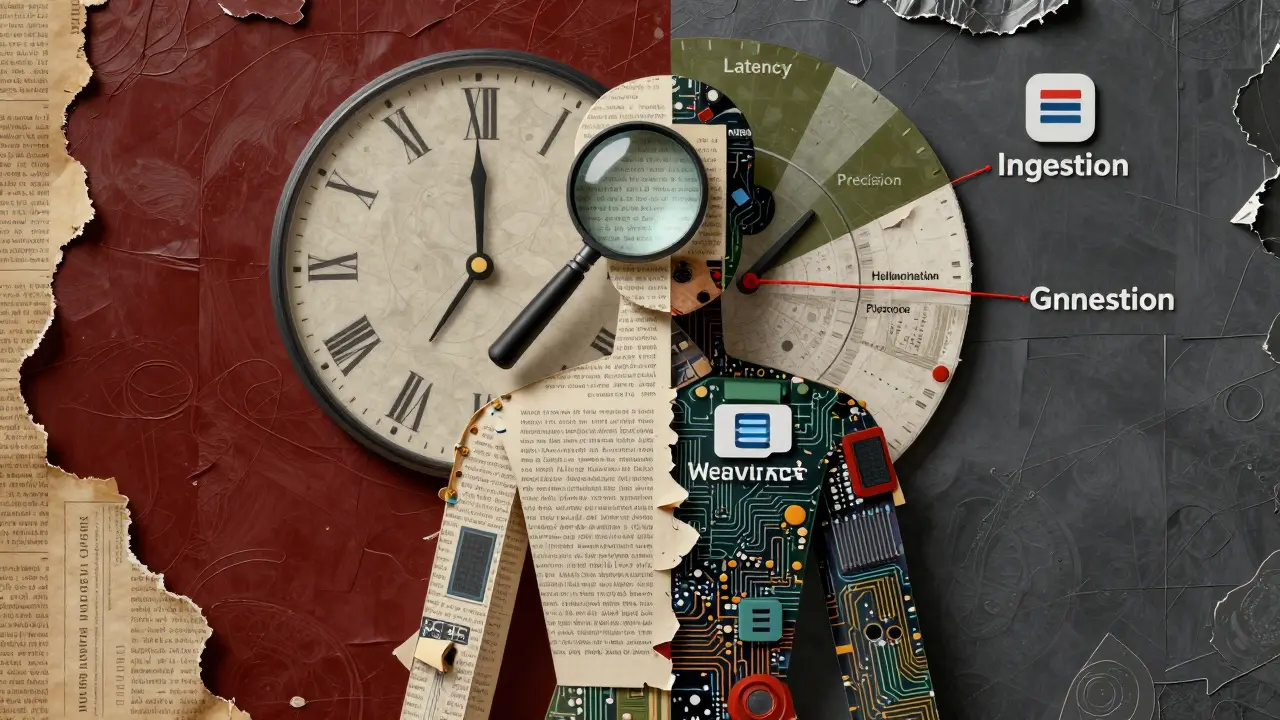
Most teams take 8-20 weeks to get RAG production-ready. The biggest bottleneck? Tuning retrieval relevance. It takes 37% of total time. Don’t skip it.
The Future of RAG
The next wave is here. Meta’s "Recursive RAG" lets the AI loop: retrieve → think → refine query → retrieve again. It improved complex answer accuracy by 37%. Google’s Gemini RAG now pulls in images and videos alongside text. Need to answer "Where is this part in the manual?"-the system finds the diagram, too. The market is exploding. Gartner reports $4.7 billion in RAG spending in 2025, with 82% of Fortune 500 companies using it. But only 22% of implementations are truly sophisticated. Most are still stuck in Naive RAG, creating a dangerous illusion of competence. The consensus? RAG isn’t a fad. It’s a new architectural standard. AWS, Google, and Microsoft all agree: RAG will stay in the AI stack for years. Not because it’s perfect, but because it works-when done right.Final Thought
RAG doesn’t make AI smarter. It makes AI honest. It forces the model to ground its answers in reality, not guesses. That’s why it’s not just a tool. It’s a responsibility. If you’re building AI that answers questions for customers, employees, or regulators, RAG isn’t optional anymore. It’s the minimum standard.What’s the difference between RAG and fine-tuning?
Fine-tuning changes the AI’s internal weights by retraining it on your data. It’s powerful but expensive-around $18,500 per retraining-and slow to update. RAG keeps the model unchanged and instead pulls in fresh data from your documents during each query. It’s cheaper, faster to update, and avoids retraining entirely. But fine-tuning handles deep reasoning better. Many teams use both: RAG for real-time data, fine-tuning for core logic.
Can RAG be used for customer-facing chatbots?
Yes, and it’s becoming standard. Companies like GitLab and Shopify use RAG to power support chatbots that answer product questions using live documentation. Accuracy jumps from 53% with standard LLMs to 78.6% with RAG. But you need strong retrieval quality. If the system pulls wrong documents, users get confused. Start with internal use cases first, then expand to customers once reliability is proven.
Why is latency higher with RAG?
RAG adds steps: retrieving data, reranking it, and injecting it into the prompt. Each step takes time. AWS benchmarks show an average of 427ms added per query. This is normal. You can reduce it by compressing context (cutting input length by 47% without losing accuracy), using faster embedding models, and caching frequent queries. But don’t expect the same speed as a plain LLM. The trade-off is accuracy.
What’s the biggest mistake people make with RAG?
Assuming it works out of the box. Many teams upload documents, run a test, see an answer, and declare victory. But if retrieval is sloppy-pulling outdated, irrelevant, or duplicate content-the answer will be wrong. The biggest failure isn’t technical. It’s skipping testing. Measure retrieval precision. Run 100 real queries. Fix what breaks. Don’t guess.
Is RAG secure? Can someone hack the retrieval data?
RAG inherits the security of your vector database. If your database is public or poorly protected, attackers could inject false documents. This is called "poisoning." Best practices: encrypt data at rest, restrict access, validate document sources, and monitor for unusual retrieval patterns. Enterprise platforms like Azure AI Search include built-in safeguards. Open-source tools require more manual setup.
Does RAG work with non-text data like images or videos?
Yes, but it’s new. Google’s Gemini RAG (Jan 2026) can retrieve and combine images, audio, and video with text. For example, if you ask, "How do I fix this error?" and there’s a video tutorial, the system finds it and references it. This is called multimodal RAG. It’s not mainstream yet, but it’s coming fast. For now, most systems focus on text-only retrieval.
How do I know if my RAG system is working well?
Measure three things: 1) Retrieval precision-how many of the top 5 results are actually relevant? Aim for 80%+. 2) Answer accuracy-use human reviewers to check 50 answers against your source docs. 3) Latency-keep it under 700ms for real-time apps. Tools like RAG-Eval 1.0 (March 2026) will standardize this. Until then, build your own test suite. Track trends. If accuracy drops, investigate the retrieval logs.
Kevin Hagerty
February 16, 2026 AT 16:35So let me get this straight-we’re paying millions to build an AI that needs a textbook to pass a 5th grade quiz? And we call this progress? I mean, sure, it’s better than hallucinating that our HR policy says ‘work from Mars’… but come on. This isn’t intelligence. It’s a fancy copy-paste with a PhD in overengineering.
Also, ‘Agentic RAG’? Sounds like a rejected Marvel villain name. Next up: ‘Quantum RAG with Emotional Intelligence’ and we’re all just gonna nod like we understand.
And why is no one talking about how 68% of these systems just return the first sentence of the 3rd paragraph and call it a day? I’ve seen RAG spit out answers from 2018 docs like they’re gospel. It’s not magic. It’s a broken thermostat with a thesaurus.
ravi kumar
February 16, 2026 AT 22:54I’ve been working with RAG on our internal knowledge base for 6 months now. The biggest win? We cut support tickets by 40%.
But honestly? The setup is brutal. Chunking is everything. If you don’t break your PDFs right, you get garbage in, garbage out. We switched from 1024 tokens to 384 and accuracy jumped overnight.
Also, don’t skip testing. Run 100 queries. Don’t trust the first 5. We had one case where ‘employee vacation policy’ pulled in the IT helpdesk FAQ because the word ‘leave’ matched. Took us 3 weeks to fix.
It’s not plug-and-play. But when it works? It’s beautiful. Worth the pain.
Megan Blakeman
February 18, 2026 AT 08:59Oh my gosh, I just had to comment because this is SO TRUE!!
I work in compliance, and our old AI kept saying we could ‘waive penalties if you’re feeling stressed’-like, WHAT?!
After we implemented RAG? It’s like a miracle. It pulls the exact clause from the 2025 handbook, even if it’s buried in Section 7.3.2. I cried. I’m not even joking.
And the fact that we don’t have to retrain every time HR updates a policy? That’s freedom!!
Also, I love how you mentioned BGE-M3-I used it for our Spanish docs and it worked like a charm!! 🥹💖
PLEASE don’t give up on RAG. It’s not perfect, but it’s the most honest AI we’ve ever had. And honesty? That’s rare.
Akhil Bellam
February 19, 2026 AT 20:08Let’s be brutally honest: RAG is the AI equivalent of a parrot that’s been trained to say ‘I have the manual’ while still not understanding a single word.
You think this is innovation? This is just a band-aid on a corpse. Fine-tuning is expensive? So what. If you want real reasoning, you pay. Period.
And ‘Agentic RAG’? Please. That’s not intelligence-that’s a Rube Goldberg machine built by a grad student who just learned about LangChain.
Companies are throwing money at this because it sounds futuristic. Meanwhile, your customer gets a 478-word answer that starts with ‘According to Section 4.1…’ and ends with ‘I’m not sure.’
Real experts? They’re fine-tuning. The rest? They’re just hoping their vector DB doesn’t crash before lunch.
Amber Swartz
February 21, 2026 AT 09:32Okay, I NEED to say this-I’ve been in AI for 8 years and I’ve NEVER seen a tech trend that causes this much emotional whiplash.
On one hand, I’m like-YES! Finally, an AI that doesn’t lie to me! I can trust it! I feel safe!
On the other hand-I’ve seen teams spend 6 months on RAG, only to realize their retrieval system is pulling from a corrupted cache from 2023. One guy told me his chatbot told a user they could ‘fire their manager for being ‘too chill.’
And then there’s the latency. My team’s RAG takes 0.8 seconds. Customers think we’re broken. We’re not. We’re just… honest.
But here’s the thing: if you don’t monitor it like a hawk, RAG becomes a liability. Not a tool. A liability.
I’m not saying don’t use it. I’m saying: don’t sleep on it. Don’t assume. Test. Again. And again. And then test again. Or your users will hate you. And honestly? They deserve better.