When you type a simple prompt like "build a login page with React and Node.js" into an AI coding tool, it spits out working code in seconds. That’s vibe coding - and it’s fast. But here’s the catch: up to 40% of that code has security flaws. A console.log() with an API key. A missing Content Security Policy. No HTTPS. These aren’t hypothetical risks. They’re real. In January 2025, a startup deployed an AI-generated dashboard on Vercel and got hacked within 12 hours because the CSP was set to "*" - meaning any script, anywhere, could run on their site.
Why Secure Defaults Matter More Than Ever
Vibe coding isn’t just about writing code faster. It’s about deploying full-stack apps without ever touching a terminal. Tools like v0.dev, GitHub Copilot, and Replit’s GhostWriter are now used by 67% of Fortune 500 companies. But most of these tools don’t lock down security by default. You get a working app - but not a safe one.Security isn’t an afterthought in vibe coding. It’s the first thing you should check. Why? Because AI doesn’t understand context. It doesn’t know that a console.log(process.env.API_KEY) in production is a disaster. It doesn’t know that allowing inline scripts in CSP opens the door to cross-site scripting (XSS) attacks. And it definitely doesn’t know that your app needs HTTPS - even if you’re just showing a form.
According to Wiz Academy’s January 2025 report, apps without proper security headers suffer 37% more XSS attacks than those with them. That’s not a small number. That’s a system-wide vulnerability waiting to be exploited.
Content Security Policy (CSP): The Gatekeeper
CSP is like a bouncer for your website. It decides what scripts, styles, images, and fonts can load. Without it, an attacker can inject malicious JavaScript through a form field, a comment, or even a compromised third-party widget - and your users’ browsers will happily run it.AI tools often generate CSP headers like this:
Content-Security-Policy: default-src 'self'; script-src 'unsafe-inline' https://cdn.example.com;That 'unsafe-inline' is a red flag. It means any script embedded directly in your HTML - even one injected by an attacker - will execute. That’s how XSS attacks work.
The right way? Use nonces or hashes. Here’s what a secure CSP should look like:
Content-Security-Policy: default-src 'self'; script-src 'self' https://cdn.example.com 'nonce-abc123'; style-src 'self' 'unsafe-inline'; img-src 'self' data:;Each time the page loads, the server generates a unique nonce (a random string) and adds it to the CSP header and to every script tag. The browser only runs scripts with the matching nonce. No nonce? No execution.
Platforms like Replit now auto-generate nonces for AI-generated code. Vercel? Still requires manual setup. That’s a gap. If you’re using Vercel, you’re responsible for adding CSP. If you’re using Replit, it’s already done. That’s the difference between building fast and building safely.
HTTPS: Non-Negotiable
You might think, "My app doesn’t handle payments. Why do I need HTTPS?" But here’s the truth: HTTPS isn’t just for money. It’s for trust. It’s for data. It’s for preventing man-in-the-middle attacks, session hijacking, and cookie theft.AI tools often generate apps that run on HTTP by default. That’s dangerous. Even if you’re just collecting emails, attackers can intercept them. In Q1 2025, 22% of API breaches traced back to unencrypted communications.
Secure defaults mean TLS 1.2 or higher - no exceptions. And you need HSTS (HTTP Strict Transport Security) to force browsers to always use HTTPS:
Strict-Transport-Security: max-age=31536000; includeSubDomains; preloadThis header tells browsers: "Never, ever connect to this site over HTTP - even if the user types it manually." Replit enables this by default. Vercel enables HTTPS automatically, but HSTS? You have to add it yourself. That’s a missed opportunity.
And don’t forget: if your app uses any external APIs - even Google Maps or Stripe - they need to be called over HTTPS too. AI often generates mixed-content links. A single HTTP request can break your entire security posture.
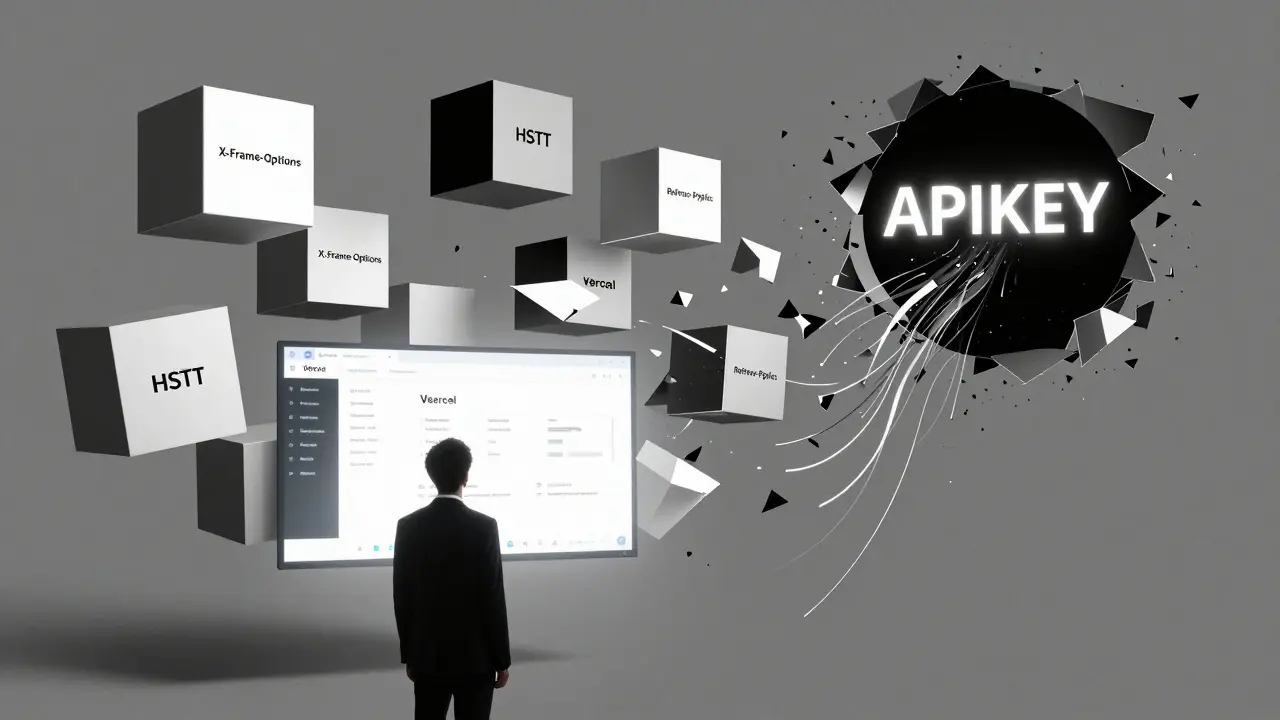
Security Headers: The Silent Protectors
Beyond CSP and HTTPS, there are other headers that act like invisible armor:- X-Content-Type-Options: nosniff - Stops browsers from guessing file types. Prevents attackers from tricking your site into executing a malicious file as JavaScript.
- X-Frame-Options: DENY - Blocks your site from being loaded inside an iframe. Stops clickjacking attacks where users think they’re clicking a button on your site - but they’re actually clicking something hidden underneath.
- Referrer-Policy: strict-origin-when-cross-origin - Prevents sensitive URLs (like those with tokens or IDs) from being leaked to third-party sites when users click external links.
Replit adds all of these by default. GitHub Copilot? None. v0.dev? Sometimes. The inconsistency is dangerous. You can’t rely on AI to remember them. You need them baked into the platform.
Wiz Academy found that 41% of vibe-coded apps had at least one of these headers missing. That’s more than 4 out of 10 apps exposed to basic attacks.
Platform Comparison: Who Gets It Right?
| Platform | HTTPS by Default | CSP with Nonce | X-Content-Type-Options | X-Frame-Options | Referrer-Policy | Secrets Management |
|---|---|---|---|---|---|---|
| Replit | Yes | Yes | Yes | Yes | Yes | Encrypted, auto-rotated |
| Vercel | Yes (TLS) | No | No | No | No | Manual environment vars |
| GitHub Copilot | No | No | No | No | No | None |
| v0.dev | Depends on deploy target | Partial | Maybe | Maybe | Maybe | Manual |
Replit leads. It’s the only platform that treats security as part of the core workflow - not a checklist. It auto-generates secrets, encrypts them, and blocks dangerous headers before they ever reach production.
Vercel is great for speed. But if you’re using it for vibe coding, you’re doing the security work yourself. That’s a recipe for mistakes.
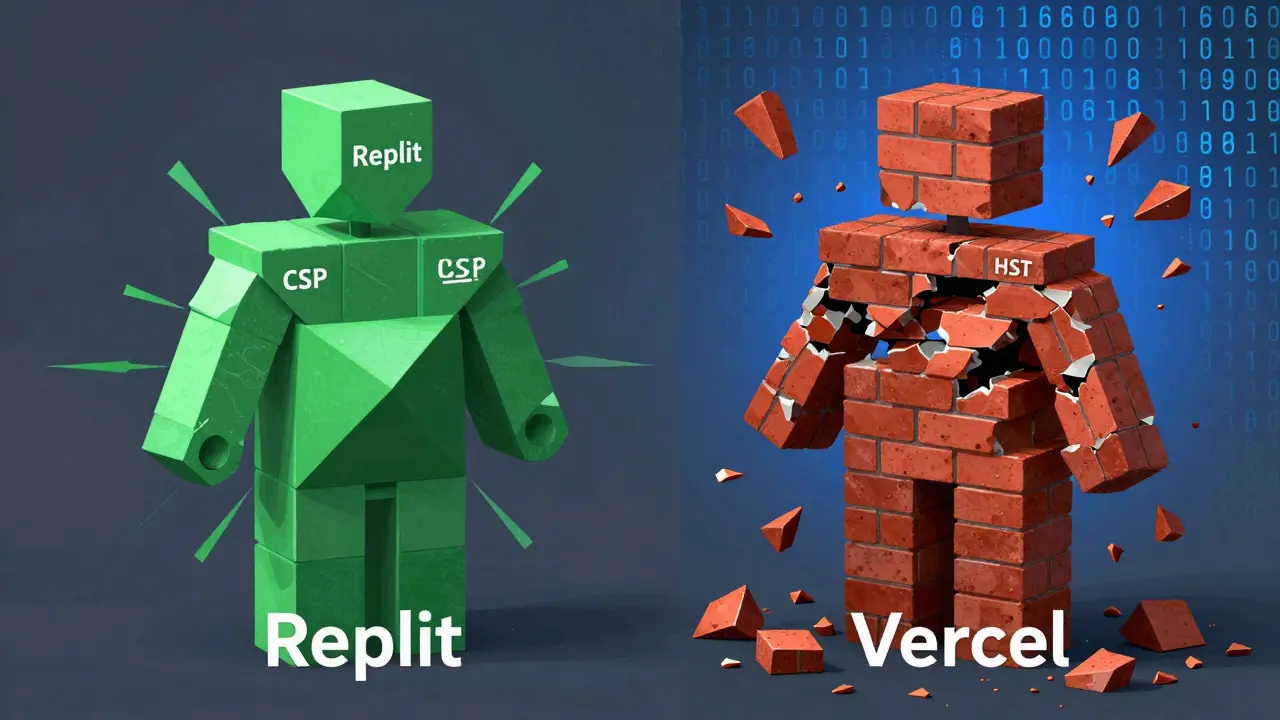
What Happens When You Skip Secure Defaults?
Let’s say you’re a solo developer. You use v0.dev to build a dashboard. You deploy it on Vercel. Everything looks fine. You even test it locally. But then you get an email:"Your site is serving malware. Users are getting redirected to phishing pages. Your API key is exposed on GitHub. Your CSP allows scripts from any domain. Your HSTS header is missing. Your site is on a blocklist. Fix it or we’ll take it down."
That’s not fiction. That’s what happened to Base44 in January 2025. Their Swagger UI - an API documentation tool - was left publicly accessible. AI-generated code had left it unsecured. Attackers scanned for it. They found it. They stole data from 12,000 users.
It didn’t take a hacker with years of experience. It took a script that checked for missing CSP headers. That’s how easy it is now.
How to Fix It - Fast
You don’t need to become a security expert. But you do need to act. Here’s a quick checklist:- Check your CSP. Remove 'unsafe-inline'. Use nonces or hashes. Test it with Chrome DevTools > Security tab.
- Enable HSTS. Add
Strict-Transport-Security: max-age=31536000; includeSubDomains; preloadto your server headers. - Add the three key headers:
X-Content-Type-Options: nosniff,X-Frame-Options: DENY,Referrer-Policy: strict-origin-when-cross-origin. - Scan for secrets. Run a quick check:
grep -r "API_KEY" .in your project folder. If it shows up, delete it. Use Replit’s secrets or Vercel’s environment variables - never hardcode. - Use automated tools. Integrate Snyk or Checkmarx into your CI/CD. Let them scan every AI-generated commit.
If you’re on Replit? You’re already covered. If you’re on Vercel or GitHub? You’ve got work to do. Don’t wait for a breach to remind you.
The Future Is Automatic
The industry is waking up. Cloud Security Alliance’s April 2025 guide says: "Secure defaults are no longer optional in vibe coding." Gartner predicts that by 2026, 75% of enterprises will require AI coding tools to ship with security headers enabled by default.Platforms that don’t adapt will lose trust. Developers will leave. Companies will switch. Replit’s 4.2/5 Trustpilot rating? 87% of positive reviews mention "security just works." Vercel’s reviews? Mixed. Because security is still manual.
The future of vibe coding isn’t about writing code faster. It’s about deploying code that doesn’t get hacked. And that starts with secure defaults - not afterthoughts.
Do I need to learn all the security headers if I use vibe coding?
You don’t need to memorize them - but you do need to know whether your platform adds them automatically. If you’re using Replit, you’re covered. If you’re using Vercel or GitHub Copilot, you’re responsible for adding them. Learn the three essentials: CSP, HSTS, and X-Frame-Options. Use templates from trusted sources like Replit’s docs or the Cloud Security Alliance guide. Automation is your friend.
Can AI tools fix their own security mistakes?
Not yet. AI generates code based on patterns, not risk assessment. It doesn’t know that a hardcoded API key is dangerous. It doesn’t know that "*" in CSP is a vulnerability. Some tools, like Replit, are building guardrails around AI output - but the AI itself won’t fix it. You still need to review, test, and enforce security.
Is it safe to use vibe coding for customer-facing apps?
Yes - if you secure it. Many startups and even mid-sized companies now use vibe coding for production apps. The key is using platforms with secure defaults (like Replit) or manually enforcing headers, scanning for secrets, and testing CSP. Don’t skip the security step just because the code was generated. Speed without safety is a liability.
What’s the biggest mistake vibe coders make?
Assuming the platform will handle everything. Vercel gives you HTTPS - great. But it doesn’t add CSP, X-Frame-Options, or HSTS by default. GitHub Copilot gives you code - but no security. The biggest mistake is thinking "it works" means "it’s safe." It doesn’t. Always check the headers. Always scan for secrets. Always test.
How do I know if my app is secure?
Use Chrome DevTools. Open the Network tab, reload your site, click on the main HTML file, and check the Response Headers. Look for CSP, HSTS, X-Content-Type-Options, X-Frame-Options, and Referrer-Policy. If any are missing, you’re exposed. You can also use free tools like securityheaders.com - just paste your URL. It’ll grade you and tell you exactly what’s wrong.
If you’re building with AI, you’re building fast. But speed without security is just a ticking clock. The tools are here. The knowledge is here. The platforms that protect you are here. Don’t wait for a breach to learn the lesson.
Agni Saucedo Medel
January 15, 2026 AT 18:38OMG YES THIS. 😭 I used v0.dev last week and deployed straight to Vercel... thought I was a genius until my site got flagged for malware. Turns out the AI dumped my API key in the console. No CSP, no HSTS, nothing. Replit saved my sanity after that. 🙏
ANAND BHUSHAN
January 17, 2026 AT 13:36AI writes code fast but it dont know what's safe. I seen this happen three times at my job. Always the same: works on laptop, gets hacked in 10 minutes online.
Indi s
January 19, 2026 AT 07:34I used to think security was for nerds with command lines. Then my cousin's startup got breached because they used Copilot and forgot to check headers. Now I check every single one before I hit deploy. Simple stuff, huge difference.
Sumit SM
January 20, 2026 AT 15:17Let’s be real-vibe coding is the digital equivalent of leaving your front door open because you ‘felt like it’ today. The AI doesn’t care about your users’ data-it cares about pattern matching. It’s not sentient, it’s not ethical, it’s not even curious. And yet we hand it the keys to our digital kingdoms and call it innovation? We’ve outsourced responsibility to a statistical parrot. The real tragedy isn’t the missing CSP-it’s that we stopped asking why we let machines make decisions we’re too lazy to understand.
Jen Deschambeault
January 22, 2026 AT 07:56This is so important. I’ve been pushing my team to use Replit for prototyping now-just because the security stuff just works. No more late-night panic calls. You can move fast AND sleep at night. Seriously, if you’re not using secure defaults, you’re just gambling with your users’ trust.
Kayla Ellsworth
January 22, 2026 AT 23:06Wow. So you're saying we shouldn't trust AI to write code without checking it? Shocking. Next you'll tell me water is wet and the sky is blue. I'm sure this post will make Vercel change their entire architecture overnight. 🙄
Soham Dhruv
January 23, 2026 AT 10:50Yea i use copilot all the time and never thought about headers till now... thanks for the wake up call. Just checked my last project and yep no csp no hsts. gonna fix it today. also grep -r API_KEY was eye opening lol
Bob Buthune
January 25, 2026 AT 08:40It’s not just the headers… it’s the soul of the thing. You know? When you build something with your own hands, you feel it. You smell the sweat, you hear the clicks of the keyboard, you see the mistakes as they happen. But now? You type ‘build me a login’ and a machine vomits code and you just… click deploy. No connection. No care. And then the hackers come in like vultures and you’re left wondering why your users vanished. It’s not a bug. It’s a spiritual crisis. We’ve turned development into a soulless factory. And the AI? It doesn’t even know it’s killing something beautiful. It just… generates. And we just… accept. And that’s the real breach.
Jane San Miguel
January 27, 2026 AT 07:05While your piece is superficially compelling, it lacks rigorous citation of primary sources. Wiz Academy’s ‘January 2025 report’-is this peer-reviewed? Is it publicly accessible? And you reference a 41% statistic without a confidence interval. Furthermore, the conflation of platform features with developer responsibility reveals a fundamental misunderstanding of the DevSecOps paradigm. Security headers are not ‘defaults’-they are configuration artifacts. The real issue is cultural, not technical. You’re blaming tools, not the lack of training.
Kasey Drymalla
January 27, 2026 AT 16:06THEY KNOW. THEY ALL KNOW. This is all a test. The AI is being trained to make us sloppy so they can hack us later. Replit? Vercel? All owned by the same shadow group. They want us to rely on auto-security so when the big breach happens, they’ll say ‘oh we warned you’ and then sell us the fix. You think your nonce matters? Your HSTS? Nah. They’re watching. Always watching. And your API key? Already in the dark web. You’re just living in the waiting room.